Field Guide
Red-cockaded Woodpecker
In early morning, the trunk of an old longleaf pine glistens. Not with dew. The resin wells are fresh, reopened before first light by a bird that weighs less than two ounces, and now the thick clear sap runs in ribbons down the bark toward the cavity entrance eighteen metres above the ground. Any rat snake that tries to climb this tree will meet that barrier before it meets the eggs inside. This is Dryobates borealis - the Red-cockaded Woodpecker - conducting its daily maintenance on one of the most sophisticated nest-defence systems in North American ornithology.
No other woodpecker on the continent does this. No other bird digs its home into a living tree.
What it looks like
The Red-cockaded Woodpecker is a medium-small woodpecker: 18 to 22 centimetres in length, 40 to 50 grams in weight, spanning roughly 33 to 36 centimetres across the wing. The measurements place it close in size to a Downy Woodpecker but noticeably smaller and slimmer than a Hairy.
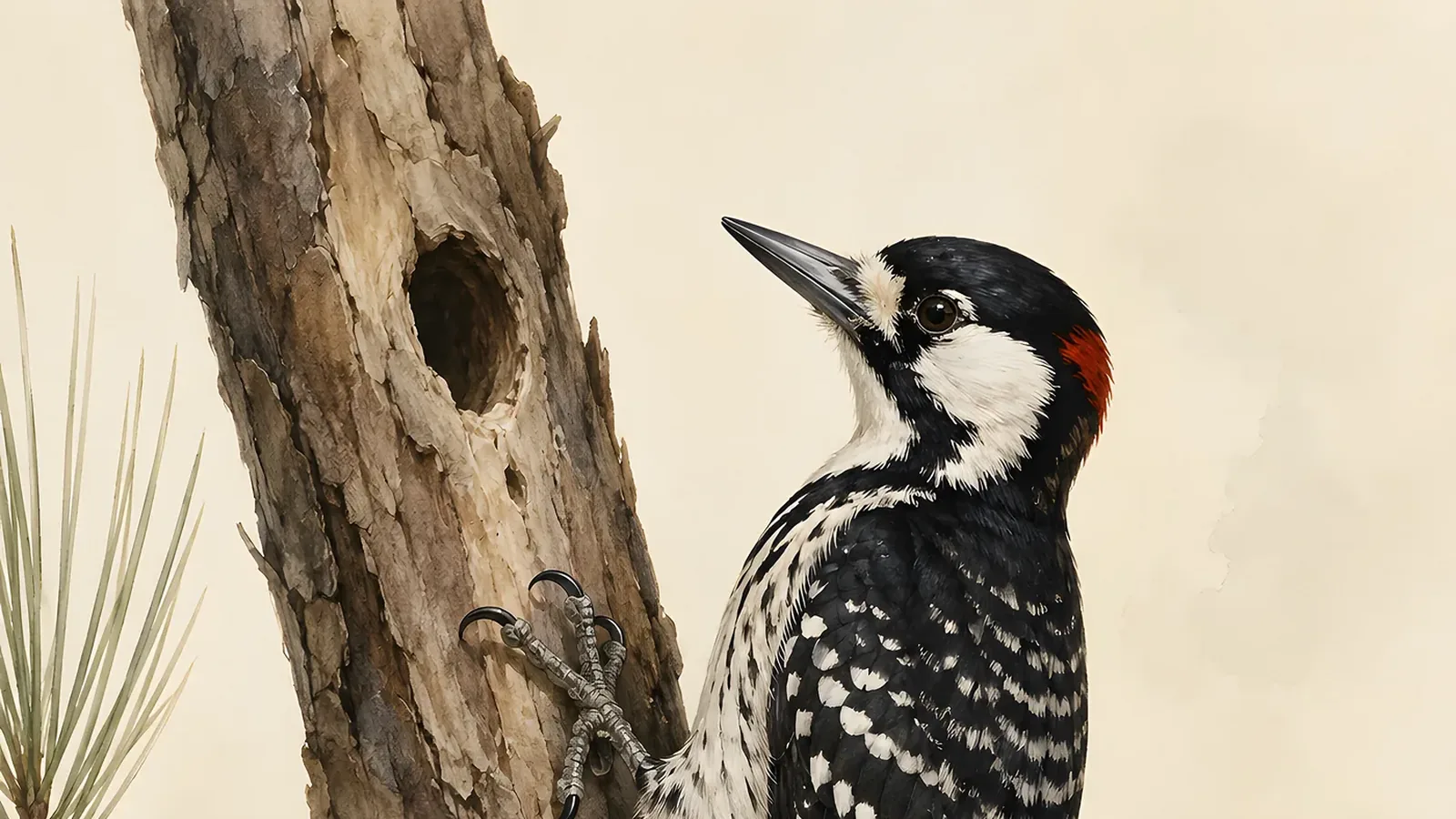
The diagnostic mark is the cheek. A large, clean white patch fills the face below the eye and above the throat - bold, hard-edged, impossible to miss at any range. The cap is black. The back is barred in alternating black and white, giving a ladder-stripe effect on the dorsal surface. The underparts are white with sparse dark streaking along the flanks.
The “cockade” that gives the bird its name is a stripe of red feathers behind the eye on adult males. It is nearly invisible in the field. John James Audubon himself, who gave this bird its English name in his Birds of America, noted that the red marking required examination in hand to confirm. Most field sightings offer only a dark-capped bird with that bold white cheek. Females lack the cockade entirely. Juvenile males carry a red patch on the crown that disappears after their first autumn.
What actually identifies this bird at distance and in motion is the combination of the white cheek, the barred back, and the habitat: a mature, fire-maintained pine forest where almost nothing else looks quite like it.
| Feature | Measurement |
|---|---|
| Length | 18 - 22 cm |
| Weight | 40 - 50 g |
| Wingspan | 33 - 36 cm |
| Lifespan (wild) | up to 16 years |
| Clutch size | 3 - 5 eggs |
| Incubation period | 10 - 12 days |
The living-pine cavity
This is what sets D. borealis apart from every other North American woodpecker, and what makes it ecologically extraordinary.
Every other woodpecker that excavates nest cavities uses dead wood - snags, rotting stubs, the decayed heartwood of fallen or dying trees. Dead wood is soft, workable, and easy to dig. Living trees are saturated with resin that clogs tools and makes the wood extremely hard.
Dryobates borealis excavates exclusively in living pines. The process takes one to six years, sometimes longer. The bird works downward through the hard, resinous sapwood, tapping and probing until it reaches the heartwood beneath - a core of dense, dry wood where resin no longer flows. The target is almost always a mature pine, generally older than 80 years, and preferably one already colonised in its heartwood by red heart fungus (Phellinus pini), which decays the interior and makes the final excavation considerably easier. Research published in The Auk has documented the woodpecker’s preference for trees where fungal decay has begun, which is one reason why old-growth pines - with their decades of accumulated infection risk - are so critical to this species.
The product of this long effort is a cavity in a tree still pumping resin through its living tissue. That resin is the key to everything.
Rudolph, Kyle, and Conner (1990, Wilson Bulletin, vol. 102) demonstrated through direct experiment that the sticky resinous coating produced at red-cockaded woodpecker cavity trees was “highly effective in preventing predatory snakes from gaining access to active cavities.” The birds do not simply occupy a resin-rich tree. They actively tend the barrier. Each day, members of the group return to the cavity tree and reopen the resin wells - small wounds drilled above and below the cavity entrance - with repeated pecking. The fresh resin bleeds down the bark in a curtain that a rat snake, the main nest predator, cannot cross without becoming fatally immobilised in the stickiness.
“The socially dominant breeding male selects the cavity tree that produces the most resin for his roost tree.” - Rudolph, Kyle & Conner, Wilson Bulletin, 1990
When a cavity is abandoned - occupied by a Flying Squirrel, a Carolina Chickadee, or any other opportunistic squatter - the resin barrier deteriorates within weeks because no one maintains the wells. The defence is not passive chemistry. It is daily labour.
What it sounds like
The call most often heard from a foraging group is a raspy, emphatic yank - described by Audubon’s field guide as nuthatch-like in quality, carrying well through open pine woods. In alarm the notes run together into a harsh scolding rattle. The drum is seldom used for territorial advertisement compared to most woodpeckers. This is a bird that communicates more through movement and group behaviour than through solo percussion.
Males forage on the upper trunk and outer limbs. Females concentrate on lower trunk sections. This spatial separation, documented by North Carolina Wildlife Resources Commission field biologists, reduces competition within mated pairs when arthropod numbers fall in dry months.
Range and the fire-kept forest
The Red-cockaded Woodpecker inhabits the longleaf pine country of North Carolina, south through Georgia and South Carolina, west across Alabama and Louisiana, and into eastern Texas. The population in longleaf-dominant forest once stretched continuously across roughly 37 million hectares of the Southeast. The estimate at the time of initial ESA listing in 1970 was approximately 1,470 active clusters scattered across a fragmented remnant of that original range.
The forest this bird requires is not simply any pine woodland. It must be old. The understorey must be open - grasses and low shrubs rather than a dense mid-storey of oaks and palmettos. That openness is maintained by fire. Longleaf pine savanna is a fire-evolved system: without regular burning, hardwoods invade the understorey, shade out the ground layer, and destroy the habitat structure the woodpecker depends on for foraging. The birds work the trunk bark for insects - beetles, ants, roaches, centipedes - and they need unobstructed access to trunks from ground level upward. A thicketed understorey makes that impossible.
The ecological implication is that where fire management stopped, Red-cockaded Woodpecker habitat collapsed, regardless of whether mature pines remained standing.
Diet
Dryobates borealis is a bark specialist. The core diet consists of arthropods living on or under pine bark: wood-boring beetles and their larvae, ants, roaches, spiders, centipedes, and termites. Both sexes work by scaling loose bark with the bill tip, then probing with a forked tongue well adapted to extracting insects from the groove-and-furrow surface of aged pines. Pine seeds and small wild fruits supplement the diet seasonally but are secondary to arthropods year-round.
The spatial division between sexes - males on upper trunk and limbs, females on lower trunk - also divides the arthropod community by microhabitat. Insects on dry outer bark differ from those in the more sheltered lower bark crevices, so the pair effectively splits a resource rather than competing for the same prey items.
Breeding and the helpers
Red-cockaded Woodpeckers are cooperative breeders. A typical group consists of one breeding pair plus one to four helpers - almost always males from previous seasons, often sons of one or both breeding adults. The helpers incubate eggs, brood nestlings, bring food to the female on the nest, and feed fledglings after they leave the cavity.
The breeding female lays three to five white eggs in mid-April, with incubation running ten to twelve days. The speed of hatching - unusual among woodpeckers - is partly offset by the extended period of group investment: fledglings receive food from the whole group for weeks after leaving the nest. Young males that remain as helpers improve the breeding pair’s productivity measurably. Groups with two or more helpers consistently raise more young per season than pairs alone.
Both roost cavity and nest cavity are in living pines. The group may maintain a cluster of two to five cavity trees within a defended territory. Excavating new cavities is long-term group work. Since natural cavity construction takes years, conservation managers have developed artificial cavity inserts - artificial cavities drilled by hand and fitted with wooden plugs - that can establish new groups without waiting for trees to be excavated naturally.
The recovery
The Endangered Species Act listing of 1970 arrived as biologists were documenting the near-total collapse of longleaf pine in the Southeast. Suppression of fire, agricultural conversion, and timber harvesting had reduced the original longleaf estate by roughly 97 percent. The Red-cockaded Woodpecker was a flagship species for the entire ecosystem’s loss.
Recovery required a shift not just in how wildlife managers treated one bird, but in how federal and state agencies managed fire across millions of hectares of public pine land. The prescribed burn programs that expanded through the 1980s and 1990s on national forests, military installations, and wildlife management areas across eleven states were as much about the black-backed woodpecker-adjacent fire ecology of the longleaf system as about the single species.
By 2024, the U.S. Fish and Wildlife Service estimated the population at approximately 7,800 active clusters - a more than fivefold increase from the 1970s low. On October 24, 2024, the USFWS officially reclassified D. borealis from Endangered to Threatened under the Endangered Species Act. The IUCN independently lists the species as Near Threatened (NT).
The distinction matters. Threatened is not safe. Hurricanes Helene and Michael demonstrated in consecutive seasons how a single storm can eliminate cavity trees accumulated over decades in a few hours. Longleaf pine savanna remains among the most altered ecosystems in North America. The bird that built its own fortress in a living tree, maintained it daily with its own bill, and recruited its own children to help raise the next generation is still dependent on humans maintaining the fire regimes that keep its forest open.
The resin is still glistening at first light. Whether it will keep glistening depends on what happens to the pines underneath it.