Field Guide
Harlequin Duck
There is a drake in the LeHardy Rapids of Yellowstone, early June, riding white water that would pin a human flat against the rock. The current is pushing ten miles an hour in places, folding around boulders, shouldering into standing waves. The duck rides it sideways, tilts, and ducks under for four seconds. When he comes up he has an aquatic insect larva, and he shakes the water off his slate-blue face as though he has done nothing in particular. He has the whole river to himself. No heron stands in this water. No merganser lingers here. Histrionicus histrionicus, the Harlequin Duck, has found its niche where other birds cannot follow, and it has paid for that niche in bones.
What it looks like
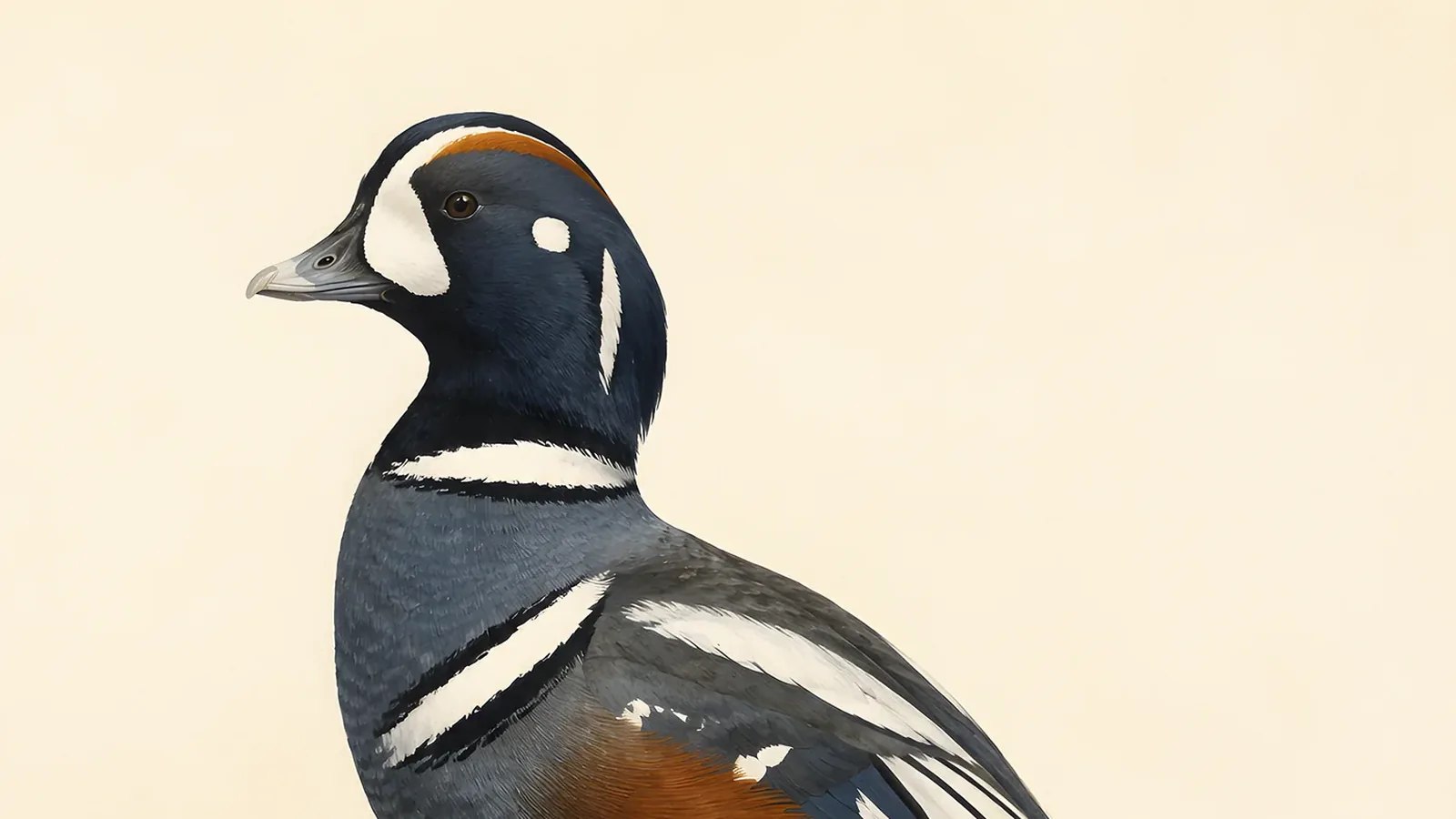
The male is unlike any other North American waterfowl. The base colour is a deep blue-grey - the shade of slate pulled from a quarry - and over it runs a system of markings so theatrical that common sense says they should break the bird’s outline. They do not. A white crescent arcs from the base of the bill back across the cheek. A round white spot sits behind the eye. A white collar interrupts the neck. The flanks glow chestnut, bounded above by white stripes. The crown shows a chestnut stripe. The Audubon Society field guide describes the overall effect as that of a court jester’s costume, which is exactly right and also almost too convenient, because histrionicus means “actor” or “theatrical” in Latin, and the species carries its name honestly.
The female is plain brown, paler on the belly, with two or three white patches on the face around and behind the eye. She could pass for a female scoter at a distance. The plainness is functional - she alone incubates the nest.
| Measurement | Range |
|---|---|
| Length | 38-43 cm |
| Weight | 540-760 g |
| Wingspan | 64-71 cm |
| Lifespan (wild) | 12-14 years |
A life in rough water
The Harlequin Duck has made a commitment that no other common North American duck has made in full: it spends summer on fast, rock-strewn rivers and winter on exposed rocky coastlines where the surf runs hard. Both environments are violent. Both are chosen deliberately. The Cornell Lab of Ornithology at All About Birds notes that the species favors “rushing rivers, diving and swimming against the current” in summer and “the roughest coastal water, with rocks pounded by the surf” in winter. This is not opportunism. This is the whole strategy.
On the breeding rivers, the duck works by walking as much as swimming. It dives to the riverbed, grips the substrate with strong feet, and walks upstream against a current that would sweep a lighter animal away. Biologists watching birds in Yellowstone and in the mountain drainages of Alaska have described them wedging into crevices on the stream bottom to hold position. On the coast in winter, they work the intertidal zone - the strip of rock that takes the full force of each incoming wave - diving through breaking surf to pull mussels and periwinkles off submerged ledges.
The strategy works because no predator can function in this water. A peregrine cannot stoop where a wave will slam it into basalt. A mink cannot hunt a river running this fast. The Harlequin is alone in its chosen habitat. That is the bargain it has struck, and the cost of the bargain is written in its skeleton.
The broken bones
“Harlequin Ducks suffer more broken bones than any other species, and X-rays and museum specimens have determined that most adults live with multiple healed fractures.”
- Cornell Lab of Ornithology, All About Birds
Examination of specimens and X-ray surveys of live birds reveal healed fractures throughout the skeleton - ribs, wings, sternum. The injuries come from being slammed into boulders by fast current, from being driven into rock faces by surf, from a lifetime of navigating water that treats a one-pound duck as negligible mass. The duck heals. It goes back in. It gets slammed again.
This is one of the most concrete demonstrations in avian ecology of the costs embedded in a niche specialisation. The Harlequin did not evolve into the easiest habitat available. It evolved into the most exclusive one, and it pays a physical price that accumulates across the years. That most adults carry old fractures without apparent impairment says something about the healing capacity of this species. It also says something about what the niche demands: being in the rough water is not optional. The food is there. The safety is there. The bones will mend.
What it sounds like
The Harlequin is a quiet duck for most of the year. On the water it is often silent. When it does call, it produces a high, thin, mouse-like squeak - so narrow and unremarkable that early naturalists gave the bird one of its folk names: sea mouse. Females issue a raucous chattering call during courtship interactions. Neither sex is noisy in the manner of a Mallard or a Common Loon. In the din of white water, a quiet call has limited range anyway.
Range and the two habitats
The species breeds across two broad zones: the mountain west of North America from Alaska through the Cascades and Rockies as far south as Wyoming and California, and a smaller eastern arc from Labrador and northern Quebec through Newfoundland and down to the Gaspe Peninsula. A third breeding population occupies Iceland and Greenland. These groups are ecologically similar but genetically distinct enough to have been treated as separate management populations.
The eastern North American population is the one of conservation concern. COSEWIC (Committee on the Status of Endangered Wildlife in Canada) assessed the eastern population as Special Concern in 2013, estimating a wintering adult population of between 3,226 and 3,420 individuals. That is a small number. The western population, by contrast, numbers in the hundreds of thousands and winters from the Aleutian Islands down through the Pacific Northwest. The two populations winter on opposite coasts: eastern birds appear along rocky shores from Maine down to Virginia, concentrated at known sites on headlands and offshore islands where the surf is heavy.
Migration is short by waterfowl standards. The birds simply move from their rivers to the nearest appropriate coastline and back again in spring. They do not travel the distances a Mallard or a Common Loon might cross. Their range is defined by the availability of two very specific habitat types rather than by latitude alone.
Diet and breeding
The diet divides cleanly by season. On breeding rivers, the Harlequin eats primarily the larvae of aquatic insects - blackflies, caddisflies, stoneflies, midges - gathered from the riverbed by diving and walking along the bottom. Harwell and colleagues (2012, Human and Ecological Risk Assessment) documented the winter coastal diet in Prince William Sound, finding it composed of gastropods (nearly 60 percent), mussels, fish eggs, crustaceans, and clams. Both diets require diving in moving or turbulent water.
Breeding begins in late May or early June. The female selects a nest site close to the breeding river - a shallow scrape or depression under bankside vegetation, sometimes in a crevice among tree roots. She lays three to eight eggs and incubates them alone for 27 to 30 days. The male leaves shortly after laying and moves to moulting grounds, typically on the coast. The female raises the ducklings without him. Young birds fledge at around 40 to 50 days old but remain with their mother through the first winter.
The species does not breed until its second or third year. Breeding success is low in younger birds and improves substantially by age five. A long-lived individual of 12 to 14 years therefore has real reproductive value in later years, which may explain why evolution has built such effective bone-healing into a bird that seems determined to injure itself continuously.
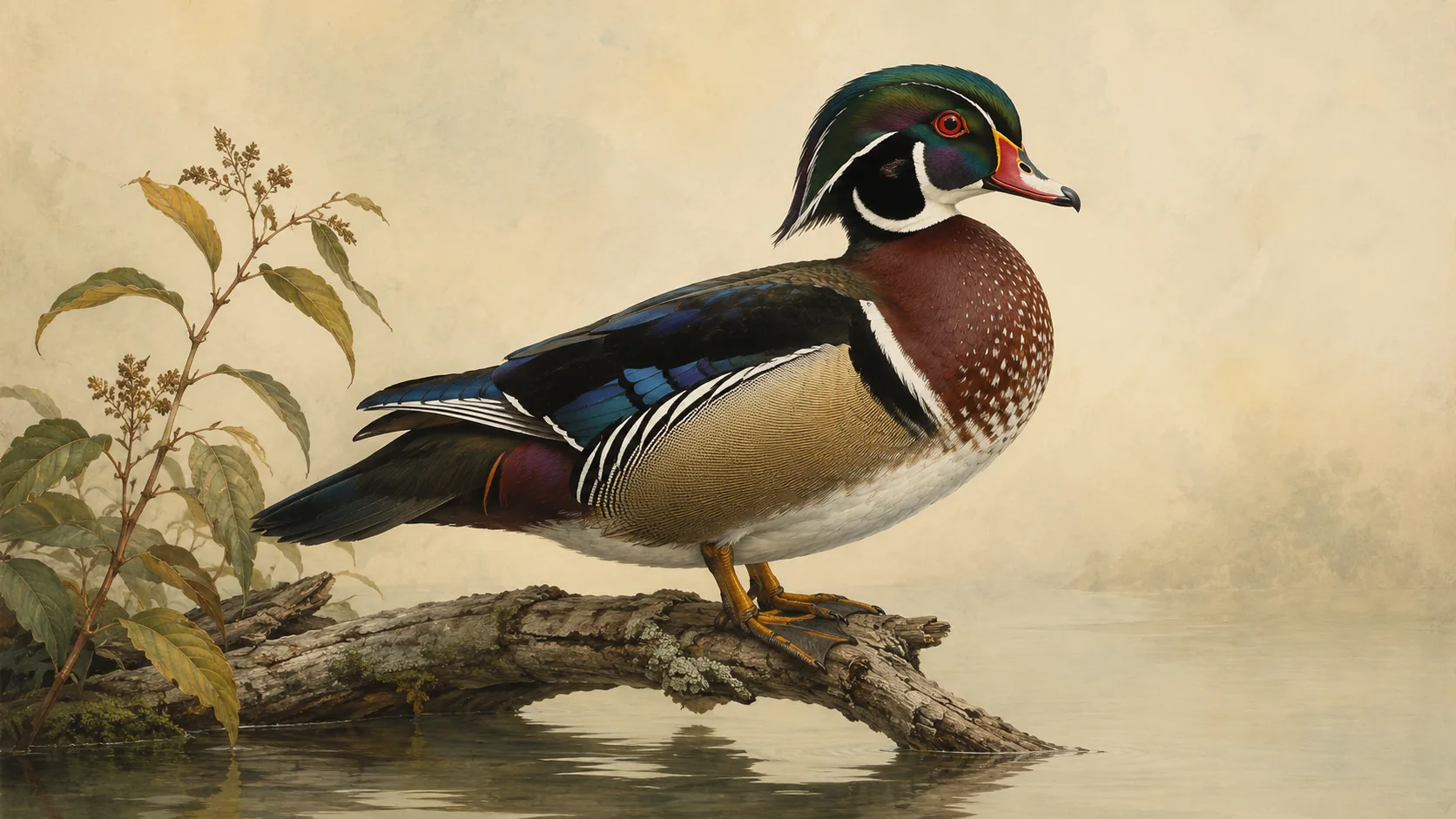
The wood duck shares the Harlequin’s family and its gift for improbable nesting decisions, though the wood duck chose cavities in calm wooded ponds rather than the exposed banks of a white-water river. Both birds look theatrical. Only one of them has chosen the most dangerous water on the continent and made it work. The argument the Harlequin makes with its life is that exclusivity - genuine, physical, bone-fracturing exclusivity - is its own form of safety. Every other duck that cannot enter this water is a competitor that will not be there. The Harlequin is alone, and it is fine, and its ribs are healing already.