Field Guide
Pileated Woodpecker
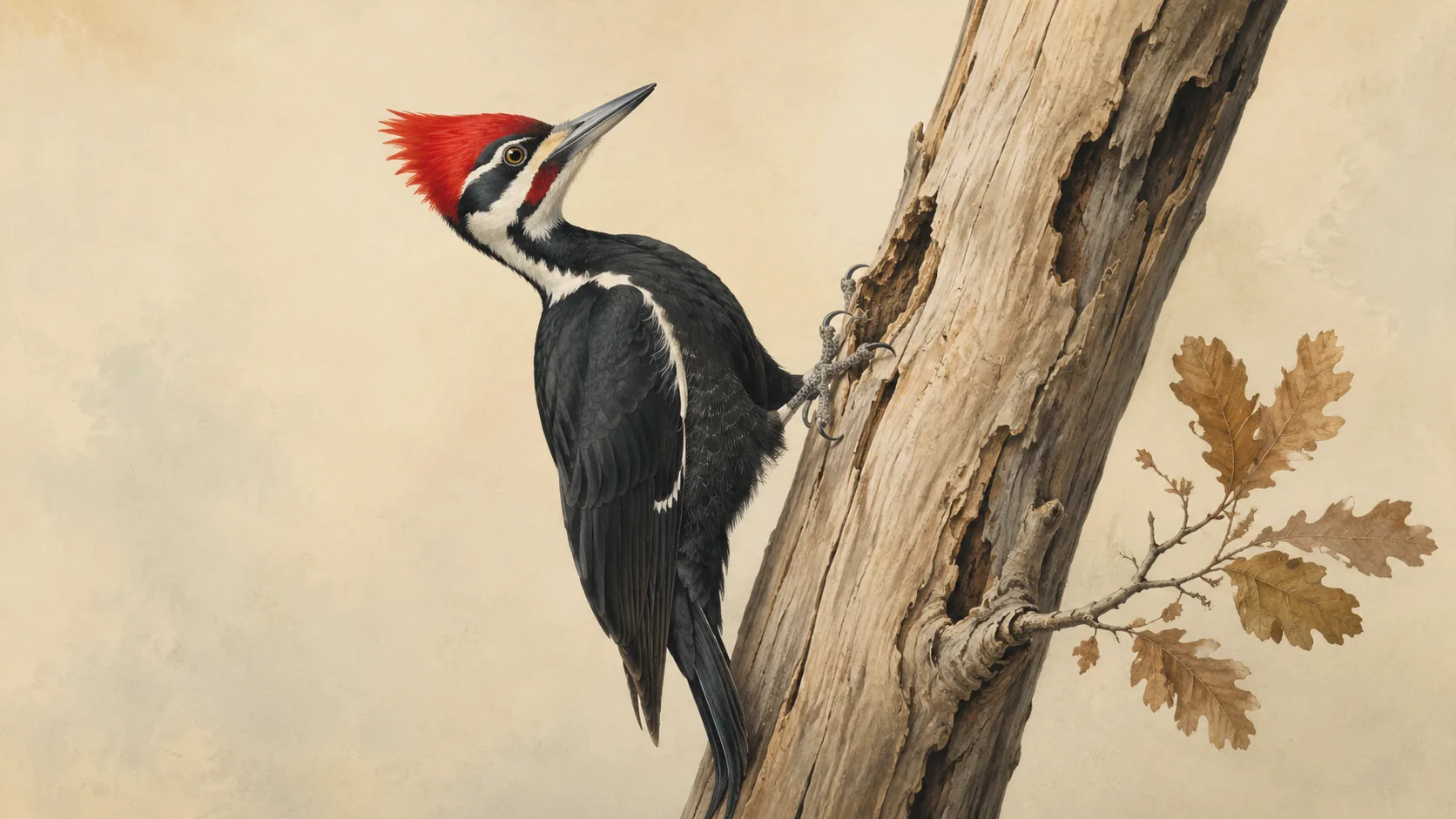
A dead sugar maple on the edge of a hemlock stand in northern Ontario is not the end of anything. It is the beginning of a sequence. The Pileated Woodpecker finds it, assesses it, and goes to work. The chips fly. They land in a bright white pile at the base of the trunk, which is how you know, before you see the bird, that something serious has happened here. The excavation is rectangular - not round, not ragged, but architectural. In a few days the bird has opened the tree like a book and extracted the carpenter ants inside. What remains is a cavity large enough for a Wood Duck to nest in. Which, often enough, is exactly what happens next.
Dryocopus pileatus is the largest woodpecker found across most of North America, crow-sized and unmistakable, and the case worth making about it is this: the species does not simply use old-growth forest. It creates habitat inside it that no other North American bird can create. The Pileated Woodpecker is a keystone species, and understanding it as one changes how you look at every large dead tree in a northeastern wood.
Identification and appearance
At 40 to 49 centimetres long and 250 to 350 grams, the Pileated Woodpecker is substantially larger than any other North American woodpecker you are likely to encounter. The wingspan runs 66 to 75 centimetres. In flight it resembles a crow at a distance, but the wingbeats are different - shallow, undulating in a more exaggerated arc - and the bold white underwing patches flash with each stroke.
At rest, the bird is mostly black: back, wings, breast, and belly all the same deep matte black. Against this, two white stripes trace from the bill down the sides of the neck. The face carries a white patch below the eye. The crest - the feature that gives the species both its common name and its Latin one, from the Latin pileatus, meaning “capped” - is a solid triangular wedge of red, rising steeply from the forehead and making the bird’s silhouette unmistakable against a pale winter sky.
He and she differ in two places. The male carries a red moustachial stripe running back from the bill; the female’s is black. The male’s red crest extends all the way to the base of the bill; in the female it stops at the forehead with a brownish-black border in front. Both sexes share the same black-and-white body. Juveniles look like adults but carry shorter crests and slightly duller plumage in their first year.
The bird most likely to cause confusion is the Ivory-billed Woodpecker, now almost certainly extinct across the continental United States. The Pileated shows white underwing in flight; the Ivory-billed showed large white trailing edges on its upperwing as well. At a feeder or on a trunk in your garden, there is no realistic confusion species once you have seen the Pileated once.
Voice and drums
The call is loud and far-carrying: a series of resonant kuk-kuk-kuk-kuk-kuk notes, irregular in rhythm, wild enough in character that birders in the eastern woods often describe it as prehistoric. It carries half a mile through bare winter forest. Ornithologists at Cornell’s Macaulay Library note a rising-then-falling quality that distinguishes it from the simpler calls of smaller woodpeckers. There are softer contact calls between mates and a sharp single wuk used as an alarm.
The drumming is equally distinctive. According to Cornell’s Birds of the World, the species drums at approximately 17 beats per second in bursts of two to three seconds, with the rate accelerating and then decelerating through each burst - a pattern unusual enough to be diagnostic once you have learned it. The drums carry through dense forest and serve for territorial advertisement and mate attraction simultaneously.
Range and habitat
The Pileated Woodpecker is a year-round resident across a broad arc of North America: east through the Canadian boreal forest from British Columbia to Nova Scotia, south through the eastern United States to Florida and the Gulf Coast, and west along the Pacific coastal strip from California to Alaska. It does not migrate. Individuals hold territories year-round; published studies place territory size at roughly 150 to 400 acres per pair in eastern and midwestern forest, and up to 1,000 acres or more in western old-growth.
The habitat requirement is specific: large tracts of forest with large dead trees. The species needs trees of sufficient diameter to excavate cavities - the cavity a nesting pair requires is deep enough that only a trunk of serious girth can contain it. Fragmented suburban woodlots rarely offer what it needs. Old-growth and mature second-growth forest, mixed deciduous and coniferous, are where the species concentrates. In the Pacific Northwest, old-growth Douglas-fir and western red cedar. In the east, mature oak, beech, and hickory forest with standing snags.
The population has grown since the mid-twentieth century as eastern forests have regrown on abandoned farmland, and Audubon notes the species now found in suburbs with sufficiently large trees where it was absent two generations ago.
Diet
Carpenter ants are the core of the diet - Cornell’s All About Birds places them at roughly 60 per cent of foraging observations. The Pileated locates ant galleries by sound and by the spongy feel of rotting wood, then excavates directly to the colony rather than probing. The result is those characteristic deep rectangular pits, sometimes cutting entirely through a standing snag, exposing the ant gallery in cross-section.
Wood-boring beetle larvae come second. Fruits, nuts, and wild berries make up the balance, particularly in late summer and autumn when insects are less accessible. The bird does not visit seed feeders in the way that smaller woodpeckers do, but suet feeders mounted on large trees can draw it in, especially in winter when ant colonies are dormant and the bird works harder for its protein.
The tongue is the engineering that makes the excavation viable: extraordinarily long, barbed, and coated in sticky saliva, it reaches into galleries that the bill cannot access and retrieves ants or larvae the bill alone would miss.
Breeding and nesting
Pairs are monogamous and appear to maintain long-term bonds. Both sexes excavate the nest cavity, typically in a dead tree or a dead section of a living one, anywhere from four to 15 metres above the ground. The entrance is oval rather than round, and the cavity drops steeply below the entrance hole so that the eggs sit below the level of any rain that enters.
Clutch size is three to five white eggs. Both parents incubate, with the male typically taking the night shift - a pattern confirmed across the Picidae family. Incubation runs approximately 18 days. The young fledge at 26 to 28 days, which is fast for a bird this size, and remain with the parents for two to three months after fledging as they learn to forage.
The pair excavates a new cavity each year, sometimes in the same tree, sometimes in a new snag. The previous year’s cavity does not go unused. As Cornell’s Birds of the World documents, abandoned Pileated cavities are subsequently occupied by Wood Ducks, American Kestrels, Great Crested Flycatchers, Northern Flying Squirrels, and a range of other cavity-dependent species that cannot excavate their own homes. No other North American bird produces cavities of this size and structural quality at scale. The Pileated’s annual excavation habit effectively provides the forest’s secondary housing stock.
The ecological position
The population sits at an estimated 2.6 million mature individuals with an increasing trend, and the IUCN lists the species as Least Concern. Those numbers, however, do not change what a forest loses when Pileated Woodpeckers are absent from it. The species is considered a keystone not because it is rare but because its function - creating large cavities in large dead trees - cannot be substituted by any other organism in its range.
A large standing dead tree in a mature northeastern or Pacific Northwestern forest is already doing ecological work before the woodpecker arrives. After the woodpecker has finished with it, it does more. The tree that looked like an ending is, in the Pileated’s presence, an infrastructure project.
The pile of fresh wood chips at the base of a worked trunk is worth pausing over the next time you find one. The bird that made it is, in a direct and measurable sense, part of what makes the rest of the forest possible.