Field Guide
Gyrfalcon
A white Falco rusticolus breaks from a basalt cliff over the Icelandic tundra and drops to two metres above the ground. The target is a rock ptarmigan sixty metres ahead. There is no stoop, no height advantage, no long falling arc. There is only speed - low, flat, and relentless - as the largest falcon in the world runs its prey down across open ground the way a coursing greyhound runs a hare. The ptarmigan jinks left. The falcon adjusts without losing a wingbeat. Half a second later it is over.
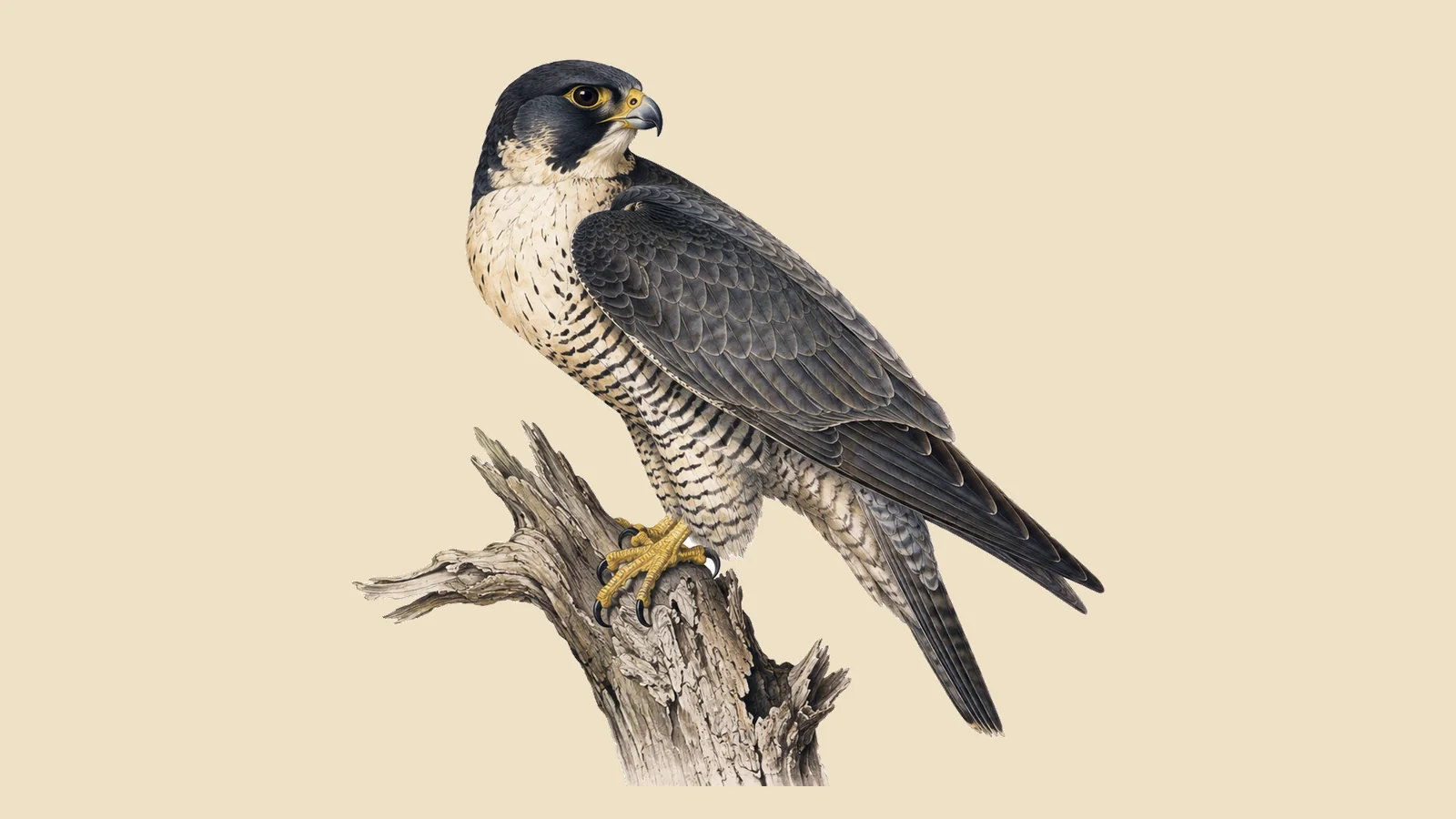
This is the Gyrfalcon’s argument: not the vertical drama of the peregrine falcon, which kills with gravity, but the horizontal dominance of a bird built for sustained pursuit. The Peregrine stoops. The Gyrfalcon chases. Both are effective. Only one was reserved, in the medieval courts of Europe, for kings.
What it looks like
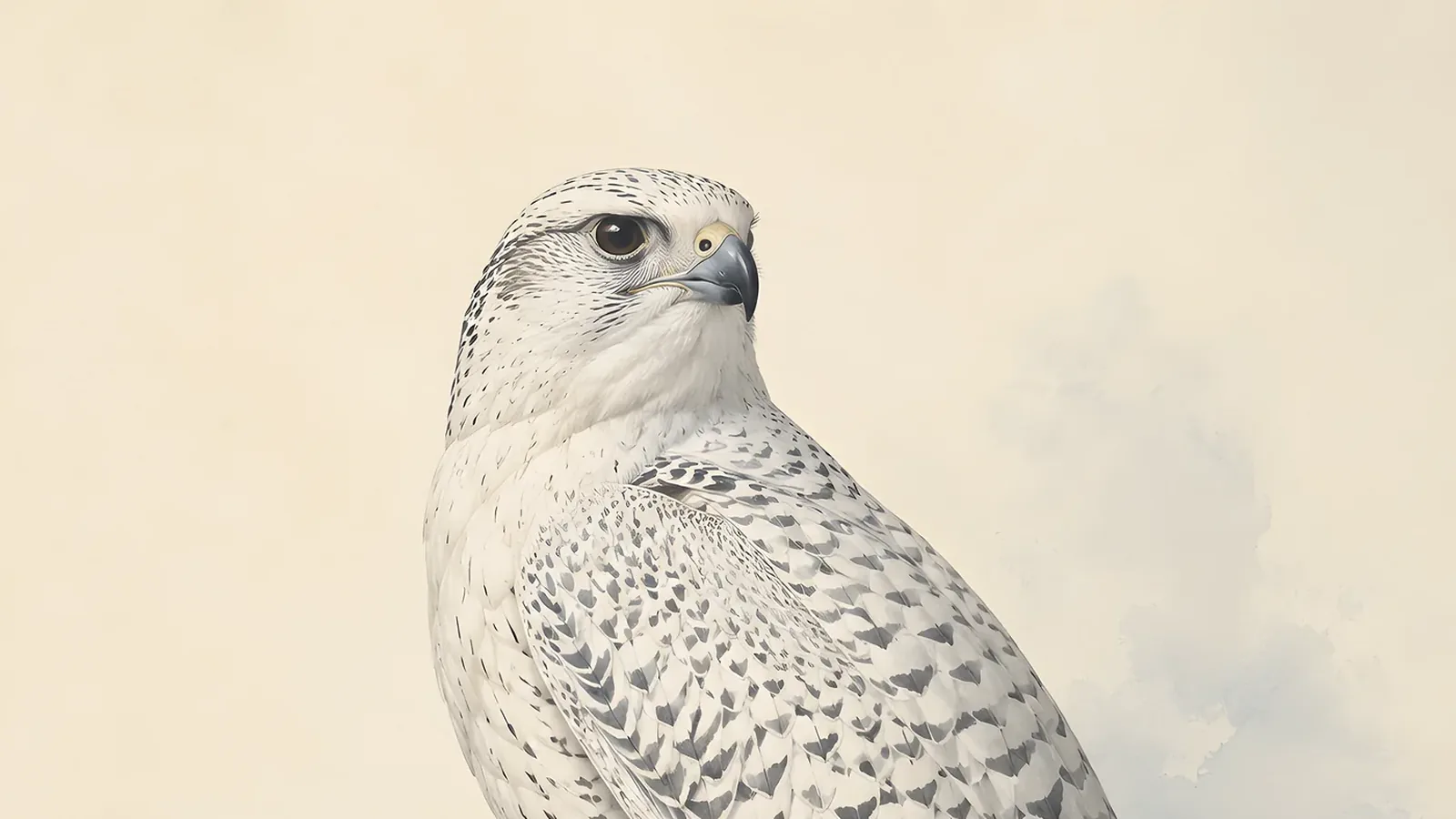
Falco rusticolus is substantially larger than any other falcon. Females run 51 to 64 centimetres from bill-tip to tail and weigh 1,130 to 2,150 grams - more than twice the weight of a large female Peregrine. Males are smaller, as is typical in raptors: 48 to 61 centimetres, 769 to 1,450 grams. The wingspan spans 105 to 135 centimetres, with broad, relatively short outer wings compared to a Peregrine, and a longer tail that gives the bird impressive manoeuvrability at low altitude.
The silhouette in flight is distinctive: heavier through the chest and shoulders than other large falcons, the wings swept back but broader at the base, the tail long enough that the bird reads almost accipiter-like at distance until the wing shape resolves. The head is large and rounded. There is no bold facial mask of the Peregrine type, no dark hood effect. At close range the face shows a faint moustache mark against a paler cheek, but nothing that demands attention the way a Peregrine’s face does.
The colour morphs
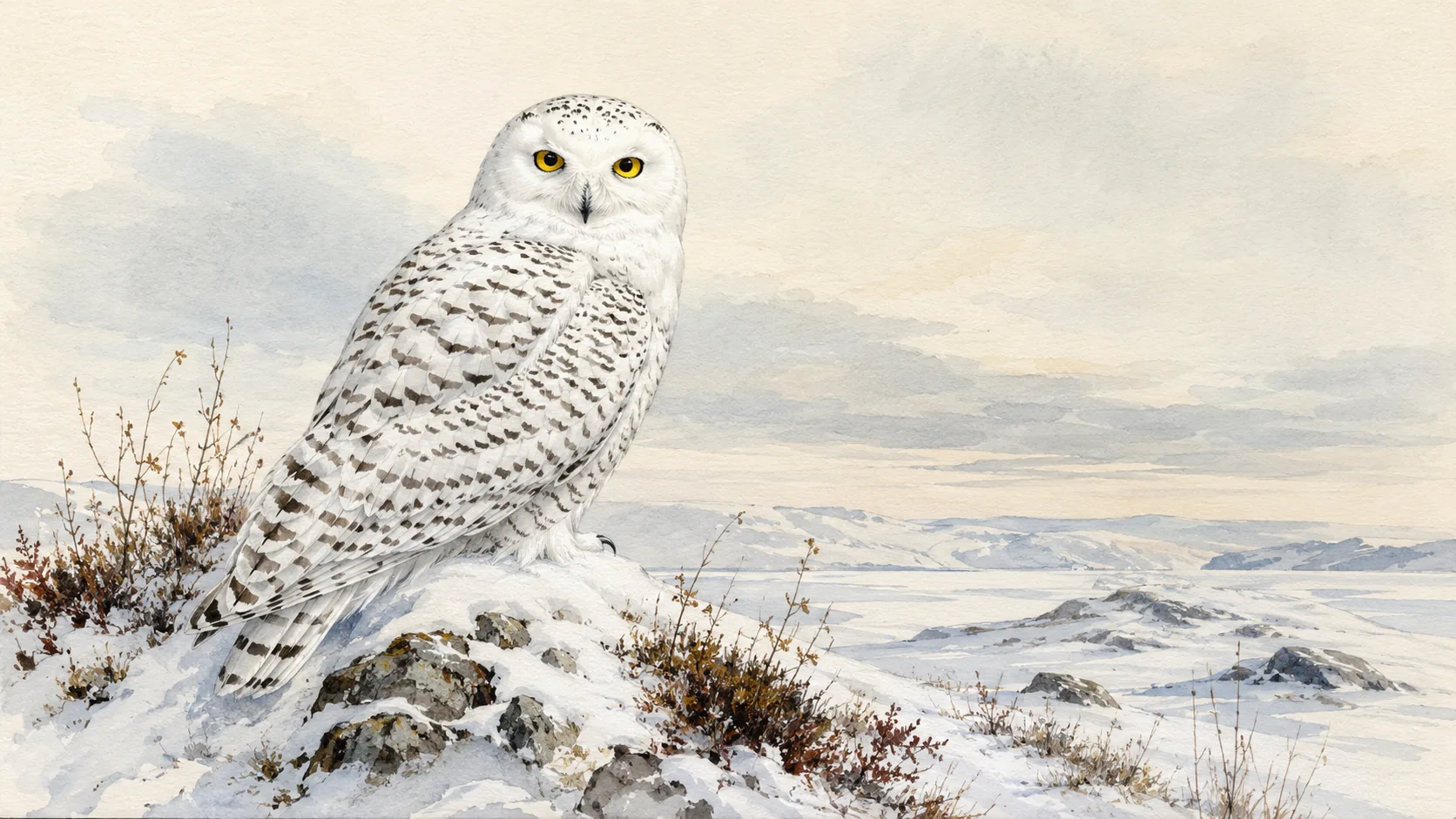
The Gyrfalcon is the most polymorphic falcon in the world. The spectrum runs from birds so white they vanish against Arctic snow to individuals so dark they appear nearly black on the wing. Between these poles sits the grey morph - the most common form in North America - in which the upperparts are blue-grey to brownish-grey, patterned with darker barring, and the underparts are white with variable dark streaking and spots.
The white morph breeds predominantly in Greenland, where pale individuals can be almost pure white with only sparse dark flecking on the upperwing. Research by Chang and colleagues (2010, Journal of Raptor Research) identified that plumage colour in F. rusticolus is largely governed by variation in the melanocortin-1 receptor gene (MC1R), with white-morph birds from northern Greenland sharing a single high-frequency MC1R allele at 98 percent prevalence. In Iceland, where only grey-morph breeders are known, seven distinct alleles were recorded. The dark morph - charcoal to near-black throughout - occurs primarily in northern Canada and is the least common form across the range.
| Morph | Upperparts | Underparts | Where most common |
|---|---|---|---|
| White | White with sparse dark flecks | White to pale cream | Northern Greenland |
| Grey (silver) | Blue-grey to brownish-grey, barred | White with dark streaking | North America wide |
| Dark | Dark grey to near-black | Dark, heavily marked | Northern Canada |
Juveniles of all morphs are browner and more streaked than adults and may hold immature plumage for two to three years before approaching adult colouration. This protracted development is one reason the Gyrfalcon does not breed until it is two to four years old.
How it hunts
Where the Peregrine wins by kinetic energy - arriving on prey at 320 kilometres per hour from a controlled dive - the Gyrfalcon wins by output and determination. It hunts using a low, fast, coursing flight, scanning terrain by cruising at near-ground height to surprise prey on the ground or flush birds from cover. When a target flushes, the chase is on: a tail-chase across open tundra that the falcon wins through raw acceleration and the stamina to press for a long distance if the first pass fails.
Cade (1982) described this approach as relying on “raw power to capture prey, usually in a tail chase,” and Poole (1987) noted that Gyrfalcons will sometimes wear prey down across extended distances until capture becomes easy. In open habitat with no cover, a ptarmigan running ahead of a Gyrfalcon has limited options. In most cases the falcon has more.
Coastal and winter-dispersing birds also take waterfowl and gulls, which requires a different approach - a horizontal chase over water, often at heights that let the bird exploit terrain for concealment. Some winter birds in Alaska and along northern coastlines have been recorded hunting far out over sea ice, taking seabirds in level flight far from land.
The Peregrine owns the vertical. The Gyrfalcon owns the horizontal. They have divided the sky between them.
The falcon of kings
In medieval Europe, the hierarchy of falconry birds was a social document. Merlins were for ladies. Peregrines were for earls and knights. Eagles, in theory, were for emperors. And Gyrfalcons - specifically white Gyrfalcons from Iceland, Greenland, and the Norwegian coast - were for kings alone.
Emperor Frederick II of Hohenstaufen wrote in his falconry treatise De Arte Venandi cum Avibus (composed in the 1240s) that “the gyrfalcon is the nobler among the species of falcons.” White Gyrfalcons were among the most valuable diplomatic objects in the medieval world - carried overland and by sea as gifts between rulers at a cost in logistics that rivalled the movement of troops. The most often-cited measure of that value is from the Nicopolis crusade of 1396: when John the Fearless, son of the Duke of Burgundy, was captured by the Ottoman sultan Bayezid, a ransom of 200,000 gold ducats was offered and refused. What Bayezid wanted instead - and received - was twelve white Gyrfalcons.
The birds were worth it. A white Gyrfalcon from the breeding cliffs of Iceland or Greenland was not simply a hunting tool. It was proof that you had the reach, the connections, and the resources to obtain the most difficult-to-acquire living thing in the known world.
Range and habitat
F. rusticolus breeds across the entire circumpolar Arctic - Alaska, northern Canada, Greenland, Iceland, Svalbard, arctic Norway, Russia - on cliffs and outcrops above the treeline. The species shows strong nest-site fidelity: the same ledge may be used by successive pairs for decades, and birds return to cliff faces used by ravens or rough-legged hawks, occupying old stick nests rather than building their own. Breeding pairs in northeast Iceland have been monitored continuously since the 1970s.
The core population is resident. Most adult Gyrfalcons hold territory year-round in the high Arctic, hunting through the polar winter in near-darkness. Immature birds disperse more widely, and in years when ptarmigan numbers crash at the northern end of their ten-year cycle, even adults may move south. In North Dakota and Montana, and occasionally as far south as northern Oklahoma, a Gyrfalcon appearing in winter is a prized rarity - a bird displaced by prey failure, sitting on a utility pole above a prairie that is nothing like the cliffs it came from, studying the pheasants below.
Breeding
Gyrfalcons begin establishing territory as early as January - months before the Arctic thaw - and pair bonds form six weeks before egg-laying. The nest is a ledge scrape or an occupied stick-nest of another species, with no new material added. Clutch size is typically three to four eggs (range two to seven), creamy white and spotted with reddish-brown. Incubation runs 35 days (Cade 1982) and is carried out primarily by the female while the male hunts. Chicks reach thermoregulatory independence by ten days and fledge at 45 to 50 days.
The dependence of Gyrfalcon productivity on ptarmigan numbers has been measured quantitatively. Nielsen (1999, Journal of Animal Ecology) studied the predator-prey relationship in northeast Iceland across a complete ten-year ptarmigan cycle, recording a 4.3-fold difference in ptarmigan density between peak and trough years. Rock ptarmigan made up an average of 72 percent by biomass of the gyrfalcon’s summer diet in that study (range 52 to 86 percent). The number of occupied Gyrfalcon territories lagged ptarmigan density by three years - the falcons’ late-maturing population responding slowly to food abundance - and the study concluded that the Gyrfalcon “destabilizes” ptarmigan dynamics by acting as a specialist predator that amplifies rather than damps the prey cycle. When ptarmigan are scarce, the falcons fail to breed. When ptarmigan are plentiful, they breed well and their own numbers build - until the prey cycle turns again.
Bird Banding Laboratory records put the maximum documented lifespan for a wild Gyrfalcon at just over 15 years, with an average wild lifespan around 13 years. Captive birds, insulated from starvation and injury, may live past 25.
The IUCN lists Falco rusticolus as Least Concern, with a global population estimated at around 83,000 individuals and a broadly stable trend. North American populations are considered stable. Declines have been recorded in parts of arctic Europe. Climate change is the identified long-term threat: as the Arctic warms and ptarmigan ranges shift, the cliff-nesting, tundra-hunting bird that has evolved over millennia for this specific landscape will need a tundra that still exists to hunt it.
The Gyrfalcon is already perfectly made for a world that is changing faster than any falcon can adapt to. That is the thought to hold as you watch a white bird bank out of a northern skyline and vanish into the grey.