Field Guide
Gunnison Sage-Grouse
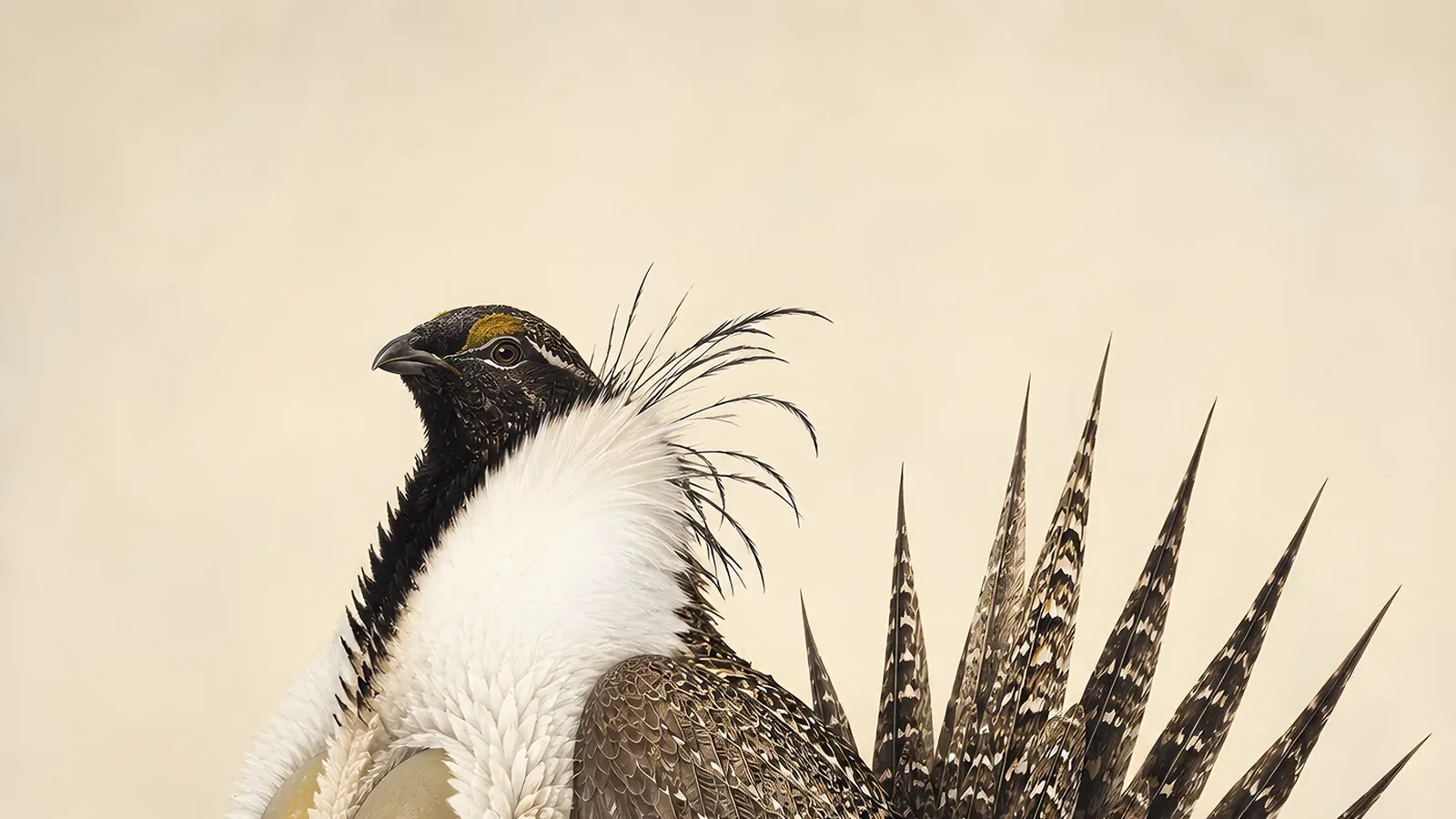
It is March on the Gunnison Basin of southwestern Colorado, before full light, and the male is already performing. He spreads his spiky tail into a fan, draws his wings out to brush the frost-stiffened earth, and throws the long, dense filoplumes off the back of his head forward over his crown - a gesture that tips the whole arrangement of feathers like a heavy curtain dropped from behind. The ponytail lands. He inflates his esophageal air sacs, pops them nine times in rapid succession, and the sound - a series of low, liquid plops unlike anything else on a North American lek - drifts out across the sage.
He is Centrocercus minimus: the Gunnison Sage-Grouse. One of the last few thousand of his kind on Earth, displaying on a lek that may have been used by birds of his lineage for centuries, unaware and unconcerned that for most of recorded ornithological history, nobody knew he existed.
What it looks like
The Gunnison Sage-Grouse is a large, ground-dwelling bird built on the same architectural plan as its close relative the greater sage-grouse, but considerably smaller. Males measure 43 to 56 centimetres in length and typically weigh 1,400 to 2,435 grams. Females are markedly smaller, running 32 to 40 centimetres and 990 to 1,300 grams. The species is roughly one-third smaller than the greater sage-grouse by body mass - a gap wide enough to notice clearly in the field when both occur in the same frame.
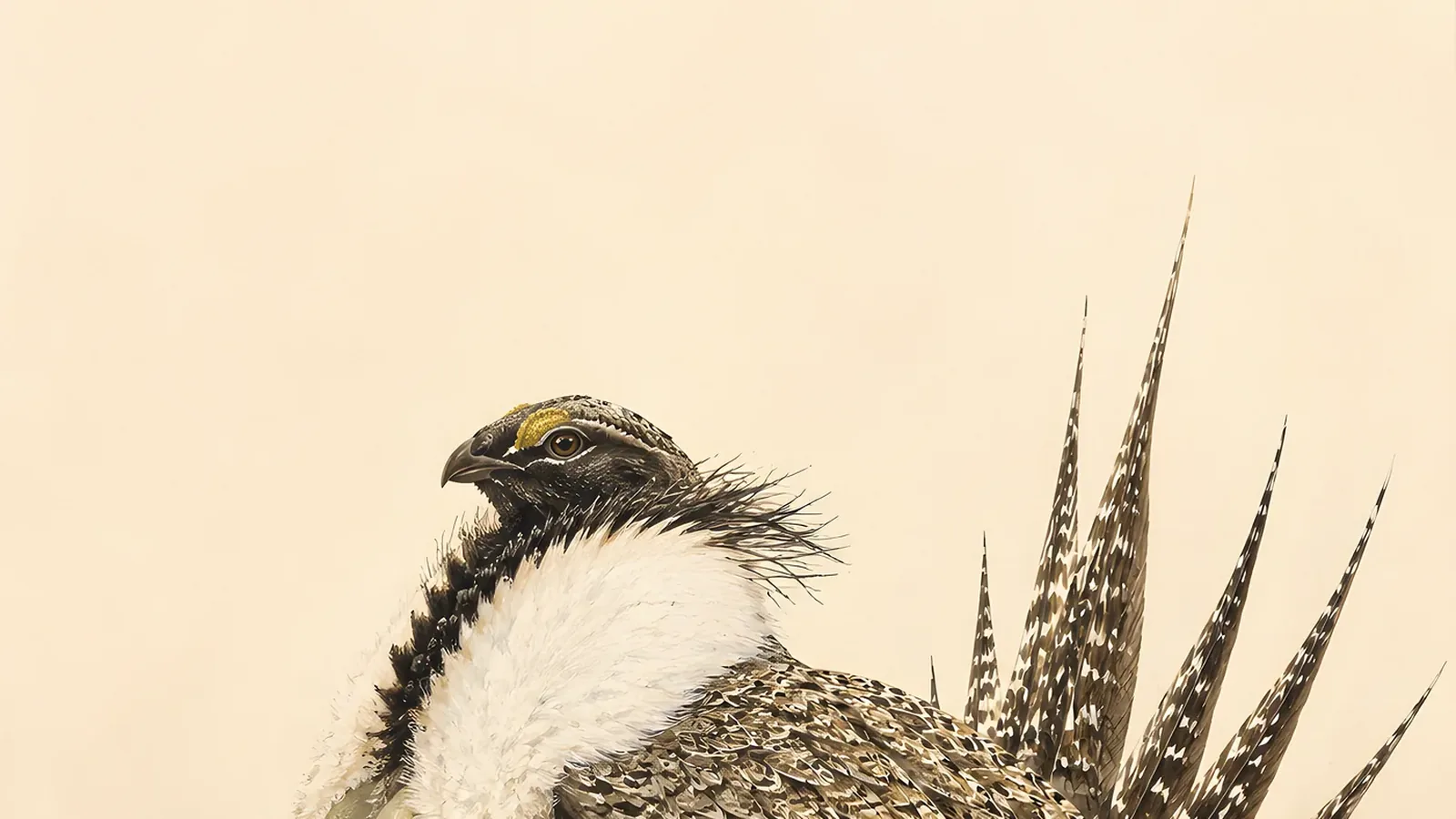
Both sexes wear the classic sage-grouse palette: cryptic brown and buff upperparts barred with black and white, providing nearly perfect camouflage against dry sage scrub. The breast of a displaying male is a deep black bib, framed by a ruff of white feathers. The tail, when fanned, shows more obvious pale barring than in the greater sage-grouse - a diagnostic field mark when views are good enough.
The single most distinctive visual feature of the male is the filoplumes at the back of the head. These are elongated, structurally dense plume-feathers, far thicker and heavier than the sparse, shorter versions on the greater sage-grouse. In full display they project forward over the crown in a drooping mass - the “ponytail” that researchers and field observers alike use as shorthand for the species. No other North American grouse produces anything comparable.
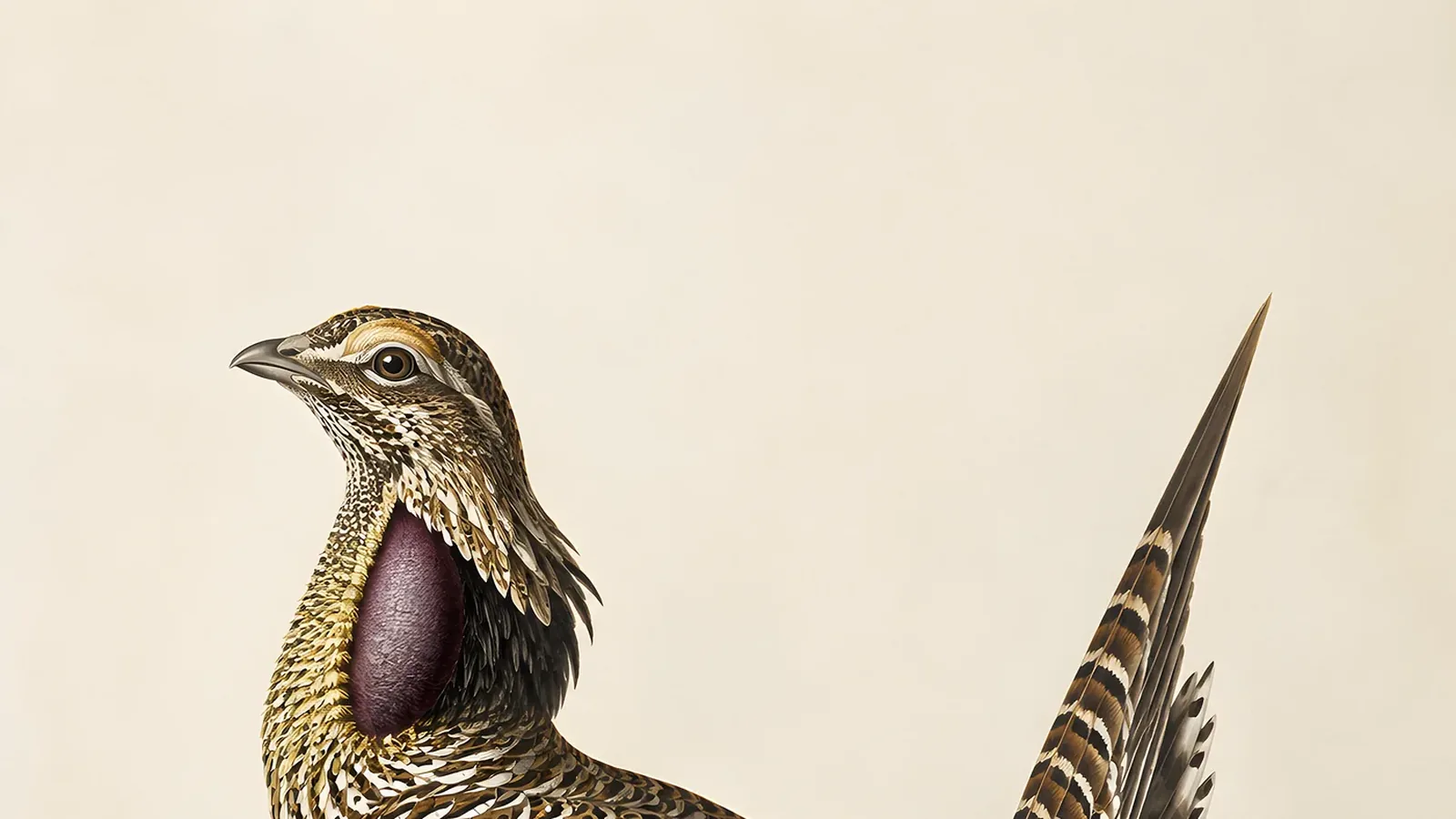
The male’s yellow eye-combs flush bright during display. His esophageal pouches, when deflated, hang on his chest like loose leather. When inflated for the display sequence, they swell to prominent yellow-green globes visible at distance. The female is plain brown throughout, streaked and barred, with a pale throat - well-suited to sitting motionless on a nest under a sage canopy.
| Measurement | Range |
|---|---|
| Length | 32 - 56 cm |
| Weight | 990 - 2,435 g |
| Wingspan | 66 - 76 cm |
| Wild lifespan | 3 - 9 years |
| Clutch size | 6 - 9 eggs |
| Incubation | 25 - 27 days |
A species named in 2000
The Gunnison Sage-Grouse is one of the most recently recognised birds in North America. For most of the twentieth century, ornithologists treated the birds of the Gunnison Basin as simply a southern, isolated population of the greater sage-grouse. They were smaller and geographically separated, but that was not, by itself, unusual.
The formal argument for species status came together through converging lines of evidence. Hupp and Braun documented distinct morphological differences as early as 1991. Oyler-McCance and colleagues in 1999 showed, via mitochondrial DNA and nuclear microsatellites, that the Gunnison population was genetically distinct - with low gene flow to all other populations, consistent with a long history of reproductive isolation (Oyler-McCance et al., 1999, The Condor). Then in 2000, Dr. Jessica Young and co-authors - Braun, Oyler-McCance, Hupp, and Quinn - published the formal species description in the Wilson Bulletin, designating the name Centrocercus minimus and making the case on morphological, behavioral, and genetic grounds. The American Ornithological Society checklist committee accepted the split the same year (Young et al., 2000, Wilson Bulletin 112: 445-453). Young et al. received the Edwards Prize for the best major article published by that journal that year.
The description made the Gunnison Sage-Grouse the first new bird species described from the continental United States in over a century.
A subsequent genomic study by Oyler-McCance and colleagues published in 2019 in Genome Biology and Evolution reinforced the picture: the two sage-grouse lineages show deep divergence, with sexual selection on display traits - including the filoplumes and the vocalisation pattern - playing a key role in reproductive isolation (Oyler-McCance et al., 2019, Genome Biology and Evolution 11: 2023-2038).
The lek and the ponytail
The Gunnison Sage-Grouse lek display is not simply a smaller version of the greater sage-grouse’s. It is structurally different, and the differences matter both to the birds themselves and to the researchers who study them.
The central behavioural distinction is the air-sac popping sequence. Greater sage-grouse males pop their air sacs twice per display cycle. Gunnison Sage-Grouse males pop theirs nine times. The sound is distinct: lower-pitched, wetter, more insistent, carrying a different acoustic signature across the lek. Gunnison males also wag their tails at the end of each display sequence - a movement with no counterpart in the greater sage-grouse’s repertoire.
The filoplume throw is the visual centrepiece. As the male begins his display, the thick plume-mass at the back of his head tips forward over the crown, hangs briefly above his bill, and falls back. It is improbable-looking at close range and memorable once seen. The motion is not identical bird to bird. Individual and population variation in display timing and structure exist, and these regional differences may function as barriers to interbreeding between the seven remaining satellite populations. The populations no longer exchange mates with any regularity, and their display dialects may be drifting further apart.
Leks are traditional sites. Males arrive from late February through mid-May, before first light, and leave by mid-morning. A dominant male will occupy the centre of the lek. Only 10 to 15 percent of males on a given lek mate successfully in any season - a ratio that concentrates reproductive success tightly and means that the effective population size of this species is considerably smaller than the raw head-count suggests.
Range and how few remain
The world population of Centrocercus minimus fits inside a single drainage basin with room to spare. The Gunnison Basin of southwestern Colorado holds approximately 87 percent of all remaining birds. In 2023, Colorado Parks and Wildlife counters visited 83 leks in the basin and recorded a high male count of 805 - an increase from the prior year, and the highest female count since 1998 at 355 birds. Estimated total basin population sits between 3,220 and 3,950 individuals across all ages and sexes.
Beyond the Gunnison Basin, six satellite populations persist in southwestern Colorado and a small area of southeastern Utah. Their names are: Pinon Mesa, Crawford, San Miguel Basin, Dove Creek/Monticello (extending into Utah near Monticello), Cerro Summit-Cimarron-Sims Mesa, and Poncha Pass. Some of these populations number in the tens of birds. All but the Gunnison Basin show long-term declining trends. Oyler-McCance and colleagues documented in 2005 that gene flow among all seven populations is low to negligible, meaning each is effectively an isolated evolutionary unit with no demographic rescue from its neighbours (Oyler-McCance et al., 2005, Journal of Wildlife Management 69: 630-637).
The species has disappeared from approximately 90 percent of its historical range. The IUCN lists it as Endangered. The U.S. Fish and Wildlife Service listed it as Threatened under the Endangered Species Act in November 2014 - a federal listing that had been described as “warranted but precluded” for four years before it was finally formalised. The principal threats are sagebrush loss and degradation from residential and energy development, invasive plant encroachment, climate-driven drought, and the low genetic diversity inherent in an already small and fragmented population.
Diet
The Gunnison Sage-Grouse is a sagebrush obligate - a species whose survival is built around a single plant genus. In winter, the diet is virtually 100 percent sagebrush leaves and shoots. The bird lacks the muscular gizzard that most seed-eating birds use to grind hard food. It manages sagebrush via a long intestinal tract adapted to detoxify the plant’s aromatic compounds. When snow buries other food sources entirely, the sage canopy protruding above the drifts keeps these birds alive.
In spring and summer, the diet broadens. Adults shift toward forbs - flowering herbaceous plants - as they become available. Chicks rely almost entirely on insects in their first weeks: the protein load of beetles, grasshoppers, and ants is necessary for the rapid growth of bone and flight feathers. This makes insect-rich wet meadows near sagebrush critical chick-rearing habitat. A female selecting a nest site weighs sagebrush cover for incubation security against proximity to forb and insect habitat where her poults will feed.
By late summer, adults and juveniles alike are transitioning back toward sagebrush as forbs set seed and dry out. The winter diet follows without interruption.
Breeding
Breeding season is driven by the lek. Males begin arriving at traditional display grounds in March. Females visit, observe, and select mates - almost entirely from the dominant central males. After mating, the female departs and raises her clutch with no participation from the male.
She selects a nest site under a sagebrush plant or grass clump, scrapes a shallow depression, and lines it sparsely. She lays six to nine eggs - pale olive-buff, lightly spotted with brown - and incubates alone for 25 to 27 days. Hatching occurs mostly in June. The chicks are precocial: mobile within hours of hatching, feeding independently on insects within days. They cannot regulate their own body temperature for the first two weeks and depend on the hen for warmth during cold nights and rain. Sustained flight develops at five to six weeks. Young birds reach independence at 10 to 12 weeks.
Sexual maturity arrives at one year for females and two years for males. Given a lifespan that rarely extends beyond six or seven years in the wild, a female Gunnison Sage-Grouse may produce only four or five broods over her entire life. In a population already this small, a sequence of cold, wet Junes can noticeably depress productivity across the entire species.
The argument this bird makes
The Gunnison Sage-Grouse was named in 2000, listed as Threatened in 2014, and is likely the rarest grouse on the continent. None of those facts is the most interesting thing about it.
The most interesting thing is what it demonstrates about how species boundaries work. Greater and Gunnison sage-grouse were once a single population, separated - probably during the Pleistocene - by the Colorado River and a contracting sagebrush biome. Isolated in the Gunnison Basin, the birds evolved different display structures, different vocalisations, different plumage details, and enough genetic distance to become, by any rigorous definition, a different species. They did this while remaining visually similar enough to fool ornithologists for a century.
The ponytail filoplumes are not decoration. They are, in the current understanding, a signal that diverged under sexual selection - females in the Gunnison Basin came to prefer the exaggerated throw, and males with thicker, longer filoplumes bred more successfully, and the trait compounded over generations until it passed the threshold where it began to keep populations reproductively separate. The display IS the speciation mechanism.
That the birds doing this displaying now number under four thousand, on a basin ringed by ranchland and roads, gives the whole story an uncomfortable urgency. The species proved itself capable of becoming something genuinely new over geological time. Whether it has enough time left to demonstrate anything further is the open question.