Field Guide
Black-backed Woodpecker
A year after the fire, the spruce stand is still and black. The ground cover has barely returned. The standing snags hold no green needles, only charred bark, warped and lifting away from the wood in long peeling sheets. To most eyes this is a ruin. To Picoides arcticus, the Black-backed Woodpecker, it is a larder.
The bird arrives - sometimes within three months of the last smoke - and begins working the scorched trunks. It flicks bark with a sideways motion of the bill, not the hammering percussion you hear from other woodpeckers, but a methodical peeling. Beneath each loosened slab: the pale, fat larva of a wood-boring beetle. Longhorned beetles, jewel beetles, white-spotted sawyers. They colonised the dead wood first, and the Black-backed Woodpecker followed, tracking the fire by the biology it unleashes.
This is not a bird that tolerates fire. It depends on it.
What it looks like
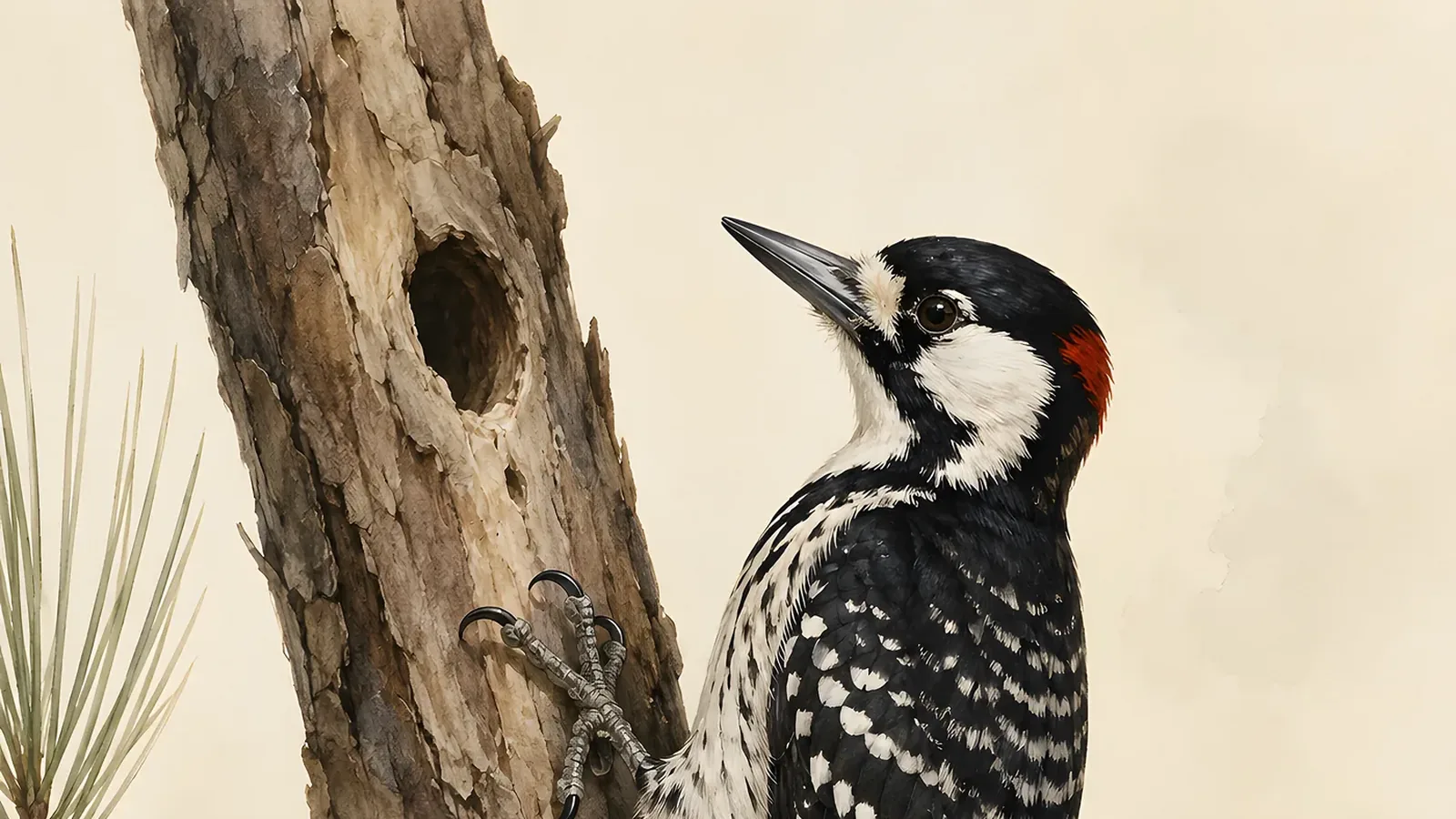
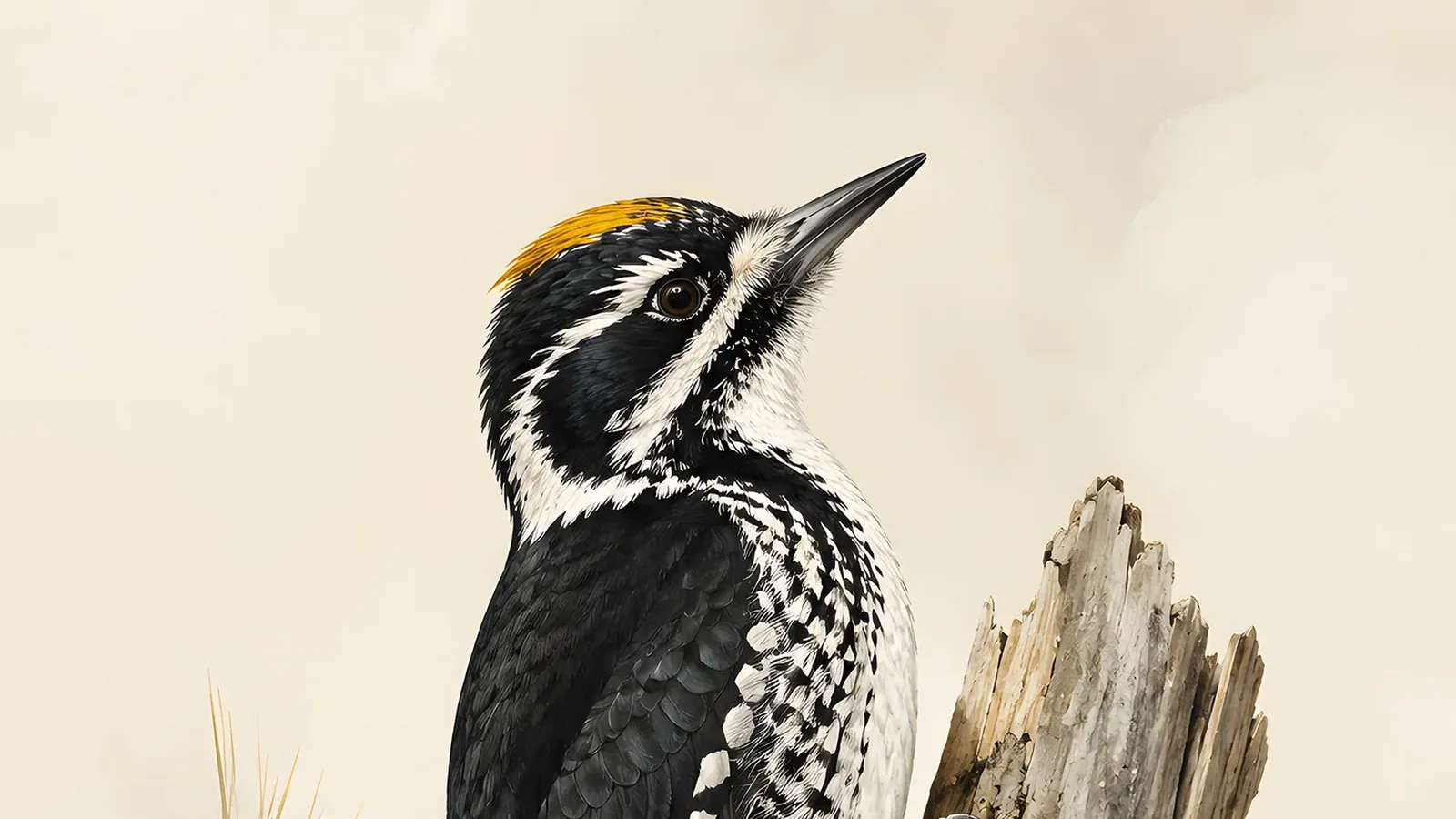
Picoides arcticus is compact and back-heavy, measuring 22 to 24 centimetres from bill to tail and weighing between 61 and 88 grams - roughly the mass of a small apple (Audubon Society field guide). The back is a single unbroken gloss of blue-black, not spotted or barred, which immediately separates it from nearly every other woodpecker on the continent. The underparts are white, the flanks carry narrow black barring, and a clean white stripe runs from the bill back along the face.
The male carries a yellow crown patch, bright and slightly forward-positioned, like a single coin pressed into the black feathering. The female shows none. Both sexes have a white supercilium stripe and a black mask that runs through the eye.
| Measurement | Range |
|---|---|
| Length | 22 - 24 cm |
| Weight | 61 - 88 g |
| Wingspan | 38 - 41 cm |
| Estimated lifespan | 6 - 8 years |
The plumage is cleanly, almost sternly, patterned. No rufous, no red (beyond the male’s crown), no brown. The bird looks designed for standing against a burned tree, which is effectively where it lives.
The bird that follows fire
No North American woodpecker is more tightly bound to a single ecological event than the Black-backed Woodpecker. Other species use burned forests opportunistically. This one makes them the centre of its existence.
The mechanism is straightforward. A wildfire kills conifers in bulk. Within months, the standing dead wood - called snag habitat - is colonised by the larvae of wood-boring beetles (family Cerambycidae and Buprestidae), which thrive in fresh, bark-covered deadwood. Picoides arcticus exploits that beetle irruption before the snags dry out or fall. The window is narrow: the bird is most productive in years two through four post-fire, when larval density peaks and bark still clings well enough to conceal prey (Nappi and Drapeau, 2009, Biological Conservation). After that the snags weather, beetles decline, and the woodpecker moves on - or not at all, in landscapes where the next fire has already opened a new patch.
The bird does not wait for conditions to stabilise. It moves toward disturbance. In this way it functions more like a specialist of ecological transition than of stable habitat - an opportunist with a very particular opportunity in mind.
“This species’ dependence on landscapes that experience regular fire and other large-scale forest disturbances is well known and exemplified by studies across its range.” - Tarbill, White, and Manley, Avian Conservation and Ecology, 2018
The great threat to this arrangement is salvage logging. After a major fire, land managers frequently remove the burned timber quickly - within the first two years, before beetle larvae can damage commercial wood value. But that window overlaps precisely with the period when Black-backed Woodpeckers are most productive. Tarbill, White, and Manley (2018) found that nest densities in salvage-logged areas declined significantly compared to unlogged burned forest. Woodpeckers persisted in retained snag patches within the logged areas, but at much lower densities. The study recommends that salvage prescriptions retain dense patches of smaller-diameter snags for foraging and larger snags for nesting cavities.
The conflict is real and ongoing, particularly in the Sierra Nevada and the northern Rockies, where post-fire timber salvage is most common. The species carries no federal protection. It is listed as Least Concern by the IUCN globally - its total estimated population sits around 1.7 million birds across an enormous boreal and montane range - but it is a species of Special Concern in Michigan, where populations are considered vulnerable. In states like the boreal forests of Minnesota and the north woods of Maine, its status is tied directly to how fire is managed in the decades ahead.
Three toes
Almost all woodpeckers have four toes. The Black-backed Woodpecker has three, an arrangement shared with its close relative the American Three-toed Woodpecker but found nowhere else in the family across its range.
The arrangement places two toes forward and one back, held slightly to the side. The conventional explanation is that losing the inner hind toe allows the bird to rotate farther back on a vertical surface before striking, producing a blow with more mechanical force than a four-toed species can generate. This matters for bark stripping, which requires lateral flicking and prying rather than straight-in percussion. The red-cockaded woodpecker and pileated woodpecker, by contrast, retain four toes and use very different foraging techniques on live and long-dead wood.
The three-toed condition in Picoides arcticus is ancient enough and stable enough across the species’ range to be considered a fixed character, not a variant. It is one of the more immediate ways to confirm an identification in the field when other marks are obscured.
What it sounds like
The primary call is a single sharp note, rendered as kyik - clipped and slightly harsh, described by the Cornell Lab as “a sharp, fast kyik.” In alarm or territorial context it extends into a rapid rattling series. The call carries well through the open snag structure of a burned forest, where the usual acoustic damping of live foliage is absent.
Drumming is rapid and even, without the double-strike pattern some species use. Both sexes drum. Males drum most intensively during territory establishment in early spring, often on resonant dead snags that project sound across a wide area. The drum is the first thing a field observer may hear in a burned stand before the bird is visible - a fast, level roll from somewhere high on a charred trunk.
Diet
The larva of the wood-boring beetle is the operational centre of this bird’s diet through most of its active season. The bird detects larvae acoustically - tapping along bark and listening for the hollow sound of a tunnel beneath - then uses its bill to pry away the outer bark and extract the grub with a barbed, sticky tongue.
In the years immediately after a fire, this can account for nearly all its foraging. As burned forest ages beyond three to four years post-fire and beetle populations drop, the bird supplements with other insects, spiders, fruit, and seeds. But the shift is not a preference - it is a response to depletion. The bird’s productivity and site fidelity both decline as the beetle bloom fades.
Foraging is systematic. A Black-backed Woodpecker will work a single snag from base toward crown, stripping bark in sequence, and return to the same tree across multiple days. Over weeks it may remove bark from the entire accessible surface of a large standing dead conifer.
Breeding
Breeding begins in late May and continues through July. Nest cavities are excavated in dead conifers, usually at heights between 60 centimetres and four and a half metres - lower than many woodpeckers, which reflects the early post-fire snag environment where taller clean snags are abundant but lower-elevation dead wood is also plentiful.
Both sexes excavate the cavity, though the male typically does the majority of the work. Clutch size is two to six eggs, with three or four being most common, and incubation runs 12 to 14 days. Nestlings fledge at approximately 25 days. The species is monogamous within a breeding season and nests once per year.
Nest-site selection within burned forest is not random. Tarbill and colleagues (2018) note that Black-backed Woodpeckers prefer larger-diameter snags for nesting than for foraging, and that they avoid areas where snag density has been reduced by salvage operations. In undisturbed burned forest, nest density can be high enough that territories overlap substantially at the edges - a density of use that has no parallel in the species’ behaviour in unburned green forest, where it occurs at very low density.
The Black-backed Woodpecker is not rare, and its conservation status does not invite alarm. But it is a species that tells you something true about fire - that wildfire is not only destruction, that the char and the fallen needles and the standing dead are an ecological phase with its own residents, its own productivity, its own logic. Suppress all fire, log what burns quickly, and the burned forest as habitat disappears. The woodpecker does not disappear with the first fire excluded. It disappears with the hundredth. That slow attrition is harder to see, and harder to reverse.