Field Guide
Downy Woodpecker
In a February woodlot somewhere in the upper Midwest, a male Downy Woodpecker is hunting the dry stems of goldenrod. He hangs upside down on a stalk no thicker than a pencil, taps once, then twice, and digs out a gall fly larva hidden inside. He weighs 21 grams. He has just found food that no other woodpecker in the county can reach, because no other woodpecker is small enough to trust a goldenrod stem with its weight.
That is the thesis of the Downy Woodpecker: smallness as competitive advantage. Dryobates pubescens is the smallest woodpecker in North America, and by most measures the most successful - found coast to coast, year-round, from the tree line in Canada to the mangrove edges of south Florida. The Audubon field guide describes the range as essentially everything that isn’t Hawaii or the arid interior Southwest. What they do not always say clearly enough is how the bird earns that range. He earns it by being able to go where his larger relatives cannot.
Identification
The Downy Woodpecker runs 14 to just under 18 centimetres in length, weighs between 20 and 28 grams, and spans roughly 25 to 30 centimetres wing to wing. These figures, confirmed by both Audubon Society records and the Cornell Lab’s network data, put him solidly in “small songbird” territory: heavier than a Black-capped Chickadee but lighter than a cardinal.
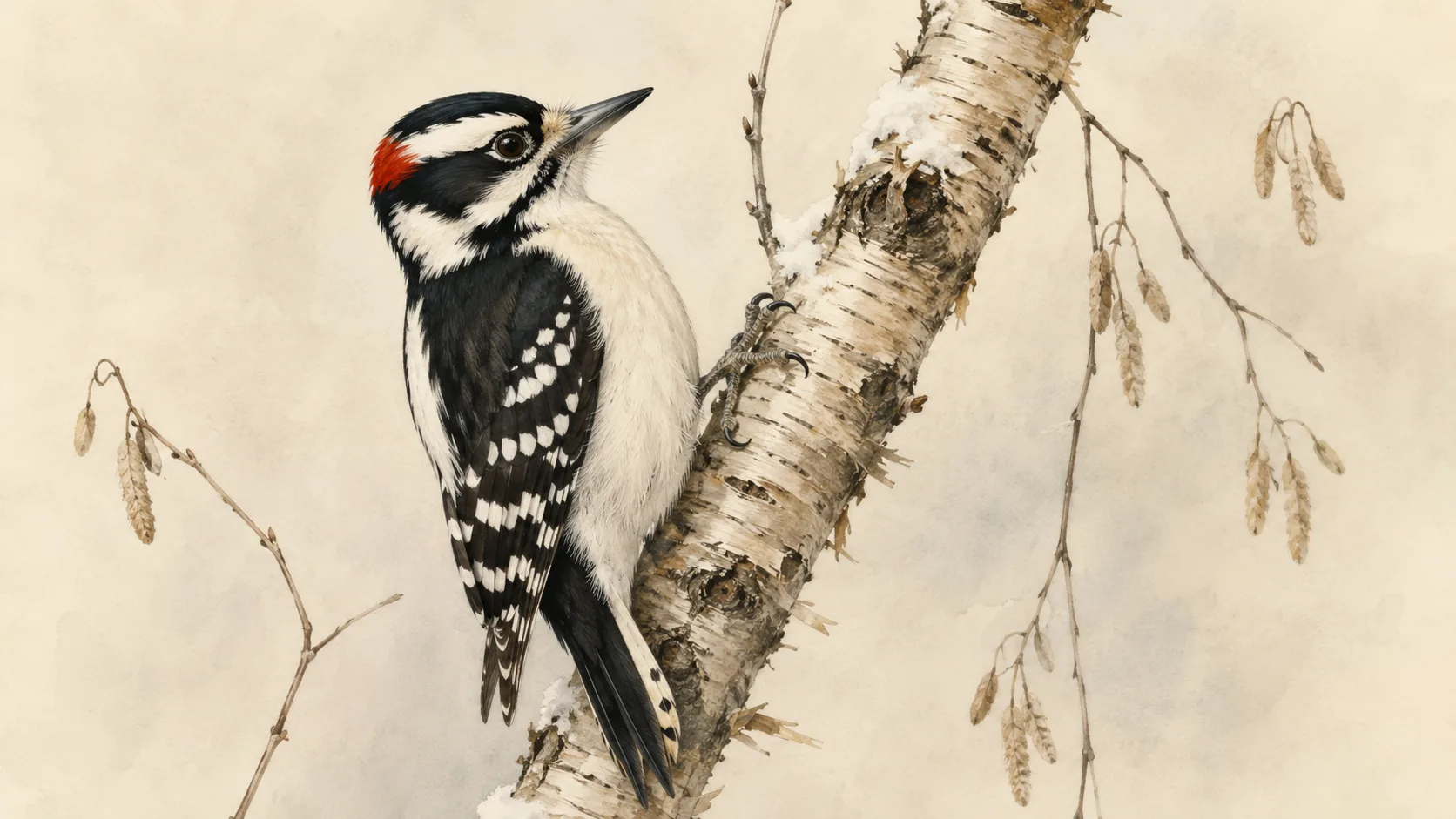
The pattern is clean and unmistakable. White underparts. Black-and-white striped face, with a white supercilium and a white malar stripe bracketing a dark eye stripe and dark moustache. Black back with a broad white stripe running down the centre. Black wings dotted and barred with white spots. Short, stubby bill - noticeably shorter in proportion than the otherwise nearly identical Hairy Woodpecker, which is the primary identification challenge.
He has a red nape patch. She does not. Otherwise male and female are identical in field conditions.
The bill is the quickest separator from the Hairy Woodpecker: a Downy’s bill is shorter than the depth of its own head; a Hairy’s is equal to or longer than the depth of its head. Size alone is unreliable without a reference object in frame.
The outer tail feathers carry black barring on white - useful when the bird fans its tail clinging to a branch end, and another point of difference from the Hairy, whose outer tail feathers are plain white.
Voice and sound
Two calls matter. The first is a sharp, clipped pik - flat in tone, given singly or in short runs, carrying a surprising distance for such a small bird. Audubon’s field guide describes it as quiet, which is relative: in winter stillness it crosses 50 metres easily. The second is a descending whinny: a rattling series of notes that drops in pitch over about a second and a half. That call, once learned, flags the species from the moment the bird lands in your hedgerow.
Drumming is territorial and communicative, performed on resonant dead wood. The Downy’s drumming rate is faster than the Hairy’s and softer - useful as a supporting cue but not reliable on its own.
Cornell’s Birds of the World notes that the sexes use different vocal and foraging strategies even when occupying the same territory: males tend toward smaller, outer branches and weed stalks, while females work larger limbs and tree trunks. This is not casual overlap. It is a measurable ecological division within a mated pair, one of the cleaner examples of within-species niche partitioning in North American ornithology.
Range and habitat
Year-round resident across most of North America. Cornell’s Birds of the World describes the range as extending from the tree line in Canada and Alaska south through the entire eastern and western United States, reaching south Florida and the riparian corridors of southern California. The species is absent from the arid interior Southwest and from Hawaii. Northernmost populations may shift south in winter, though Cornell flags these movements as not well understood - likely dispersal rather than true migration.
Habitat is broad. Deciduous and mixed woodland are the core. But the Downy also works suburban gardens, city parks, overgrown fence rows, cattail marshes, and scrubby second growth. The key requirement is woody stems and dead wood - the beetle larvae and wood-boring insects that make up the bulk of the diet concentrate where dead or dying wood accumulates. A woodlot, a row of snags along a field edge, or a patch of goldenrod in a weedy suburban corner all qualify.
Diet
Primarily insectivorous, with beetles, ants, gall wasps, and caterpillar larvae making up the core of the diet. The Downy is the species most associated with foraging on weed stems and small branches - habitat that the larger Hairy and Pileated Woodpeckers cannot exploit at all. In winter, insect sources are supplemented by seeds, berries, and suet at feeders. Suet blocks are the single most reliable way to bring a Downy into a garden.
The goldenrod foraging is not anecdotal. Audubon’s records note that the species actively targets plant galls - the larva inside a goldenrod gall is a near-certain winter meal, and the Downy is small enough to work those stems without bending them flat. It is a dietary strategy unavailable to any other North American woodpecker.
Breeding and nesting
Pairs form in late winter and begin excavating cavities in February or March. Both sexes work on the nest hole, though the male typically does more of the digging. Cavity depth runs around 20 to 30 centimetres, and the entrance hole is round, roughly three centimetres across. Dead wood is preferred - softer to work, and already beginning to decay.
Clutch size is four to five white eggs, occasionally three to six. Incubation runs approximately 12 days, shared by both parents. The male incubates at night. Nestlings fledge 18 to 21 days after hatching, both parents bringing insects to the nest in the final days before fledging. Audubon records one brood per year as the norm, with two possible in southern parts of the range.
The nest hole is not a permanent installation. A new cavity is excavated each year. Abandoned Downy holes are then used by other cavity-nesting species - Black-capped Chickadees, House Wrens, small owls - making the Downy an inadvertent housing provider for birds that cannot excavate wood at all.
The winter flock
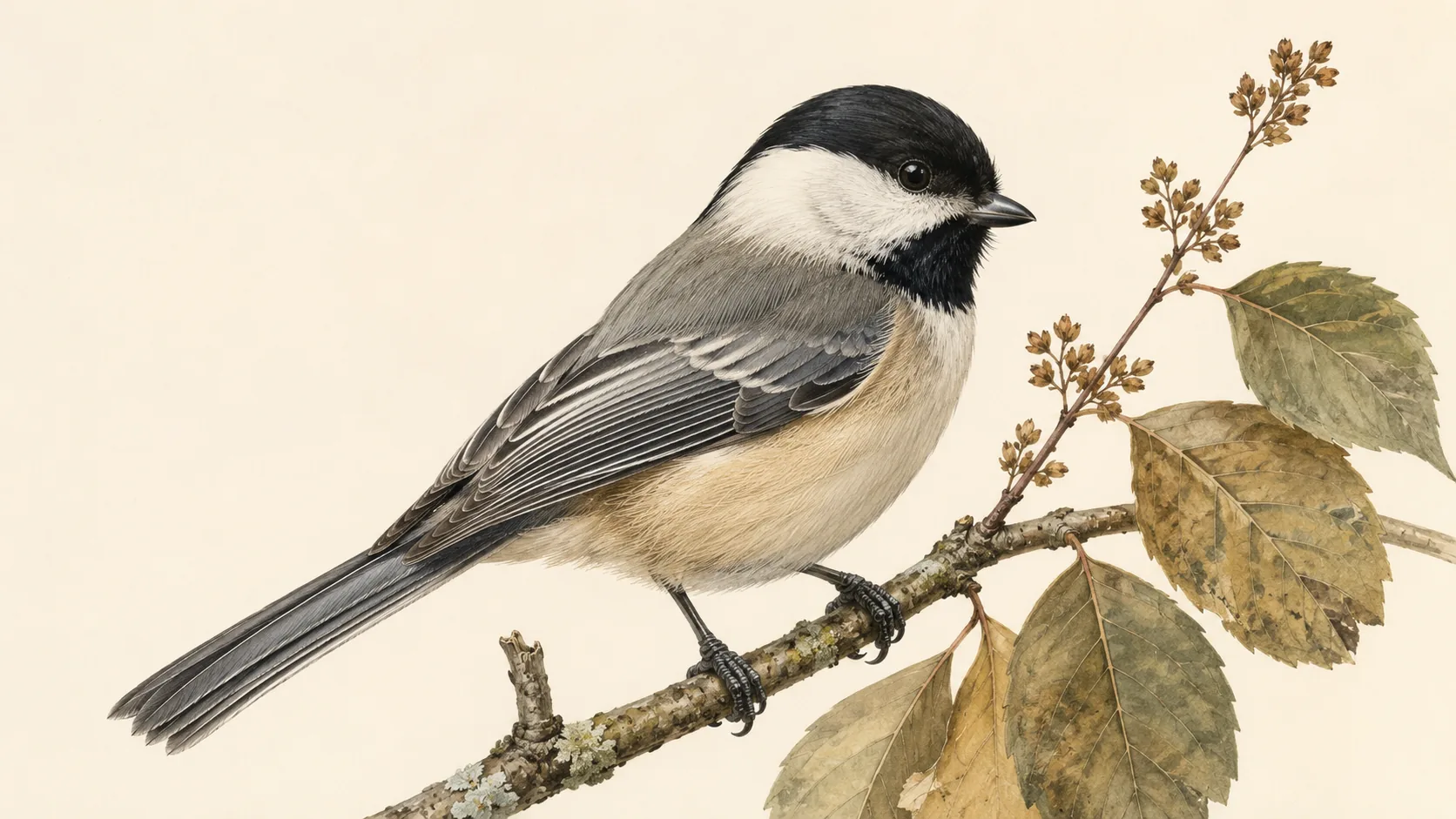
From October through March, Downy Woodpeckers regularly join mixed-species foraging flocks: small travelling groups of Black-capped Chickadees, White-breasted Nuthatches, and occasionally titmice that move through woodland together and collectively cover more ground than any single species could alone. The Downy is a near-constant member of these flocks across the northern half of its range.
The arrangement is not altruism. Each species forages differently - the chickadee takes insects from leaf clusters, the nuthatch works bark downward from above, the Downy hammers dead wood and stems - so competition is minimal. The shared benefit is early detection of predators: more eyes, more alarm calls, and the Downy’s pik call carrying its own warning value when it stops abruptly.
Lifespan
Most Downy Woodpeckers do not live long. Natural mortality from predation and winter exposure keeps typical lifespans to two to five years. But banding records documented by the USGS Bird Banding Laboratory show that the species can reach well beyond that. The longest-lived known individual, a California male, was recaptured at 11 years and 11 months. A New York female reached 11 years and five months. These are outliers, but they are real, and they suggest that in benign conditions the bird is more durable than its small frame implies.
The IUCN lists the Downy Woodpecker as Least Concern, with no evidence of population decline. Partners in Flight estimates a global breeding population of approximately 14 million individuals. The population appears stable and the species has benefited from suburban woodland expansion across eastern North America over the past half-century.
The goldenrod stem matters. Not because it is a charming detail, but because it is the key to understanding why this bird is everywhere and its relatives are not. The Hairy Woodpecker is bigger, louder, and more powerful. The Pileated Woodpecker excavates cavities the size of a brick. Neither of them can hang inverted on a stem that bends under a sparrow’s weight and eat what is inside it. The Downy Woodpecker can. In North American ornithology, that narrow capability turned out to be worth a continent.