Field Guide
Red-bellied Woodpecker
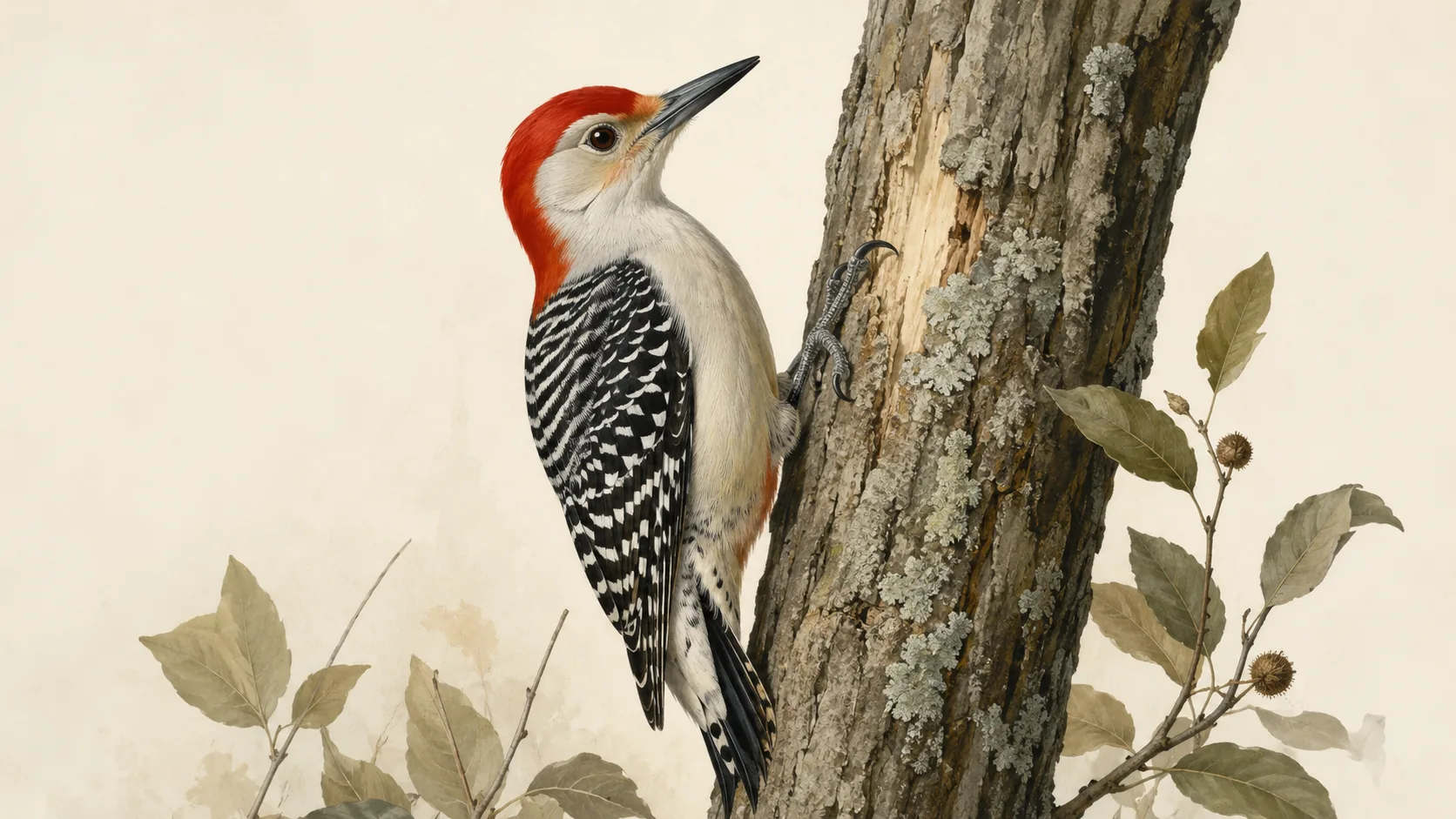
The name is one of ornithology’s small injustices. There is red on this bird’s belly, a faint wash of it, but the belly is pressed against bark most of the time and the wash is the last thing anyone sees. What you see is the back. A Red-bellied Woodpecker climbing an oak trunk in a Georgia bottomland looks like it has been painted in black-and-white ladder rungs from nape to tail, and then someone has poured flame-red over its head. Birders call the back pattern a zebra back. It is the field mark the name should have been built on.
The bird is loud about being there. A rolling churr rolls out of the canopy, then a sharp cha-cha-cha, and the whole performance carries through bare winter woods the way the Carolina Wren’s does, which is to say further than a bird this size has any business projecting. Melanerpes carolinus is not a shy woodpecker. It is a conspicuous one that has spent the last hundred years moving north into gardens, and it would like you to know it has arrived.
What he looks like
The back is the signature: fine, even black-and-white barring running the length of the upperparts, crisp enough that the bird seems to glow in flight when the white flashes open. The underparts are a clean pale grey-buff, and low on the belly sits the namesake patch, a smudge of rose-red that is genuinely hard to see in the field.
The head settles the sex. On the male, a band of bright red runs in an unbroken sweep from the base of the bill back over the crown and down the nape. On the female, the crown is plain grey and only the nape carries the red, leaving a grey cap with a red collar behind it. Both sexes share a small red blush at the base of the bill. Juveniles are duller, with a brown-grey head and no red until their first moult.
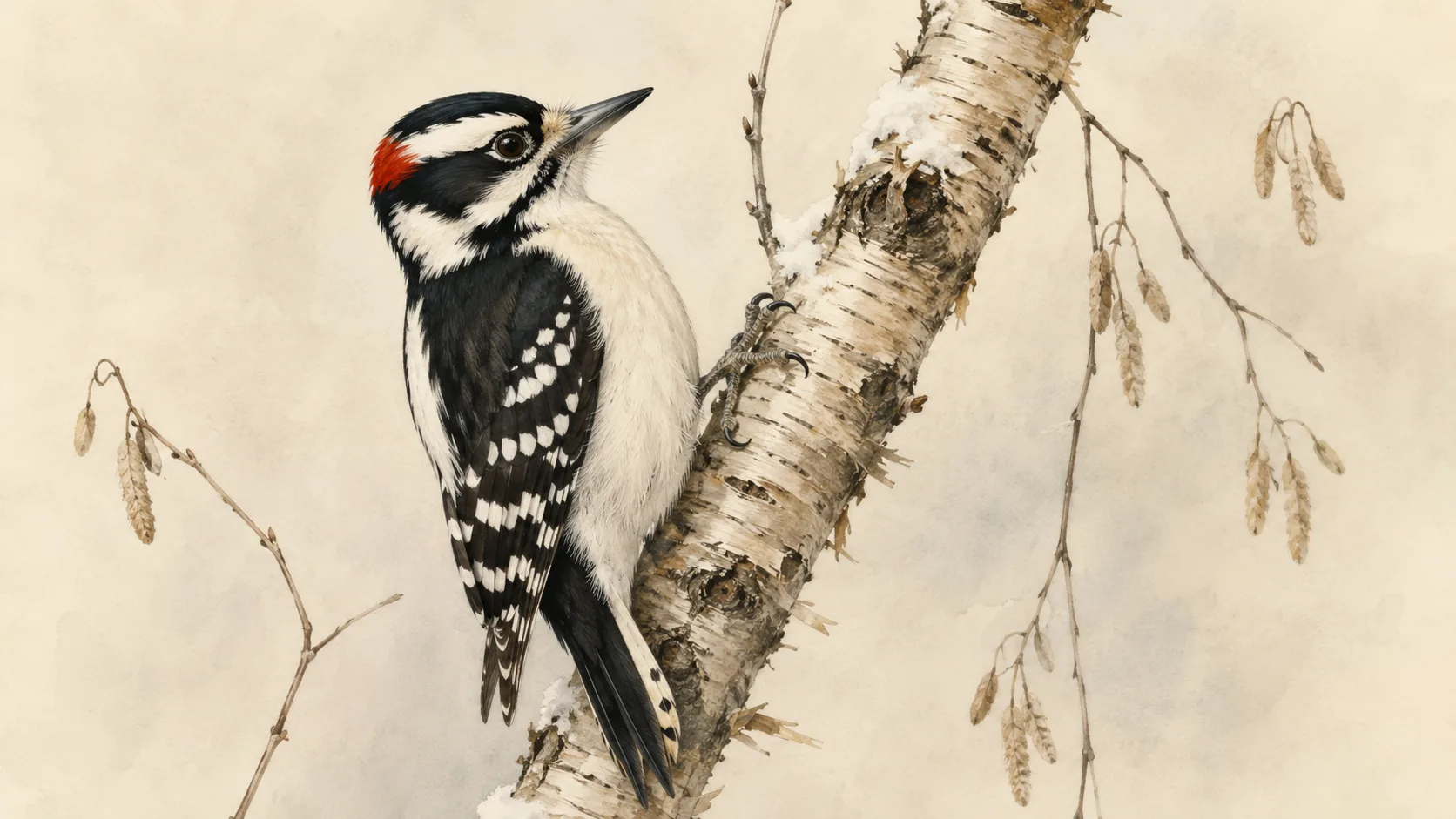
The silhouette is pure woodpecker: a sturdy, chisel-tipped bill, a stiff propping tail, and the upright, trunk-clinging posture of a bird built to work vertical wood. At 24 centimetres, Cornell Lab puts it at roughly robin size, larger and longer-billed than the Downy Woodpecker that shares its feeders, smaller and tidier than the crow-sized Pileated Woodpecker that shares its woods.
What he sounds like
The voice is the reason you find this bird before you see it. The common call is a rolling, resonant churr or quirrr, delivered from high in the canopy and easy to mistake, on first hearing, for something larger. Close behind it comes a staccato cha-cha-cha, often given in a string, harder and more urgent than the churr.
Both sexes call year-round, and the calls carry social weight beyond simple alarm. Birds of the World describes pairs keeping in contact across a territory with these notes, the churr working as a kind of running announcement of presence and ownership. In the breeding season the calling tightens up around the nest tree and around disputes over cavities.
Drumming is the other half of the voice, and it is not song so much as percussion. The male hammers a steady roll against a resonant dead limb, a hollow stub, sometimes a metal gutter or chimney flashing that amplifies him beyond anything the woods could offer. The drum is territory and courtship at once. A bird that has found a good sounding board will return to it day after day.
Range and habitat
The Red-bellied Woodpecker is a bird of the eastern and central United States, resident from the Gulf Coast and Florida north through the Atlantic and Midwestern states and west onto the edge of the Great Plains. It does not truly migrate. Audubon notes that northern birds, at the cold leading edge in places like Michigan, may shift south in severe winters, but a pair holding a patch of riverside hardwood is, for the most part, a pair you can expect to find there in every month of the year.
The northward push is the headline of this bird’s recent history. Over the past century the species has expanded its breeding range steadily north, and the Cornell-run Breeding Bird Survey records the population climbing at roughly 0.8 per cent a year from 1966 to 2019. Backyard feeding and maturing suburban woodland have carried it into places that were once beyond its reach.
Preferred habitat is deciduous and mixed forest, and it leans toward the damp: bottomland hardwoods, river floodplains, wooded swamps. It also takes readily to orchards, pinewoods, and suburban gardens with mature shade trees and a feeder, which is where most people now meet it.
Diet
This is one of the broadest diets in its family. Audubon records that plant material can make up more than half the food at some seasons, which is high for a woodpecker. Acorns, beechnuts and other hard mast, wild and cultivated fruit, and seeds all feature heavily alongside the expected insects.
The animal half of the diet is taken in classic woodpecker fashion, prised and probed from bark and dead wood, and here the bird carries an extraordinary tool. Cornell Lab documents that a Red-bellied Woodpecker can extend its tongue nearly two inches past the end of its bill, the tip barbed and the saliva sticky, so that it can spear and haul out prey from deep in a crevice it cannot otherwise reach. Beetles, ants, caterpillars, and grasshoppers go this way; so, on occasion, do tree frogs, small lizards, and the eggs or nestlings of other birds.
It is also a hoarder. The bird wedges acorns, nuts and kernels into bark furrows, fence posts and crevices, packing them in tight and returning to them through winter. At feeders it takes suet, peanuts and sunflower seed, and much of what it carries off does not get eaten on the spot. It gets stored.
Breeding and nesting
The nest is a cavity, excavated by both sexes in dead wood, a snag, a dead limb, or the rotting heart of a living tree, usually well up the trunk. The male typically does most of the chiselling and often initiates the site, sometimes drumming from a chosen tree to draw the female in.
The female lays two to six white eggs onto the bare floor of the cavity. Cornell Lab gives an incubation period of about twelve days, shared by both parents, with the male characteristically taking the night shift on the eggs. The young are fed by both adults and leave the nest around 24 to 27 days after hatching, then continue to be fed for weeks after fledging. Northern pairs raise a single brood a year; in the warm south, two or three broods in a season are normal.
The cavity is also the bird’s great vulnerability. European Starlings, themselves cavity nesters and aggressive ones, routinely seize freshly excavated woodpecker holes, and Red-bellied Woodpeckers lose a meaningful share of their nest sites this way. A pair may chisel out a cavity only to be evicted from it before they ever lay.
The behaviour worth watching
Watch the tongue. It is the thing this bird does that nothing at your feeder does, and once you know to look for it you start to see the whole animal differently. The Red-bellied Woodpecker is not just hammering wood. It is reaching into it.
That tongue is anchored by a long, looping bone-and-tissue apparatus, the hyoid, that wraps up and over the back of the skull, and it lets the bird probe a depth its bill could never reach. Pair that reach with the barbed, glue-tipped end and you have a creature that can hunt by feel inside dead wood, hooking grubs out of galleries it has only heard or sensed. The drumming, the excavating, the storing of acorns in bark, the long red tongue flicking into a crevice: it is all one trade, practised on vertical wood, by a bird that has quietly decided your neighbourhood counts as forest.
The red belly gave it a name. The zebra back gives it away. The two-inch tongue is what actually keeps it alive.
That is the bird worth watching. Not the faint blush it was named for, but the working animal underneath it: loud, adaptable, spreading north, and equipped with a piece of anatomy that turns a tree trunk into a larder.