Field Guide
Cerulean Warbler
High in the canopy of a West Virginia ridge-top oak, sixty feet off the ground, a male Setophaga cerulea is singing. You will not see him without effort. He is working the outermost leaves in broken morning light, a flicker of cerulean against green shadow, and the song reaches you before the bird does - a buzzing, ascending spiral that climbs toward a sharp terminal note and then stops. Below him, on the same slope that gives way to creek-bottom sycamore, a coal seam runs through the bedrock. On the eastern slope of the Andes, 3,700 miles south, a farmer is deciding whether to cut the old shade trees on his coffee plot and switch to full-sun varieties. The warbler is caught between those two decisions, and it has been losing ground to both for sixty years.
The cerulean warbler - Setophaga cerulea, family Parulidae - is the fastest-declining Neotropical migrant songbird in North America. Cornell Lab’s All About Birds documents a 70 percent population drop since the 1960s based on Breeding Bird Survey data. The current population stands near 530,000 individuals, a fragment of what once moved through the eastern hardwood forest. The bird is IUCN-listed as Vulnerable (VU).
What he looks like
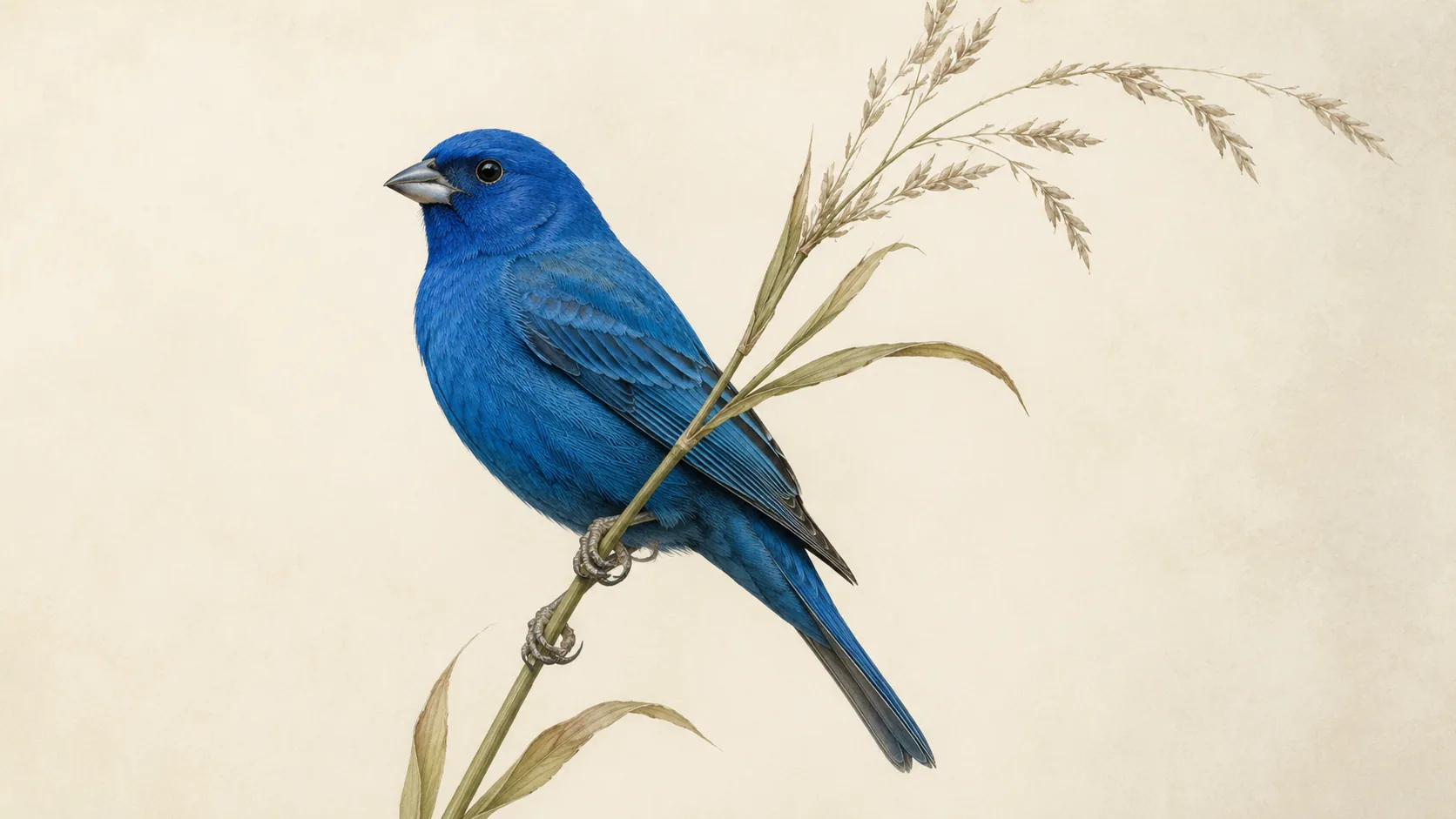
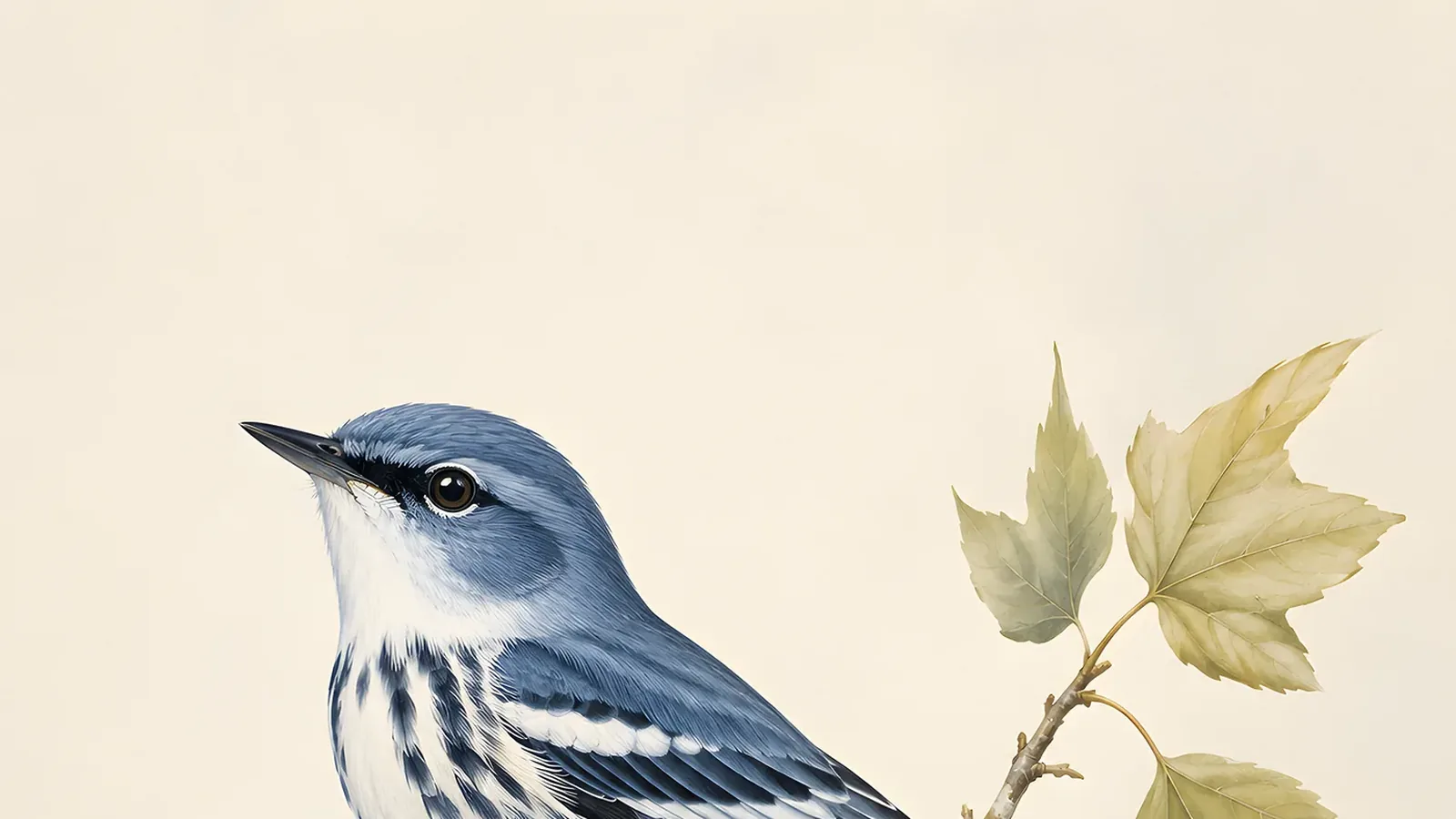
The male is small and perfectly coloured for disappearing into sky. The back is pure cerulean blue, the blue of a cloud gap on a cold morning. The underparts are white, crossed by a dark blue-black “necklace” across the breast that gives him a formal, compressed look. Down the flanks run dark streaks, fine and parallel. He is 11 to 12 cm long, 8 to 10 g, with a wingspan of 19 to 21 cm - roughly the size and weight of a large moth.
Two white wing bars. White spots in the tail. A short, sharp bill built for picking insects off leaves.
The female is quieter in every sense. Her back runs blue-green rather than true blue, her underparts wash to pale yellow, and a pale eye stripe softens the face. Both sexes carry those wing bars and tail spots. Females are frequently misidentified. The eye stripe is the diagnostic mark.
Older males tend to run larger than younger ones. The species shows age-related size variation within an already small frame.
What he sounds like
The song is buzzy, metallic, accelerating. Rendered phonetically by Cornell Lab’s recordings as something close to zray zray zray zray zeeee, with the final note climbing sharply and then cutting off. There is a compressed urgency to it, as if the bird is aware that time is short.
The call is a quick, buzzy zzee. Short enough to miss. Males use song for territory and mate attraction, and they are vocal through the breeding season, but they work high enough in the canopy that the source is often hard to fix. The sound comes from above, echoing off leaves, and the bird is already somewhere else.
Range and the two forests he needs
| Measurement | Value |
|---|---|
| Length | 11 - 12 cm |
| Weight | 8 - 10 g |
| Wingspan | 19 - 21 cm |
| Breeding elevation | ridge tops, mid-slope hardwood |
| Wintering elevation | 500 - 2,000 m (Andes slopes) |
| Migration distance | over 5,000 km each way |
The breeding range covers much of the eastern United States, from southern Tennessee to southern Ontario, bounded west by the Great Plains and east by the coast. The Appalachian Mountains - specifically the Cumberland Plateau and Ohio Hills, running through the mature forests of West Virginia, Kentucky, Ohio, and Tennessee - hold the majority of breeding pairs. These are birds of large, unfragmented mature deciduous forest: elm, maple, oak, birch, hickory in multi-layered canopy. They require forested tracts exceeding 700 hectares for stable breeding populations, according to territory studies summarized in Cornell’s Birds of the World account. Territories average two hectares. The birds nest at height - 15 to 90 feet up on horizontal branches, over clear space, away from vertical structure below.
The wintering range is the eastern Andes slope, from Colombia and Venezuela south to Bolivia, at elevations between 500 and 2,000 meters. Research led by Douglas Raybuck, deploying geolocator loggers on 257 male warblers across 13 US sites between 2014 and 2017, documented that 93 percent of Appalachian breeders winter in the Colombian and Venezuelan Andes, with 80 percent specifically in Colombia. Ozark breeders track differently, wintering further south in Peru and Ecuador. These are not general forest birds in winter. They prefer tall old-growth subtropical forest and - critically - traditional shade-coffee plantations where native trees persist above the coffee. When those trees go, the warblers go with them.
Migration covers more than 5,000 km each way, routed overland through Central America in spring, crossing the Gulf of Mexico at the Yucatan Peninsula. Autumn migration may cross the Caribbean directly from Florida. Stopovers last two to 18 days per location. Total migration runs 40 to 70 days.
Diet
He feeds almost entirely on insects: caterpillars and other lepidopteran larvae, supplemented with winged insects taken in flight. He gleans from leaves and twigs across the mid to high canopy. Males forage roughly two meters higher than females within the same stand of trees, a division documented consistently across field studies. The thin bill is precise. He works the outer leaves where prey density is highest and where most observers cannot follow him.
Breeding
The nest is built by the female over about seven days: a shallow open cup of bark strips, grasses, and lichens, bound together with caterpillar silk and spider thread. It sits on a horizontal branch high in the canopy, typically shaded, over open space. The clutch is three to five eggs, laid over approximately seven days. The female incubates alone for 12 days. Both parents provision the nestlings, which fledge after about 11 days and reach independence roughly 12 days after that. One brood per year. The survival rate during the fledgling period runs 34 to 62 percent across documented cohorts.
Compare this to the prothonotary warbler, another Neotropical migrant facing habitat pressure, but one that nests in cavities at water level: the cerulean’s exposure in the high canopy makes it particularly vulnerable to forest fragmentation that removes the large overstory trees entirely.
What he is for - the decline
The cerulean warbler is not declining because of a single cause. It is declining because the two places it needs - Appalachian ridge tops and Andean cloud forest slopes - are being removed from the same global economy that drives both coal extraction and commodity agriculture.
The Breeding Bird Survey, running since 1966, has tracked the cerulean across its range. Cornell Lab’s analysis shows an estimated two percent annual decline between 1966 and 2023, compounding to a cumulative loss of approximately 68 percent over that period. Other analyses of the BBS data, including a period-specific study of 1966 to 2007, found annual declines closer to 4.1 percent per year. The species has been described, by the American Bird Conservancy and others, as the fastest-declining Neotropical migrant in North America.
On the breeding grounds, the mechanism is not hard to follow. Ceruleans require large contiguous blocks of mature forest on steep ridges and ridge tops. A 2002 Biological Resources Division study found that 92 percent of breeding territories occurred only in fragments with ridge-top habitat intact. Mountaintop removal coal mining - the practice of blasting ridge tops to access underlying seams, practiced extensively across West Virginia, Kentucky, Tennessee, and Virginia - targets precisely those elevations. A multi-agency study of mountaintop mining in four states found that between 1992 and 2012, more than 1.4 million acres of Appalachian forest were lost, more than half from this single extraction method. Reclaimed mine sites are seeded with grasses. Compacted overburden prevents forest succession for decades. The ridge tops that ceruleans need do not come back on any timeline relevant to a bird population already at 30 percent of its historical size.
On the wintering grounds, a different economics operates. The Andean slopes at 800 to 2,000 meters elevation are ideal for human settlement and agriculture. Traditional shade-coffee cultivation - growing coffee beneath a canopy of native trees - maintained functional forest structure that the birds could use. As world coffee prices fluctuated across the 1980s and 1990s, growers converted shade plots to higher-yield sun monocultures, removing the overstory. Appalachian History’s account of the period estimates that 40 to 50 percent of shade-coffee plantations in the species’ wintering range were converted in this period. The warblers that survived the summer found the winter quarter shrinking.
The American Bird Conservancy and Colombia’s Fundacion ProAves established the Cerulean Warbler Bird Reserve in 2008 - described at the time as the first protected area created specifically for a Neotropical migrant. The initiative has since protected more than 40,000 acres across eight reserves in Colombia, and coordinated reforestation on private coffee and cocoa farms involving more than 220 landowners and 500,000 native seedlings. The reserves occupy the narrow elevation band where the birds actually winter. They are real. They matter. They are also a response to a problem that continues at a scale they cannot match alone.
The cerulean warbler is, in miniature, the test case for whether conservation can bridge the full life-cycle of a migratory bird: breeding ground, migration corridor, wintering ground, all three simultaneously degraded, all three requiring coordinated action across governments, land-use systems, and commodity markets. The bird itself asks nothing of us. It sings from the canopy, works the outer leaves, and migrates more than 5,000 km twice a year with nine grams of fuel. The question it poses is whether we can hold together the two distant forests it has always needed - not for sentiment, but because the answer will tell us whether any migratory songbird that links two continents can survive an economy that treats both as extraction zones.