Field Guide
Greater Prairie Chicken
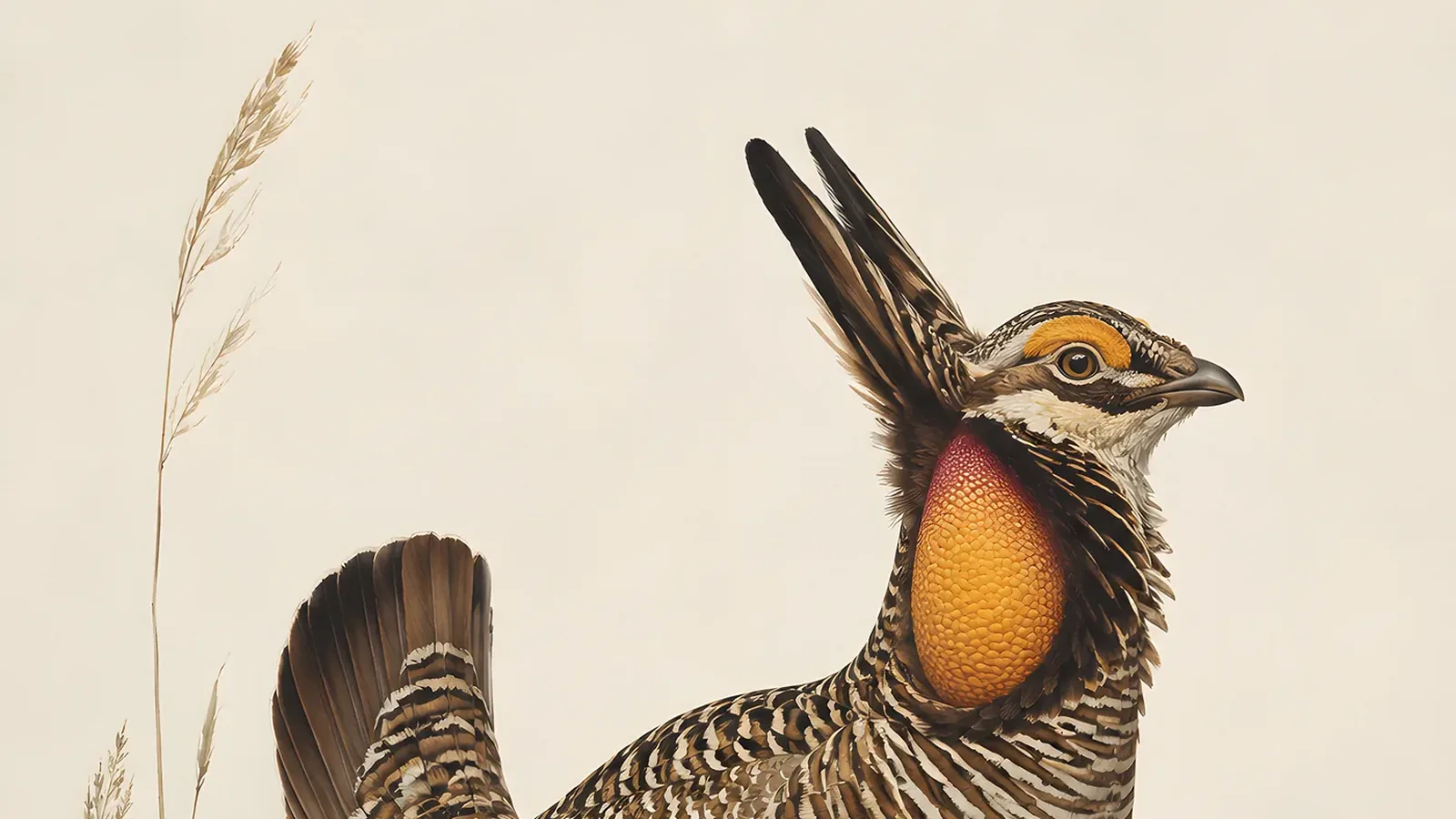
Before the light reaches the grass, the males are already on the ground. A flat ridge in the Flint Hills of Kansas, the dew still heavy on the bluestem, and eight or ten Tympanuchus cupido have taken their positions on a hilltop clearing no larger than a tennis court. Each one stamps his feet in rapid tattoos against the earth. Each one erects two short, dark ear-tufts - pinnae - straight up from his crown. Then the orange sacs inflate along either side of his neck, round and taut as small fruit, and the bird tips forward and releases a sound that carries more than a mile across the open plain.
The boom is low, hollow, unmistakably alive. It rolls out of the chest of a two-pound bird and travels so far that the first-time listener cannot place it. It seems to come from the ground itself.
This is the lek, and it has been running here, or somewhere close to here, for thousands of years. The question now is how much longer.
What it looks like
The Greater Prairie Chicken is a compact, round-bodied grouse: 41 to 48 centimetres long, weighing 750 to 1,300 grams, with a wingspan of 61 to 71 centimetres. Both sexes are strongly barred in brown and buff, with white barring on the flanks and a paler, spotted belly. The pattern is designed for grass. A bird crouching motionless in native tallgrass is nearly impossible to find by eye.
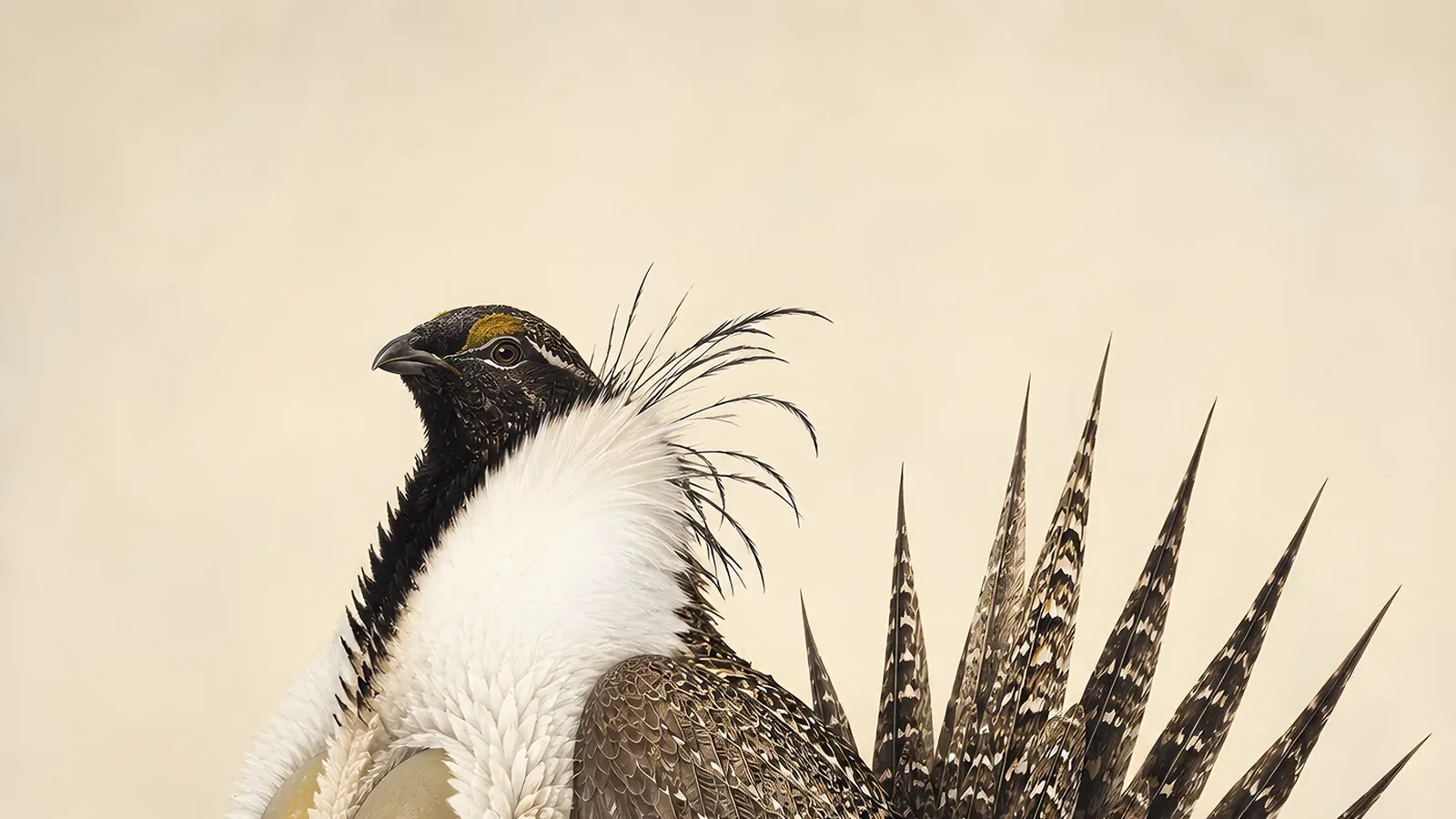
The male carries the distinctive extras. The pinnae - elongated dark feathers above each eye - rise in display and lie flat at rest. The orange-yellow skin patches above each eye, called supraorbital combs, flush and enlarge when he is agitated. The tympani - the inflatable air sacs at the sides of the throat - are orange in the Greater Prairie Chicken, distinguishing him from his close relative the greater sage-grouse, whose sacs are yellowish-white. A short tail, rounded wings, and short dark bill complete the picture. In flight the bird is fast and direct, with alternating bursts of wingbeats and glides.
The female is nearly identical in plumage but lacks the pronounced pinnae, has smaller combs, and holds no air sacs. Her camouflage is her primary defence.
| Measurement | Range |
|---|---|
| Body length | 41 - 48 cm |
| Weight | 750 - 1,300 g |
| Wingspan | 61 - 71 cm |
| Lifespan (wild) | 2 - 5 years |
The booming ground
The lek is the centre of the Greater Prairie Chicken’s year. Males arrive at traditional booming grounds in late February or early March, before most grassland plants have broken dormancy. They return to the same hilltop patches, season after season, compelled by a territorial logic that precedes any individual bird’s birth.
A typical lek holds eight to 20 males. Dominant males hold the central territories - the highest ground, the most visible positions. Subordinate males occupy the edges and rarely mate. According to Cornell’s All About Birds, exceptional leks can hold up to 70 males at once. The competition for central position is continuous and sometimes violent: males charge, leap, and flutter into each other with locked feet, though most encounters resolve through display alone.
The display itself runs in sequence. The male droops his wings, fans his short tail upward, erects his pinnae, inflates the tympani, and stamps his feet in rapid bursts. Then the boom, produced by air passing across the syrinx and resonating through the inflated sacs. It is not a single call but a series of three-note phrases repeated for hours. The Nature Conservancy notes that the sound can carry over a mile on a still morning, which means a lek of active males creates an acoustic beacon audible long before the birds are visible.
Females move through the lek and make their choices. Most matings happen with two or three central males. Dominant males may account for 90 percent of copulations in a season. The female then departs to nest alone. The males continue booming until early May, when the grass grows tall enough to conceal the ground and the acoustic advantage of bare ground is lost.
What it sounds like
The boom is the diagnostic call, but it is not the only one. The full repertoire includes cackles, clucks, and high whinnying notes produced during aggressive encounters. Flushed birds give a sharp cackle on takeoff. Females use soft clucks to communicate with newly hatched chicks.
The three-syllable boom - often written as “oo-loo-woo” - is distinctive enough that experienced birders have identified Greater Prairie Chickens by ear from distances at which binoculars are useless. It is one of the defining sounds of the northern Great Plains in early spring.
Range and habitat
The species once occupied tallgrass and mixed-grass prairie from southern Canada through the Great Plains into Louisiana and the Gulf Coast. That range has collapsed. Audubon’s field guide places the current core breeding population in Kansas, Nebraska, and South Dakota, with smaller populations in Missouri, Oklahoma, Minnesota, Wisconsin, and a few other states.
Missouri’s prairie-chicken population holds on across a few managed grassland areas. Wisconsin’s numbers fell from an estimated 55,000 birds in 1929 to 649 males counted in 1998, according to state wildlife surveys, though 2025 monitoring recorded 307 males on booming grounds - the highest count since 2007. Illinois, which biologists estimate once held around ten million prairie chickens in 1860, documented fewer than 200 individuals by the early 2000s.
The habitat requirement is non-negotiable: large, unbroken native tallgrass prairie with short-grass patches for lekking, tall grass for nesting, and shrub edges for winter cover. The birds need all three within a few kilometres of each other. Fragmented parcels are effectively useless. The Cornell Lab of Ornithology identifies loss of native habitat as the single greatest threat to the species.
Individuals are year-round residents in their core range, though some birds move up to 160 kilometres seasonally between breeding and wintering areas.
Diet
The diet shifts with the season. In winter, Greater Prairie Chickens rely on seeds, waste grain from agricultural fields, dried berries, and - historically, where oaks were present - acorns. Foraging flocks work stubble fields in cold weather, sometimes gathering in numbers at corners where machinery missed grain.
In summer, green leaves, buds, and insects replace the winter staples. Grasshoppers and beetles are important protein sources from June through August. Chicks eat almost exclusively insects in their first weeks - the protein load drives early growth and thermoregulation. An adult bird eating insects in July and eating waste corn in January is using the same body in two completely different metabolic modes.
Breeding
Females nest on the ground in dense grass, sometimes within 500 metres of the lek, sometimes farther. The nest is a shallow scrape lined with grass and a few feathers. A typical clutch runs ten to 12 eggs, olive to pale buff and finely spotted with brown. Incubation takes 23 to 25 days, carried out by the female alone. The male has no role after mating.
Chicks are precocial - on their feet within hours of hatching. They can make short flights at two weeks and stronger flights by three weeks. They stay with the female for approximately three months. First-year survival is low. A cold, wet May or June can collapse reproduction across an entire region for that season.
Males reach breeding condition in their first spring. Most wild birds live two to five years.
What is left
The story has a harder edge, and it runs through three subspecies.
T. c. cupido, the Heath Hen, inhabited the barrens and shrubby coastal plains of the northeastern United States. By 1870 it had been eliminated from the mainland, with a remnant population holding on at Martha’s Vineyard, Massachusetts. The island birds recovered briefly to several hundred in the early 1900s under protection, then a catastrophic 1916 wildfire reduced them to 150, most of them male. Disease, inbreeding, and predation did the rest. Professor Alfred O. Gross of Bowdoin College, who monitored the last birds through the 1920s, recorded the final individual - a solitary male ornithologists called Booming Ben - as last sighted on March 11, 1932. Gross wrote in 1931 that the Heath Hen’s extinction should “serve as a warning of what may happen to other game birds.” It did not warn quickly enough.
T. c. attwateri, the Attwater’s Prairie Chicken, clings to a handful of coastal Texas prairies. The U.S. Fish and Wildlife Service lists it as Endangered. Captive breeding programs at the Houston Zoo and other facilities have kept the subspecies from immediate extinction, but wild populations have proven desperately fragile: a single hurricane season can erase years of recovery effort.
The nominate subspecies, T. c. pinnatus - the bird on the Kansas lek at dawn - holds the largest population at an estimated 360,000 individuals, and the IUCN lists it as Near Threatened. The category reflects what the numbers do not fully show: a species whose global estimate fell from 1,079,000 birds in 1968 to approximately 391,000 by 1997, according to survey data compiled by the Cornell Lab. Over 95 percent of the native tallgrass prairie that once ran from Indiana to the Gulf has been converted to row crops. What remains is mostly the rocky, thin-soiled ground that was too difficult to plow.
“The bird presented a pathetic figure as it stood out there all alone.” - Alfred O. Gross, Bowdoin College, describing the last Heath Hen, 1932.
The Flint Hills of eastern Kansas survive largely because the chert-laden soil resisted the moldboard plow. That geological accident is now the reason Kansas holds the continent’s most important Greater Prairie Chicken population. The bird’s fate, and the landscape’s, have always been the same thing. One is not separable from the other.
Booming Ben disappeared into the shrubby farmland of Martha’s Vineyard in March 1932 and was never seen again. On a Kansas ridge this spring, before the light reached the bluestem, eight males were already stamping their feet.
That eight is not ten million. But it is still something.