Field Guide
Greater Sage-Grouse
The light has not reached the basin yet. In the sagebrush flats of Wyoming, at an elevation where April nights still drop below freezing, a dozen Centrocercus urophasianus have arrived on the lek before dawn. They come as they have always come - out of darkness, on foot, moving toward a piece of flat ground their ancestors have used for longer than any record exists. Each male takes a position. Each male begins.
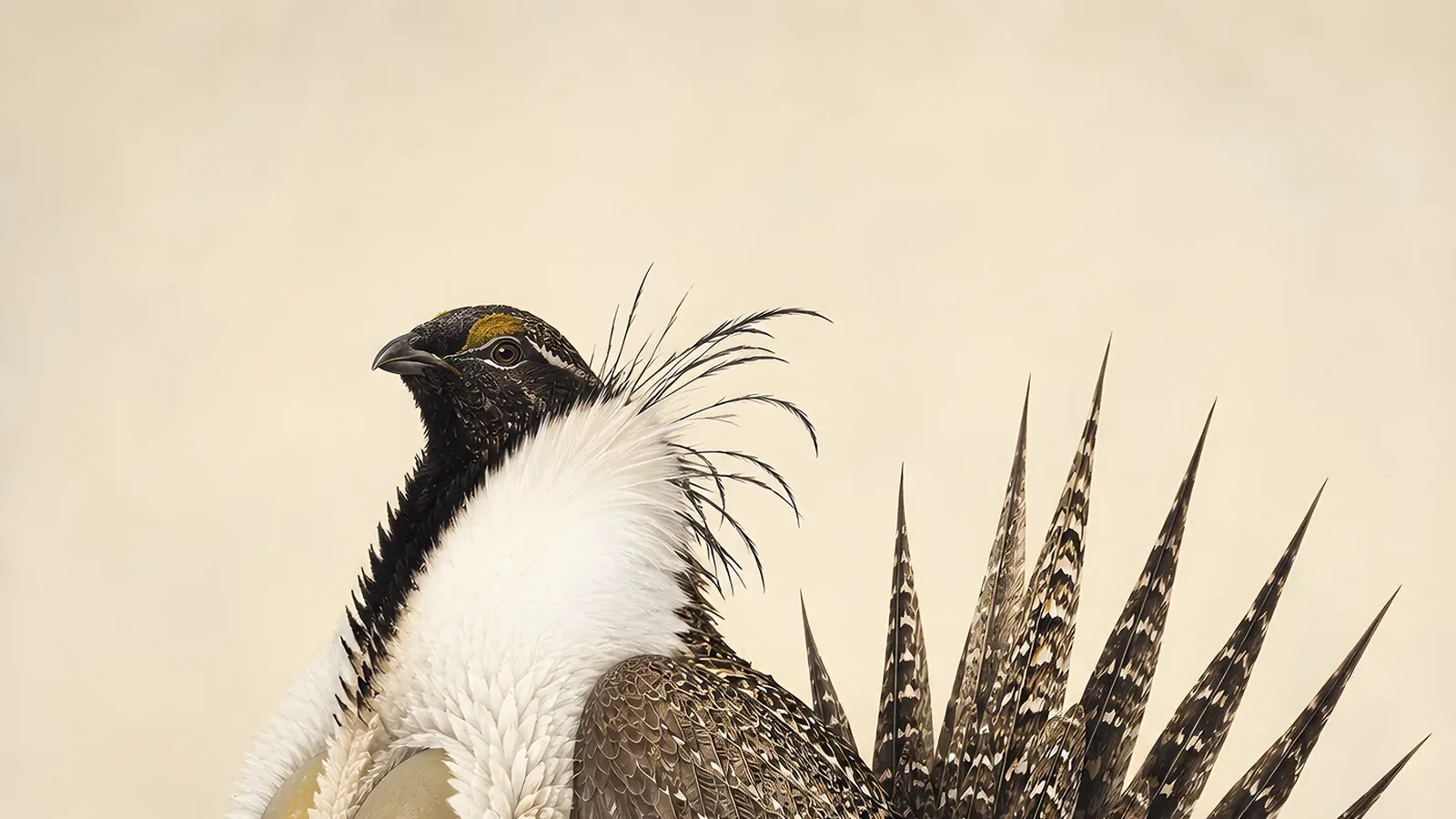
First the wing-swish: primary feathers raking across the stiff, scale-like breast feathers in a sound like a brush dragged across a drumhead. Then the chest swells forward, the spiky tail fans upward and outward into a sunburst of 20 stiffened retrices, and the two yellowish-green air sacs along the esophagus inflate until they stand out from the white breast ruff like a pair of small balloons. The bird tips forward, compresses the sacs, and releases them. A resonant double pop - somewhere between a plonk and a boom - rolls out into the cold air. It can carry two miles across an open basin.
The Greater Sage-Grouse is the largest grouse in North America. It is also a bird that cannot survive without a single plant species. Whether those two facts matter to the future depends on whether enough of the sagebrush west survives what is coming.
What it looks like
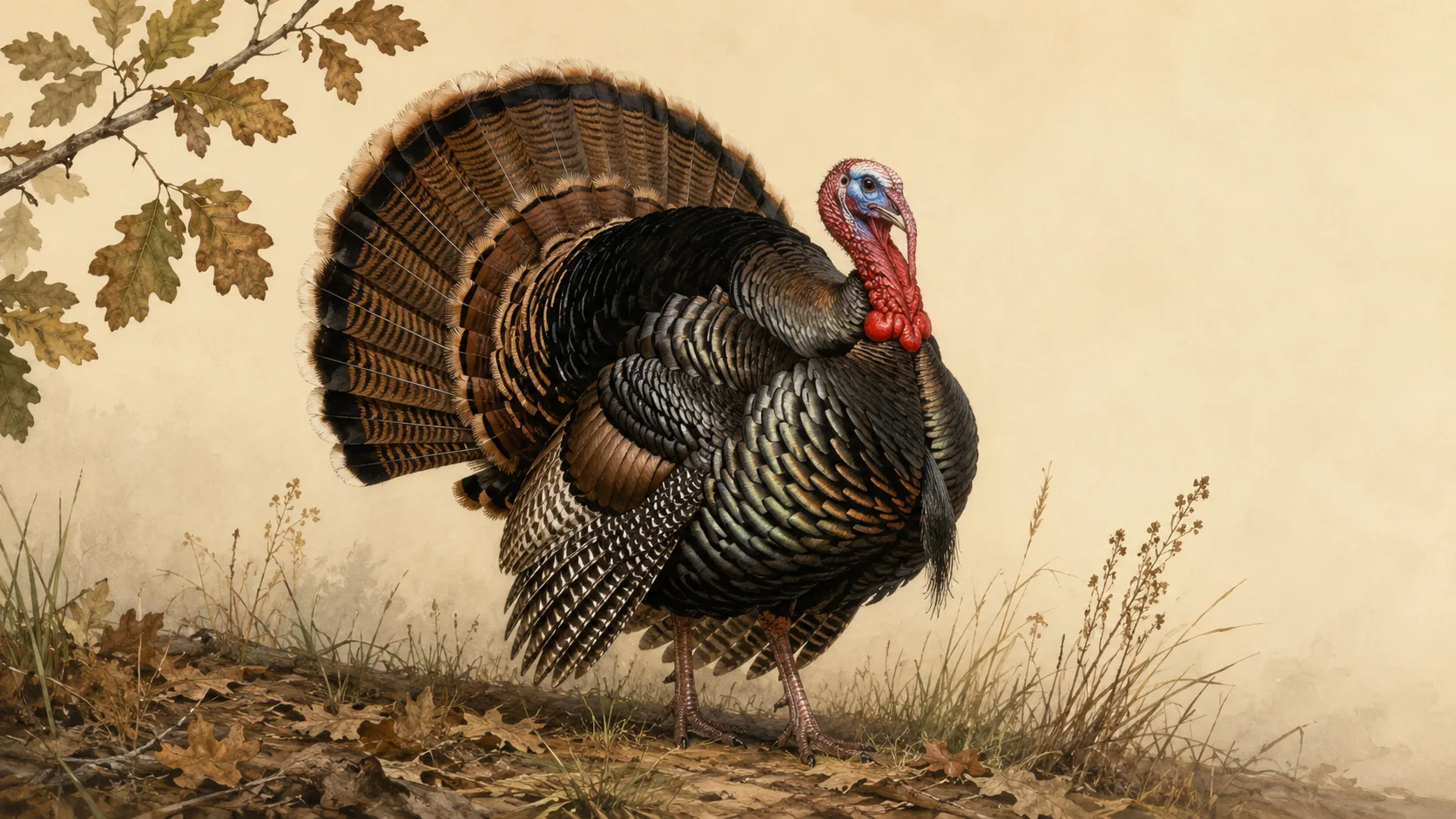
Centrocercus urophasianus is a heavy, ground-bound bird built for a treeless landscape. Males run 66 to 76 centimetres long and weigh up to 3,500 grams - a size more comparable to the wild turkey than to most grouse. Females are considerably smaller, typically 58 to 66 centimetres and 1,500 to 2,000 grams. Wingspan across both sexes runs 86 to 97 centimetres.
The male’s plumage is a study in contrast. Back and wings are grey-brown with buff and black vermiculations that mirror the texture of mature sagebrush. The breast is white - a broad ruff the bird expands during display. Below that ruff sits a solid black belly patch. The throat is dark brown, yellow lores flare above the bill, and the tail - long, pointed, stiff - fans to vertical in display, each central feather ending in a narrow spike.
The female is mottled grey-brown throughout: belly patch present but subdued, throat paler, tail shorter and without spikes. She is built for invisibility on a nest under sagebrush.
| Measurement | Range |
|---|---|
| Body length | 58 - 76 cm (male larger) |
| Weight | 1,500 - 3,500 g |
| Wingspan | 86 - 97 cm |
| Lifespan (wild) | 3 - 9 years |
The lek
The lek is the axis around which the Greater Sage-Grouse’s year turns. Males return to ancestral display grounds each spring, typically in late February or March, before the snow is gone. These sites are flat or slightly raised areas of sparse ground - sparse enough to give males visibility, open enough that females can approach from any direction.
Territory within the lek is not arbitrary. Dominant males hold the center. Subordinate males hold the edges. The dominant male at the center typically accounts for the majority of all copulations in a season - a sexual selection system as skewed as almost any among North American birds. Females visit for two or three days, observe, and choose. The choice, once made, is over in seconds.
The display sequence is fixed: wing-swish, tail-fan, air-sac inflation, double pop, repeat. Males cycle through it for hours before and after sunrise. The pop - produced by collapsing the esophageal sacs - is broadband enough to cut through wind. One pair of sacs. Heard at two miles.
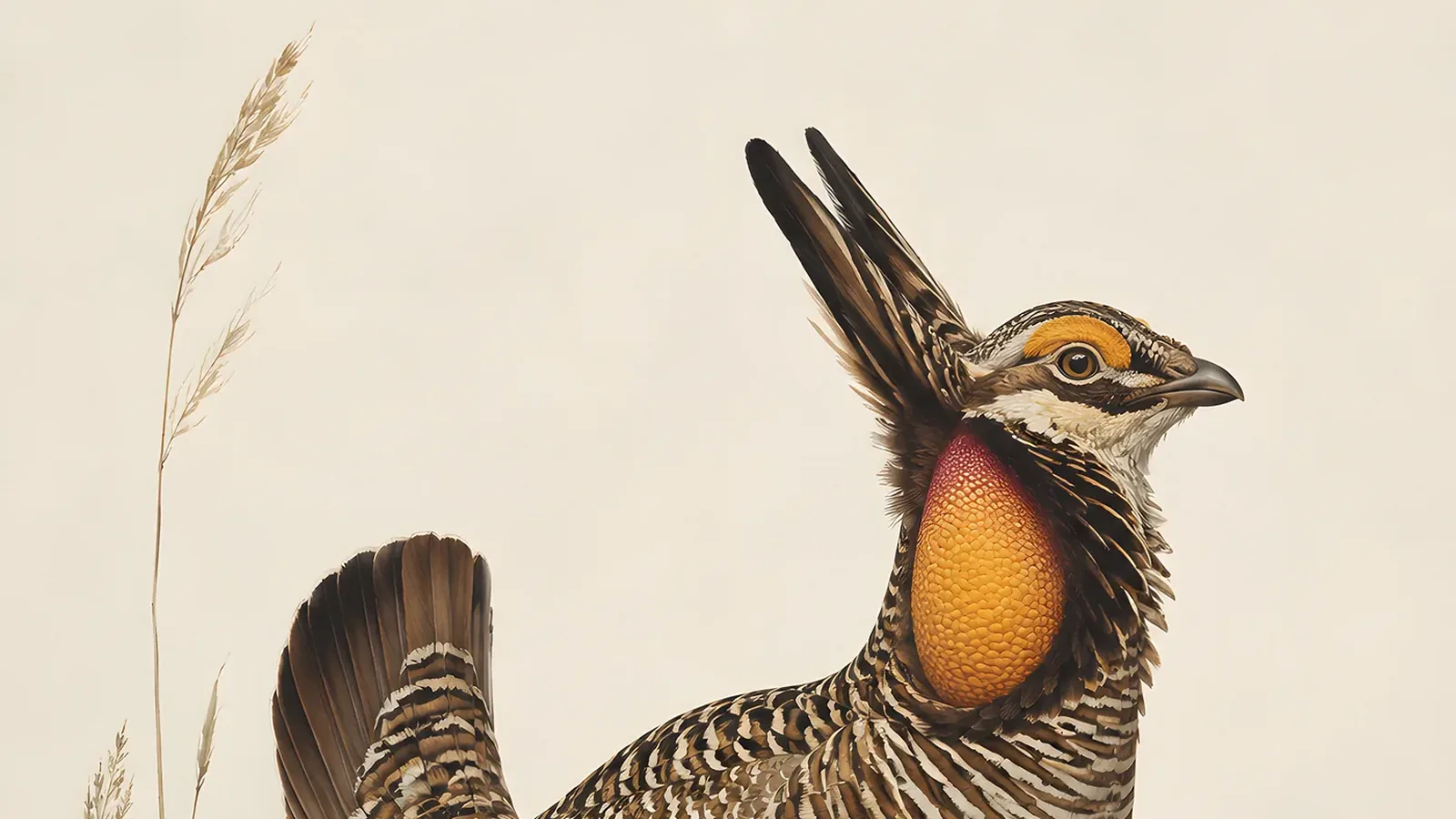
The greater prairie chicken performs a structurally similar lek display with orange air sacs and a rolling boom rather than a pop, suggesting these display structures predate the divergence of the two lineages.
The sagebrush diet
This is the fact that defines everything else about Centrocercus urophasianus: it lacks a muscular gizzard.
Most birds that eat seeds or hard plant matter have a heavily muscled gizzard that grinds food against small stones the bird has swallowed. The Greater Sage-Grouse has no such structure. It cannot grind hard seeds. It cannot process grain or nuts or tough grasses the way almost any other ground bird can. The one food it can process in quantity - soft, digestible, available year-round in its range - is the leaf of sagebrush (Artemisia spp.).
In winter, the diet is nearly 100 percent sagebrush leaves and fresh shoots (National Wildlife Federation). In summer the proportion drops somewhat as the birds take forbs, flowers, and grasses, and young chicks eat insects for the first weeks of life. But the adult bird in November, in January, in March before anything else has greened up, is eating sagebrush. Only sagebrush.
Ecologists call this “sagebrush obligate.” The Greater Sage-Grouse needs sagebrush for food, nest concealment, summer loafing cover, and winter thermal protection. Remove the sagebrush and you do not have degraded habitat. You have no habitat at all. This is not a preference. It is anatomy.
What it sounds like
The display pop is not a vocalization in the conventional sense - it is a mechanical sound produced when air forces out through the esophageal sacs. Males also produce lower-frequency cooing notes between display sequences. Flushed birds give sharp, chicken-like cackles on takeoff. Females use soft clucks with chicks. Both sexes call quietly while foraging.
The pop is what birdwatchers come to hear. On a still April morning with 15 males displaying simultaneously, the acoustic effect is something experienced ornithologists still describe with difficulty.
Range and habitat
The Greater Sage-Grouse currently occupies 11 western U.S. states and parts of southern Alberta and Saskatchewan. Core populations hold in Wyoming, Montana, Nevada, Idaho, and Utah. The species has been extirpated from Kansas, Nebraska, Arizona, New Mexico, Oklahoma, and British Columbia - places where sagebrush once covered significant ground.
The species does not migrate conventionally. It moves altitudinally, descending in winter to elevations where sagebrush stays accessible above the snow line, returning to higher ground in late spring. Movements can span 50 to 100 kilometres. Birds are loyal to both their leks and their wintering areas.
Habitat requirements are not complicated but they are absolute: sagebrush ecosystem of adequate size and connectivity. Leks need open flat ground. Nesting requires dense sagebrush with herbaceous understory. Brooding requires proximity to wet meadows where insects concentrate in early summer. All three must exist within a few kilometres of each other.
Breeding
Females leave the lek shortly after mating and find nest sites independently. The nest is a shallow scrape beneath a sagebrush plant, lined with grasses and dry leaves. Clutch size runs seven to nine eggs, olive-buff with fine brown spots. Incubation lasts 25 to 27 days by the female alone.
Chicks are precocial - mobile within hours of hatching. They require insects intensively for the first three weeks and stay with the female through late summer before dispersing. Males play no role after mating. Many males live only three to four years. Females, facing lower predation pressure than the conspicuous lek-performing males, sometimes reach seven to nine years.
The sagebrush sea
“More than half of the Sagebrush Sea natural habitats have been lost, with an additional 1.3 million acres disappearing each year.” - Defenders of Wildlife, citing Sage Grouse Initiative data
The sagebrush ecosystem once ran across a vast interior swath of the American west - a plant community as ecologically distinctive as the tallgrass prairie to the east, and now in the same condition. What remains is roughly half the original area. Cheatgrass (Bromus tectorum), an annual grass introduced from Eurasia in the late 1800s, now dominates millions of degraded acres. It burns more readily than native sagebrush and burns earlier in the season, creating a fire cycle that kills mature plants and prevents recovery. Energy development - gas wells, transmission lines, wind installations - fragments what fire spares into parcels too small or too disturbed for sage-grouse to use.
A 2021 USGS study led by Peter Coates found an 80 percent rangewide population decline since 1965 and a nearly 40 percent decline since 2002. The same research found only a 50 percent probability that most current leks would remain productive in 60 years under present conditions. The U.S. Fish and Wildlife Service has evaluated the species for ESA listing multiple times. In 2010 it found listing warranted but precluded by higher-priority work. In 2015 it determined that voluntary state conservation plans had reduced threats enough to avoid listing - a conclusion widely disputed by conservation organizations. A congressional rider in 2014 prevented USFWS from spending money on listing at all, effectively removing the statutory option while the arguments continued.
The IUCN lists the Greater Sage-Grouse as Near Threatened. The category captures the trajectory without fully conveying the scale: a species that once numbered in the tens of millions, now counted in the low hundreds of thousands, in a habitat losing more than a million acres per year.
What the numbers cannot show is what is at the center of a functioning lek at dawn in April. The males stamping in the cold. The pops rolling two miles across open ground. The females at the sagebrush edge, watching.
The Greater Sage-Grouse does not need a recovery plan. It needs the plant it was built around. Whether it gets to keep that plant is a decision that has nothing to do with biology.