Field Guide
Indigo Bunting
On a hot July afternoon, when most songbirds have gone quiet and the fields shimmer, one voice keeps going from the topmost twig of a roadside sapling. The bird at the top of it is a fleck of electric blue against the haze, singing the same paired phrases over and over, hour after hour, in heat that has silenced everything else. He is small enough to sit in a closed fist. He sings as though the field belongs to him because, for the season, it does.
That blue is a lie the light tells. Passerina cyanea carries no blue pigment in a single feather. The colour you are looking at is built, not dyed - and the same bird that blazes in full sun goes near-black the moment a cloud crosses. Most of what makes the Indigo Bunting remarkable works like this: ordinary materials arranged to do something that looks, from a distance, like magic.
What he looks like
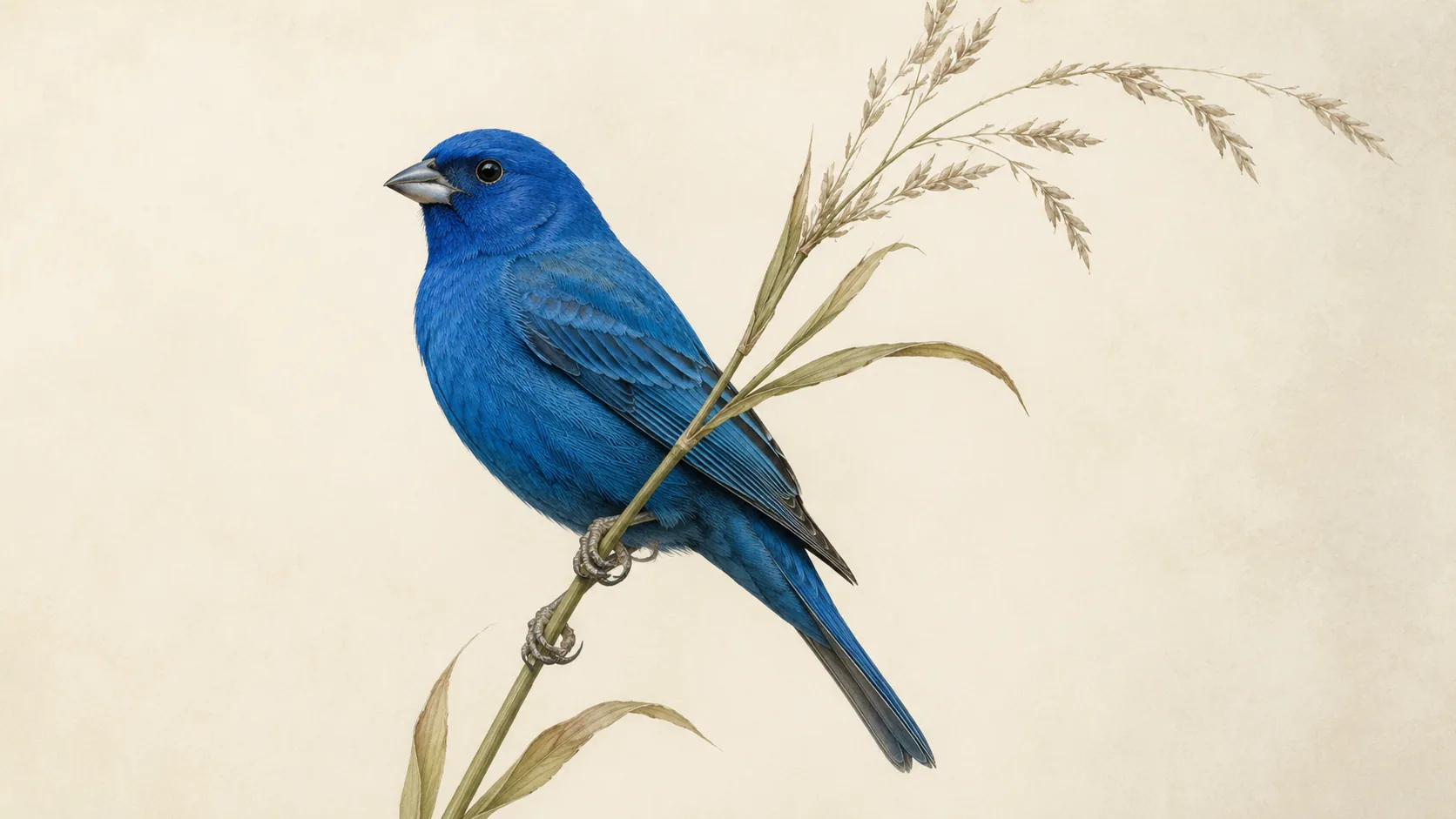
The breeding male is the entire reason this bird gets noticed. From a distance he reads as a uniform deep, saturated blue, brightest and most intense on the head, shading slightly darker towards the wings and tail. There are no wing bars, no streaks, no mask. He is, more or less, blue all over. The bill is short, conical, and silver-grey, the heavy seed-cracking bill of the cardinal family he belongs to.
That blue is structural. As Cornell Lab explains, Indigo Buntings, like all blue birds, lack blue pigment entirely. The jewel colour comes from microscopic structures in the feather barbs that scatter blue light, the same physics that makes the sky blue. The feathers do hold the pigment melanin, which is brown-black. Hold a blue feather up with the light behind it rather than on it, and you see the truth of it: dull brown. The colour lives in the angle of the light, which is why a male can look almost black in shadow and incandescent in the sun a second later.
The female is a different bird entirely to the untrained eye. She is plain, warm brown, palest on the throat, with faint blurry streaking on the breast and often the barest wash of blue in the wings or tail. Subtle is the word. The winter male is the giveaway in autumn: a patchwork, brown and blue mixed together as the breeding plumage moults away. Juveniles resemble the female. This is a bird where the field mark is the male and only the male.
What he sounds like
The song is a bright, lively warble, the notes paired - a phrase given, then repeated, in couplets - sweet-sweet, chew-chew, sweet-sweet. It is high, cheerful, and unhurried, and the male delivers it from an exposed high perch in the open, often through the hottest, stillest part of a summer day when little else is singing. That persistence in the heat is one of the easiest ways to locate him.
The detail that lifts this bird out of the ordinary is how the song is learned. Cornell Lab documents that young males do not learn their song from their fathers. They learn it from established males near where they settle to breed. The result is “song neighbourhoods”: clusters of males within a few hundred metres all singing nearly identical songs, distinct from the songs sung by birds in the next cluster over. A patch of countryside develops its own dialect, passed down the generations of birds that settle there, not down any single bloodline. The song is local culture, not inheritance.
The common call is a sharp, dry spit, given in flight and in alarm.
Range and habitat
The Indigo Bunting is a bird of edges and disturbance, and it has thrived on the way people have reshaped the land. It breeds across the eastern United States and into southern Canada, favouring brushy and weedy ground: the edges of woods and fields, roadsides, streamsides, powerline cuts, logged forest plots, brushy canyons, and abandoned fields growing back to scrub. Clearing and regrowth suit it. Where a mature forest is opened up, the bunting moves in.
It is a true long-distance migrant. Audubon notes a journey of roughly 1,200 miles each way between the breeding grounds and the wintering range, which runs from southern Florida through Mexico and Central America to northern South America and the Caribbean. Many cross the Gulf of Mexico in a single overnight flight in spring and autumn.
The migration is the headline. Indigo Buntings travel at night, and they navigate by the stars. In a now-famous set of experiments in the late 1960s, Stephen Emlen tested captive buntings in a planetarium and then under the real night sky, and showed that the birds orient themselves using the pattern of stars rotating around the celestial pole. A brown-bodied bird weighing about as much as four sheets of paper finds Central America in the dark by reading the sky. It is one of the most quietly astonishing facts in North American ornithology.
Diet
The Indigo Bunting feeds low and feeds widely. In the breeding season the diet leans heavily on insects and spiders - caterpillars, grasshoppers, aphids, cicadas, beetles - which supply the protein for a growing brood. As summer wears on it shifts towards small seeds and berries: thistle, dandelion, goldenrod, and grains such as oats, alongside blueberries, strawberries, and blackberries. Buds and twigs fill the gaps.
It forages on or near the ground and in low vegetation, often clinging to grass stems and bending them under its weight to reach the seed heads. At feeders it will take small seed, nyjer (thistle) and fine millet especially, and is most likely to appear during spring and autumn migration when flocks pass through. A garden with seeding weeds left standing at the edges will do more to draw one in than any feeder.
Breeding and nesting
The nest is the female’s work almost entirely. She builds a compact open cup of leaves, grasses, and bark strips bound with spider silk, set low - usually within a metre or two of the ground - in the fork of a dense shrub, a bramble tangle, or a stand of tall weeds at a field edge.
She lays three to four eggs, white to faintly bluish-white and usually unmarked, though Cornell Lab notes they are rarely spotted with brown or purple. She incubates alone for 12 to 13 days. The young leave the nest at around 9 to 12 days old, and the pair will often raise two broods in a season, the male frequently taking over care of the first fledglings while the female begins the second clutch. In a long, warm southern summer this conveyor of broods is how a single pair sends several young buntings into the autumn migration.
The blue that is not there
Strip the Indigo Bunting down to its parts and almost nothing about it is what it appears to be. The blue is brown feathers and bent light. The song is borrowed from the neighbours, not the father. The navigation is a stellar map carried in a body the size of a sparrow’s. None of it is what a casual glance would assume.
This is the bird’s real lesson, if a small songbird is allowed one. The most striking things about it are all matters of arrangement. The pigment is dull; the structure makes it dazzle. The genes carry no song; the culture of the field supplies it. The brain is tiny; the sky is enough to steer by.
Hold his feather to the light and it is brown. The blue lives in the angle of the sun, the song in the neighbours, the route in the stars. Almost nothing about this bird is the thing it appears to be.
Partners in Flight estimates a global breeding population of around 77 million, and the IUCN lists the Indigo Bunting as Least Concern. But the North American Breeding Bird Survey records a slow decline of roughly 0.6 per cent a year, a cumulative loss of about a quarter of the population between the 1960s and 2019, as scrubby field edges are tidied away into lawn and tillage. The bird that thrives on disturbance is, quietly, running short of the rough ground it needs. The blaze of blue on the July hedgerow is commoner than it has any right to be, and rarer than it used to be, both at once.