Field Guide
Yellow Warbler
The Yellow Warbler is the small flame of wet willow edges. All yellow, all motion, gone before most people fix him in the glass. Here is how to know him, and where to look.
How to know it
Start with the colour. No other warbler is this uniformly yellow.
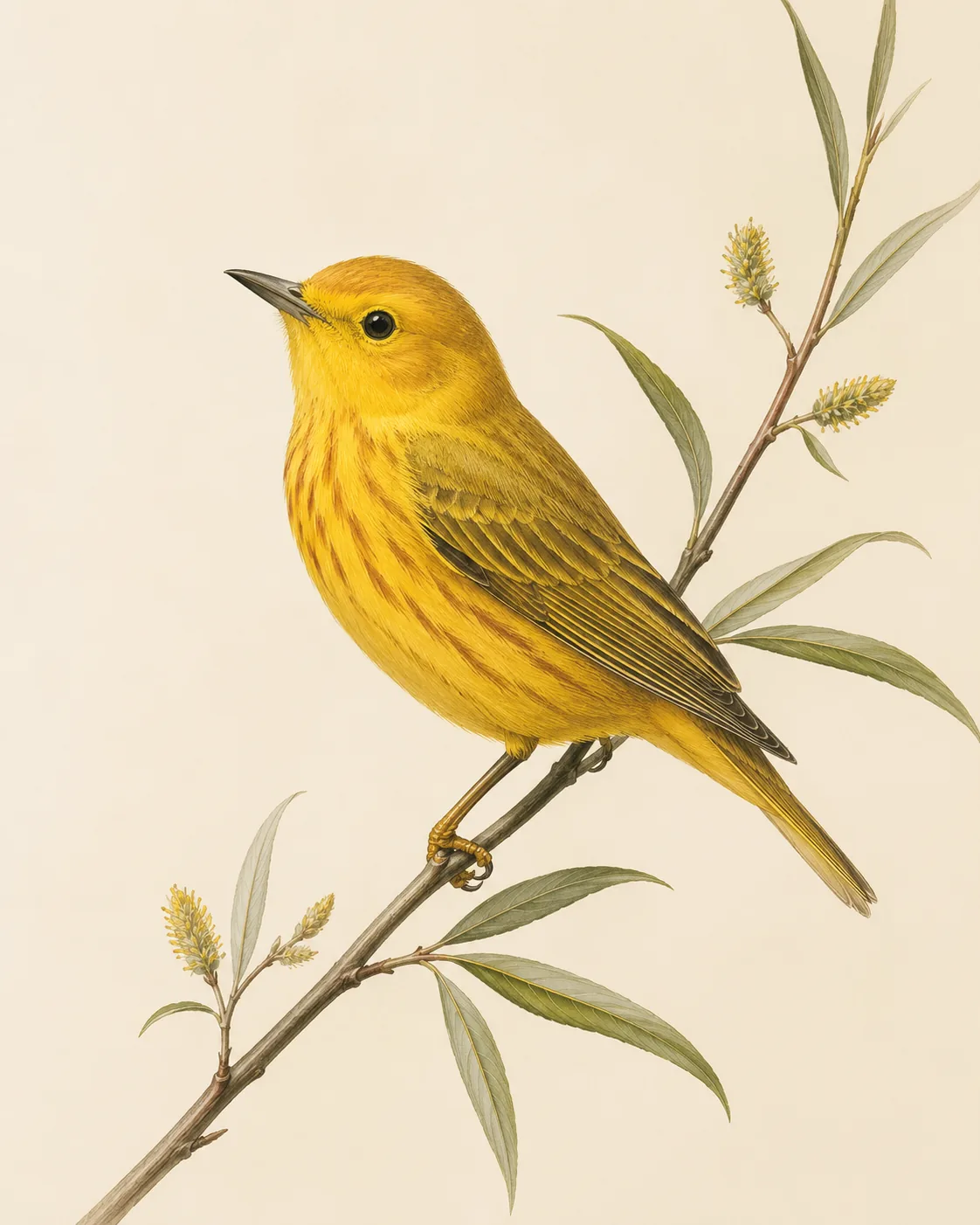
The male in spring is lemon-gold from crown to tail, lit through as if from inside. Fine chestnut streaks run down his breast like brushwork. His eye is large and dark on a plain yellow face, which gives him a gentle, open look.
The female is paler. Soft yellow-olive, often without the streaks. Both sexes show yellow patches in the tail, a useful mark when the bird flicks and turns.
He is tiny. Around 10 to 18 cm, and light enough to ride a swaying stem. The bill is thin and pointed, made for picking insects from leaves.
Range and habitat
Few American songbirds spread as wide.
Yellow Warblers breed across almost all of North America. Through Canada and Alaska, down through most of the lower United States, and into Mexico. Island and coastal forms reach the Caribbean and the mangroves of northern South America.
In winter most withdraw south, to Central America and the northern edge of South America.
Look for him low and near water. Willow carr, streamside thickets, the damp scrub at the edge of a pond. He likes the wet margin where the leaves stay soft and the insects gather.
Behaviour
He rarely sits still for long.
Watch him work a stem, gleaning caterpillars and small insects from the undersides of leaves, hopping out to the thin twigs where heavier birds cannot follow. Quick, restless, always a little ahead of you.
He is also a known target of the Brown-headed Cowbird, which lays its eggs in his nest. The Yellow Warbler answers in kind. He will build a new floor straight over the foreign egg and start again, sometimes stacking nest upon nest several storeys high.
Voice
The song is bright and hurried, a clear ringing phrase often written as “sweet sweet sweet, I’m so sweet.”
It carries well across open wet ground. Once you have it, you will pick him out of a willow thicket long before you see the gold.