Field Guide
Prothonotary Warbler
A flash of gold over dark water. Not the gold of sunlight, which moves. The gold of the bird itself - steady, almost defiant - as it crosses six feet of black swamp and vanishes behind a bald cypress knee. That is your first encounter with Protonotaria citrea, the Prothonotary Warbler. You look for it again. You look for a long time.
It is the bird that broke a spy.
What he looks like
No eastern warbler burns quite this color.
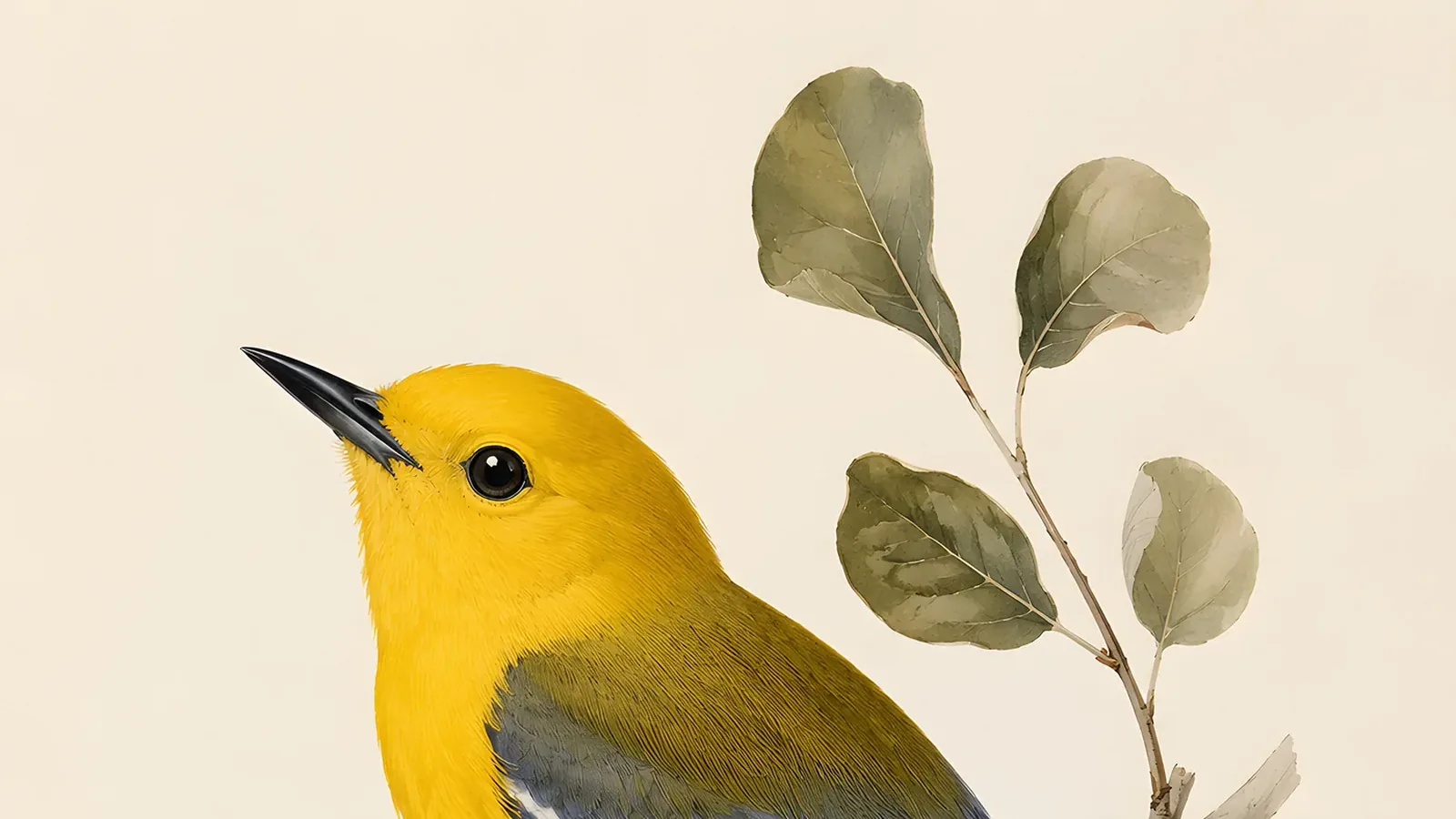
The head, the neck, the throat, the breast: all saturated golden-orange-yellow, the hue of a late candle flame. The intensity on the male is startling against the background of dark tannin-stained water and grey dead wood. His back is olive-green, which softens the transition into blue-grey wings and a blue-grey tail. The undertail coverts are white. His eye is large and dark, plain-faced, giving him an alert and unguarded expression.
The bill is heavier than you expect in a warbler. Longer too. He holds it upright when alarmed, which gives him an air of particular alertness. His legs are short and dark. His tail is relatively short.
The female is dimmer. The yellow is still present - this is not a species where she disappears entirely - but softer, not quite burning. Her wings share the same blue-grey as the male’s, which is a helpful field mark when she moves through shadow.
| Measurement | Range |
|---|---|
| Length | 13 - 14 cm |
| Weight | 12 - 14 g |
| Wingspan | 22 - 24 cm |
| Maximum recorded age | 8 years, 11 months (USGS Bird Banding Laboratory, 2021) |
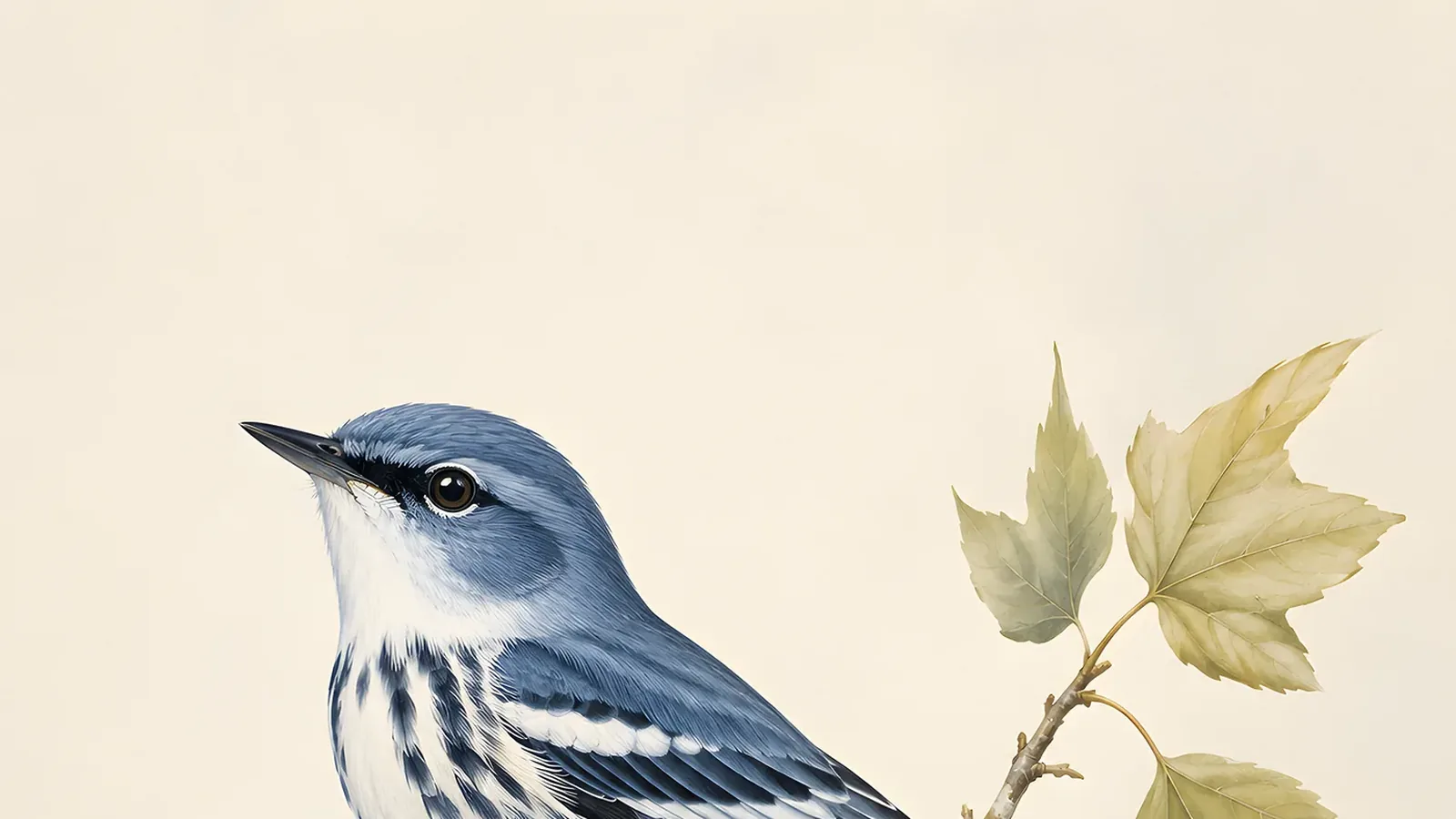
Among the wood-warblers, he is stocky - a big-headed, front-heavy bird with presence. The cerulean warbler occupies the canopy. This one stays low, often at eye-level or below, working the flood zone where your feet cannot easily follow.
The cavity in the swamp
Here is the fact that sets Protonotaria citrea apart from every other eastern wood-warbler: it nests in holes.
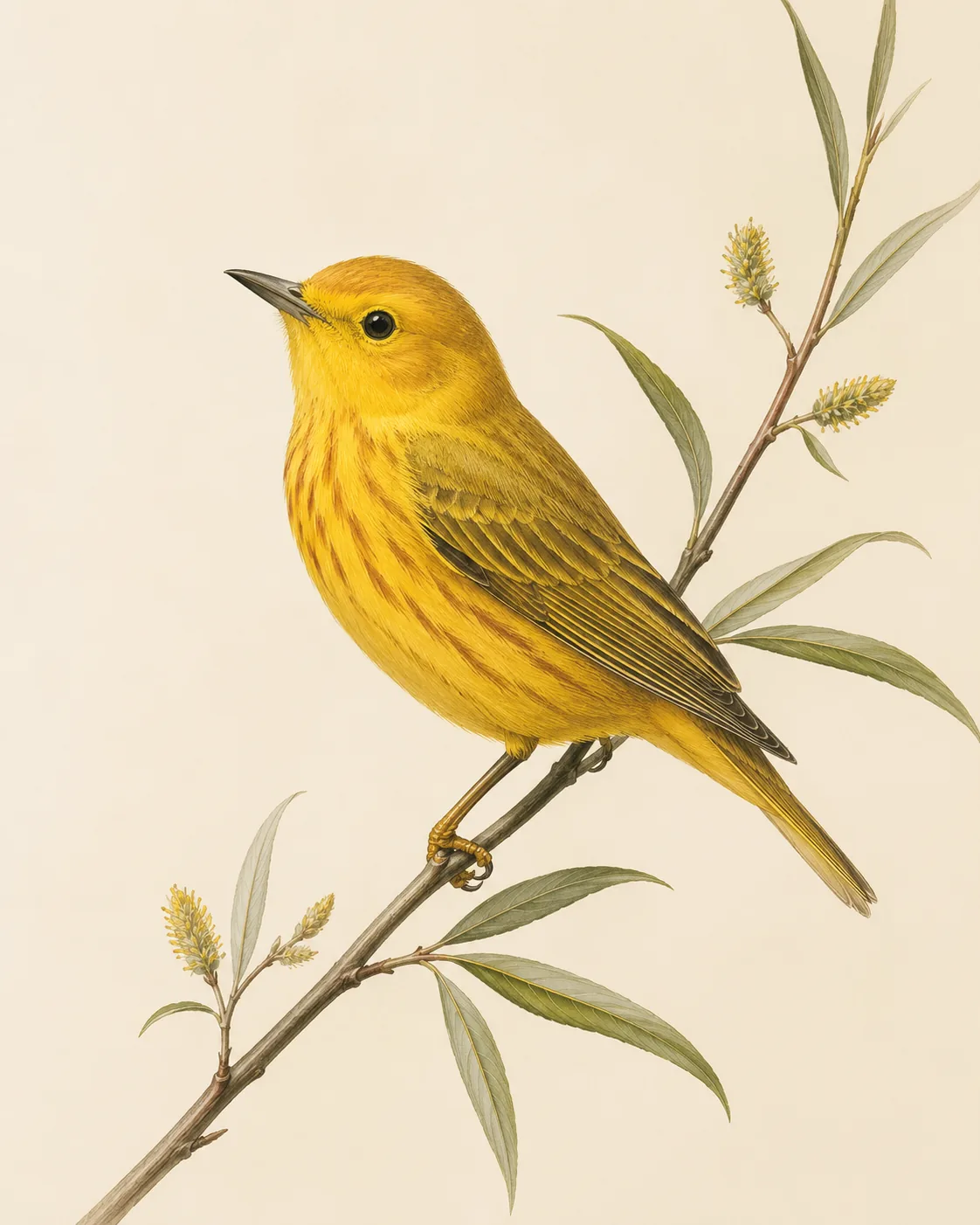
While Wilson’s Warblers build in sedges and Black-and-whites spiral up bark and Yellow-warblers construct open cups in willows, the Prothonotary nests in a cavity. A natural hollow in a dead stub, a woodpecker hole, an artificial nest box mounted five feet above standing water. According to the Cornell Lab of Ornithology’s All About Birds, it is the only member of the eastern wood-warbler assemblage to rely on this nesting strategy. That distinction has shaped how conservation biologists approach the species - nest boxes work, and local populations have recovered where they have been deployed with predator guards.
The male is tireless in the pre-nesting period. He inspects cavities, carries green moss into promising holes, and constructs partial nests in several of them. This is display, not planning. The female makes the final selection. She alone completes the working nest, weaving moss, grasses, sedge and leaf skeletons into a cup inside the chosen hole. She then lays four to six eggs - creamy-white, speckled reddish-brown - and incubates them alone for 12 to 14 days. Both parents feed the young, which fledge after about ten to eleven days.
The pair may raise two broods in a good year.
In the bottomland swamps of Arkansas, and across the broader Southeast, nest box programs have demonstrated that the species responds quickly when suitable cavities are provided. Where natural dead snags are removed - a common effect of river channelization and timber extraction - the boxes substitute effectively. Nest site limitation, not food supply, is the brake on local populations.
What he sounds like
The song is a single strong syllable repeated in a rising, ringing phrase: sweet-sweet-sweet-sweet-sweet-sweet. Clear, loud, insistent. Not the wandering improvisation of a thrasher or the warbled complexity of a tanager. A pure note, hammered out.
You hear it across open swamp water before you see the bird. The call is a sharp metallic chip, easy to miss but useful when the bird is moving through dense bottomland brush.
Range and habitat
The Prothonotary Warbler is a bird of the American Southeast. It breeds from the Great Lakes southward through the Mississippi Valley and across the coastal plain to the Atlantic states, with the core of its population in the swamp forests of Louisiana, Tennessee, and the river bottoms of the mid-South.
It requires flooded forest. Not just wet ground. Water - standing, dark, slow, with trees rooted in it. Bald cypress and water tupelo swamps are the heart of the breeding habitat. River-bottom hardwood forest that floods seasonally will do. The key elements are: water underfoot, dead wood with cavities, and a canopy close enough to provide some cover.
In winter the birds withdraw entirely from the United States. They move south through Central America and into northern South America and the Caribbean, where mangrove forests are the primary wintering habitat. The BirdLife International factsheet notes mangrove loss from coastal development and aquaculture as a significant winter-ground threat - a reminder that a bird can be well-protected at its nest and still decline because of what happens 1,500 miles away.
Partners in Flight places the Prothonotary Warbler on its Yellow Watch List, with a Continental Concern Score of 14 out of 20, reflecting a population decline of roughly 31% between 1966 and 2019 - approximately 0.7% per year as documented by the North American Breeding Bird Survey. The IUCN Red List category is Least Concern (LC), though the population trend is decreasing.
Diet
Protonotaria citrea is an insect specialist working a specific stratum. He forages low - often within a metre of the water surface - picking aquatic insects, beetles, mayflies, ants, caterpillars and spiders from bark, mossy logs, and waterlogged debris. Snails and other mollusks appear in the diet, particularly when the bird is moving slowly through flooded wood. Seeds are taken occasionally but insects are the substance.
The foraging style is deliberate compared to many warblers. He moves along a mossy log, probes bark crevices, flips bits of debris. He does not flit and dart through foliage at treetop height. This low, methodical habit is part of why he is so visible to a patient observer with a canoe and a good vantage point.
Breeding
Spring arrives at the nest site in April. Males establish territories and begin cavity inspection early. A useful fact for field workers: the male may attend two or three partial nests simultaneously, but the female’s choice determines the actual nest. Studies cited by the Cornell Lab note that nest boxes mounted over standing water consistently outperform those on dry ground, presumably because water provides a barrier to terrestrial nest predators like raccoons and black rat snakes.
Brood parasitism by the Brown-headed Cowbird occurs but at relatively low rates compared to open-cup nesters in the same habitat - the cavity entrance provides a degree of protection that a cup nest in a willow branch does not.
The name
Protonotaria comes from Late Latin protonotarius, the term for a senior ecclesiastical notary in the Roman Catholic Church. The prothonotaries - papal clerks who recorded significant acts of the Holy See - were associated with robes of yellow or golden hue.
The bird, first described by French naturalist Georges-Louis Leclerc, Comte de Buffon in 1779 under the French name Le figuier protonotaire, apparently acquired the English vernacular from Louisiana Creoles who saw in the male’s plumage a resemblance to those golden-robed clerks. It is one of the more particular etymologies in North American ornithology - a swamp warbler carrying a medieval ecclesiastical title.
The bird entered American political history in August 1948, when the House Committee on Un-American Activities was investigating Alger Hiss, a senior State Department official accused of espionage. Whittaker Chambers - Hiss’s accuser and a former Soviet courier - had mentioned in executive session that Hiss was an amateur ornithologist who had once seen a Prothonotary Warbler along the Potomac. When Committee members later asked Hiss about his hobbies, Congressman John McDowell asked casually whether Hiss had ever seen a prothonotary warbler. Hiss confirmed he had - right there on the Potomac. That match of detail, a rare bird shared between two men who denied knowing each other well, helped convince Committee members that Chambers’s account of their close acquaintance was credible. The bird’s name appeared in the trial record. Hiss was convicted of perjury in 1950. (Source: U.S. House of Representatives, History, Art & Archives; algerhiss.com)
It is worth pausing on that exchange. A congressman who knew his warblers well enough to ask that particular question. A diplomat who answered without thinking. A courtroom that turned, in part, on a flash of gold over dark water.
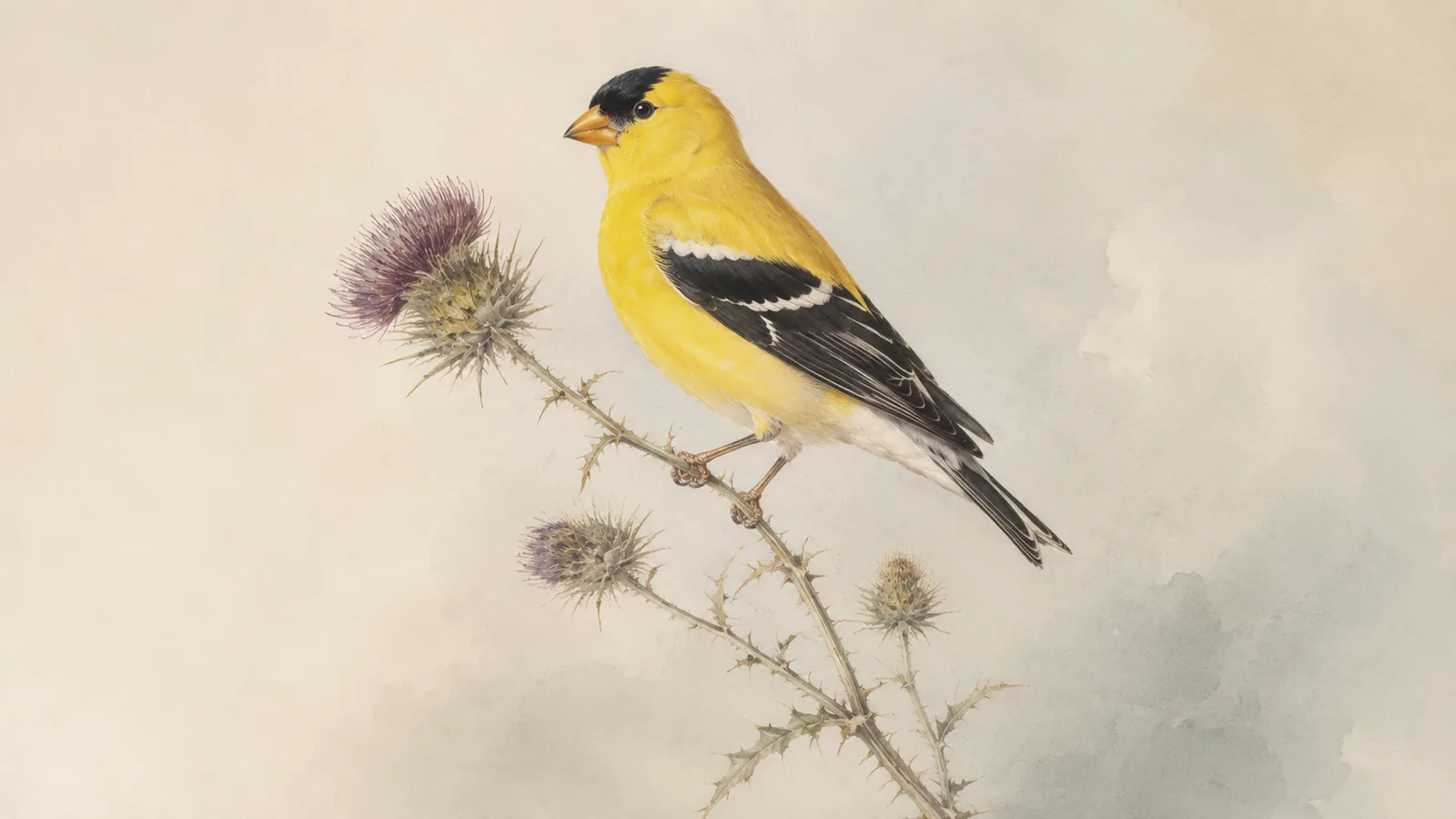
The Prothonotary Warbler is a specific bird for specific places. It does not spread itself wide like the yellow warbler or the american goldfinch, which occupy half a continent. It asks for swamp, dead wood, standing water, and a hole in a tree. Where those elements remain, you will find it. Where they are drained, channeled, or cleared, you will not. The bird has exacting requirements, and it is honest about them.