Field Guide
Greater Rhea
In the southern pampas of Argentina, sometime in August, a male Rhea americana chooses a patch of open grassland and begins to scrape. He hollows a shallow depression in the soil, lines it with leaves and dry grass, and waits. Then the females arrive - not one, but several, drawn in by his wing-fanning displays and low booming calls. Each lays a clutch of eggs in his nest. Then she leaves, finds another male, lays again. The male, by the time incubation begins, may be sitting on 50 eggs or more from half a dozen different females, none of whom will return.
This is the reproductive logic of the Greater Rhea, and it inverts almost every assumption a Northern Hemisphere birder carries into the field. The female is the roamer. The male is the parent. The nest is a communal crèche, and the one bird responsible for it chose none of its occupants.
South America’s largest bird is also, quietly, one of its most unusual.
Identification and appearance
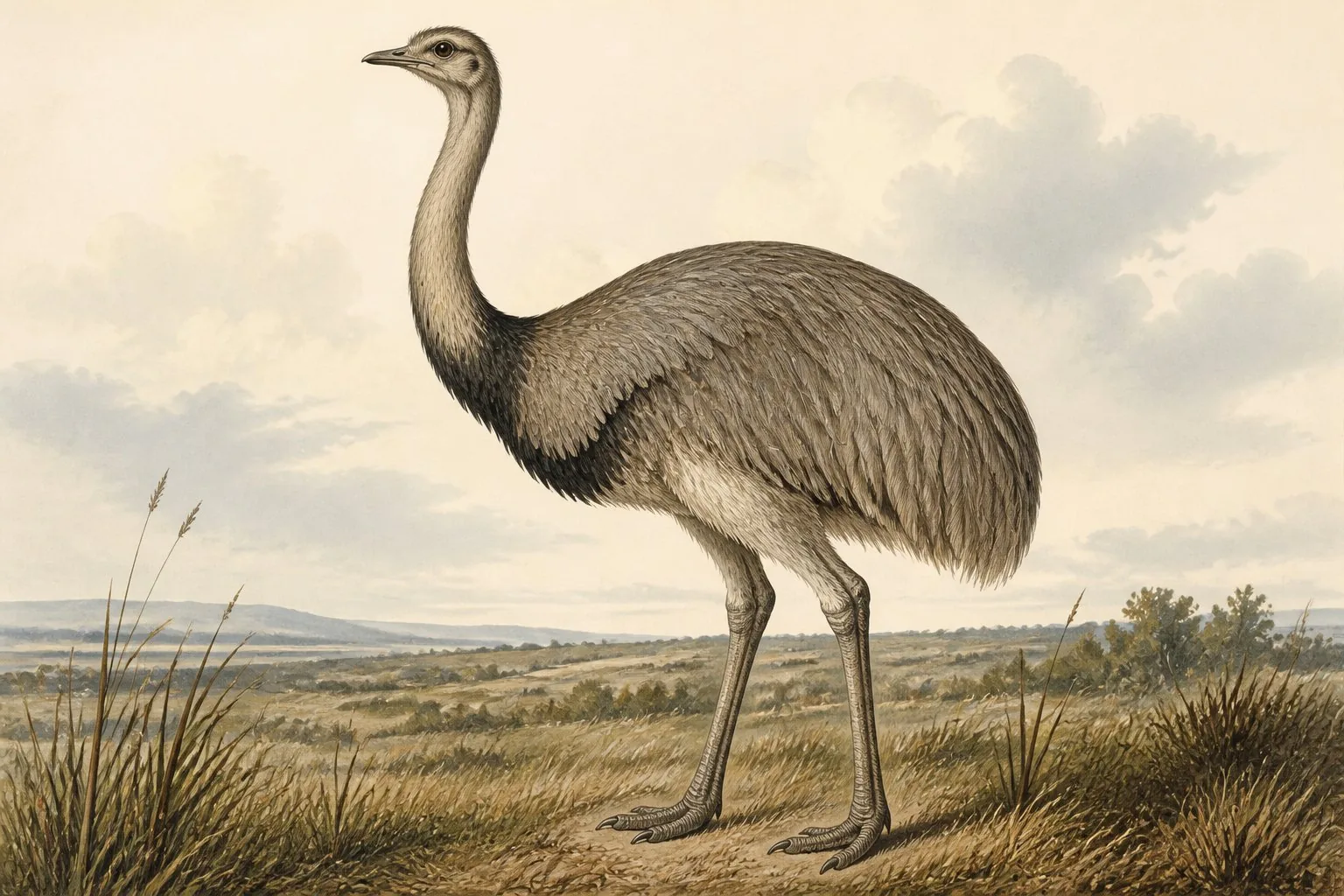
The Greater Rhea is not a bird you mistake for something else once you have seen one. At 127 to 150 centimetres tall and typically 20 to 27 kilograms, he stands chest-height to an adult human. The wings span nearly 150 centimetres and are held loose at the sides when the bird walks, giving him a slightly dishevelled silhouette - feathers falling away from the body rather than folded flat. He cannot fly. The breast bone carries no keel, the anchor point for flight muscles in every flying bird. Those wings are not vestigial decoration. He uses them as a rudder when running, raising one and dropping the other to cut angles at speed. In open country he can sustain 60 kilometres per hour.
The plumage is grey to brownish-grey across the back and wings, shading to white on the underparts. Males develop a patch of black feathers at the base of the neck during breeding season - a collar visible from some distance. Females are slightly paler overall. Leucistic individuals, appearing washed-out or nearly white, turn up with enough regularity in the wild that early European naturalists catalogued them as a separate species. The legs are long, scaled, and yellowish-brown. Each foot carries three forward-facing toes tipped with flat nails that double as weapons - a kick from an adult rhea can open a wound.
Juvenile Greater Rheas are striped brown and buff, a pattern that breaks up their outline in the grass and may explain why a male shepherding 20 or 30 striped chicks is one of the more disorienting sights in South American grassland birding.
Voice
Adults are close to silent for most of the year. The communication that matters happens through posture and movement. During breeding season, males produce a low, resonant boom - often rendered in the literature as a drawn-out nandú call - that carries across open ground and is audible well beyond the territory’s edge. The call is produced with the neck inflated, the throat visibly swelling. Outside breeding season, distress calls and contact notes exist, but the species does not hold a vocal territory. It holds a physical one.
Range and habitat
The Greater Rhea occupies a band of open country running south and east through South America. Its core range covers the pampas of Argentina, the cerrado and campos grasslands of central Brazil, and the chaco and grassland regions of Paraguay, Uruguay, and Bolivia. It is sedentary rather than migratory, though flocks will shift locally in response to drought or the seasonal cycles of agricultural crops. Cornell’s Birds of the World places it consistently in grassland, open savanna, and grassy wetland edges - open country where visibility is high and the bird can see threats at distance.
A feral population established itself in northeastern Germany following escapes from farms, a detail that underscores both the rhea’s adaptability to temperate grassland and the inadvertent reach of the South American farming industry that domesticated it.
Within its range the species increasingly forages on agricultural land. Soya fields, maize crops, and rice paddies provide food in large quantities, which has complicated its relationship with landowners. In some areas this foraging brings it into direct conflict with farmers. The IUCN lists it as Near Threatened, with the primary pressures being hunting and the conversion of native grassland to intensive agriculture - a habitat transformation that removes not just food but the open structure the species requires for predator detection and nesting.
Diet
The Greater Rhea is essentially a grazing bird with occasional omnivorous supplements. Animal Diversity Web records that plant matter accounts for roughly 99 per cent of observed foraging, weighted heavily toward broad-leafed plants, grasses, seeds, legumes, and agricultural grains. The remaining fraction covers insects, small vertebrates such as lizards and rodents, and, in one detail that surprises almost everyone who encounters it, occasional consumption of carrion. The bird also swallows grit and small stones to assist with mechanical digestion, the same strategy used by ostriches and emus.
It forages in flocks outside breeding season - groups of 10 to 100 birds have been recorded, with larger aggregations appearing where food is locally abundant. The flock provides multiple sets of eyes. The rhea’s defence against a puma or a maned wolf is not the flock itself but the distance the flock’s collective vigilance buys.
Breeding and nesting
The breeding season runs from approximately July to January across most of the range, adjusted by latitude and local rainfall. Males establish territories and court through elaborate wing-fanning displays, running with wings held outward and upward, feathers spread. The display is directed at any female in the vicinity and is preceded or accompanied by the booming call.
Each male mates with multiple females in sequence, a system described as polygynandrous: females also mate with multiple males, moving through territories and depositing eggs in each. The male incubates the entire communal clutch alone, for 29 to 43 days depending on conditions. He defends the nest aggressively. Post-hatch, he shepherds the striped chicks for several months, calling them together when threatened, interposing himself between the brood and any intruder.
A nest containing the eggs of 12 females is not unusual. Nests with 50 or more eggs have been documented. The eggs are large, pale gold to greenish-yellow in fresh condition, fading to a matte cream. Their size alone - each one weighing roughly 600 grams - suggests the scale of the incubating male’s physical investment.
The running quirk
A Greater Rhea chased across open ground does not run in a straight line. It zigzags, raising one wing then the other in alternating beats, using the spread feathers as airbrakes and turning aids. The strategy breaks the predictive lock a predator needs to make a committed strike. It also means that a running rhea looks faintly absurd in a way that should not be mistaken for ineffectiveness. The bird is fast, and the angles it cuts at speed are sharper than they appear from a distance.
This use of wings during terrestrial locomotion - flight apparatus repurposed as a steering mechanism - is one of the cleaner illustrations of evolutionary tinkering available in any modern bird. The wing did not disappear when flight became impossible. It became something else.
The pampas did not need a bird that could reach the sky. It needed one that could cross open ground faster than anything chasing it. The Greater Rhea is the answer the grassland arrived at.