Field Guide
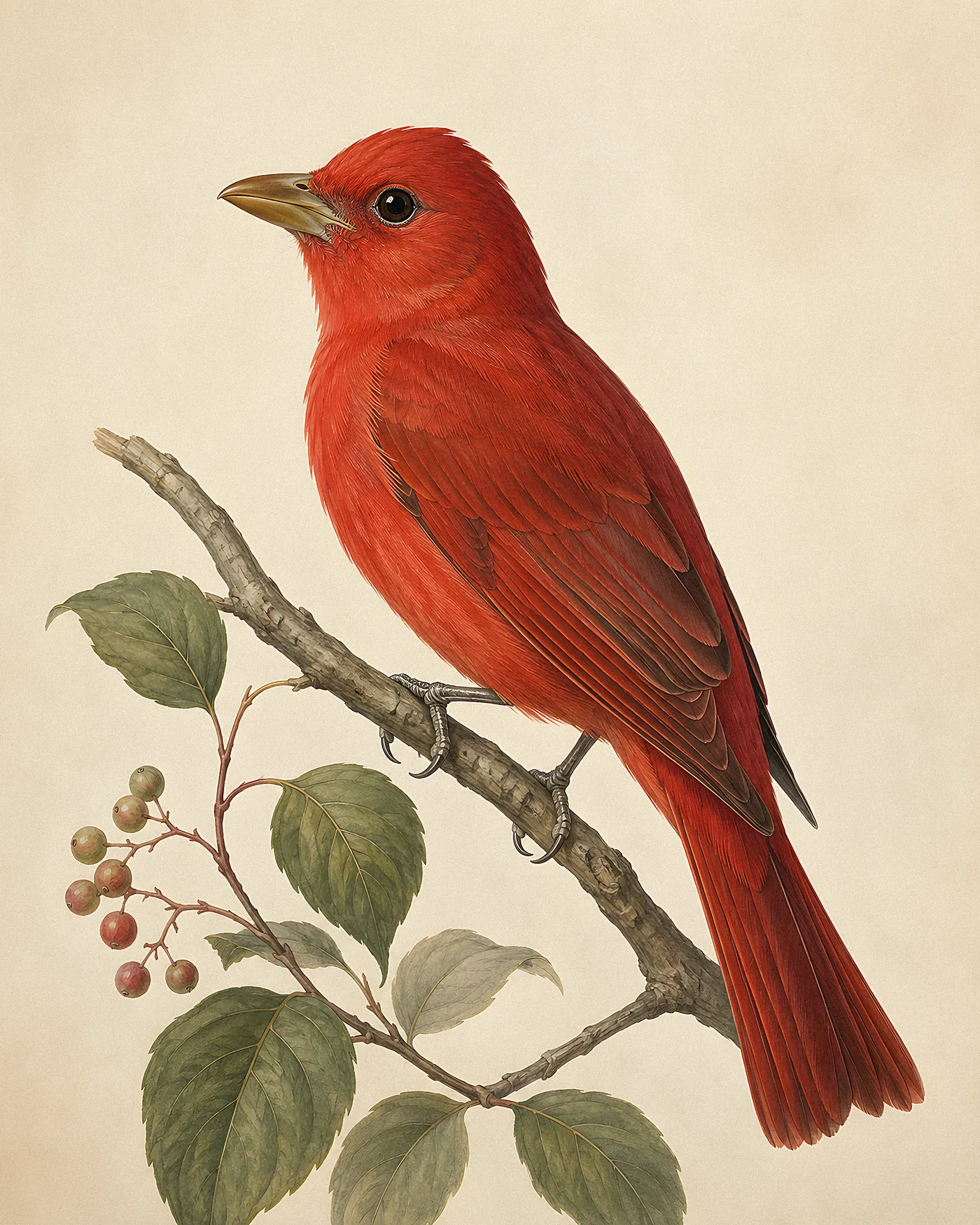
Scarlet Tanager
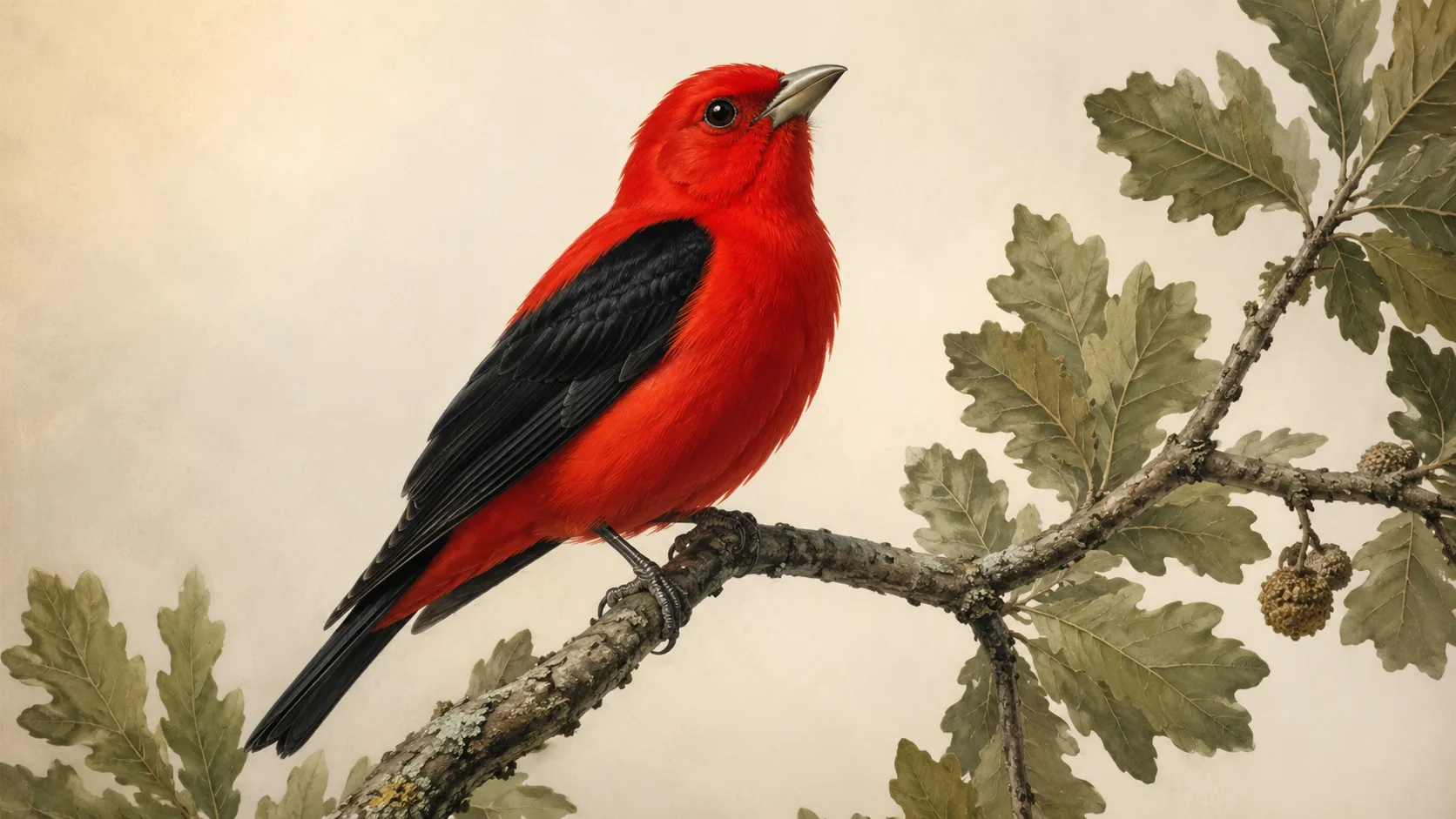
In late May, somewhere in a stand of mature oak in southern Ohio, there is a colour in the canopy that does not belong to anything else in the temperate world. It is sixty feet up, half-screened by new leaves, and it is the red of arterial blood set against wings of absolute black. A male Scarlet Tanager has come back from South America to breed, and he has brought with him the most startling plumage of any songbird in the eastern forest.
You will almost certainly not see him. That is the central fact of this bird. The colour is operatic and the bird is a ghost. He sings from the high crowns of tall trees, moves deliberately through the leaves, and the dense green of a closed-canopy forest swallows even that scarlet whole. Most people who know the Scarlet Tanager know him as a sound and a rumour. The sighting, when it comes, is a small event you remember for years.
What he looks like
The breeding male is unmistakable and almost impossible to confuse with anything else on the continent. The entire body is a deep, saturated scarlet. The wings and tail are solid jet-black, unmarked. There is no crest, no mask, no wing bar, nothing to complicate the two-colour design. The bill is pale, stout and slightly rounded, built for both seizing insects and handling fruit. The effect, in good light, is so vivid it reads as artificial.
The female is a different bird entirely. She is soft olive-yellow above and warmer yellow below, with darker olive-brown wings and tail. She carries no red at all. Where the male is a shout, she is camouflage, which serves her well on a nest set high in the leaves.
The autumn male is the strange one. After breeding, he moults out of his scarlet into a plumage close to the female’s olive-yellow, but he keeps the black wings and tail. For a few weeks in late summer he can look patchy and mottled, green and red at once, mid-transformation. By the time he migrates he is yellow-green, and he makes the journey to South America wearing the female’s colours, not his own. Cornell Lab measures the species at roughly 16 to 19 centimetres long, weighing between 23 and 38 grams, with a wingspan around 25 to 30 centimetres. He is robin-shaped but smaller and stockier, a compact bird with a heavy head.
What he sounds like
The song is the thing you learn first, because it is usually all you get. It is a burry, hurried series of four or five chirruping phrases, rising and falling, delivered from high in the canopy. The standard description, repeated everywhere because it is exactly right, is that he sounds like an American Robin with a sore throat. The phrasing is robin-like in shape but rougher, scratchier, as if the notes are being pushed through gravel.
The female sings too, a similar song but softer and with fewer syllables, usually from near the nest. Both sexes give the call that clinches the identification: a sharp, energetic chick-burr. Once you have it in your ear, it cuts through the forest noise and tells you a tanager is overhead, even when the bird stays hidden. In a summer wood full of robin-like song, the chick-burr is the tell.
Range and habitat
The Scarlet Tanager breeds across the eastern United States and into southeastern Canada, from the Great Lakes and New England south through the Appalachians, west to the eastern edge of the Great Plains. It is a true long-distance migrant. It winters in the forests of northwestern South America, on the eastern slope of the Andes and into the western Amazon basin, where Audubon notes it joins mixed-species foraging flocks alongside flycatchers, antbirds, woodcreepers and the resident tropical tanagers.
The habitat requirement is specific and it matters. This bird wants large, unbroken tracts of mature deciduous forest, especially oak, and it wants the closed canopy that comes with them. It is an area-sensitive species: small woodlots and fragmented forest do not hold it the way a big contiguous stand does. That preference is the root of its single greatest vulnerability, which surfaces at the nest.
Diet
Through the breeding season the Scarlet Tanager is overwhelmingly an insect-eater, and it hunts high. Audubon records a diet of caterpillars, moths, beetles, and a notable willingness to take wasps, bees, hornets and aphids, along with some spiders, snails, worms and millipedes. It forages deliberately in the tall trees, especially oaks, walking along branches in the high canopy and gleaning prey from leaves, bark and flowers. It will hover briefly to pluck an insect from the underside of a leaf, and it will sally out to snatch flying insects, including stinging ones, from the air.
In late summer and on migration, fruit becomes a larger part of the picture. The same stout bill that handles a hornet handles berries, and a southbound tanager will take soft fruit readily. It is not a feeder bird in any meaningful sense. You do not lure a Scarlet Tanager with sunflower seed. You get it, if you get it, by having the right forest.
Breeding and nesting
The female does the building, and she builds high. The nest is typically set well out on a horizontal limb, often fifteen metres or more above the ground and well away from the trunk, screened by leaves. It is a notably flimsy, shallow cup of twigs, grass and rootlets, put together in three or four days with relatively little time spent on it each day. From below it can be nearly invisible.
According to Cornell Lab, she lays a clutch of generally three to five eggs, most often four, pale blue-green with brown speckling. She alone incubates, for about twelve to fourteen days. The young leave the nest roughly nine to fifteen days after hatching, and the parents continue to feed the fledglings for about two more weeks before the family disperses ahead of the autumn migration. The species typically raises a single brood a year.
The cost of an open edge
Here is where the bird’s need for deep forest becomes a matter of survival. Where woodland is broken up by roads, fields and development, the Brown-headed Cowbird gets in. The cowbird lays its eggs in other birds’ nests, and the Scarlet Tanager is a frequent host. When a pair spots a female cowbird approaching, they will drive her off aggressively. When they miss her, she removes a tanager egg and replaces it with one of her own, and the tanagers cannot tell the difference, before or after it hatches. They raise the imposter alongside their own brood, at their own young’s expense.
Cowbirds hunt the edges. The more a forest is cut into fragments, the more edge there is, and the more exposed every tanager nest becomes. This is why forest fragmentation, rather than any direct persecution, is the long-term pressure on the species. The IUCN currently lists the Scarlet Tanager as Least Concern, and Partners in Flight estimates a global breeding population of around 2.6 million, rating it low on the continental concern scale. The bird is not in trouble today. But it is a species whose fate is tied directly to how much unbroken eastern forest we keep standing.
The Scarlet Tanager is the brightest bird in the eastern canopy and the one you are least likely to see, and what protects it is not a feeder but a forest left whole.
That is the quiet lesson of this bird. The most flamboyant colour in the woods belongs to a creature that asks only for big, intact forest and the privacy of the high leaves. Hear the chick-burr, find the patience to scan the crown of an oak for ten minutes, and you may be rewarded with the sight. If you are not, the song alone tells you the forest is still working.