Field Guide
American Dipper
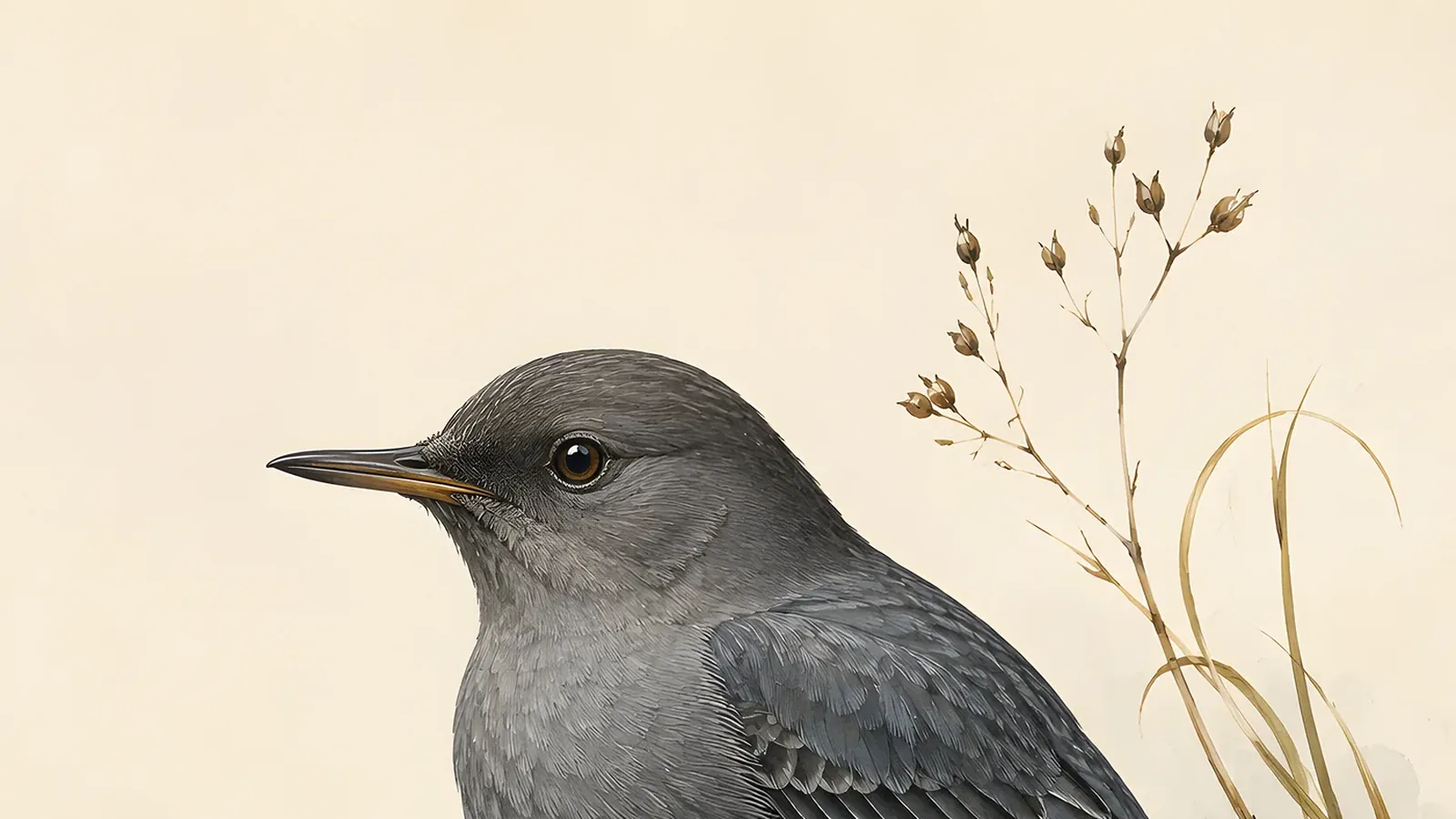
There is a bird standing on the floor of the river. The water is shallow, fast, and cold enough to numb a hand in thirty seconds, and the bird - a small, round, slate-grey thing, about the size of a plump wren - is entirely submerged, gripping the gravel with its claws, using its short wings as fins against the current, peering into the spaces between stones for the caddisfly larva it has been tracking for the last four seconds. Then it walks out onto a midstream rock, shakes once, and bobs. Always it bobs, a repetitive, almost mechanical dip from the knees, as if acknowledging the river it cannot leave.
Cinclus mexicanus, the American Dipper, is the only member of family Cinclidae to breed in North America. It is the continent’s sole truly aquatic songbird - not a diver that sings, but a passerine that has evolved, over millions of years, into something that treats rushing, ice-cold water as its primary hunting ground. No other North American songbird does what this bird does. The kingfisher plunges in and immediately comes back out. The dipper walks the bottom and stays.
What it looks like
The dipper is plain, deliberately so. It measures 14 to 20 centimetres in length, weighs 43 to 67 grams, and carries a wingspan of 25 to 28 centimetres. In silhouette it looks like a large wren - short tail often cocked, compact body, strong legs - but the plumage is a uniform, unbroken slate-grey, with a faint brown wash across the head and upper back. There is no wing bar, no eye ring, no field mark of any ambition. The bird identifies itself not by colour but by what it does.
The one ornament is the eyelid. The nictitating membrane - a white, translucent third eyelid shared by all birds but rarely noticed - is here made conspicuous by contrast. When the dipper blinks, a white arc sweeps across the dark eye, bright and startling. Birders who have watched this bird for years still reach for their binoculars at that flash.
The bill is short and straight, adapted for probing gravel. The feet are unwebbed - the dipper is not a waterfowl - but the toes grip stone with precision.
| Measurement | Range |
|---|---|
| Length | 14 - 20 cm |
| Weight | 43 - 67 g |
| Wingspan | 25 - 28 cm |
| Typical lifespan | ~7 years (oldest recorded: 8+ years) |
| IUCN status | Least Concern (LC) |
The only one that swims
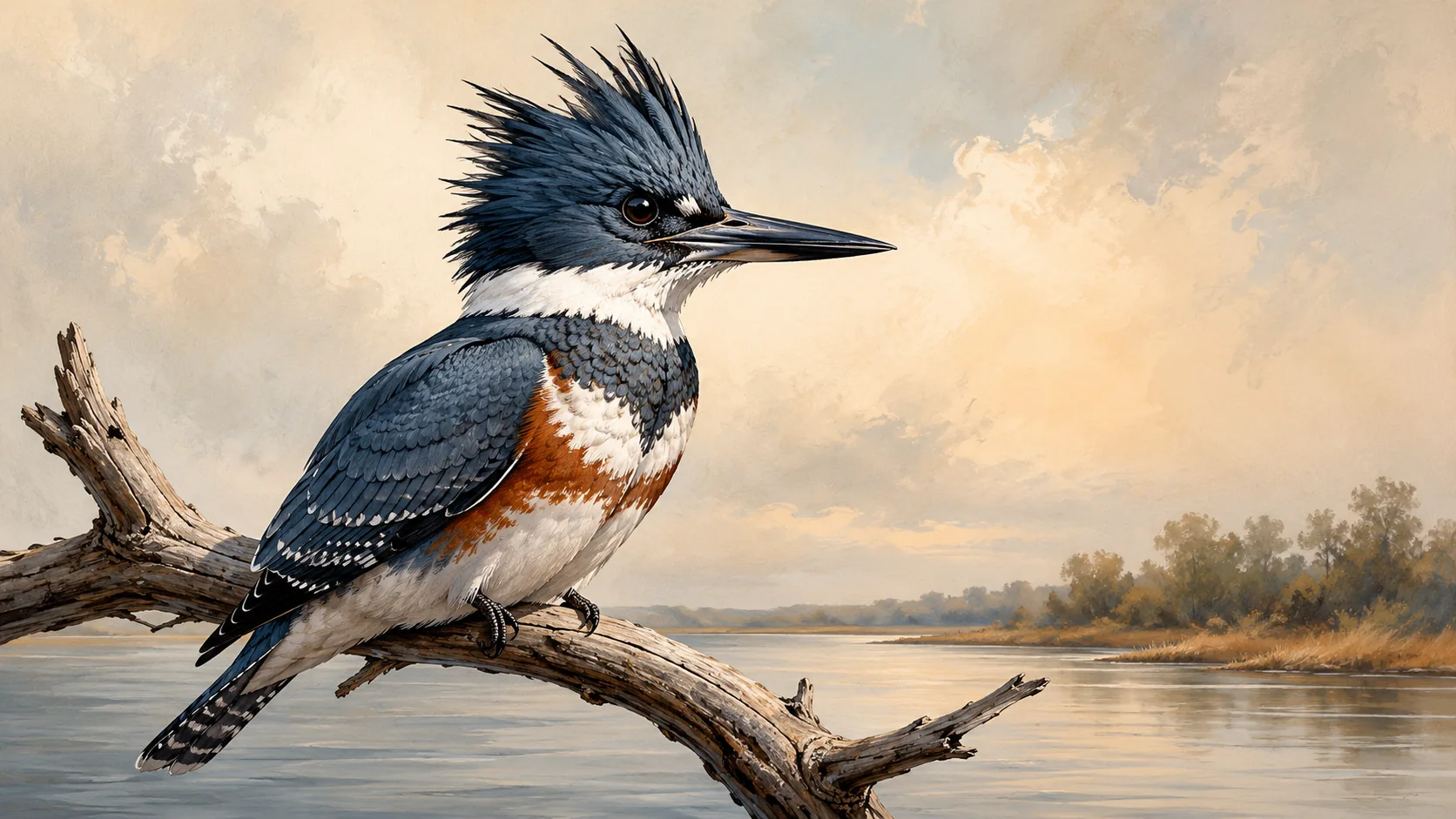
Of the roughly 5,000 passerines in the world, exactly five walk underwater for a living. All five are dippers. All belong to family Cinclidae. Cinclus mexicanus is the American species, and among North American songbirds it stands alone: the belted kingfisher plunges and retreats, the heron wades the shallows, the merganser dives and surfaces. None of them are passerines. None of them are songbirds. The dipper is.
The bird forages in fast, broken water: riffles, cascades, the channels between boulders where the current runs white. It walks into the flow from a midstream rock or directly from the bank, submerges without ceremony, and spends four to fifteen seconds underwater, probing the substrate. It also swims by rowing with its wings, using them as short, stiff paddles against the current rather than for propulsion in the aerial sense. The Audubon Society’s field guide puts it plainly: the dipper uses its wings to swim. A passerine. Using its wings. To swim.
The bobbing motion that names the bird is not nerves. It is linked to alertness and communication - frequency increases when the bird is excited or has spotted a rival. At rest between dives it dips steadily, like a clock ticking in the current.
Built for cold water
The Audubon Field Guide to North American Birds notes that the preen gland of Cinclus mexicanus is roughly ten times larger than that of any other songbird of similar size. The oil it produces is applied constantly to the dense outer plumage, keeping the skin dry during prolonged submersion in streams that run near freezing. The nictitating membrane covers the eye underwater, with enlarged sphincter muscles allowing the bird to focus at depth. Scaled nasal flaps close over the nostrils when submerged. The blood carries an unusually high concentration of haemoglobin, extending foraging time underwater. The metabolic rate is low, reducing heat loss in water that would kill most songbirds within minutes.
These adaptations together mean the dipper breeds year-round in Montana or Colorado or Oregon at elevations above 2,000 metres, hunting under ice shelves in January without retreating south. Most individuals are residents on their stretch of stream every month of the year.
Wayland, Kneteman, and Crosley (2006, Environmental Monitoring and Assessment 123: 285-298) demonstrated a further consequence: because the dipper eats invertebrates that concentrate pollutants, it becomes a measure of what is in the water. Their study on coal mine-affected streams in Alberta used dipper tissue as a direct index of selenium contamination. The bird is not just adapted to clean water. It stores the chemistry of dirty water in its body.
The song over the river
John Muir, who wrote “The Water-Ouzel” as the thirteenth chapter of The Mountains of California (1894) and who rarely overstated what a mountain showed him, called this bird the one that cheered him most in his wanderings - and noted the reason: “For both in winter and summer he sings, sweetly, cheerily, independent alike of sunshine and of love, requiring no other inspiration than the stream on which he dwells.”
Both sexes sing. The song is a long series of trills and repeated phrases, warm and slightly husky, carrying above the white noise of a rapid because it is built to do so. It sings on January mornings with ice on the banks, and in July with wildflowers up the canyon walls. The seasonal variable that triggers song in almost every other North American passerine - lengthening days, warming temperatures, the chemical cascade of spring - does not seem to apply here. The dipper requires only the stream.
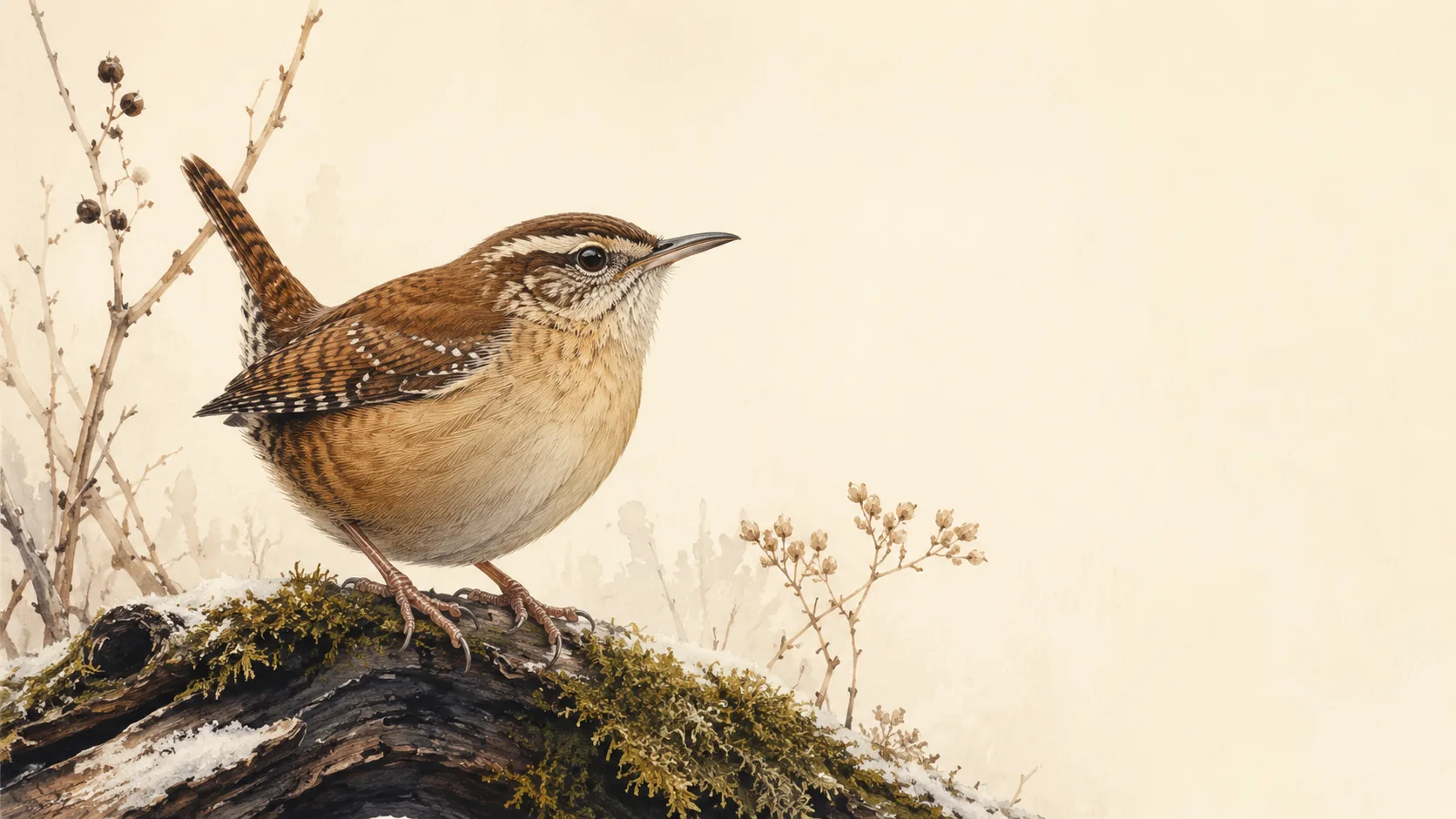
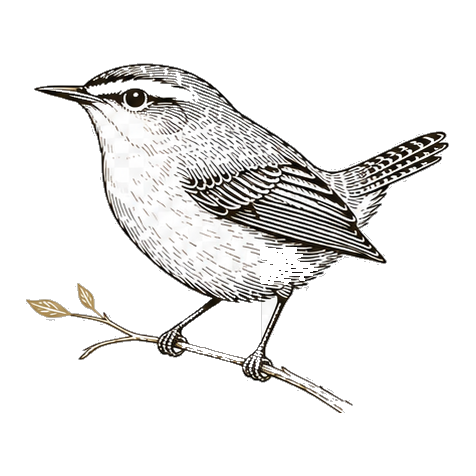
The Carolina wren also sings in winter, holding year-round territory. But the Carolina wren sings from sheltered thickets. The dipper sings from a rock in the middle of a river, water running white around its feet.
What it eats
The diet is almost entirely aquatic invertebrates, taken underwater by probing, turning stones, or picking larvae directly from the substrate. Caddisfly larvae (order Trichoptera), mayfly larvae (Ephemeroptera), and stonefly larvae (Plecoptera) form the core - the same EPT taxa used by stream ecologists to score water quality. The bird takes small fish and fish eggs opportunistically, and adult flying insects during emergence events.
Feck and Hall (2004, Freshwater Biology 49: 1123-1137), in a study of 32 dipper territories, found that birds selectively fed nestlings a higher proportion of EPT taxa than adults took for themselves. This foraging specificity is what makes the dipper so useful as a biological indicator: it is not sampling the water, it is sampling the macroinvertebrate community that lives in it. A stream that cannot support EPT cannot support a breeding dipper. A stream with breeding dippers, by definition, contains what EPT need to persist.
Range and what it certifies
Cinclus mexicanus breeds from the Brooks Range in Alaska south through the Rocky Mountains, the Cascades, and the Sierra Nevada to the highlands of Panama. Populations occur from sea level in coastal Alaska to above 3,600 metres in the Sierra Nevada. Most are sedentary. Where winter freezes lock a stream solid, birds may move downstream to find open water, but the movement is short - a few kilometres, not a migration.
The range map follows mountain water. Where there are fast, cold, clear, well-oxygenated streams, there may be dippers. Where there are not, there are not, and no argument will change that. The bird’s absence from a historically occupied stream is not ambiguous: something in the water has changed.
This is what the dipper certifies. Its presence tells you the stream is cold, clean, swift, and rich in benthic invertebrate life. Its absence tells you the opposite. Christy Morrissey of the University of Saskatchewan has documented how dipper breeding success tracks stream quality across the Coast Mountains of British Columbia - not as a proxy, but as a direct read of what the water contains.
A stream with a dipper pair raising young in Idaho or Washington or California is, in the plainest sense, a healthy stream. Not because the dipper is an emblem, but because it is incapable of choosing otherwise. Its biology will not allow it.
The bird standing on the riverbed, wings out against the current, is not demonstrating resilience or adaptation in the abstract. It is demonstrating that the stream it stands in is still doing what streams are supposed to do - running fast, staying cold, and growing enough life in its gravel to feed a songbird that evolved, over a very long time, to need exactly that.