Field Guide
Pine Grosbeak
A Pine Grosbeak feeds in a frosted mountain-ash on a still winter morning, plucking the frozen berries one by one, and it does not flush when you walk up to the tree. It does not flush when you stand beneath it. It goes on feeding, a large rosy finch the size of a small robin, unhurried and apparently untroubled by your presence. Thoreau, watching them in a New England winter, wrote that a male flew nearer out of curiosity and perched fearlessly within four feet. That tameness is the first thing anyone notices about the bird, and it has earned the species a reputation as the gentle giant of the finch family.
It is the largest of the true finches in North America, a bird of the far northern and high mountain forests that most people only meet when winter pushes it south or down to the valleys. Slow, plump, and confiding, it is the opposite of the restless little redpolls and siskins it sometimes shares a feeder with.
What he looks like
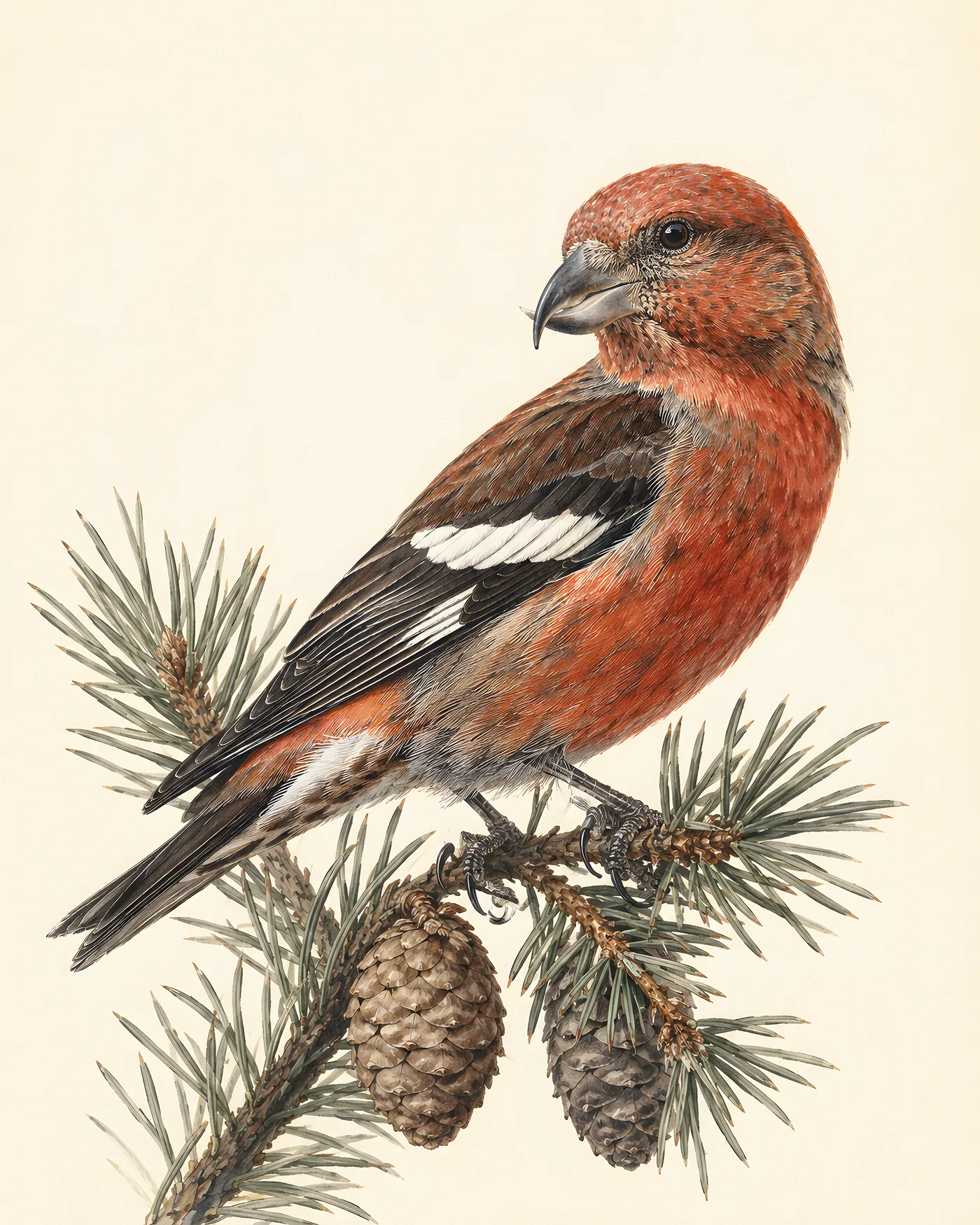
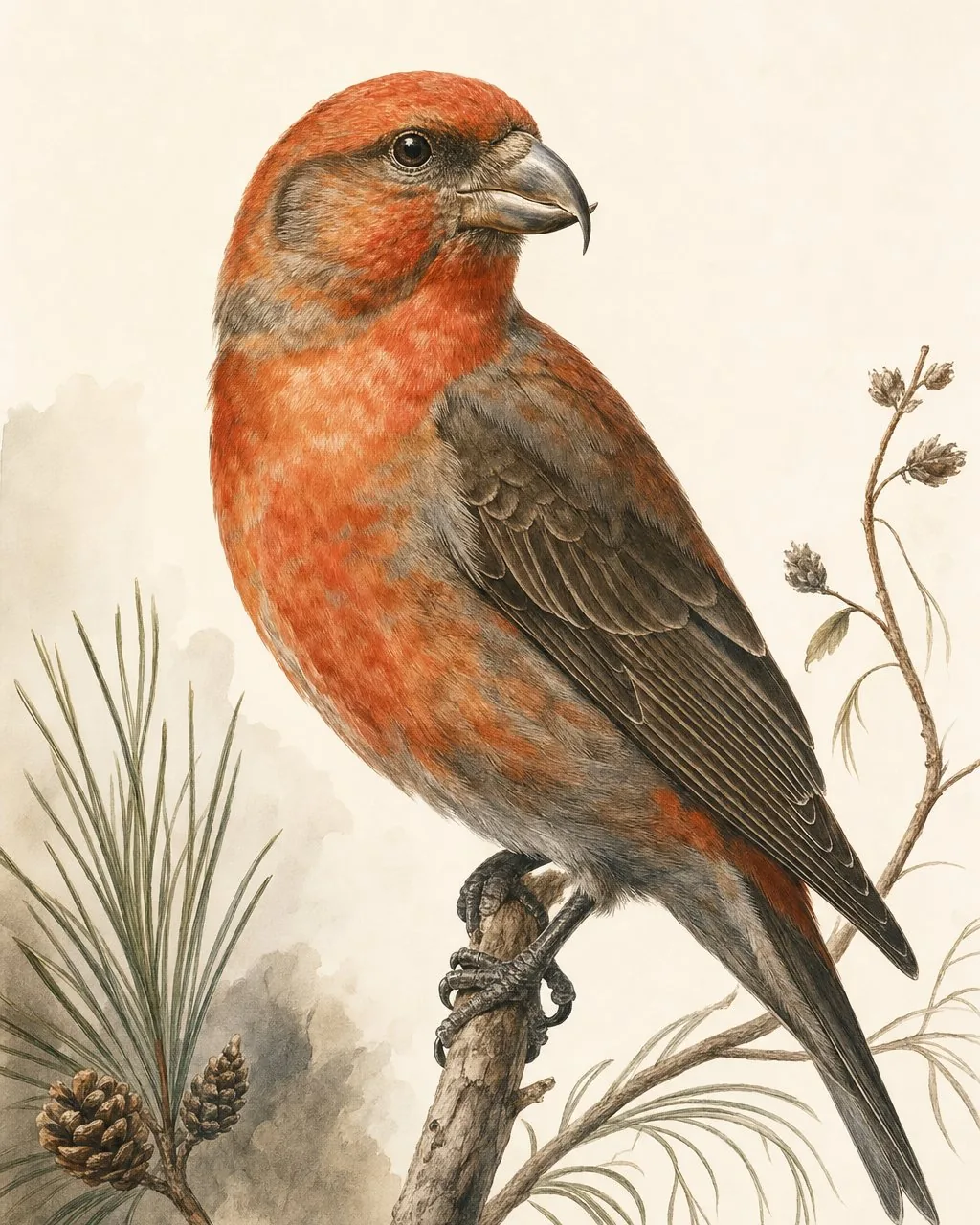
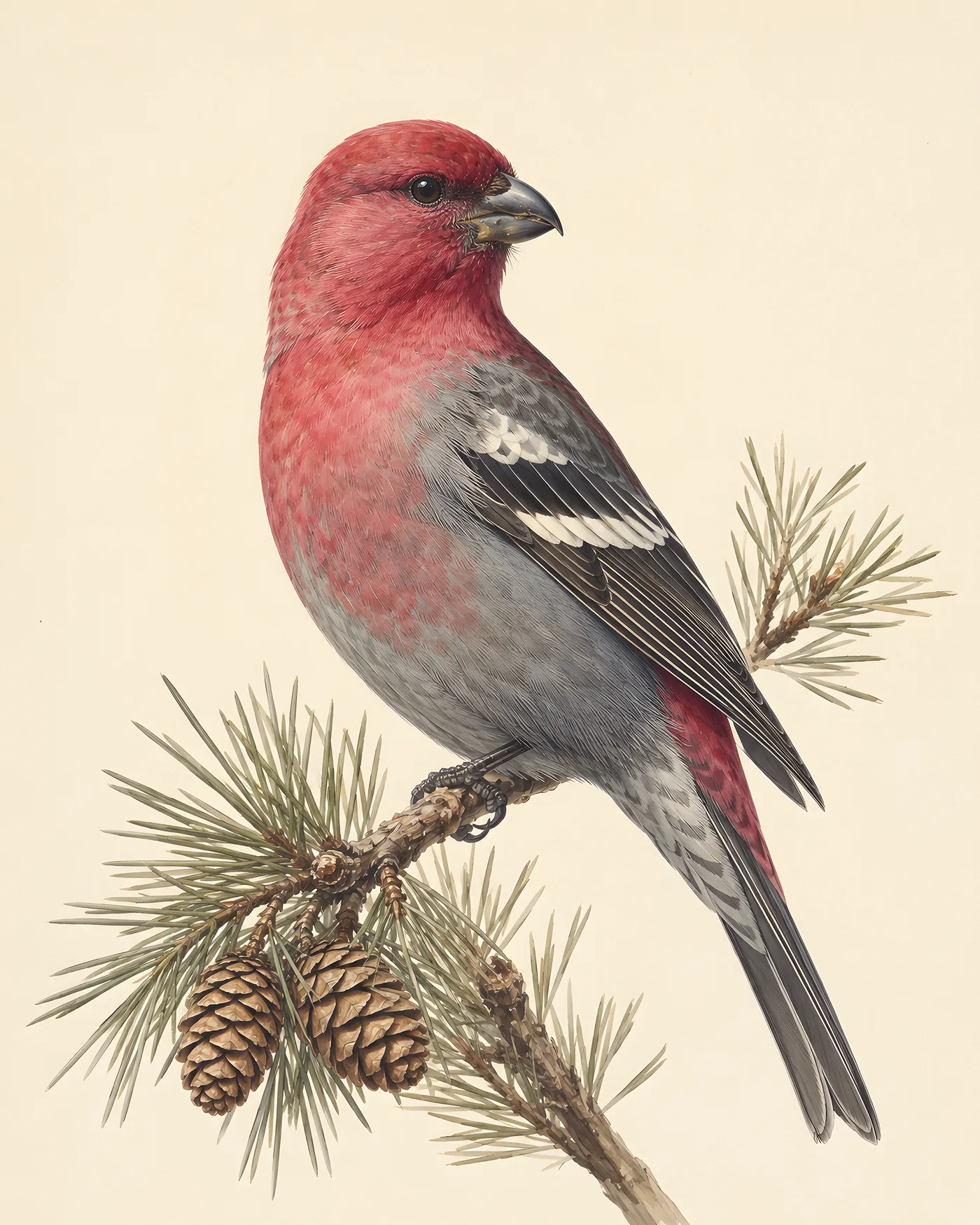
The adult male is a soft, deep rose-red over the head, breast and back, the colour washed and even rather than sharp, fading to grey on the belly and flanks. The wings and tail are dark grey, marked with two white wingbars. The bill is short, stout, dark and strongly curved, a blunt seed-and-bud tool. The overall impression is of a large, round, plump finch, heavier and longer-tailed than a House Finch by far.
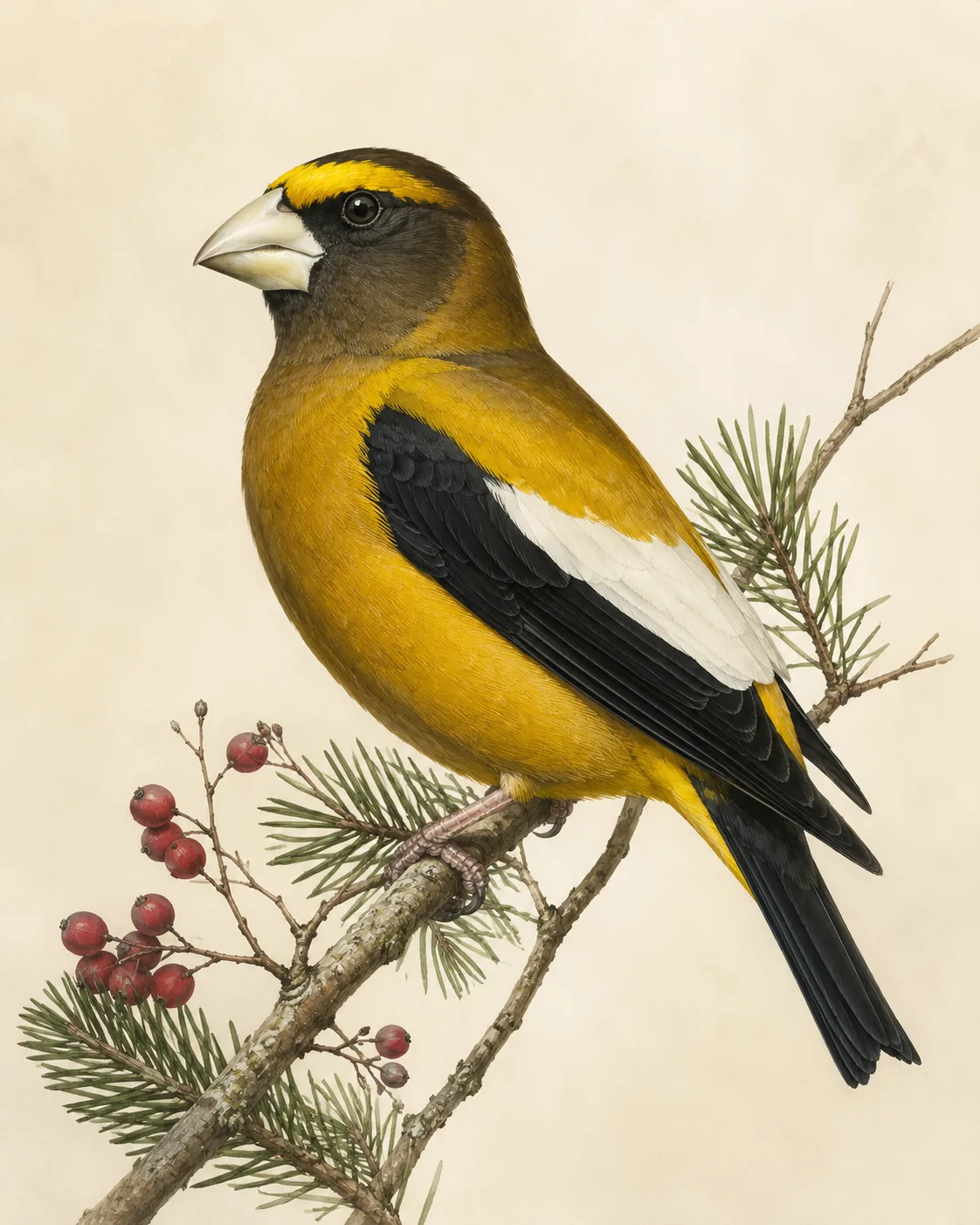
The female and young male are dressed in grey instead of red, with a head and rump washed a warm yellow-olive or russet, the same dark grey wings and white wingbars, and the same stubby curved bill. Cornell Lab notes that the species shows this strong difference between the rosy male and the grey-and-gold female, while both sexes keep the heavy build, the round head and the short hooked bill that mark the bird as a Pine Grosbeak rather than any smaller finch.
What he sounds like
For so large a finch the voice is gentle. The song, heard mostly on the breeding grounds from late spring into summer, is a rich, soft, musical warble, given from the top of a spruce or pine, rising and falling without harshness. Cornell Lab describes a sweet, flute-like quality to it, in keeping with the bird’s unhurried manner.
The call is a clear, whistled note, often a soft three-note tee-tee-tew or a musical pui pui, given in flight and among feeding birds. A small wintering flock keeps up a gentle, conversational whistling as it moves through the trees, a sound far softer than the dry chatter of the redpolls and crossbills it travels near.
Range and habitat
Pinicola enucleator is a circumpolar bird of the boreal and subalpine conifer forest, breeding across northern Alaska and Canada, through the mountains of the western United States, and right around the north of Europe and Asia. It nests in open spruce, fir and pine forest, often near the treeline, and in the mountain West it climbs to high elevation in the same conifer belt.
In winter it stays north where the food holds, but in lean years it drifts south and downslope in loose flocks, turning up in the northern United States, in mountain valleys, and at fruiting trees and feeders well below its breeding range. These movements are irruptive, tied to the seed and berry crop rather than to a fixed migration. The IUCN lists the Pine Grosbeak as Least Concern, with the very large range its circumpolar distribution gives it.
Diet
The Pine Grosbeak is very nearly vegetarian. Cornell Lab records a diet built almost entirely of the buds, seeds and fruits of trees and shrubs: spruce, pine and juniper, the catkins and seeds of birch and maple, and the berries of mountain-ash, crabapple and other fruiting trees, with weed seeds taken as well. In summer it adds some insects and spiders, and it feeds insects to its young, but the year-round staple is plant matter.
Winter fruit is what most often brings the bird into view. A heavily laden mountain-ash or crabapple can hold a feeding flock for days, the grosbeaks working slowly through the frozen berries, crushing them in the stout bill for the seeds inside. Because they feed so deliberately and tolerate a close approach, a fruiting tree full of Pine Grosbeaks is one of the easiest of all northern finches to watch at length.
Breeding and nesting
Breeding is a northern, high-country affair, timed to the short cool summer. The female builds the nest, placing it in a conifer near the trunk where dense growth hides it, usually a few metres up. Cornell Lab describes a loose foundation of evergreen twigs into which she weaves rootlets, finer twigs and grass, lining the cup with rootlets, lichen, soft grass and feathers.
She lays a clutch of around two to five blue-green, dark-spotted eggs and incubates them herself for roughly thirteen to fourteen days, fed by the male while she sits. Both adults then feed the young, which leave the nest a little over two weeks after hatching. The male carries food to the female and the nestlings in an expandable throat pouch, a feature shared with other northern finches, letting him gather a load of seed before the trip back to the well-hidden nest.
The largest and tamest of the finches will feed on frozen berries within a few feet of a watcher, unhurried and unafraid.
There is no better winter bird to meet than this one. It asks nothing of the watcher except stillness, and it rewards it generously, letting you stand close while it works a frosted tree. Find a mountain-ash still hung with berries after a hard freeze, wait quietly, and there is a fair chance a flock of rosy giants will drift in and let you watch them eat.