Field Guide
Belted Kingfisher
On a grey afternoon along almost any North American river, the first sign is the sound. A loud, dry, mechanical rattle, running down the watercourse like a stick dragged along railings, gets louder, and then a stocky blue-grey bird with an oversized head powers past low over the water on stiff, irregular wingbeats and lands on a bare branch. It sits. It watches. Then, without warning, it drops.
The Belted Kingfisher hunts by falling out of the sky into the river. It plunges head-first, eyes shut, seizes a small fish in a dagger of a bill, and labours back up to its perch to beat the catch senseless against the wood before swallowing it head-down so the fins fold flat going in. It is the rattling sentinel of clear water across the continent, and it is built for one job: looking down, and then going in after what it sees.
What she looks like
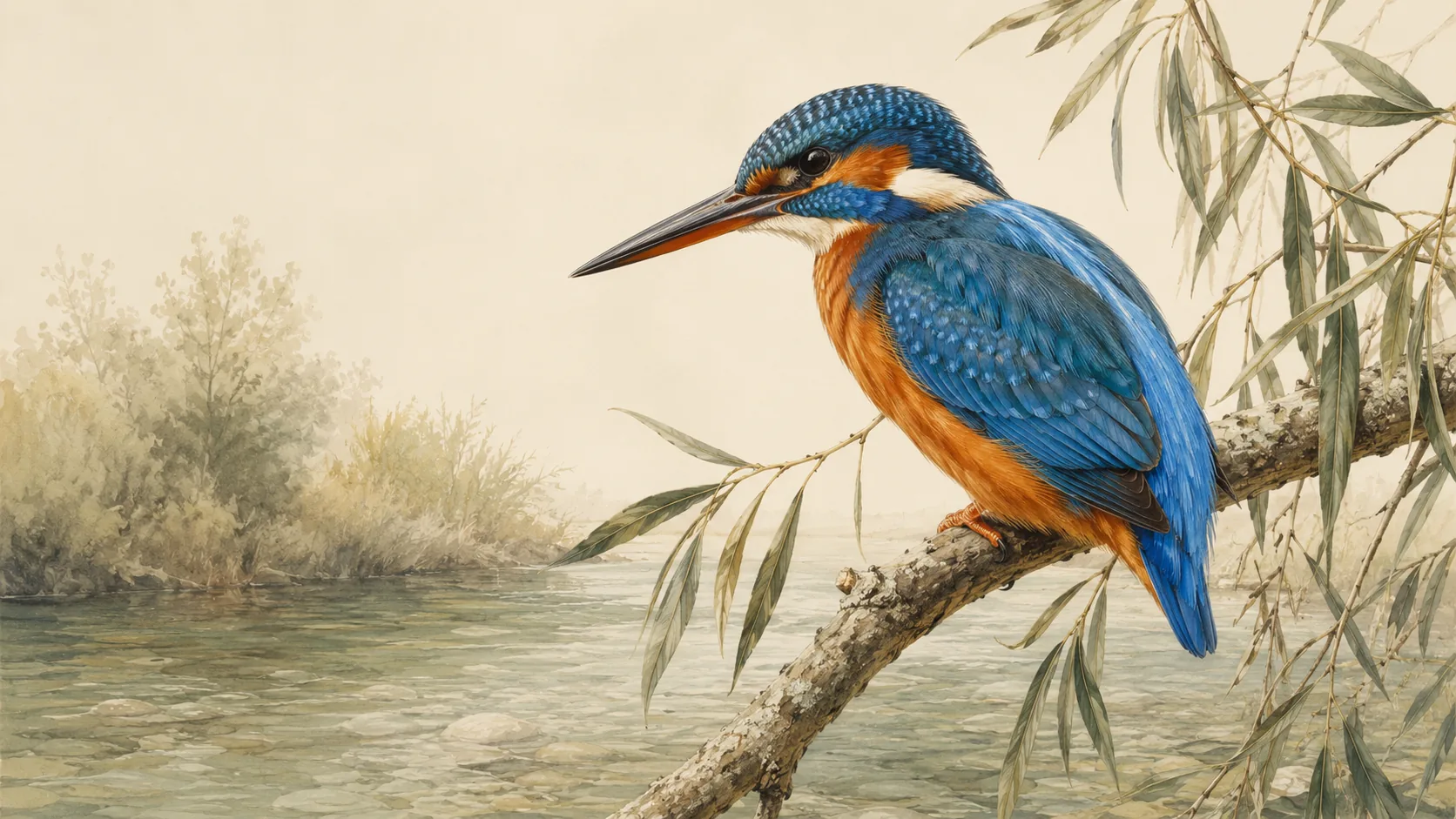
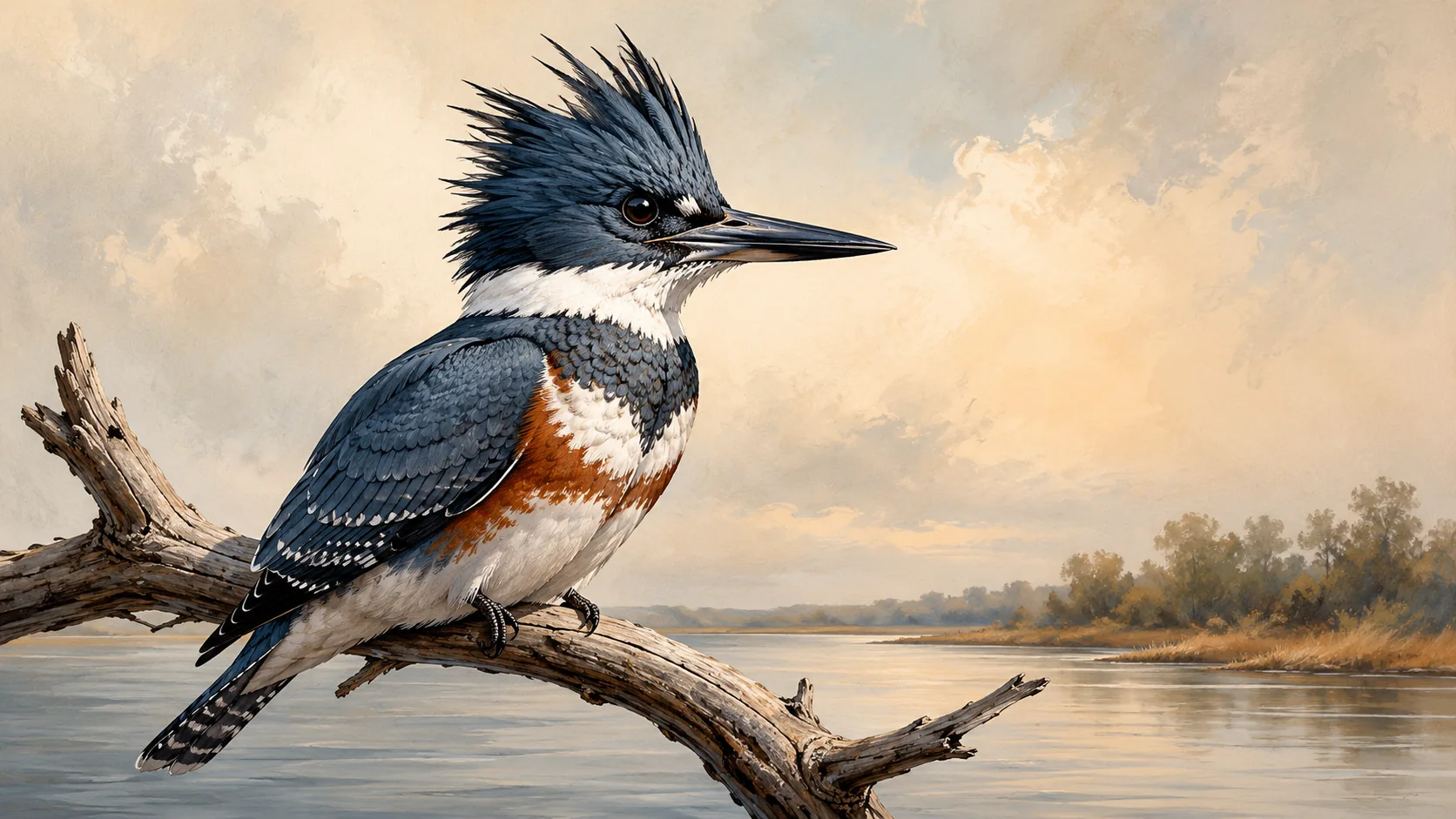
The Belted Kingfisher is top-heavy and big-headed, with a shaggy, double-pointed crest that it raises and lowers, and a heavy, dagger-shaped bill out of all proportion to the rest of it. The upperparts are a powdery slate-blue, broken by a white collar that wraps the neck. A broad blue-grey band crosses the white breast.
This is one of the small number of North American birds in which the female is the more colourful of the pair, a reversal of the usual rule. Cornell Lab notes that the male wears a single blue-grey breast band, while the female adds a second band of rich chestnut across the belly, with rufous washing down the flanks. Where a sexually dimorphic songbird almost always dresses the male in the brighter suit, the kingfisher does the opposite, and a birder learns to read sex by counting the bands.
Cornell Lab gives the bird a length of 28 to 35 centimetres, a weight of 140 to 170 grams, and a wingspan of 48 to 58 centimetres. The silhouette does most of the identifying: a stocky, short-tailed, big-headed shape on a bare snag over water, crest ragged, bill heavy, body tipped slightly forward as it scans the surface.
What he sounds like
The voice is the giveaway, and it travels. The signature call is a long, dry, uneven rattle, harsh and mechanical, given most often in flight as the bird moves between perches along a stretch of water. It is loud, it carries, and it announces the bird’s arrival long before the blue-grey shape resolves against the sky. Both sexes rattle. The call doubles as territorial advertisement and as alarm, and a kingfisher disturbed from its perch will almost always rattle as it flees downstream.
There is no song in the songbird sense. The kingfisher is not a passerine, and its repertoire is functional rather than musical: the rattle, harsher screaming notes during disputes, and softer calls between mates near the nest. The rattle is the one to learn. Once it is fixed in the ear, the bird is identified the moment it speaks, often before it is seen at all.
Range and habitat
The Belted Kingfisher is tied to water, and where there is open clear water with fish and a perch to watch from, the bird can occur across nearly all of North America. It breeds from Alaska and across Canada south through almost the whole of the United States, along rivers, streams, lakes, ponds, estuaries and sheltered coasts. The non-negotiable requirements are clear water shallow enough to hunt and an earthen bank steep enough to tunnel into.
It is a partial migrant. Audubon describes birds that stay through winter as far north as the southern coast of Alaska wherever water remains open and fish remain catchable, while others retreat south to Central America, the West Indies and northern South America. The trigger is ice. A kingfisher cannot hunt a frozen river, so the northern limit of its winter range is drawn not by cold itself but by the line beyond which the water locks shut. When the surface freezes, the bird moves.
Diet
The Belted Kingfisher is, above all, a fish-eater. Its staple is small fish taken near the surface of clear water, and Audubon lists trout, sticklebacks and mummichogs among the prey. To this it adds crayfish, frogs, tadpoles and aquatic insects, and on occasion it will take small mammals, young birds, reptiles and even berries when the chance arises.
The hunting method is the heart of the bird. It watches from a perch above the water, a branch, a wire, a rock, and when it locates a fish near the surface it plunges head-first into the water, eyes closed, to seize the prey. Where no perch is available it will hover on rapidly beating wings before the dive. Back on the branch, it beats the fish against the wood to subdue it, then swallows it head-first. The indigestible parts, bone and scale and shell, are later cast back up as pellets, much as an owl does.
Breeding and nesting
The nest is the most remarkable thing about the species, and it is invisible. Rather than build in a tree, the Belted Kingfisher excavates a burrow into a vertical earthen bank, usually beside or near water and often in sandy soil that digs easily. Both birds dig, loosening the soil with the bill and kicking it backward with their feet. Audubon gives a typical tunnel of two and a half to six feet, sloping gently upward from the entrance so that rainwater drains out rather than pooling around the eggs, and ending in an unlined nesting chamber.
Into that dark chamber the female lays a clutch that Audubon puts at six or seven eggs, sometimes five to eight. Both sexes share incubation, which Cornell Lab and Audubon give as 22 to 24 days. The young remain in the burrow for a long nestling period, leaving the nest around 27 to 29 days after hatching and then depending on their parents for roughly three further weeks while they learn to fish. Most pairs raise a single brood a year, though Audubon notes a second brood is possible in the south.
The behaviour worth watching
What rewards patience with a Belted Kingfisher is the dive. A bird settles on a bare branch over a clear pool, crest ragged, body tipped forward, head angled down at the water. For a long moment nothing happens. Then the calculation resolves, and the bird simply drops, folding into a head-first plunge that breaks the surface and, more often than not, comes back up with a fish crosswise in the bill.
Watch a stretch of river long enough and the whole economy of the bird reveals itself: the watching perch, the rattle as it shifts territory, the dive, the return, the workmanlike beating of the catch against the wood, the head-down swallow. It is a solitary, exacting life lived along a thin ribbon of water, and the bird defends its length of bank against all comers with that carrying rattle.
Here is a bird whose female wears the brighter plumage, and who raises her young in the dark at the end of a tunnel she dug with her own feet.
The Belted Kingfisher is common and widespread. Partners in Flight estimates a global breeding population of around 1.8 million, and the IUCN lists the species as Least Concern. Its fortunes are tied to clean water and to undisturbed earthen banks, the two things it cannot do without. Protect the river and the bank, and the rattle keeps coming back down the water every spring.