Field Guide
Phainopepla
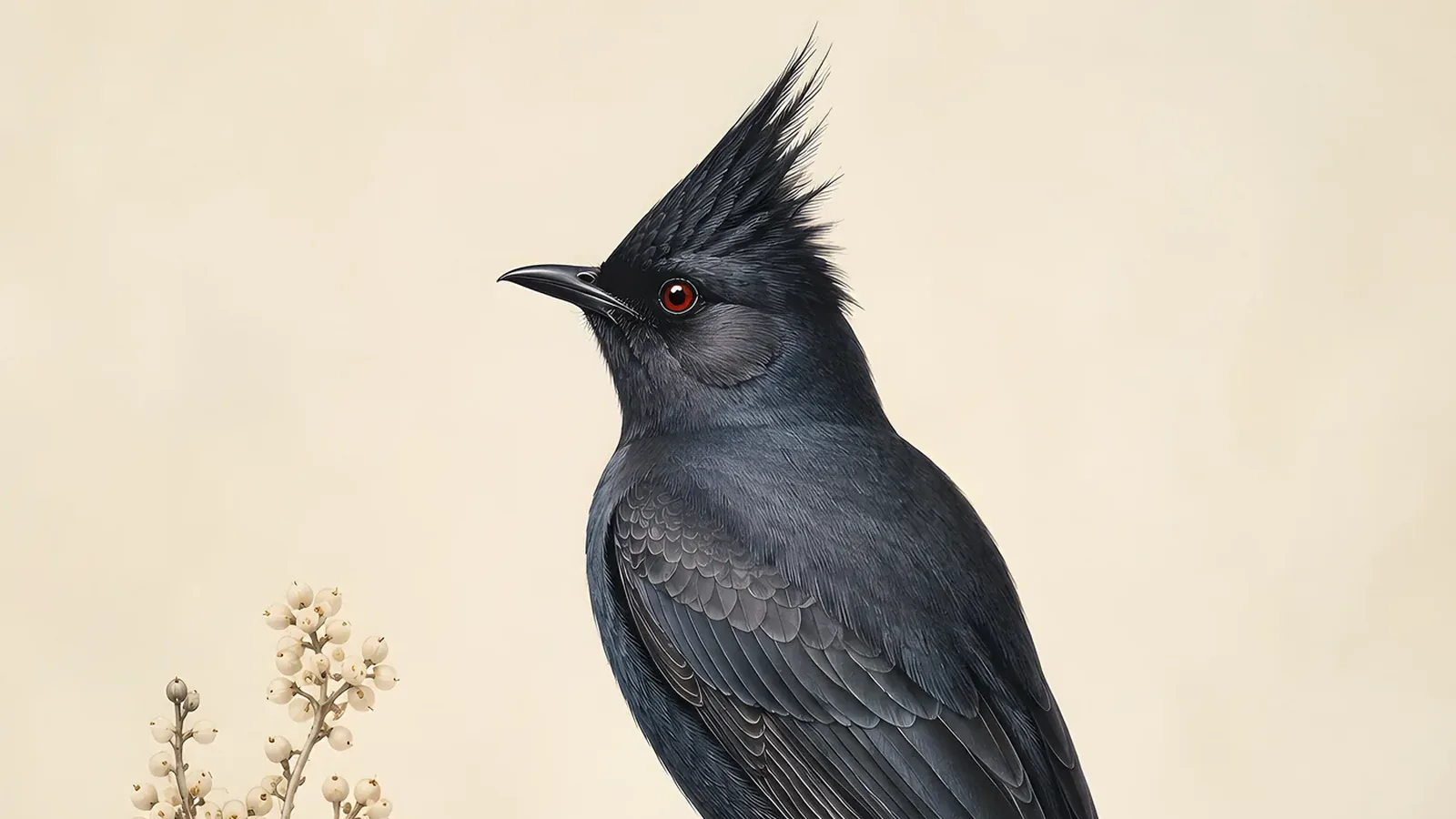
A mesquite in January, somewhere in Arizona. The tree is half-killed by drought, its bark the colour of old iron. High in the crown, a bird sits alone on the outermost branch. It is intensely black - not the flat black of a crow, but a wet, iridescent black that throws blue-green light when the sun catches it. A crest rises from its head like a thorn. Its eye is red, the red of a brake light. Hanging from the branches all around it, in great tangled clusters, is desert mistletoe. The bird watches. Then it drops into the thicket, swallows a berry, returns to its perch, and waits.
That transaction - a berry eaten, a seed deposited, the world slightly rearranged - is the centre of everything that matters about Phainopepla nitens.
What he looks like
The Phainopepla runs 18 to 21 centimetres long, weighs between 18 and 28 grams, and spans roughly 27 to 29 centimetres from wingtip to wingtip. By the numbers it is an ordinary-sized songbird. By appearance it is not ordinary at all.
The male is entirely, uncompromisingly black - the blackest bird most desert-goers will ever see this side of a raven, and far smaller. The plumage has an oily sheen, blue-green in direct light, that distinguishes it from any matt-black species. The crest is long and pointed, more blade than plume, and it rises fully when the bird is alert or agitated. The eye is a vivid, deep red. In flight, the white wing patches are large and startling, appearing from nowhere as the bird launches from a perch.
The female is a uniform slate grey with the same red eye and the same architecture - that tall crest, that long slim tail, those proportions that make the Phainopepla look like a bird built for velocity. Her wing patches show faintly pale rather than white. Juveniles of both sexes begin grey-brown and acquire adult colouration across their first year.
| Measurement | Range |
|---|---|
| Length | 18 - 21 cm |
| Weight | 18 - 28 g |
| Wingspan | 27 - 29 cm |
| IUCN Status | LC (Least Concern) |
| Family | Ptilogonatidae (silky-flycatchers) |
The family name tells you something useful. Ptilogonatidae are a small, mainly tropical family restricted to the Americas, and Phainopepla nitens is their northernmost outpost - the one that broke from the Mexican highlands and colonised the Sonoran and Mojave deserts. The common name is from the Greek: phainein (to show, to shine) and peplos (robe). The Shining Robe. It is, for once, accurate.
The mistletoe pact
Desert mistletoe (Phoradendron californicum) is a parasite. It drives haustorial roots into the branches of mesquite, palo verde, ironwood, and acacia, steals water and nutrients from its host, and grows into dense spherical masses that can weigh down whole limbs. From the tree’s point of view, it is a problem. From the Phainopepla’s point of view, it is a larder.
Walsberg (1975, The Condor) documented the terms of this arrangement. A single Phainopepla can consume more than 1,100 mistletoe berries in a day. Each berry passes through the digestive tract in as little as 12 minutes: the thin exocarp is stripped by the gizzard, the pulp is absorbed, and the sticky seed exits intact. Some seeds are wiped from the bill directly onto a branch. Others emerge in droppings. Either way, they land on wood, which is where mistletoe seeds must land to germinate.
Aukema (2002, Ecology) showed that Phainopeplas do not deposit seeds at random. They prefer to perch in tall, already-parasitized trees, which means seeds accumulate disproportionately on established mistletoe hosts. The effect is self-reinforcing: a tree already carrying mistletoe acquires more mistletoe because the Phainopepla keeps returning to eat from it. The bird is not managing the landscape consciously. But the landscape responds to its preferences as if it were.
The relationship runs in both directions. The Phainopepla depends on Phoradendron californicum so completely in the desert winter that the species’ entire geographic range in the Southwest is essentially a map of where the mistletoe grows.
This is the kind of mutualism ecologists call tight coupling. The mistletoe cannot spread without a disperser capable of depositing seeds onto branches rather than the ground. The Phainopepla cannot survive a desert January without a food source available when insects and other berries are scarce. Neither party chose the arrangement. Both are committed to it. Take one away and the desert ecosystem in question shifts in ways that are not yet fully understood.
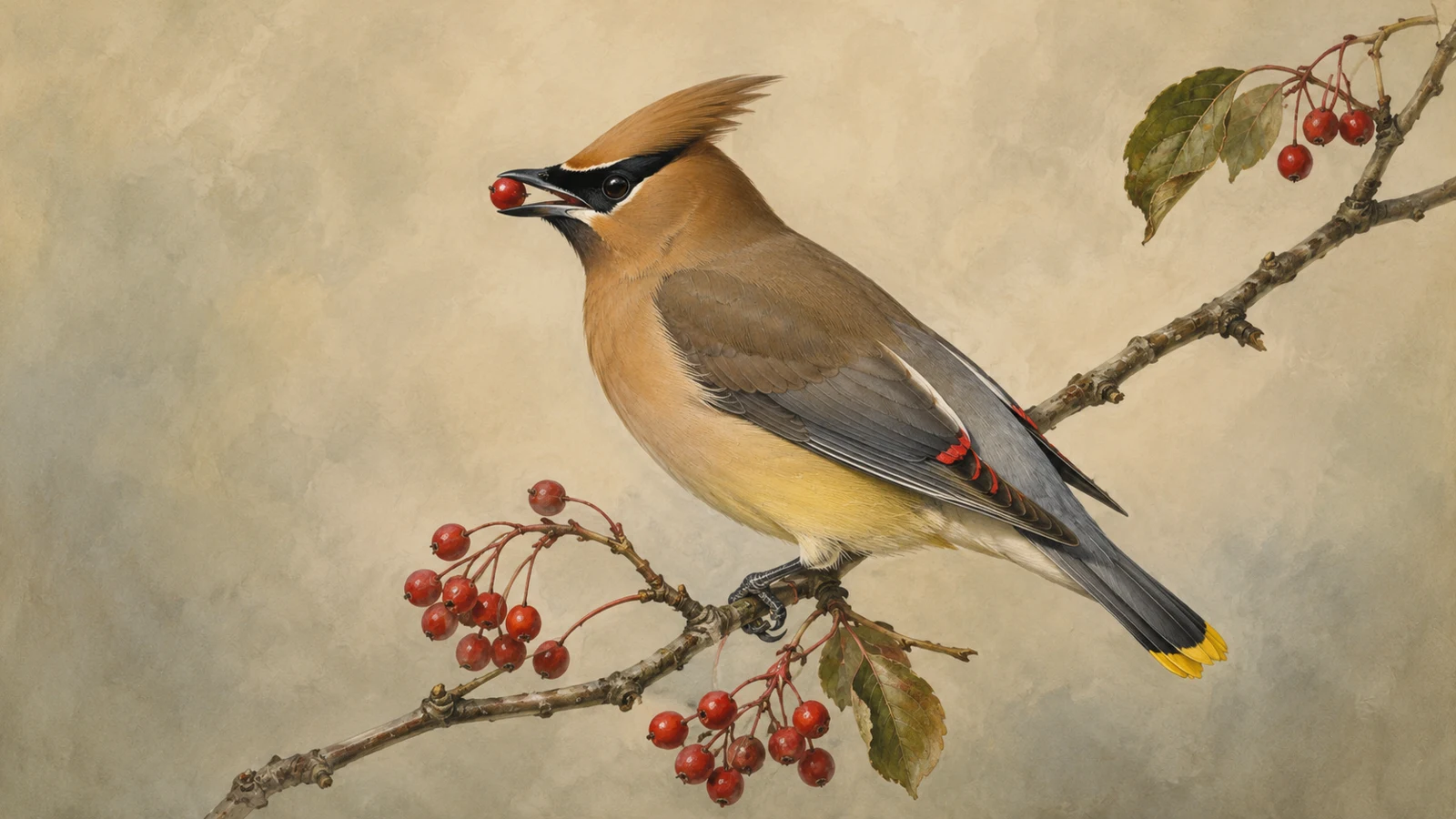
The cedar waxwing occupies a similar position in its own range - a fruit specialist that reshapes plant distributions wherever it passes. But the cedar waxwing ranges across an entire continent and eats dozens of fruit species. The Phainopepla in the desert draws its circle tighter. One bird, one parasite, one narrow arc of desert washes running through the American Southwest.
The double life
For decades, ornithologists noted something peculiar. In Arizona and California’s Sonoran Desert, Phainopeplas breed in early spring - February through April - in desert scrub, often defending mistletoe-laden mesquites as territories. Then the birds vanished. By May or June they appeared in California’s coastal oak woodlands and chaparral, breeding again, apparently, in cooler and wetter country at higher elevation. The question was whether these were the same birds making the journey, or different populations that happened to occupy different habitats at different times.
Baldassarre and colleagues (2019, The Auk: Ornithological Advances) put GPS tags on five free-flying individuals in southern California. All five birds bred in the desert first. Then, within 10 days of each other, they left - covering an average of 232 kilometres - and arrived in coastal woodland habitats that align with known summer breeding sites. Total annual movement per individual averaged 1,355 kilometres. Population genomic analysis found no genetic differentiation between desert breeders and woodland breeders, confirming the movement of individuals rather than the separation of populations.
The interpretation is striking: individual Phainopeplas may raise two broods in two entirely different habitats within a single calendar year, shifting ecosystems between them. If confirmed at scale, this would represent a form of itinerant double-breeding that has no known parallel among North American birds.
The authors are careful on the caveats. The GPS data alone cannot confirm that birds actually bred in the woodland habitat. The study tracked five individuals across one season, one potentially influenced by the 2015 to 2016 El Nino event. Direct observation of second breeding attempts in the woodland remains limited. The hypothesis is well-supported but not closed. What the study establishes with confidence is the movement itself, the habitat contrast, and the gene flow: the desert birds and the oak-woodland birds are the same birds.
The ecological logic is clear enough. Desert mistletoe berries peak in late winter. Oak and coffeeberry fruit in coastal woodlands peaks later. A bird that can track two fruiting windows in two climates, raising a brood in each, has found a solution to the calendar that most songbirds have not. Whether that solution is fully operative every year, or only under certain conditions, is an open question in Southwestern ornithology.
What he sounds like
Miyoko Chu (2001, The Condor: Ornithological Applications) recorded Phainopeplas producing 37 distinguishable vocalizations during capture, including imitations of at least 12 other species. The mimicry included red-tailed hawk screams and northern flicker calls - both alarm-associated sounds in other birds’ vocabularies. Chu found that Phainopeplas did not simply copy the most abundant species around them. The selection was apparently specific and consistent across habitats.
The everyday voice is quieter and more personal. The primary call is an up-slurred whistled hooeet - soft, almost questioning, easily missed against a desert wind. A second note, a low quirk, serves as a contact call between paired birds. The full warbling song is rarely delivered and rarely discussed, partly because the species reserves it and partly because the mimicry, when it occurs, is far more attention-grabbing.
A bird that can produce a convincing red-tailed hawk scream is doing something unusual. The function of the mimicry in the Phainopepla remains debated - deterring competitors, startling predators, or simply a vocal behaviour that was never selected against because it caused no harm. Whatever the reason, the Phainopepla’s voice is not what you expect from a bird that looks like a cut-out of pure desert sky.
Range and habitat
The Phainopepla’s permanent range runs from northern California through Nevada, Utah, Arizona, New Mexico, and Texas into Mexico’s Baja California and the central plateau. It is a bird of the arid Southwest: desert scrub dominated by mesquite and palo verde in spring, then shifting to oak woodlands, chaparral, and riparian corridors in summer. California holds some of the densest populations. New Mexico supports scattered but consistent breeding in the Rio Grande drainage.
The species does not migrate in the conventional sense. It relocates. The timing and direction of that relocation follow fruit availability more than season or latitude. In genuine desert winters, when mistletoe is fruiting and insects are absent, the bird anchors itself to a mistletoe territory and defends it aggressively. As temperatures rise and the berry supply diminishes, it moves to wherever the next fruit crop is coming in.
Non-breeding visitors appear occasionally in Texas - including the Chihuahuan Desert drainages - and very rarely push north of the established range into Nevada’s higher valleys.
Breeding
In the desert, Phainopepla nests are typically placed in the center of a mistletoe clump, four to twelve feet from the ground in mesquite or palo verde. The male builds the nest largely alone - a shallow cup of plant fibers, spider webs, and small leaves - and incubates the eggs alongside the female. Clutch size is typically two to three eggs, pale grey or pinkish-white, spotted with lavender and black. Incubation runs around 14 to 15 days. Young fledge at 18 to 19 days after hatching, according to documentation by the Cornell Lab of Ornithology.
The desert territory is held tightly. A paired male will chase intruders from a productive mistletoe clump with a persistence that seems disproportionate to his slight frame. Where mistletoe is abundant in riparian settings, breeding can become loosely colonial, with the aggression threshold dropping when food is not genuinely scarce.
In the coastal oak woodland phase - if the double-breeding hypothesis holds - pairs nest in streamside oaks and chaparral shrubs at greater heights, exploiting a different fruit community entirely. The same individual, in other words, learns two sets of nesting conditions, two defensive geometries, two food landscapes, in a single year. That is either a sign of unusual cognitive flexibility or evidence that the behaviour is deeply instilled and requires very little active learning. Given how little we can yet confirm, the honest answer is that we do not know which.
What we do know is this: a black bird with a red eye sits in a mistletoe-covered mesquite in January and eats a thousand berries. Each seed it deposits has a chance to become a new mistletoe plant on a new branch, which will feed a future Phainopepla that is not yet born. The desert keeps its accounts in a currency most visitors never notice. The Phainopepla is how the books balance.