Field Guide
Carolina Wren
On a January morning in coastal South Carolina, when the woodlands are bare and most songbirds have gone quiet, a noise erupts from a brushpile that sounds like it was made by something much larger. Teakettle-teakettle-teakettle. The source, when you find it, is 14 centimetres of cinnamon and attitude with its tail cocked up at the sky. Thryothorus ludovicianus - the Carolina Wren - is announcing that this territory belongs to it, and has for months, and will for months more, and the cold is not a relevant consideration.
This is the thesis the Carolina Wren argues with its entire life: persistence, not size, is the deciding variable in any territorial contest. It is the second-largest wren in the United States, which is a title that sounds grander than it is. It weighs between 18 and 23 grams. A standard AA battery weighs 23 grams. What the bird does with that weight is the interesting part.
What she looks like
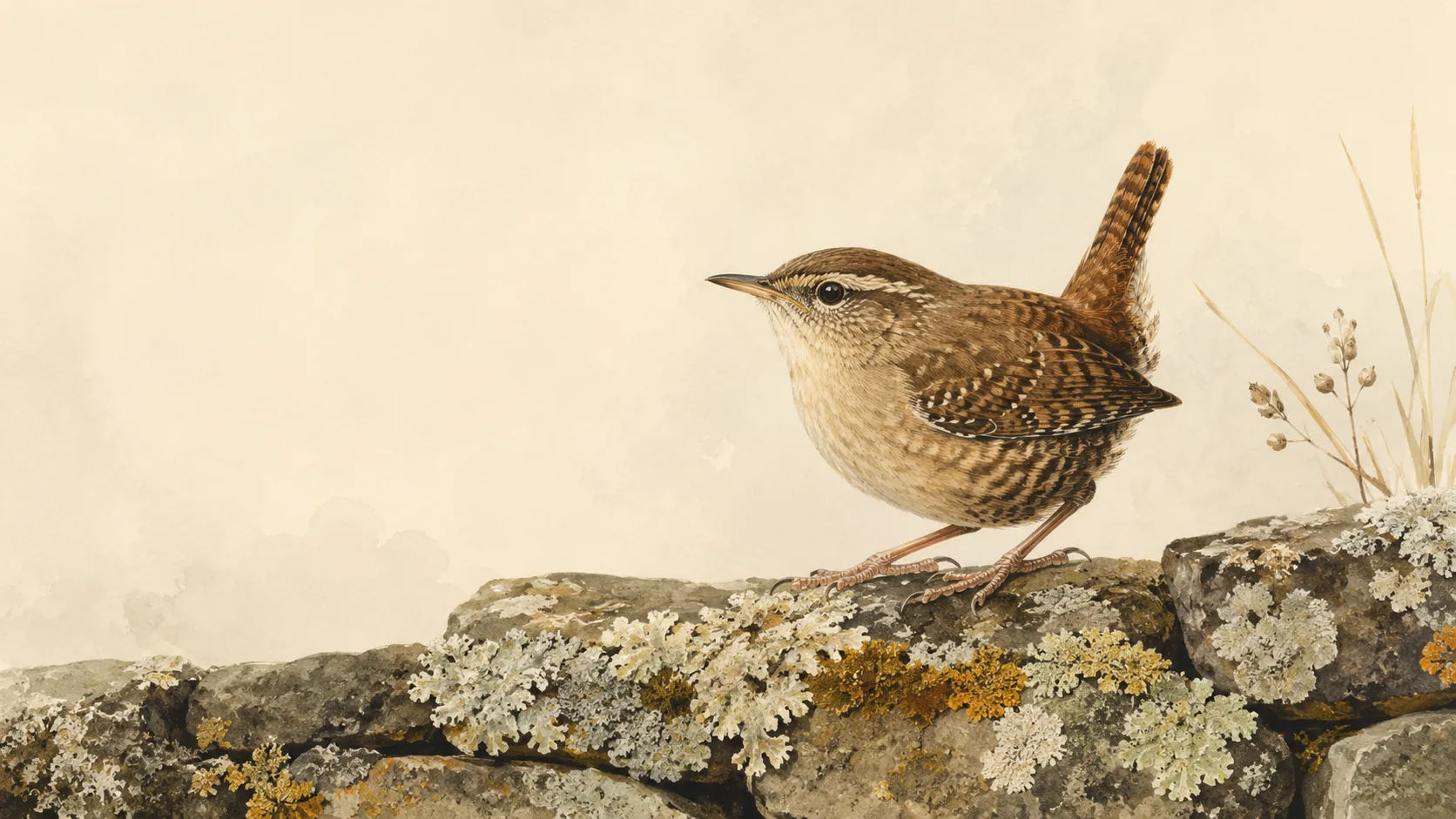
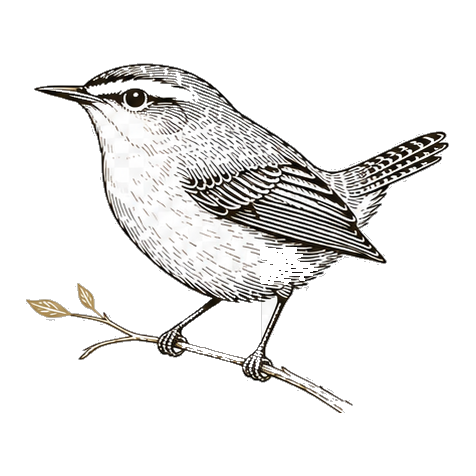
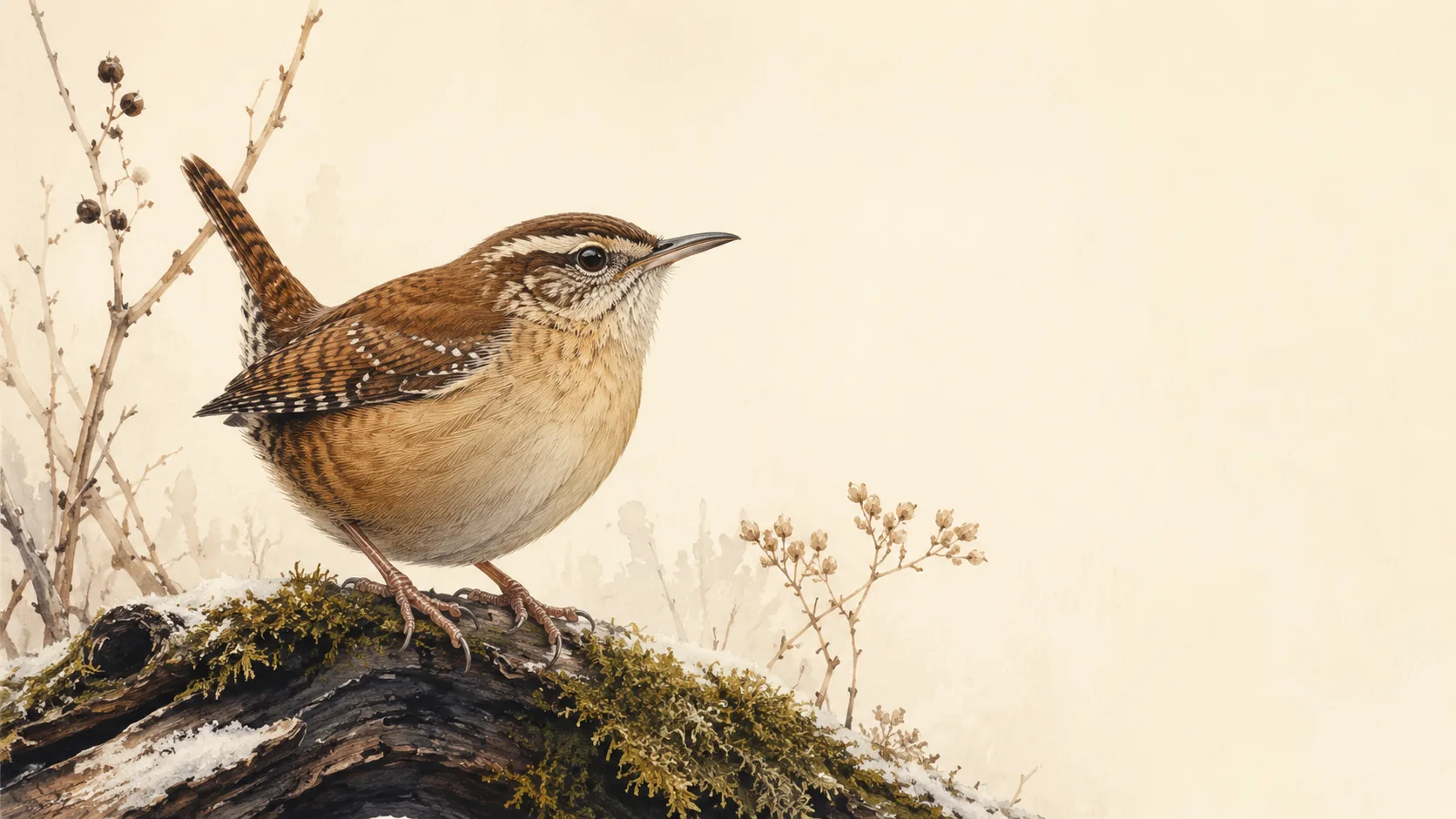
The Carolina Wren is unmistakable for anyone who has seen one. The upperparts run from rich chestnut on the back to deeper russet at the rump. The underparts are a warm cinnamon-buff, brightest on the flanks and fading to pale buff at the throat. The defining mark is the bold white supercilium - a broad stripe above each eye that extends back past the ear coverts - framed above by the rufous crown and below by a dusky cheek. Wings and tail are barred with fine dark lines. The bill is long, thin, and slightly curved downward, built for probing bark crevices and leaf litter rather than cracking seeds.
Males and females are nearly identical in plumage, though Cornell’s Birds of the World notes that males are on average about 11 per cent heavier and have measurably longer bills, wings, and legs. In the field, the difference is invisible. Size gives nothing away.
The tail, perpetually cocked upward at a near-vertical angle, is the silhouette that ID books lean on. In brushy cover, where the bird spends most of its time, the tail-up posture is often the first thing you see.
What he sounds like
The song carries the practical weight of the bird’s life. Cornell Lab documents a male’s repertoire at 32 or more distinct phrase patterns on average, delivered in bouts - the same phrase repeated roughly 15 times before switching to another. The sound most people transcribe as teakettle-teakettle-teakettle or cheery-cheery-cheery is loud enough to stop a conversation. In still woodland it carries well beyond the 50-metre radius most small songbirds achieve.
Only the male sings. He does it year-round, not as an incidental winter behaviour but as active territorial defence. One captive male, as reported by Cornell Lab’s All About Birds, sang nearly 3,000 times in a single day. The female’s contribution is a sharp rattling chatter - described in the literature as dit-dit - used in duets that coordinate pair movements across the territory.
This duetting matters. Pairs stay together on a defended territory for the whole year, foraging together and moving in tandem. When the male sings, the female answers. The territory is held jointly, and both birds appear to assess the boundary together. It is an unusual level of vocal cooperation for a passerine, and it seems connected to the pair bond’s stability: Carolina Wrens are known to mate for life, or close to it.
Range and habitat
The species’ breeding range covers the eastern United States from the Gulf Coast to southern Maine and southern Ontario, west to Kansas, Nebraska, and eastern Texas, with a separate population extending south through Mexico into Central America. It does not migrate. A pair that nests in a stand of bottomland hardwood in Virginia in June is almost certainly in the same territory in December.
This sedentary habit creates vulnerability. Carolina Wrens expanded steadily northward through the twentieth century, tracking warming winters. Cornell’s Birds of the World notes a population increase of over 1.5 per cent annually from 1966 to 2015 across northern regions. But severe ice storms or prolonged hard freezes can crash northern populations dramatically, because the bird cannot fly south to escape cold and cannot switch to seeds when the ground is locked. After brutal winters in the 1970s and 1990s, populations in New England and the upper Midwest collapsed temporarily. Recovery follows mild winters, not slowly but reliably.
Preferred habitat is dense, tangled woodland understorey: brushpiles, fallen logs, stream-edge thickets, and overgrown garden edges. The bird forages at or near ground level, hopping through leaf litter and probing bark crevices. It will use suburban gardens where mature shrubs and brush cover exist, and it will sometimes investigate open garages and garden sheds, which matters for nesting.
Diet
The diet runs overwhelmingly to invertebrates. Animal Diversity Web records a breakdown from foraging studies: caterpillars and moths make up roughly 22 per cent of prey items, bugs 19 per cent, beetles 14 per cent, grasshoppers and crickets 13 per cent, and spiders 11 per cent. Ants, wasps, bees, and flies fill out the remainder, with occasional small lizards or tree frogs taken when available. In winter, when insects are scarce, the bird shifts toward berries, seeds, and small fruits - though it never becomes the seed specialist that a chickadee or finch is. Suet feeders in winter can sustain Carolina Wrens through cold snaps, and backyard feeding has likely assisted the species’ northward range expansion.
Breeding and nesting
The breeding season runs from March through October, with most pairs raising two to three broods. The nest is an arch-shaped or domed structure tucked inside a natural or artificial cavity - a tree hollow, an old woodpecker hole, a nest box, or a crevice in a garden wall. The species’ tolerance for human structures is well documented: flowerpots, boots left on a porch, and open garage shelving have all been used as nest sites, sometimes in active use.
Both birds build the nest from leaves, bark strips, moss, and hair, with the female doing most of the final shaping. She alone incubates the three to six eggs for 12 to 16 days. Once the eggs hatch, both parents feed the nestlings, which fledge at around 12 to 14 days old.
The IUCN lists the Carolina Wren as Least Concern, with a stable to increasing population estimated by some sources at 17 million individuals.
The behaviour worth watching
The Carolina Wren’s most striking single trait is not the volume of its song but the consistency of its commitment to territory. Where most small birds compress their territorial singing into the breeding season and go quiet through winter, this species maintains a defended territory twelve months of the year, singing and defending it through cold and rain and short days with no apparent reduction in intensity.
This matters in a practical sense because it means the bird is visible and audible year-round in a way that most temperate songbirds are not. In mid-February, when the woodland has been grey and silent for weeks, the sudden teakettle-teakettle from a brushpile feels like a calendar event: something is holding its ground, and has been all winter, and intends to continue.
The loudest voice in many an eastern winter woodland weighs 20 grams. It has been singing since November. It will still be singing in August.
What the bird is actually advertising is not just territory but pair-bond continuity. The male sings because his mate is nearby and the boundary must be restated and the winter is not an excuse to stop. It is a small animal living a life of relentless specificity about where it belongs and what it intends to keep.
Whether that deserves to be called tenacity depends on how comfortable you are projecting intention onto a 20-gram bird. The behaviour is the same either way.