Field Guide
Eurasian Wren
On a cold morning in January, when the oaks are bare and the fieldfare are moving through the hawthorn, you hear it first: a long, rapid cascade of notes - clear and forceful and completely disproportionate to the body it comes from. Find the singer and you find one of Britain’s most counterintuitive birds. Troglodytes troglodytes weighs nine or ten grams. It fills a lane.
The thesis of the Eurasian Wren is proportion. Everything about this bird is calibrated at the wrong scale. The body is tiny - nine to ten centimetres long, lighter than a wren-sized leaf. The song, documented by the British Trust for Ornithology, is one of the highest-decibel outputs relative to body mass of any passerine in Europe. The territory is fiercely held. The nest count is absurd. The wren is not a small bird that behaves like a small bird. It is a small bird that has decided not to.
What it looks like
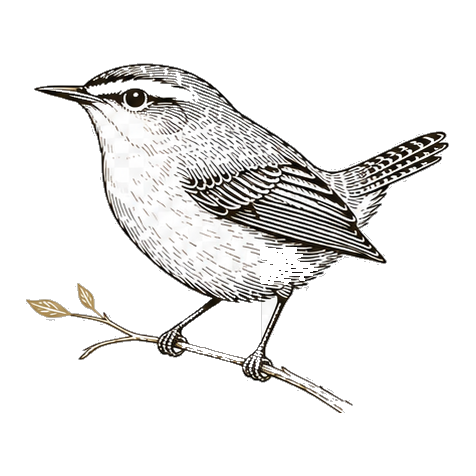
The Eurasian Wren is nine to ten centimetres long, weighing eight to 13 grams, with a wingspan of 13 to 17 centimetres. By any field-guide measure, it is one of Britain’s smallest resident birds, edged out only by the Goldcrest and Firecrest.
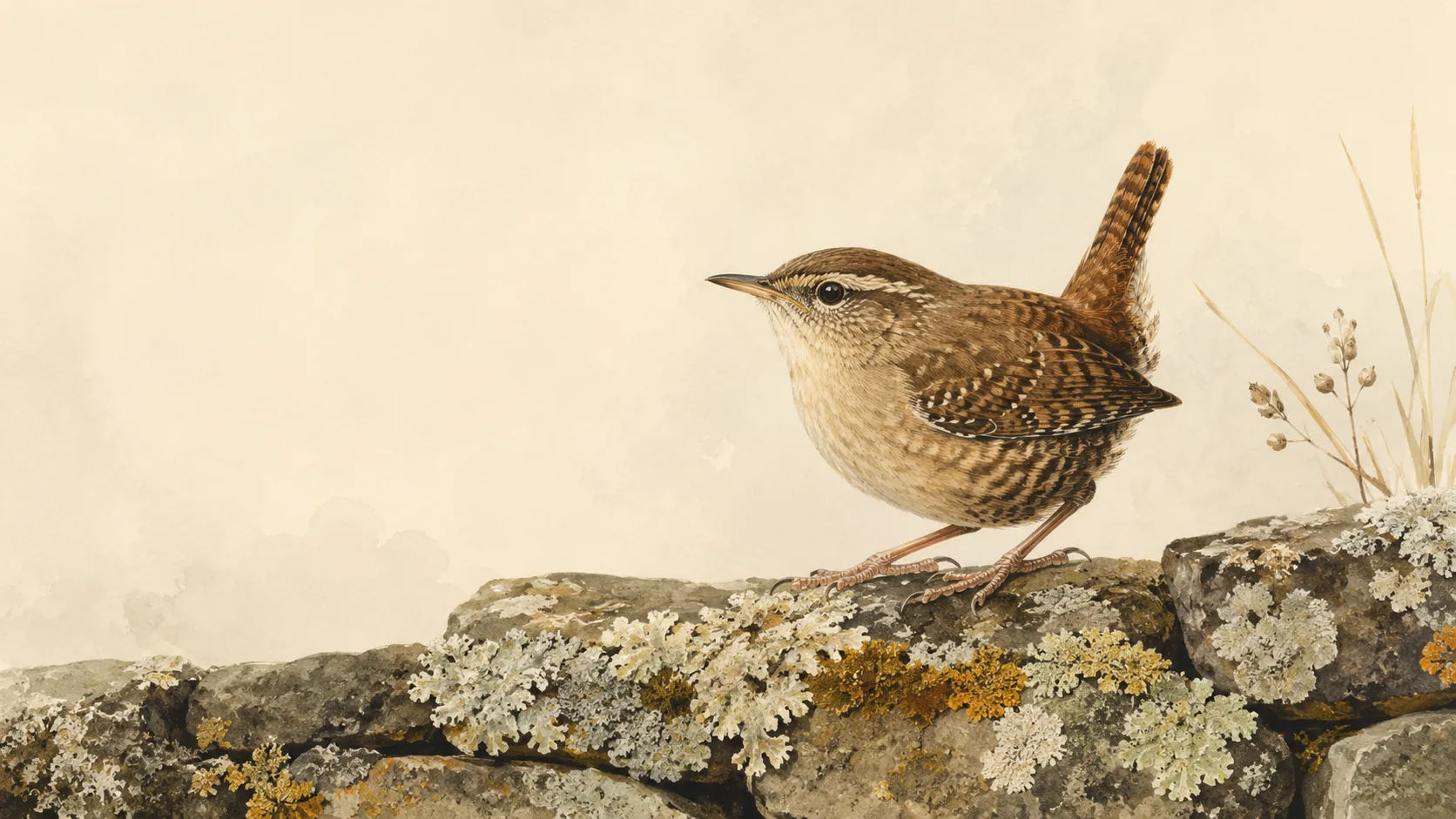
The plumage offers no drama. Rich chestnut-brown above, barred with fine dark cross-hatching on the wings and tail. Pale buff below, fading to cream on the throat. A pale supercilium - a narrow eyebrow stripe - cuts above the eye. The bill is thin, decurved, built for probing. The tail is short and almost always cocked upright, giving the bird a perky, almost confrontational posture even when it is simply standing still.
Males and females are identical. Juveniles look like adults with slightly softer, more uniform markings. In dim woodland understorey, where it spends most of its time, the wren is nearly invisible. You hear it long before you see it.
The BTO notes that 28 recognised subspecies exist across the species’ range, from the British Isles to Iceland, the Faroe Islands, Shetland, and east across Asia to Japan. The island subspecies of St Kilda and Fair Isle in Scotland are notably larger and darker, a textbook example of Bergmann’s rule playing out in an archipelago.
The voice
The song is the defining fact. A male wren produces a sustained, rapid trill - typically five to seven seconds of continuous sound - delivered from an exposed perch with visible physical effort. The RSPB describes it as “a succession of high-pitched whistles, ending with a trill.” That description is accurate and not quite adequate.
What the description cannot convey is the volume. A wren singing at full intensity in a quiet lane or winter hedgerow is audible at several hundred metres. The alarm call - a hard, repeated “tic-tic-tic,” or sometimes rendered as a churring rattle - is equally penetrating and delivered with the same conviction. For a bird that weighs less than a set of keys, the wren puts out sound on a scale that shames birds three or four times its size.
Wrens sing year-round in the UK, but song peaks in January through April, when males are establishing and defending territories before breeding begins. The January song is the wren at its most assertive - advertising a territory in conditions that most songbirds consider too cold to bother.
Range and habitat through the year
The Eurasian Wren is a year-round resident across virtually all of the British Isles. The BTO records the species as present in 98 per cent of UK breeding squares and 97 per cent of winter squares - a geographical coverage that almost no other resident bird can match. The wren is resident where the Red Kite is not, where the Barn Owl is not, where the Bullfinch is struggling. It lives everywhere.
Across its full range, the species extends from Iceland and the Faroe Islands through western and central Europe, across to Central Asia, the Himalayas, and east to Japan. The IUCN classifies it as Least Concern globally, with a European breeding population estimated at tens of millions of pairs.
In the UK, the BTO’s population monitoring records approximately 11 million territories, making the wren one of the most numerous breeding birds in Britain. The population increased by 118 per cent between 1967 and 2023, though the RSPB notes the species as Amber-listed on the UK Birds of Conservation Concern list because populations are vulnerable to sharp declines in severe winters.
Habitat is not the constraint. The wren occupies deciduous and mixed woodland, farmland hedgerows, upland heather moorland, coastal scrub, urban gardens, churchyards, cliff faces, and reed beds. The common thread is structural complexity - somewhere low, layered, and tangled, where the bird can move through dense cover at close range to the ground. It forages in the interstices of the landscape, the places too small and dark for most birds to bother with.
Diet
The wren eats insects and their larvae, spiders, millipedes, and other small invertebrates. In winter, when insect prey is reduced, it supplements with seeds and berries, and will occasionally forage for crumbs at feeding stations, though it is not a typical garden feeder bird in the way the Robin or Blue Tit is.
Foraging is conducted at low height, often on the ground or within centimetres of it, in leaf litter, along stone walls, under fallen timber, and in the root tangles of hedgerow bases. The decurved bill reaches into crevices. Near water, wrens regularly take aquatic invertebrates from stream margins, overhanging banks, and waterlogged wood.
The foraging style is restless and fast - short hops, a pause, a probe, a flick of the tail, another hop. The bird rarely pauses long enough to present a clear view.
Breeding and nesting
Breeding begins in mid-March and can extend to mid-August, with two broods typical. The clutch is five to seven eggs, incubated for 16 to 18 days, with fledging at 15 to 18 days. Standard small passerine chronology.
The nest is where the wren’s sense of proportion reasserts itself. A male constructs not one nest but several - typically six to 12 domed structures, built from moss, grass, leaves, and feathers, tucked into holes in banks, the roots of upturned trees, the tangled base of a hedge, a gap in a stone wall, or a dense climbing plant against a building. He builds all of them, often completing the exteriors before a female arrives on territory.
The female then inspects each nest, selects the one she finds acceptable, and lines it herself with feathers and hair. The rejected nests remain in the territory, unused. This investment - potentially 12 substantial nests in a season - is considerable for an animal of nine grams, and has no clear parallel in British garden birds of comparable size.
The mating system adds another layer. Males are frequently polygynous, pairing with multiple females on adjacent or overlapping territories. The BTO confirms this as a documented feature of the species’ breeding ecology. A successful male may provision two or three broods simultaneously from different nests, which, given the fledging data above, represents a significant energetic commitment.
The winter roost
The wren’s winter behaviour is the piece that earns a position in field notes. When temperatures fall, wrens roost communally - entering the same cavity in groups that can reach striking numbers. The highest recorded count is 61 birds, found in a Norfolk nest box in the winter of 1969. The birds pack tightly together, each one reducing heat loss by sharing the warmth of neighbours.
This is not typical passerine behaviour. Most small European birds roost singly or in loose, open flocks. The wren builds a communal sleeping arrangement that maximises thermal efficiency in the body with the least insulation. It is, in the plainest terms, the bird that invented the huddle.
It also explains why severe winters hit wren populations hard. The RSPB notes the species “can suffer declines following cold winters,” and the population data from the BTO bears this out in the long record. A sustained cold snap kills the insects the wren depends on and exposes the bird to the cold it has only partially solved. After mild winters, populations recover quickly. The birds breed twice, the broods are large, and the surplus pours back into the landscape by the following March.
The argument this bird makes
The Eurasian Wren does not read as a significant bird at first encounter. It is brown and small and fast. It skulks. The field guide entry is short.
What is worth stating plainly is that the wren is everywhere the field guide fails to follow: in the dark angles of the stone wall, in the leaf litter under the log pile, in the flooded ditch margin where no larger bird will go. It is the most widely distributed breeding bird in the British Isles by any honest reckoning of coverage. It produces the loudest song per gram of any British passerine. It builds more nests than it needs. It solves winter cold with communal physics.
The wren does not advertise itself. It sings from a twig inside a hedge, not from the top. The song carries. So does the bird.