Backyard
The Christmas birds (four backyard species who stay through winter)
Walk into any greeting card aisle in November and look at the birds. You will see, in rough order of frequency: Cardinals, Chickadees, Goldfinches, Bluebirds. You will also see a long tail of robins, doves, owls and Blue Jays. But the four that dominate the Christmas-card economy are the Cardinal, the Chickadee, the Goldfinch and the Bluebird. These are the Christmas birds, and they earn the title for a reason that does not have anything to do with religion.
The four species share one specific trait that almost no other brightly coloured North American songbird shares: they stay through winter. They do not migrate. They are visible in December gardens at exactly the moment when American culture turns to indoor warmth, mantelpiece decoration and the visual register of red, white and green. They are at the right place at the right time wearing the right colours.
This piece is about the four of them, what they need, and what it takes to host all four in a single garden through a single Q4.
The Cardinal
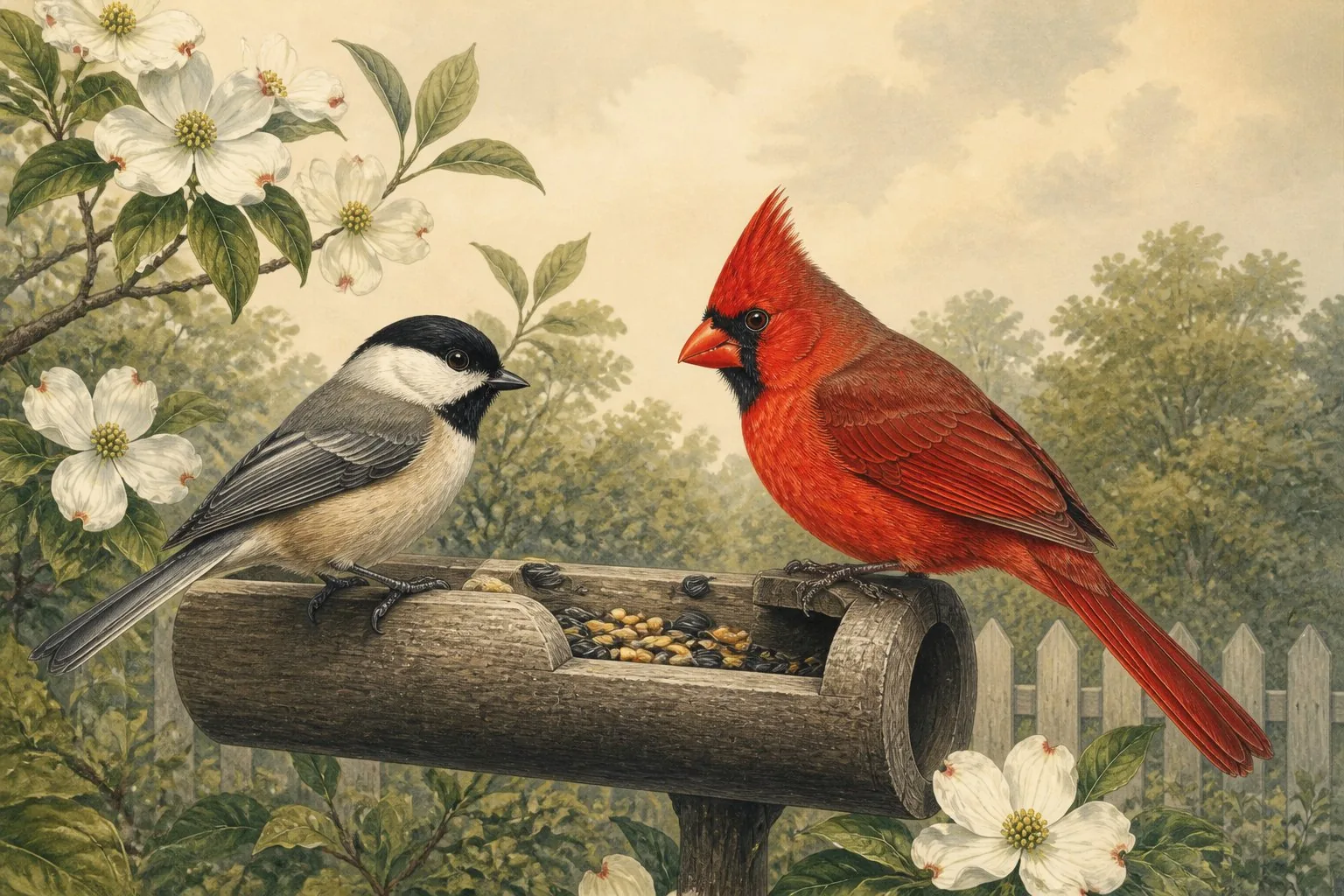
The headline bird. Bright crimson body, tall crest, coral-pink bill, year-round resident across the eastern half of North America. He does not migrate, he sings through winter, he stays paired with his mate, and he is, against a December feeder background, the highest-contrast colour in the entire backyard year.
Hosting him: black-oil sunflower seed in a hopper or platform feeder, dense shrub cover within three metres, ground feeding tolerated, water that does not freeze.
Full coverage: Northern Cardinal field guide, What to feed cardinals in winter, Cardinals in the snow, How to attract Northern Cardinals to your yard.
The Chickadee
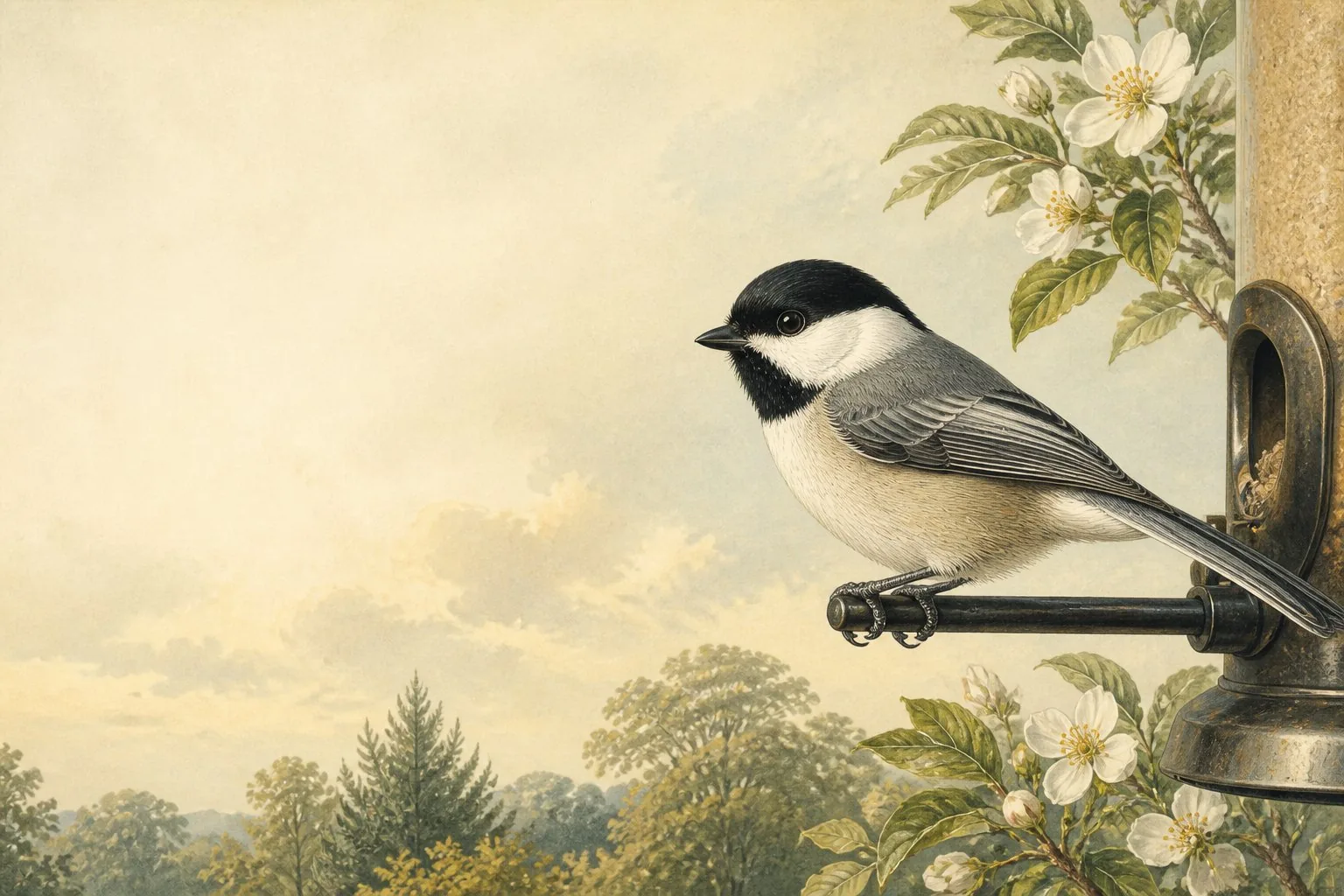
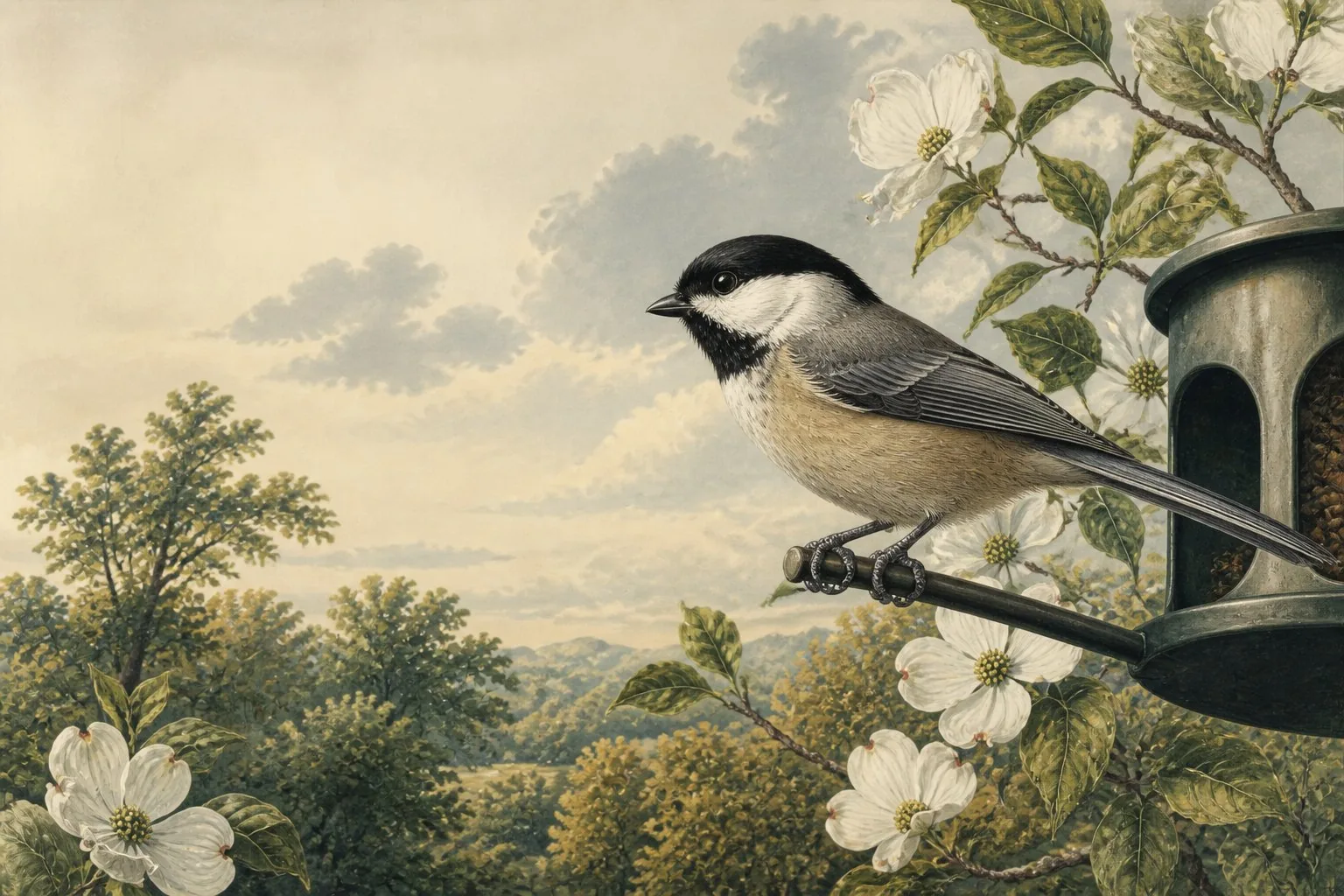
Small (12 to 14 cm), black-capped, white-cheeked, grey-bodied, soft buff flanks. Two species cover most of North America: the Black-capped Chickadee across the north and the Carolina Chickadee across the south. The two are nearly identical visually and hybridise along a narrow contact zone running roughly through Pennsylvania and the southern Midwest.
The chickadee earns his Christmas-bird status through three things. He stays for winter. He is the boldest bird at the feeder, almost tame around feeding humans, and the first species to find a new feeder when you put one up. And he is the only common backyard bird who calls his own name - the chick-a-dee-dee-dee alarm call, with the number of dee notes corresponding to the size of the threat (more dees, bigger threat - this is a real and reproducible finding from research at Cornell and the University of Washington in the 2000s).
Hosting him: sunflower hearts or whole sunflower in a tube feeder with small perches; suet in a cage feeder; mealworms in spring; dense shrubs.
The Goldfinch
The American Goldfinch is the most distinctive yellow bird at most backyard feeders. He is not bright yellow all year - the male moults into bright lemon-yellow in spring and breeds in May, then moults back to a duller olive-yellow in autumn. By December he is a muted bird, more olive than yellow, but still recognisable by the black wings, white wing bars, and small body.
The reason he qualifies as a Christmas bird despite his winter plumage being relatively muted is that he stays in nyjer-feeder yards in large social flocks. A goldfinch flock at a nyjer feeder in January is one of the busiest sights in winter backyard birding - 10 to 30 birds at a time on a single tube, calling continuously, dropping seed shells on the snow.
Hosting him: nyjer seed in a tube feeder designed for it; sunflower hearts; teasel and native composite seedheads left standing through winter.
The Bluebird
Eastern Bluebirds, in the eastern half of the country, are the fourth Christmas bird. They are small (16 to 21 cm), rich blue above with a chestnut breast and white belly. The male is the more vivid of the pair. They are not as universally winter-resident as the cardinal - many northern populations move south, with the species’ winter range extending further south than its breeding range - but in the southern half of the eastern US they hold territory all year, and in the northern half scattered pairs remain through mild winters.
The bluebird earns Christmas-card status through his blue-against-red-berries pairing. A male Eastern Bluebird on a holly branch in fresh snow is the second-most-photographed winter bird image after the Cardinal. The blue-and-red colour pairing pre-dates Christmas card iconography by centuries but reads, in December, as exactly the right palette.
Hosting him: mealworms (live or dried) on a small platform; a bluebird nest box (3.8 cm hole) mounted on a smooth metal pole; native fruiting shrubs.
The Mountain Bluebird
A note on geography. Mountain Bluebirds in the western US and Western Bluebirds in the Pacific states fill the same backyard niche but are not as commonly associated with Christmas card imagery, which was historically produced for the eastern US market. A Western Bluebird in California is the same kind of bird, doing the same kind of work, but did not enter the Christmas card economy through Louis Prang’s 1880s Boston output. The Eastern Bluebird is the Christmas bluebird by accident of which species the printer in Boston had access to.
Hosting all four in one garden
The garden requirements for the four birds overlap substantially. A single backyard can comfortably host all four through winter, with the right features.
| Need | Cardinal | Chickadee | Goldfinch | Bluebird |
|---|---|---|---|---|
| Feeder | Hopper, sunflower | Tube, sunflower or hearts | Tube, nyjer | Platform, mealworms |
| Cover | Dense shrub | Mixed evergreen and deciduous | Open with seedheads | Open with scattered trees |
| Water | Open at ground level | Same | Same | Same |
| Nest box | No (open-cup nester) | Yes (small hole) | No | Yes (3.8 cm hole) |
| Native plants | Dogwood, sumac, hawthorn | Birch, pine, alder for insects in summer | Native composites (echinacea, rudbeckia) for seedheads | Berry-producing shrubs |
The single garden upgrade that does the most for all four is dense layered planting: an evergreen layer for roosting, a deciduous shrub layer for cover, a fruit-bearing layer for winter food, and open ground with grass or low ground cover for foraging. Add three feeders (hopper for cardinals, tube for chickadees and finches, platform for bluebirds) and a heated birdbath, and you have a four-species winter habitat.
The reward for the work is the kind of December morning where all four species are visible from a single kitchen window at the same time. This is not common. It is also not exceptional. Backyard birders who report eBird checklists in mid-December across the eastern US frequently get all four on a single day. The infrastructure carries.
What this is really for
The Christmas birds are not religious symbols. They are not, in any historical sense, “of the season” - the season’s Christian iconography predates any North American knowledge of these species by centuries. The birds are Christmas birds because they are the brightly coloured residents of the December garden when most of the brightly coloured species have left.
They are also, increasingly, the way an American family keeps a connection to the natural world through the most indoor month of the year. The cardinal on the kitchen window in a Chicago January, the chickadee on the suet in a Minneapolis snowstorm, the goldfinch on the nyjer tube in a Pennsylvania ice storm, the bluebird on the holly in a Carolina mild winter day - all of these are reasons people who would not otherwise pay attention to birds wind up paying attention to birds.
If the Christmas card industry made these four into icons, the birds have done something more useful: they have made a December habit of attention to wildlife into a normal part of American domestic life. The cards are downstream of the actual relationship at the actual feeder.