Field Guide
Northern Cardinal
The Northern Cardinal is the only North American songbird that is the same colour all year, the same shape his whole life, and the state bird of seven US states. No other species claims that many. The Western Meadowlark holds six. The American Robin holds three. The cardinal holds Illinois, Indiana, Kentucky, North Carolina, Ohio, Virginia and West Virginia, a contiguous block from the Great Lakes to the southern Appalachians, and the bird does not migrate out of any of them.
A male in good March light, perched on a leafless branch against fresh snow, is the most-photographed wild bird in North America. He is also the bird that has done more for backyard feeder culture in the United States than any other species. The contrast against winter is the engine.
Plumage and identification
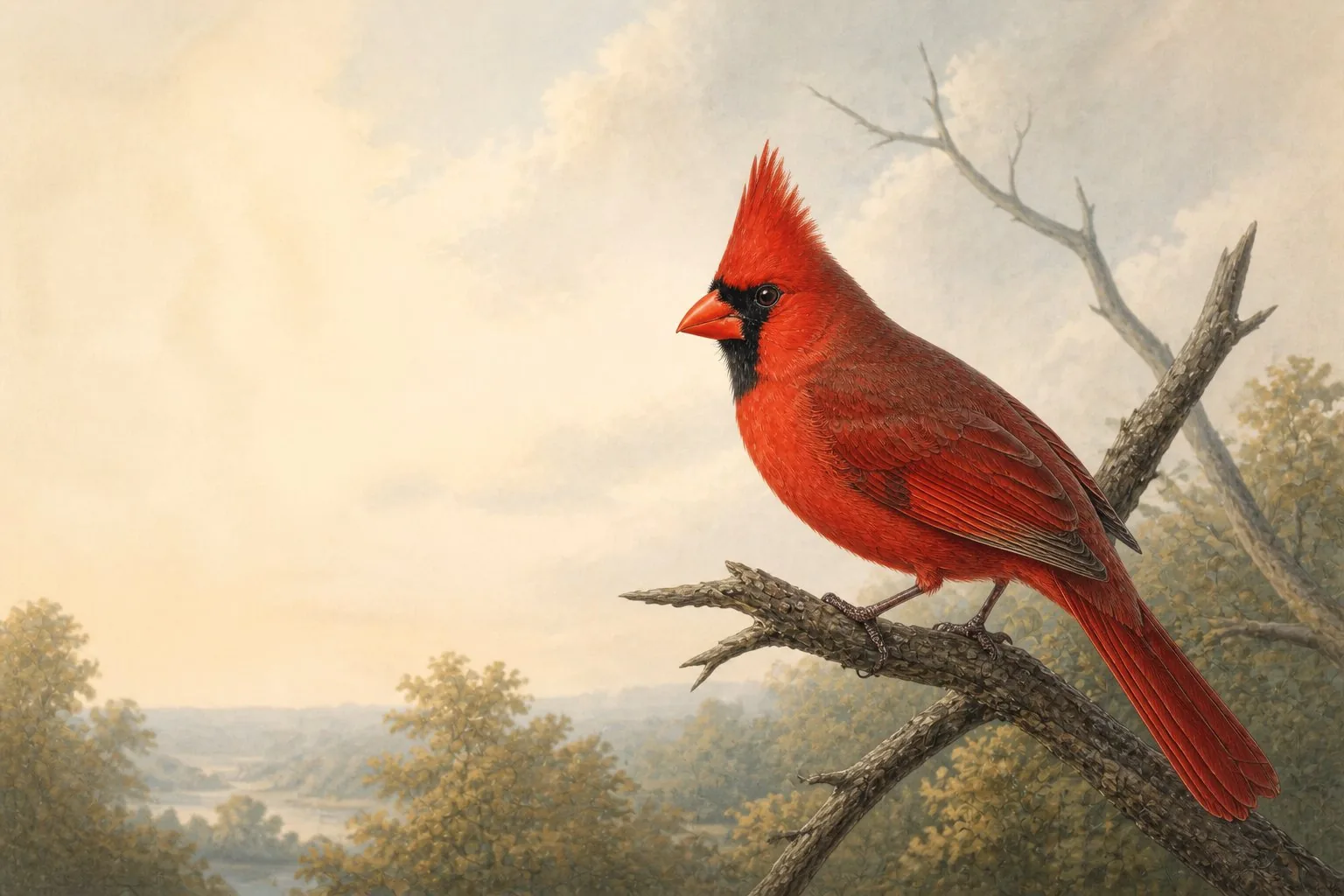
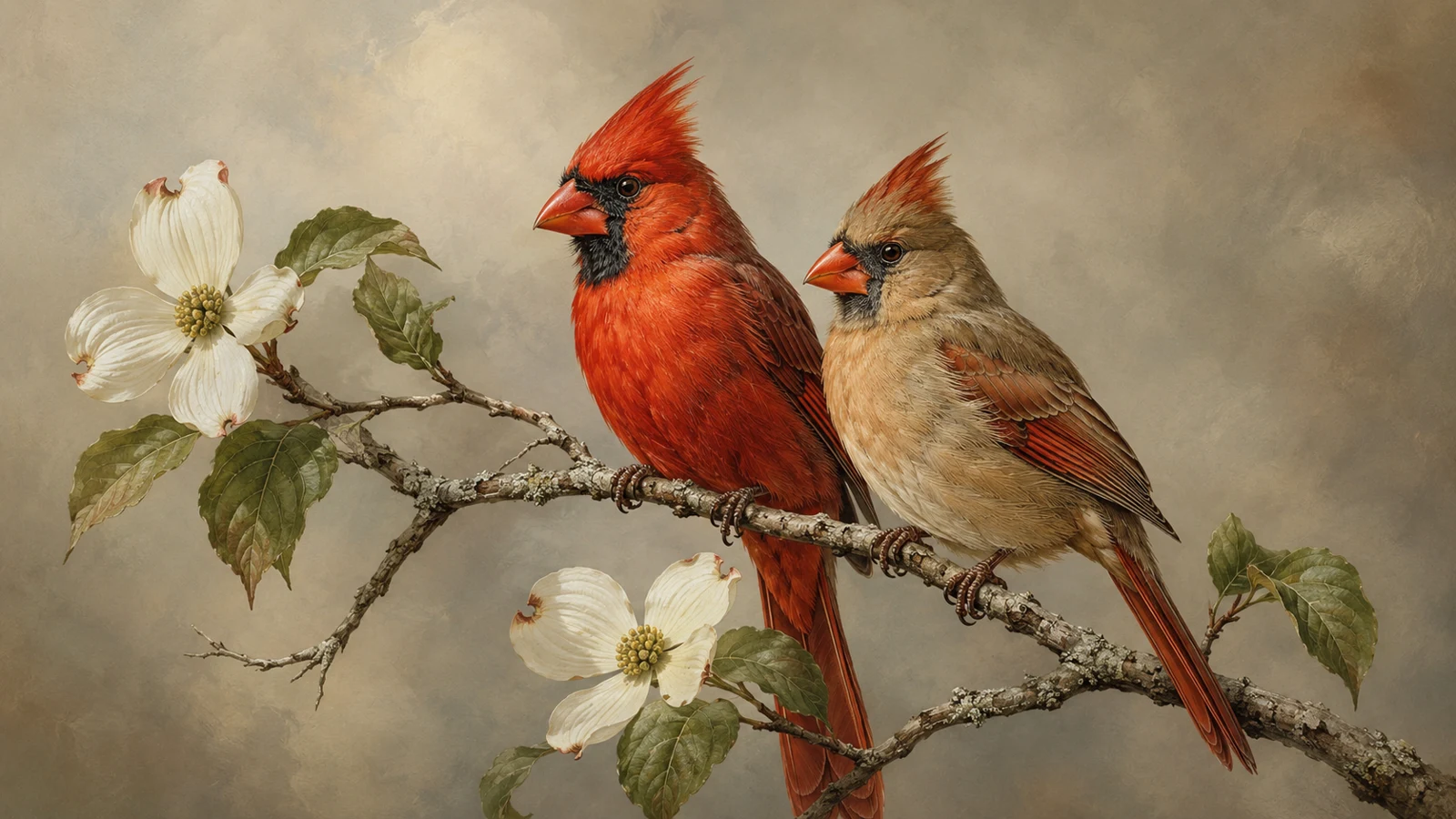
The male is unmistakable. Bright crimson body, tall pointed crest, coral-pink conical bill, and a black mask running from the bill around the eyes and down across the chin. The female wears the same shape - same crest, same heavy bill - but in soft buff-brown with rose-tinted wings, tail and crest. Her face mask is greyish and less defined.
| Feature | Male | Female | Juvenile |
|---|---|---|---|
| Body | Crimson red | Warm buff-brown | Streaky brown like the female |
| Wings and tail | Red with darker quills | Buff with rosy red wash | Buff |
| Crest | Red, tall | Buff with red tips | Short, browner |
| Face mask | Black, sharply defined | Greyish, soft-edged | Absent or vestigial |
| Bill | Coral-pink, conical | Coral-pink, conical | Dark grey-brown; pinks up over first autumn |
A male’s red is not simple pigment. It is a carotenoid-based colour, produced by oxidised compounds the bird absorbs from his diet of seeds, berries and insects. A male in a yard with abundant native fruit grows brighter feathers. A male in a yard with sunflower-only feeding grows duller ones. Female cardinals choose mates partly on plumage brightness, which means the bird’s diet in autumn becomes his auditioning costume for the following March.
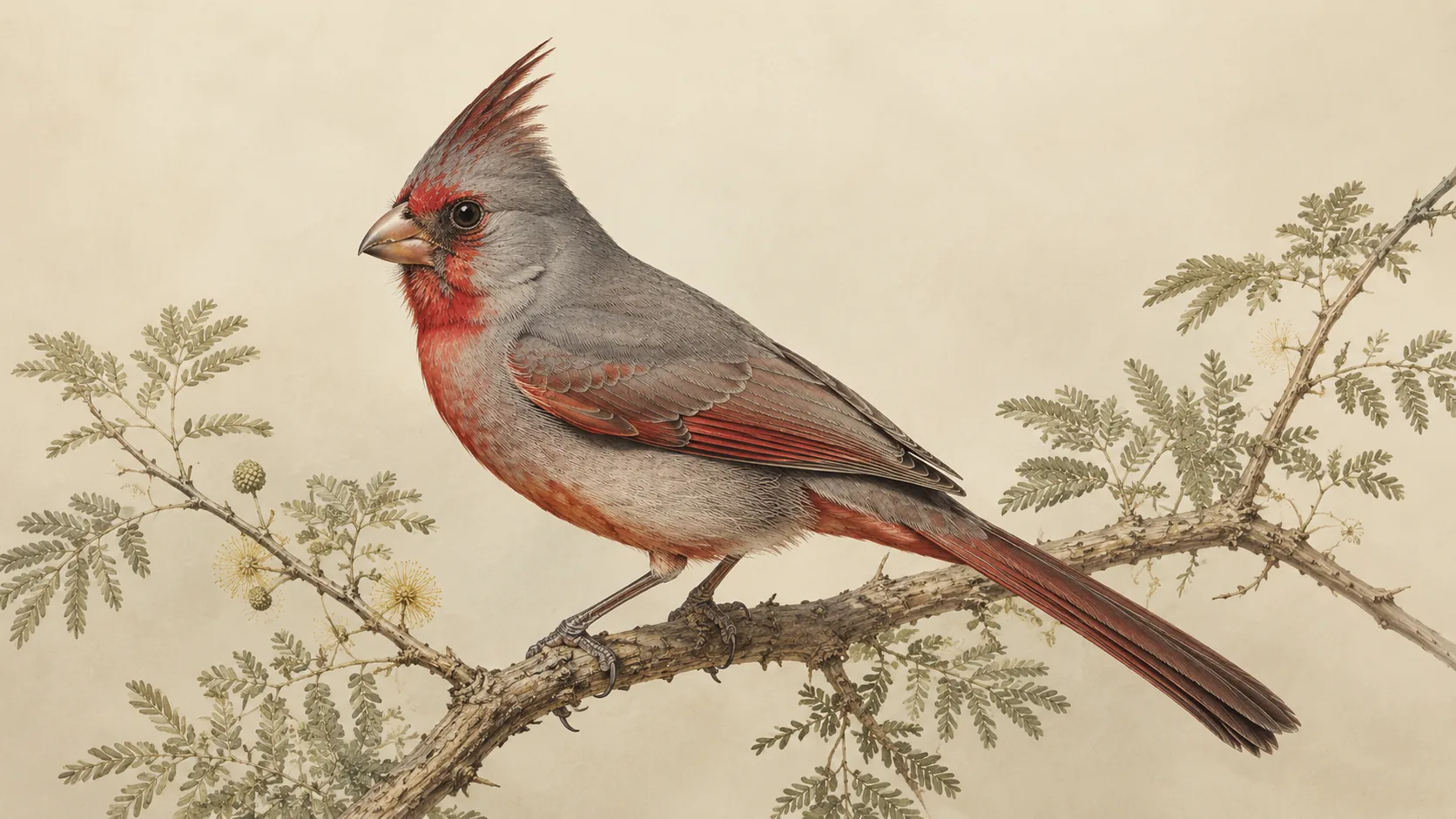
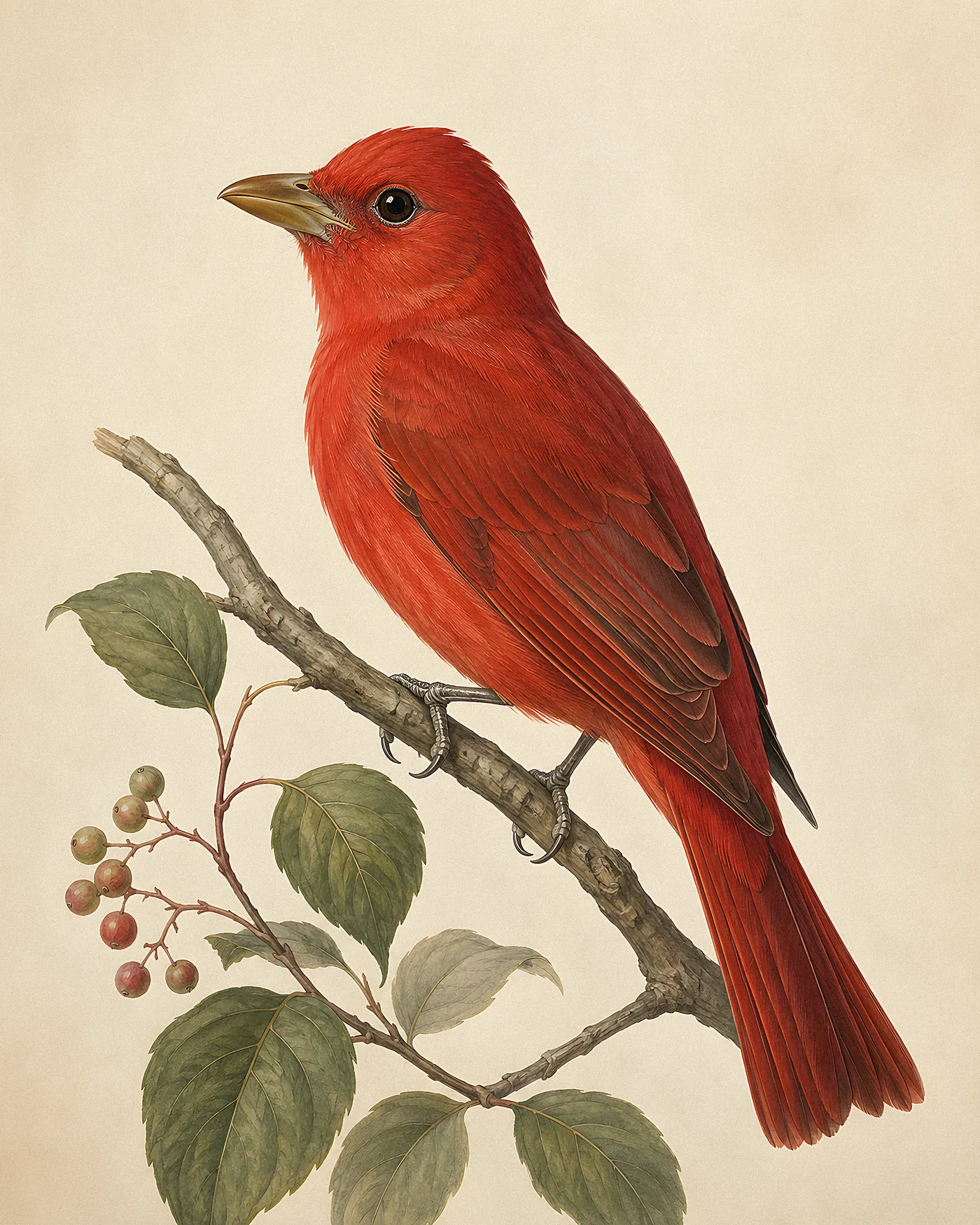
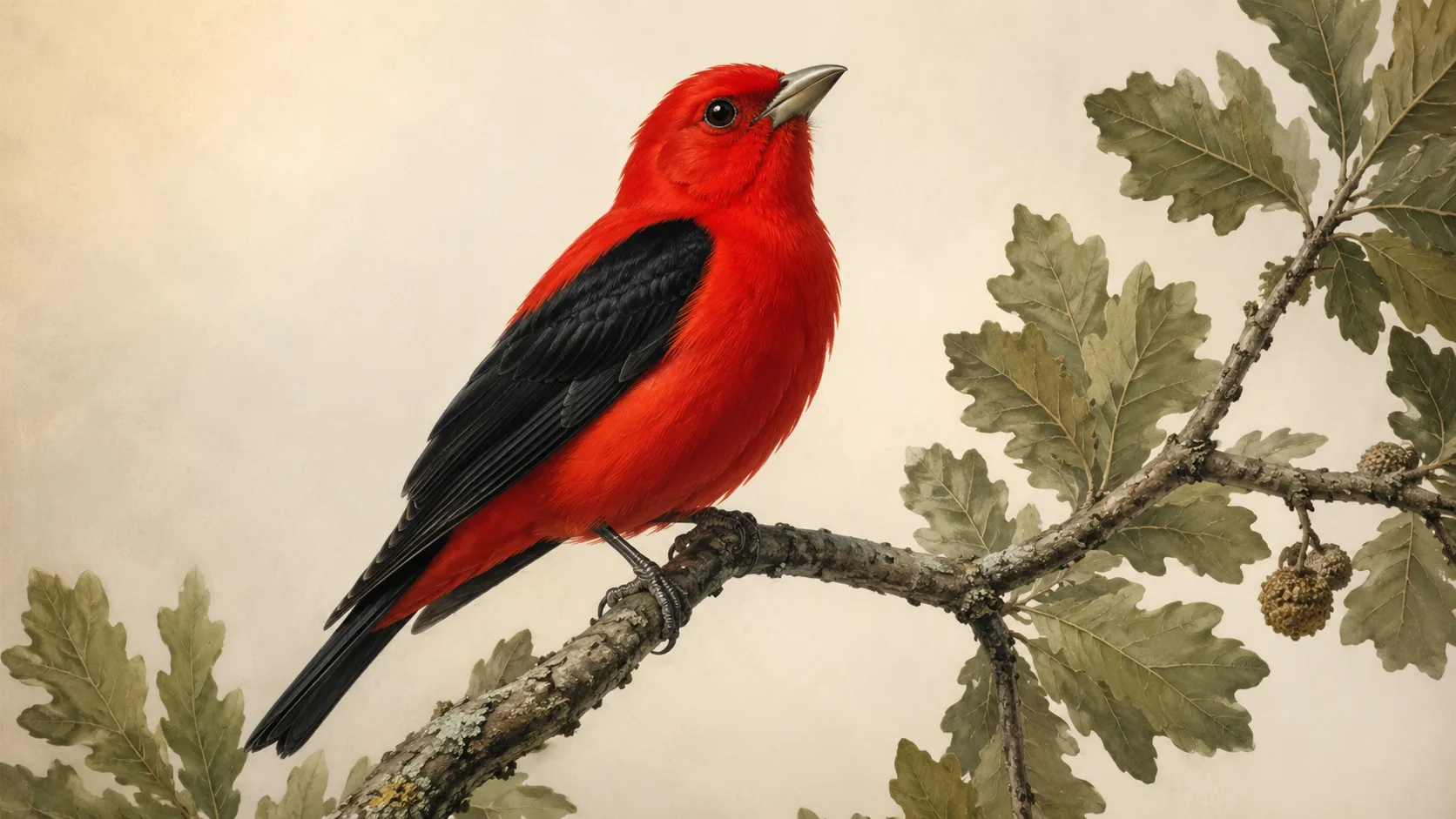
Common confusions: Pyrrhuloxia in the southwest (grey body, yellow bill, red mask), Summer Tanager (no crest, no black mask), House Finch (smaller, streaky brown sides, rosy wash). See Robin vs Cardinal and Pyrrhuloxia vs Cardinal for the field-ready disambiguation.
Voice
Cardinals are among the small number of North American songbirds where the female sings as much as the male. Both sing year-round.
- Song. A loud, clear whistled phrase, often cheer cheer cheer or birdy birdy birdy or whoit whoit whoit, repeated two to four times from a high perch. The song carries roughly 200 metres on still air. Pairs counter-sing across territory boundaries through summer.
- Female song. Slightly longer and more complex than the male’s, often delivered from the nest to communicate with her mate about feeding times.
- Contact call. A short metallic chip given at the feeder, in flight, and as alarm.
A 1983 Auk paper by Ritchison and colleagues documented the female’s song as a coordinated signal between mates rather than territorial advertisement - a behaviour rare in North American passerines and one of the most-cited reasons cardinals are unusually interesting study subjects.
Range and habitat
Year-round resident wherever the species occurs. The cardinal does not migrate. The same male you see at your January feeder is the bird that bred there in April.
The range has expanded north steadily for a century. In 1900 the species barely reached Ohio. By 1950 it was breeding in southern Ontario. Today the bird is established as far north as Maine, Nova Scotia and the southern shore of Lake Superior. The two main drivers, identified in a body of work led by Halkin and others through the 1980s and 90s, are mature backyard feeding (sunflower as a stable winter food source) and climatic warming reducing winter mortality.
Preferred habitat: forest edge, second-growth woodland, riparian thicket, hedgerow, suburban garden with dense low cover. Avoids unbroken interior forest and treeless plains.
Diet
The cardinal is a heavy-billed seed eater that takes what is available.
- Seeds. Black-oil sunflower (preferred), safflower, milo, cracked corn. The bill cracks the shell and discards it.
- Fruit. Wild grape, dogwood, mulberry, sumac, hackberry, blackberry, elderberry. Carotenoid-rich autumn fruit feeds next spring’s plumage.
- Insects. Beetles, caterpillars, true bugs, crickets, grasshoppers. Nearly half of the diet of nestlings is insect protein.
- Occasional. Suet in winter, peanut hearts.
What they do not eat: nyjer (thistle) seed, anything in a tube feeder with small perches sized for chickadees.
For feeder strategy see How to attract Northern Cardinals to your yard, What to feed cardinals in winter and Plants that attract Northern Cardinals.
Breeding and nesting
Cardinals pair-bond strongly. Many pairs stay together for multiple years. They are among the earliest songbirds to begin breeding in spring.
| Feature | Detail |
|---|---|
| Pair formation | Late winter, often December in southern populations |
| First clutch | Mid-March in the south, late April in the north |
| Nest site | Dense shrub or vine tangle, 1 to 4 m off the ground |
| Builder | Female, with the male bringing materials |
| Build time | 3 to 9 days |
| Clutch | 2 to 5 pale grey-green eggs with brown speckling |
| Incubation | 11 to 13 days, by the female |
| Fledging | Young leave the nest at 9 to 11 days, still short-tailed |
| Broods per year | 2 to 4 in the south, 1 to 2 in the north |
The male feeds the female while she incubates, then feeds the fledglings while she starts the next nest. By midsummer the pair may be raising two overlapping broods. A garden with the right shrub cover can produce three or four young cardinals a year from the same pair.
The cardinal does not use birdhouses. See Do cardinals use birdhouses for the longer explanation, but the short version is that they are open-cup nesters and a wooden box reads to them as a trap.
The reflection problem
The single most-asked question about live cardinal behaviour is why a male keeps attacking a wing mirror in spring. The answer is that the cardinal does not pass the mirror test - he does not recognise the reflection as himself, and from his behavioural toolkit there is no acceptable response to a male cardinal entering his territory other than driving him out. He will attack the reflection for two to three weeks until the breeding hormones decline or the reflective surface is broken up from outside. See Are cardinals territorial.
The molt
In August the male’s red goes patchy and his head sometimes goes completely bald. He is not sick. He is replacing every feather on his body before winter. The bird looks shabby for six to twelve weeks. By October his crest is back and the new red is being burnished over the autumn into the deep colour you will see in March. See Cardinal molting.
Folklore and meaning
The phrase “cardinals appear when angels are near” is folk wisdom of late-twentieth-century origin, not scripture. The folk reading is still the most widespread modern interpretation: the cardinal as a sign of visitation from a departed loved one. Older threads include Native American associations with renewal and faithful partnership, and a broader Christian symbolism stack tied to the colour red.
The full cross-cultural reading is at Cardinal symbolism and spiritual meaning and What it means when you see two cardinals.
Where to see Northern Cardinals
Anywhere east of the Rockies with dense low cover and a feeder. Some standouts:
- Texas. Year-round, abundant, often sharing space with Pyrrhuloxia. See Red birds in Texas.
- Virginia and West Virginia. State bird of both. Suburban hedgerow at dawn is the easiest viewing.
- Ohio, Indiana, Illinois. Backyard feeders are the standard sighting.
- Southern Ontario. Range edge, expanding.
- Coastal New England. Increasingly common, range edge expanding.
Print available
A fine-art Audubon-style portrait of a Northern Cardinal pair, painted in the same restrained palette as the rest of this site, is available at the Northern Cardinal Print. Museum-grade Hahnemuhle paper, signed edition.