Field Guide
Swainson's Warbler
The song arrives first. Three or four clear, ringing notes, then a rapid tumble of descending ones, the whole phrase thrown like a stone across the canebrake. You stop. You wait. You hear it again, closer now, somewhere in the curtain of giant cane and shadow where the ground is soft and the light barely reaches. Nothing moves. The bird does not appear. It never does, not easily, not on your terms. The song fills the swamp and the swamp gives nothing back. That is the bargain you make with Limnothlypis swainsonii, the Swainson’s Warbler.
This is a bird that rewards patience not with a brilliant plumage but with the slow satisfaction of knowing it is there at all. The canebrakes of Louisiana and the rhododendron hollows of the southern Appalachians belong, in some essential way, to this hidden creature.
What it looks like
Do not look for color. The Swainson’s Warbler will not oblige you there.
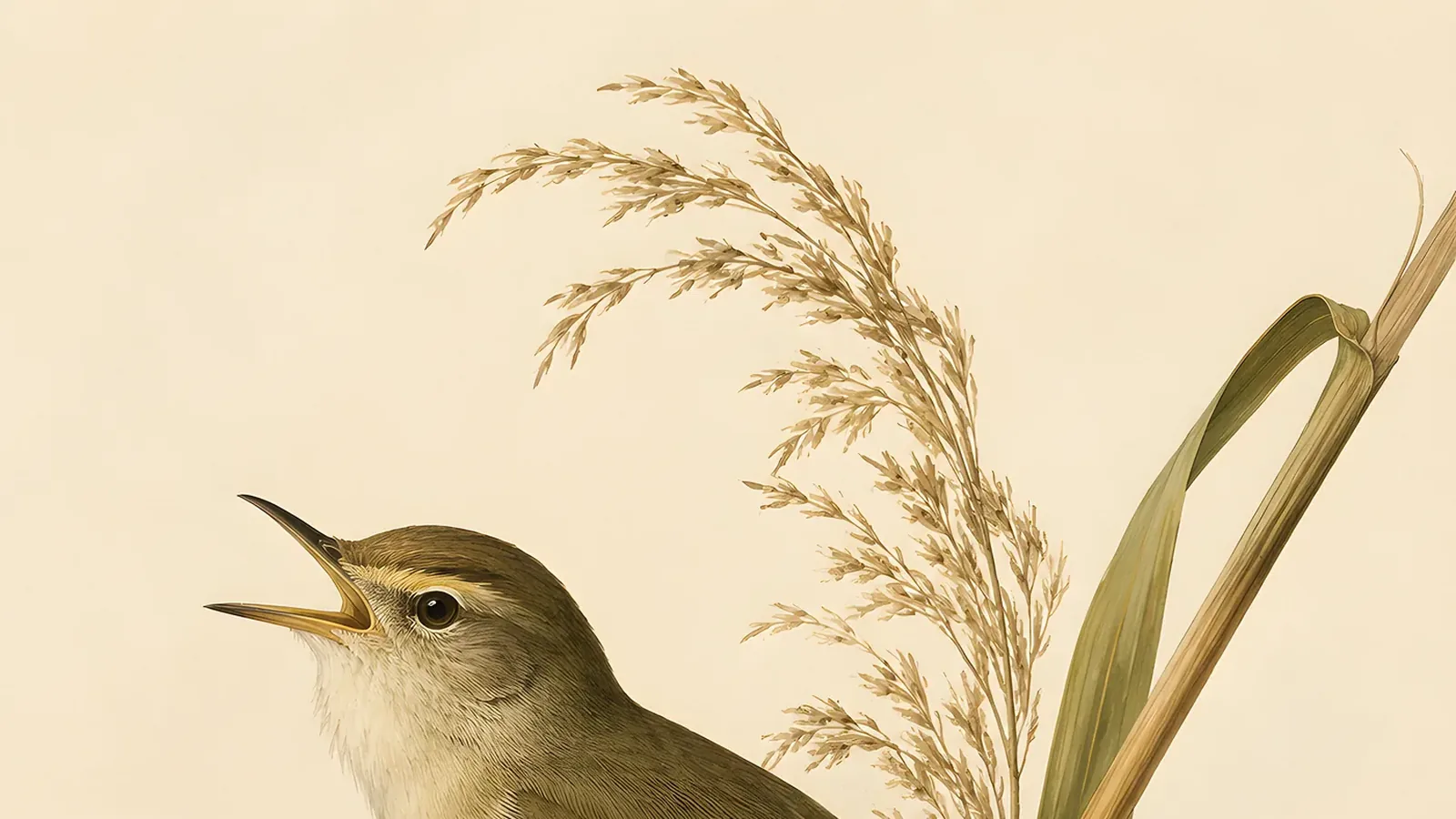
The upperparts are plain olive-brown. The crown is warmer, tipped toward reddish brown. The underparts are off-white, sometimes faintly yellowish, unmarked. The eyebrow stripe - pale and dull white - cuts across the head and provides the only real field mark, a clean pale line that contrasts against a darker eye line below it. The bill is disproportionately long and heavy for a warbler, dark above and pale below, an instrument built for prying and flipping and probing in deep leaf duff.
The legs are flesh-colored. The tail is short. The whole bird is, at 13 to 15 cm, noticeably stocky for a New World warbler.
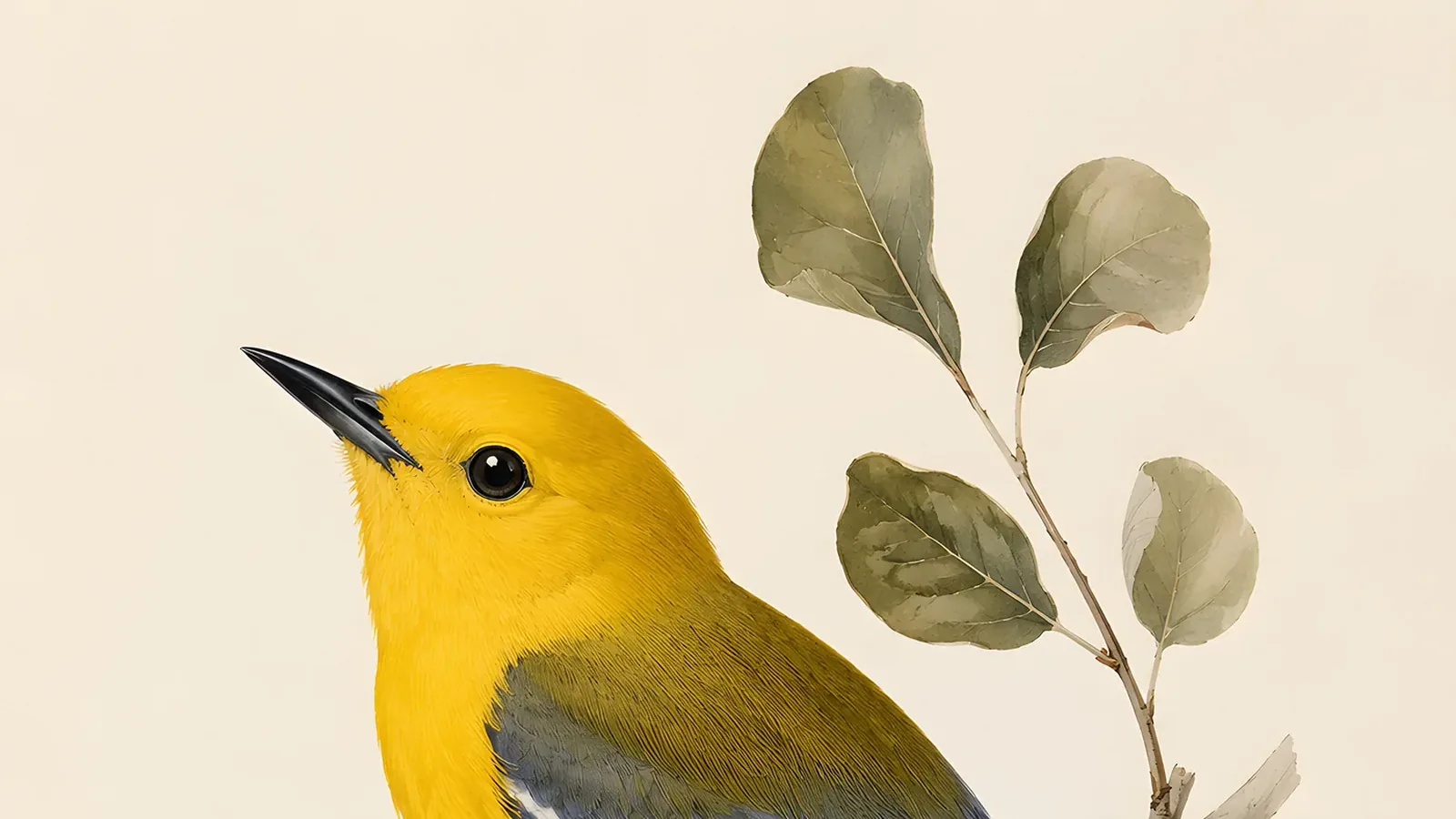
There is no streaking. No wing bars. No yellow flash, no orange crown patch, no spectacle of any kind. Compare it to the prothonotary warbler - a bird of nearly identical swamp habitat - and the contrast shocks. The Prothonotary burns gold from across a bayou. L. swainsonii dissolves into the understory.
The weight, 14 to 20 grams, is carried low to the ground. You may see the bird walking on the forest floor, pausing, lifting a leaf with the bill, walking again. It moves with deliberate purpose. The body tilts forward, tail slightly cocked.
| Measurement | Range |
|---|---|
| Length | 13 - 15 cm |
| Wingspan | 20 - 23 cm |
| Weight | 14 - 20 g |
| Max recorded lifespan | 10 years |
The song and the silence
The song is its great contradiction. For a bird that skulks, that retreats, that seems to have made invisibility a life strategy, the voice is extravagant.
The primary song - three to four high, clear, well-separated notes followed by three rapidly descending ones - carries far across open bottomland. Birders describe it as resembling the Louisiana Waterthrush, but with a more emphatic finish. Memory phrases circulate: “whee-whee-whee-whip-poor-will,” though the actual phrasing varies. What does not vary is the volume and the clarity. The song punches out of the cane with a force that seems designed for a much more open country.
The male sings persistently through the breeding season. He sings from low perches inside dense cover, rarely from an exposed tip. He is singing in a place that swallows sound and vision both. The effect is maddening and, once you accept that you will not see him while he sings, quietly wonderful.
The Audubon Society’s field guide notes the song’s three to four clear notes followed by several rapid descending notes - a structure simple enough to learn and distinctive enough to pick from a chorus of spring migrants. The Cornell Lab of Ornithology places this species among the hardest North American warblers to observe, a reputation earned honestly.
Range and the two habitats
The range is the American Southeast, roughly from southeastern Oklahoma and southern Missouri east to Virginia and south to the Gulf Coast. A disjunct population breeds in the southern Appalachian Mountains. Winter range is the Caribbean, southern Mexico, and Central America.
But the range map alone misses the point. What matters is the habitat, and the Swainson’s Warbler has chosen two of the most specialized and least visited plant communities in North America.
In the lowland South it favors bottomland hardwood forest with dense understory thickets of giant cane (Arundinaria gigantea), the native American bamboo. The canebrakes of Arkansas and the great river swamps running south through Louisiana and South Carolina are its stronghold country. Giant cane has declined by more than 98% across the Southeast since European settlement. The canebrake ecosystem is now itself considered critically threatened. The warbler has adapted, and now also occupies vine-tangled clearcuts, young pine plantations, and pocosins, but the thick-stemmed cane with its dropped culm debris and year-round leaf cover remains the signature image.
In the southern Appalachians, the same species breeds in a completely different plant community - dense thickets of rhododendron and mountain laurel in gorges and cove forests of North Carolina and adjacent states. The habitat looks nothing like a Louisiana canebrake, but the functional requirements match exactly: dense shrubby understory, deep leaf litter on the ground, and minimal ground-level light. It is the structure that matters, not the species of plant.
Gary R. Graves, publishing in Bird Conservation International in 2015, documented 297 breeding territories in pine plantations across 95 counties in 10 states, demonstrating that L. swainsonii is more flexible than its canebrake reputation suggests. He estimated a global population of around 90,000 individuals at the time, though Partners in Flight now places the figure closer to 160,000 - a discrepancy reflecting both improved survey methods and genuine population shifts as the bird colonizes managed plantation forest.
Diet
The Swainson’s Warbler eats arthropods, almost exclusively, pulled from the interface between leaf litter and bare soil.
Gary R. Graves described the species as a “terrestrial dead-leaf specialist” in a 1998 study published in the Journal of Field Ornithology - his term for a bird whose entire foraging strategy centers on accessing the invertebrates living under fallen leaves rather than in the foliage above. The method is distinctive and physical. The warbler walks at a rapid pace, inserts its long bill under a leaf, and lifts. It also performs a foot-pattering or vibrating behavior - rapid trembling of the feet against the substrate - which may help flush prey from below the leaf mat. The bill then probes the disturbed litter.
The prey list includes lepidopteran larvae, beetles, ants, crickets, grasshoppers, katydids, true bugs, flies, spiders, and millipedes. Berries and nectar are absent from the diet. This is an animal eater, a leaf-lifter, a specialist in the dark understory economy that most warblers ignore.
The heavy bill is not incidental. It is the tool the foraging strategy requires.
Breeding
Males arrive on the breeding grounds in late March through early May, seven to ten days ahead of females. They sing to establish territories in the dense cane or rhododendron.
The female builds the nest alone, completing it in two to three days. It is a bulky, loosely constructed deep cup of dead leaves placed low - between 0.6 and 4.1 meters off the ground, averaging around 1.8 meters - often over water or in the densest available shrub cover. The eggs are white or pinkish white, usually three, occasionally two to five.
Incubation runs 13 to 14 days. Nestlings fledge after ten to twelve days and receive parental care for another two to three weeks. The species raises one brood per season.
Brown-headed Cowbird parasitism occurs. Alabama data puts the rate at roughly 12% of active nests. The warbler does not respond the way the yellow warbler does - it does not bury the foreign egg under a new nest floor - and cowbird parasitism is considered one of the secondary pressures on local populations.
The oldest banded individual on record was a male at least nine years and eleven months old when recaptured in South Carolina, showing that this long-lived family can persist well into a second decade given suitable conditions.
The discovery history of Limnothlypis swainsonii is itself a kind of cautionary tale about invisibility. The Reverend John Bachman collected the type specimen along the Edisto River in South Carolina around 1832 or 1833, and John James Audubon described it formally in 1834, naming the bird in honor of his fellow ornithologist William Swainson. Then the species more or less vanished from the scientific record. For roughly forty years following its description, only three additional specimens appear to have been taken. A bird heard but rarely seen and almost never netted is a bird that science loses track of. The first confirmed nest was not found until 1885, when Arthur T. Wayne located it near Charleston.
The lesson the Swainson’s Warbler teaches is the same one the canebrake teaches: abundance and invisibility are not opposites. A bird singing in dense cover in a habitat that humans have largely eliminated does not register on the public imagination. It registers only as a voice, distant, loud, and unanswered.
Brunner and colleagues, publishing in the Journal of Field Ornithology in 2022, used geolocators to show strong migratory connectivity between breeding populations and specific wintering sites - Louisiana birds tracking to southern Mexico and the Yucatan, Appalachian birds to Jamaica. The ties are tight. What happens to a winter forest in the Yucatan or a mangrove fringe in Jamaica is not local news. It arrives eventually in the canebrake as fewer songs the following April.
The Swainson’s Warbler currently holds a Least Concern assessment on the IUCN Red List, and Partners in Flight rates it 13 out of 20 on the Continental Concern Score - low concern, nominally. But Partners in Flight also places it on the Yellow Watch List for species whose populations are restricted and whose habitats are under documented long-term pressure. Cane has not recovered. Bottomland hardwood conversion has not stopped.
The bird is still there. You can hear it on a May morning in the right stand of cane, loud as anything in the swamp, unambiguous, very close, and absolutely out of sight.