Field Guide
Bald Eagle
Two Bald Eagles lock talons high above a river and cartwheel toward the earth. They fall together, spinning, and break apart only seconds before the ground would settle the question. This display - documented by ornithologists across the continent and described in detail on Audubon’s field guide - is courtship. The bird the United States put on its seal, and freighted with centuries of symbolism, turned out to be, at close range, something stranger and more interesting than the heraldic image suggests.
Haliaeetus leucocephalus is the only eagle native solely to North America. It belongs to the family Accipitridae, the broad hawk-and-eagle family that also includes harriers and hawks, and it sits within the sea eagle genus - birds built to work coastlines and rivers, not open plains. The name means “white-headed sea eagle,” which is accurate in two of its three parts: the head is white, and the bird is at home near water. Whether it deserves the title of eagle, in the strict Old World sense that Franklin objected to, is a question worth asking. It is, in any case, the bird that came back.
Identification
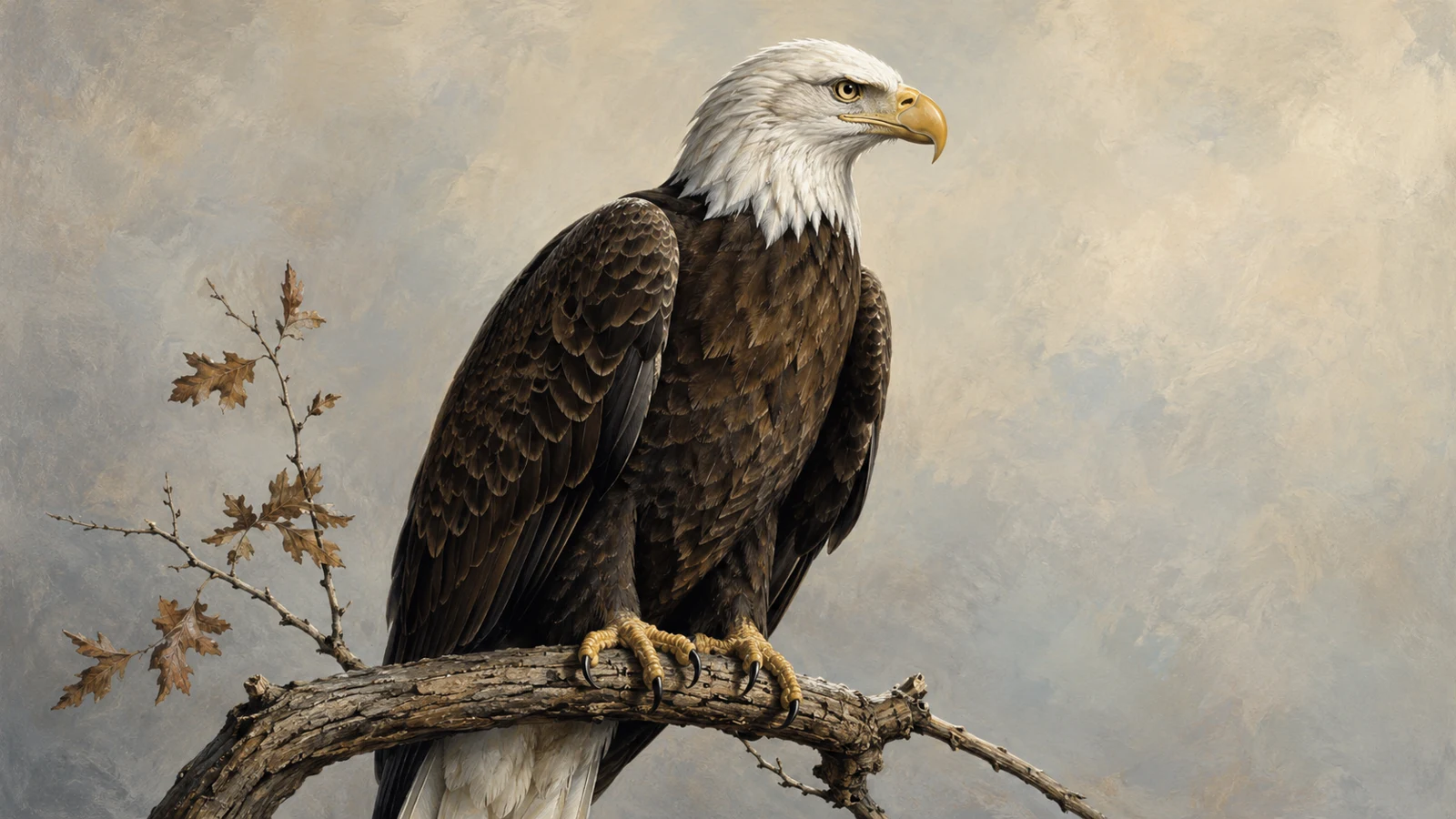
A fully adult Bald Eagle is hard to misidentify. Body length runs 71 to 96 centimetres; females are substantially larger, reaching 108 centimetres and weighing up to 6.3 kilograms, while males average closer to 4 kilograms. Wingspan ranges from 180 to 230 centimetres - nearly two and a half metres at the outer edge of the female range. Both sexes share the same plumage: dark brown body and wings, white head, white tail, bright yellow bill, yellow feet, and pale yellow eyes. The contrast is sharp and total. At any reasonable distance, against sky or water, there is nothing else it could be.
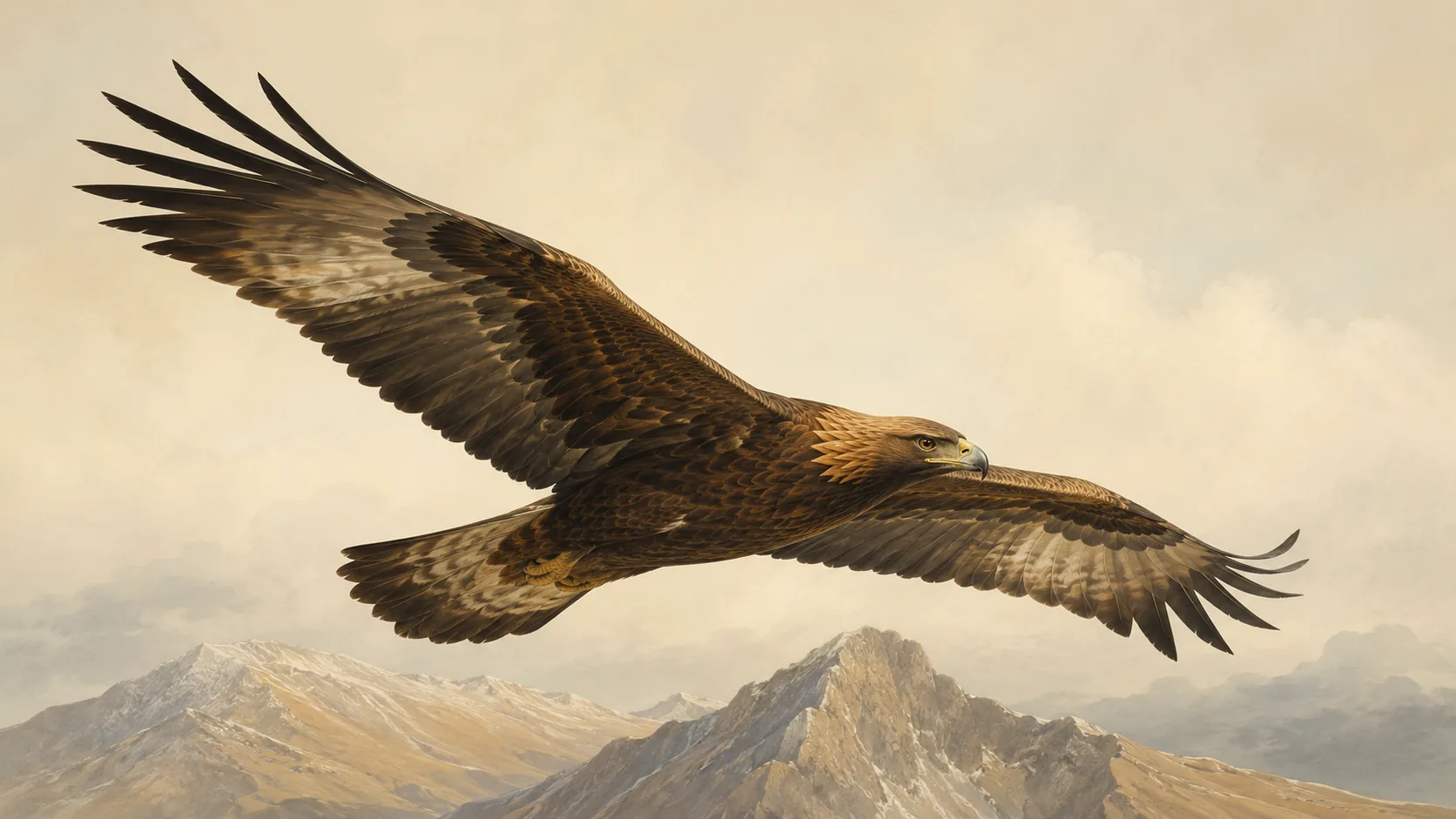
The difficulty comes with younger birds. Immature Bald Eagles wear brown plumage with variable whitish mottling across the breast and wing linings. They look, from below, somewhat like Golden Eagles - a larger-bodied, heavier relative that shares much of the same range. The distinction matters to field observers: the Golden Eagle shows golden-buff at the nape and lacks the pale underwing mottling of an immature Bald Eagle. Full adult plumage in a Bald Eagle does not appear until roughly four to five years of age. The white head and tail arrive gradually, making each year-class look subtly different from the last.
Voice
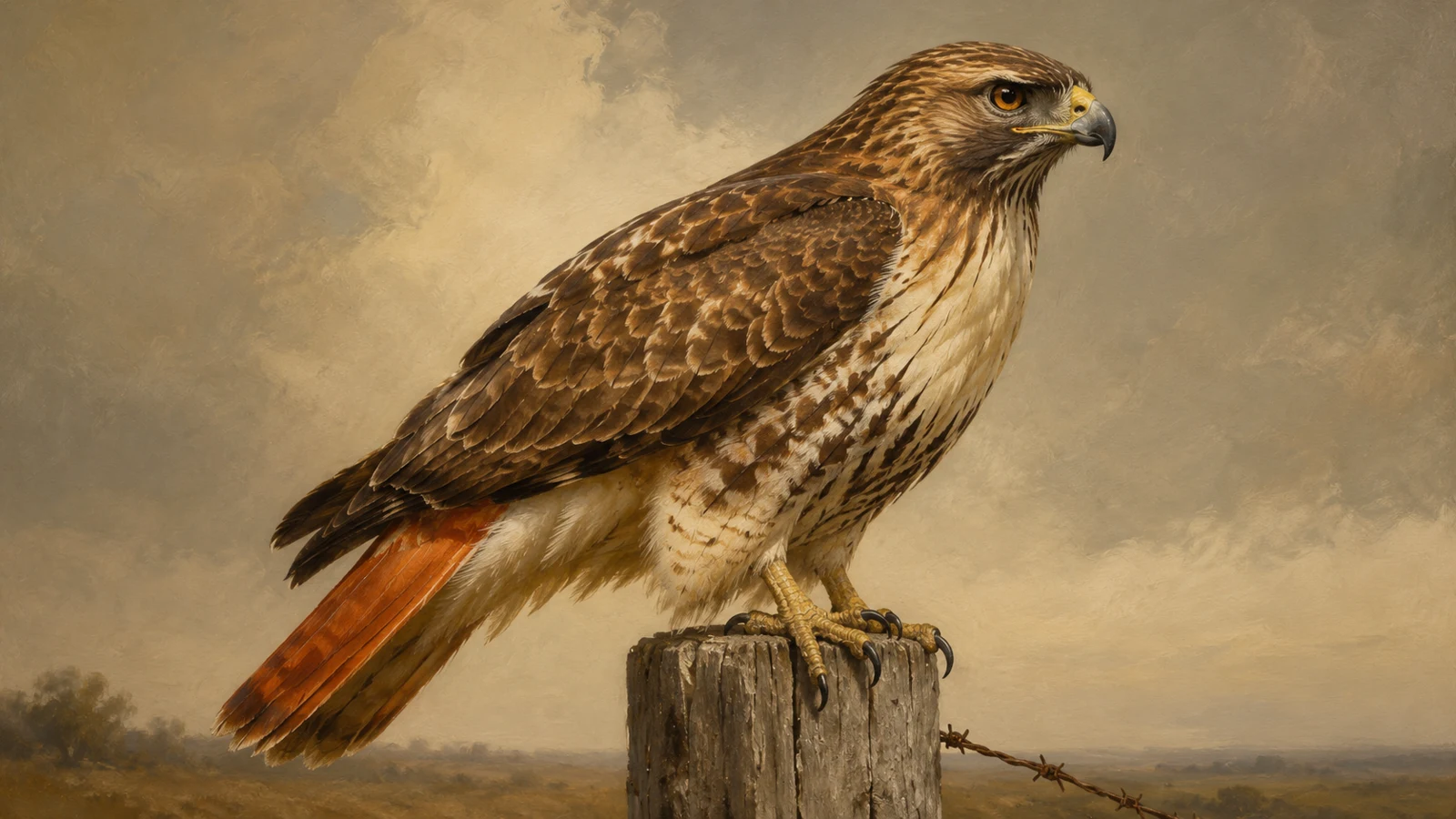
The call is one of ornithology’s great mismatches between image and reality. The sound most Americans associate with the Bald Eagle - the piercing, predatory scream over film credits and TV montages - belongs to the Red-tailed Hawk. Hollywood chose the wrong bird. The actual call of a Bald Eagle is a high, thin, slightly reedy series of whistles and chirps, softer and more hesitant than the image demands. It is not unpleasant. It is simply not what the symbol suggests.
Range and habitat
The Bald Eagle breeds across Alaska, Canada, and the contiguous United States, with the largest concentrations in the Pacific Northwest, the Great Lakes states, Florida, and the Chesapeake Bay watershed. Wintering populations concentrate along unfrozen rivers and reservoirs, particularly in the interior West and along the Mississippi drainage, wherever open water keeps fish accessible. A smaller population winters in northern Mexico. The species is a year-round resident across much of its breeding range; northern breeders move south when ice closes their foraging waters.
Habitat follows water. Coastal estuaries, large inland lakes, wide rivers, and reservoirs all hold eagles year-round when fish are running. Tall, mature trees near water are the preferred nest sites - old-growth conifers in the Pacific Northwest, hardwoods along the interior rivers, isolated pines in Florida flatwoods. The birds are tolerant of human presence where hunting pressure is low, and nest sites near suburban reservoirs and urban parks have become increasingly common over the past 30 years.
Diet
Fish form the core of the diet, taken live from the surface by a plunge of the talons or snatched from shallows during low-level cruising. Salmon, herring, catfish, and carp rank among the most frequently recorded prey. The Bald Eagle also takes waterfowl, small mammals, turtles, and snakes when fish are scarce, and it feeds on carrion without apology - a habit that drew Benjamin Franklin’s famous objection that the bird was “of bad moral character.” Franklin preferred the Wild Turkey. The eagle does not appear to have cared about the criticism.
Kleptoparasitism - stealing food from other raptors - is a regular strategy. Ospreys are the most frequent victims. An eagle will follow an osprey carrying a fish, harass it in flight, and collect the dropped prey before it hits the water. This behaviour, well-recorded and widespread, is one reason Franklin found the bird’s character wanting. It is also, from an energetics standpoint, entirely rational.
Nesting and breeding
Bald Eagles pair for life and return to the same nest year after year, adding new material each season. The result, over decades, is a structure of record-breaking scale. The largest nest on record - in Florida, documented before the tree eventually fell - measured 2.9 metres across and 6.1 metres deep, and weighed approximately 2.7 metric tons. It is the heaviest tree nest ever recorded for any species. A typical nest, used for only a few years, still weighs several hundred kilograms - the largest active nest of any bird in North America.
Both parents incubate one to three eggs over roughly 35 days. Chicks fledge at around 10 to 12 weeks. First breeding typically occurs at four to five years of age, when the adult plumage is complete. Pairs may live and breed together for 20 years or more in the wild, with the oldest confirmed wild bird reaching 38 years. Cornell’s Birds of the World notes that the male typically arrives at the nest site before the female each breeding season and begins adding nest material - a form of site-fidelity display that functions as a renewal of the pair bond.
The cartwheeling courtship
The talon-lock display is the behaviour that stays with you. Two birds, typically an established pair returning to a nest site, meet high in the air, lock feet, and fall together in a rotating spiral. They release seconds before impact. No one has fully explained why they do it - whether it is a fitness test, a bond-reinforcement ritual, or something else - but it has been observed reliably enough across enough populations to be considered characteristic of the species. Audubon’s field guide documents it. So does the U.S. Fish and Wildlife Service. It happens, it is real, and it is unlike anything else a large raptor in North America does.
Recovery
The IUCN lists the Bald Eagle as Least Concern - a status that represents, historically, one of the more dramatic reversals in conservation biology. In the mid-twentieth century, the population collapsed. DDT, the pesticide used widely from the 1940s onward, thinned eggshells to the point that incubating adults crushed their own eggs. By 1963, fewer than 500 nesting pairs remained in the contiguous United States. The species was listed under the Endangered Species Act in 1967. DDT was banned in the United States in 1972. The population responded. By 2007, when the bird was removed from the threatened species list, the breeding population in the lower 48 states had recovered to more than 9,000 pairs.
It is one of the cases where the law worked and the bird came back faster than anyone had projected. The IUCN’s current Least Concern listing, and the increasing population trend that supports it, represents the endpoint of a 50-year arc from near-extinction to routine. The bird the settlers nearly killed off now nests in every contiguous state.
What you notice, watching a Bald Eagle work a river from a dead pine above the waterline, is how still it is. It is not performing. It is watching, in the same way the spruce it sits in is watching - with the patience of something that has been here a long time and expects to stay.