Field Guide
Baltimore Oriole
In the canopy of an elm along a Maryland river in late May, a female Icterus galbula is sewing. She has selected a slender branch tip twelve metres above the ground and is weaving a pendant pouch from milkweed fibres, plant strips, and horsehair - looping each thread through itself, pulling it tight with her bill, pressing it firm with her feet. The nest will take her up to two weeks to complete. When she is done, it will hang three to four inches deep from its anchor point, swaying in the wind, holding four or five pale grey-white eggs spotted with brown, and it will not come apart.
The Baltimore Oriole is, among North American songbirds, the master weaver. That is the thesis worth holding onto through everything else.
Identification
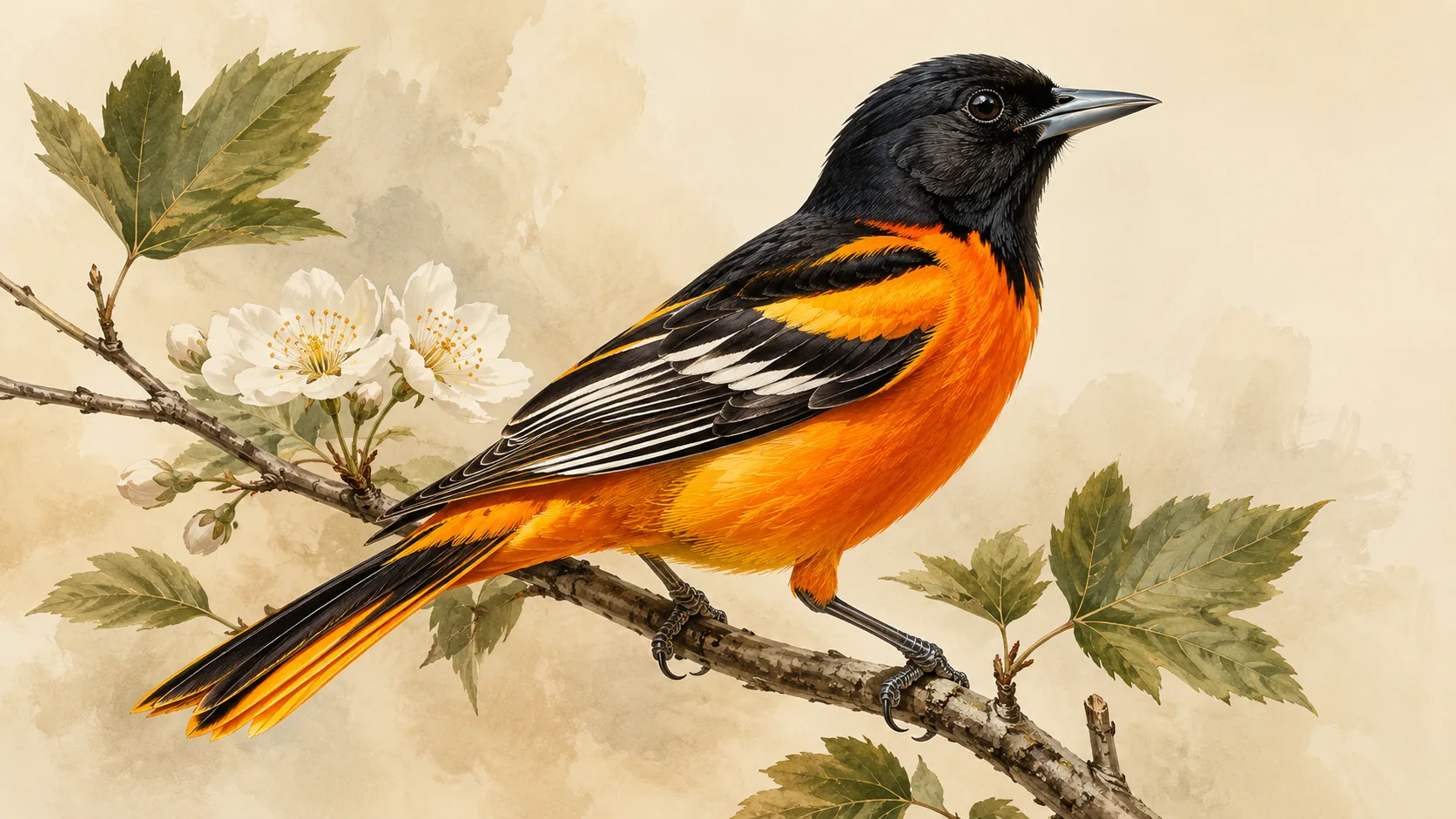
The male is one of the most immediately recognisable birds east of the Great Plains. He is 17 to 22 centimetres long, weighing between 22 and 42 grams - roughly the heft of a large walnut. His plumage is a sharp division: jet black hood, back, wings, and central tail feathers; burnt orange on the breast, belly, rump, shoulder patch, and outer tail. A single white wingbar cuts across the wing. The bill is long, pointed, and slate-grey. Nothing else in his range combines black and deep orange at this size.
She is quieter in colour. Her upperparts run to yellowish-brown and her wings show two white bars. Her underparts are dull orange-yellow, fading to cream on the belly. Immature males in their first autumn resemble adult females, which is the cause of most misidentifications. Cornell Lab of Ornithology notes that female plumage is highly variable - some females carry nearly as much orange as a male, others look washed out to a warm yellow.
The species to check against: Orchard Oriole (smaller, brick-red rather than orange in adult males), Bullock’s Oriole (extensive white wing patches, orange face with a black eye-stripe), and American Redstart (far smaller, with orange patches only on wings and tail). In the field, a bird this size combining black and orange in eastern woodland is almost certainly a Baltimore Oriole.
Voice
The male’s song is a series of clear, rich whistles - unhurried, conversational in tone, two to eight notes long - delivered from high in the canopy with the same self-assurance as a human whistling alone in a room. He sings through June, falling quieter by July as nesting winds down. The female also sings, which is unusual among passerines and worth noting. She sings to defend territory and to communicate with her mate at the nest, producing shorter, choppier phrases than his.
The alarm call is a dry, chattering rattle. Both sexes use it when a squirrel, crow, or other predator comes too close to the nest, and both adults will mob an intruder directly, dive-bombing within centimetres of a larger bird.
Range and Habitat
The Baltimore Oriole breeds across the eastern half of North America. The breeding range runs from the Canadian prairies and southern Ontario east through New England, south to central Mississippi, northern Alabama, and northern Georgia, and west through the Great Plains as far as eastern Montana and the Dakotas. Audubon’s field guide lists the full eastern range as east of the Great Plains, where open deciduous woodland meets agriculture and suburb.
The key habitat requirement is tall, mature deciduous trees - preferably elm, cottonwood, willow, maple, or apple - with open canopy and access to edge habitat below. The species does well in river corridors, parks, and well-treed suburbs. It is rarely found in dense interior forest. The elm preference is historical and practical: elms produce long, drooping branch tips that make ideal nest anchors.
By August the adults are already moving. They slip south through the Gulf States and across the Gulf of Mexico, reaching their wintering grounds in Mexico, Central America, and the northern fringe of South America. A small number winter on the Atlantic and Gulf coasts of the southern United States, sometimes appearing at hummingbird feeders. They return to breeding grounds in late April and May, one of the more reliable signs of a northern spring.
Diet
Summer is for insects. Caterpillars dominate - particularly hairy, distasteful species like forest tent caterpillars that most other birds leave alone. The Baltimore Oriole is one of the few birds willing to eat them in quantity, which gives it a genuine role in controlling caterpillar populations in deciduous forest. It also takes beetles, grasshoppers, wasps, and spiders, foraging by searching foliage and picking prey from leaf surfaces, sometimes catching insects in midair.
The fruit shift begins in late summer and continues on the wintering grounds. The oriole has a foraging technique called ‘gaping’ - it stabs its closed bill into soft fruit or flower, then opens the bill to part the tissue, and laps the exposed juice or nectar with a brush-tipped tongue. It preferentially targets dark-coloured ripe fruit: mulberries, cherries, grapes. At feeders, cut oranges and grape jelly are the preferred offerings, and both reliably bring birds in from May through July.
Breeding and Nesting
Pairs form on arrival at the breeding grounds. The male sings and performs bowing displays; the female chooses among displaying males and begins nest construction almost immediately. She builds alone. The male may carry a strand of material to the nest site occasionally, but construction is hers.
The nest is a suspended pouch woven entirely by the female over seven to 14 days. She uses plant fibres - particularly milkweed stem fibres, which are long, strong, and flexible - along with bark strips, grass, and whatever fine synthetic materials are available. Urban-nesting females have been documented incorporating fishing line, plastic twine, and hair from horse manes. The finished structure hangs 7 to 9 metres above the ground from a terminal branch, deep enough to keep eggs from rolling out during high winds.
She lays three to seven eggs, typically four, and incubates them for 12 to 14 days. Both parents feed the nestlings. The young fledge approximately two weeks after hatching. The pair typically raises one brood per season. Cornell Lab records the longest wild lifespan at 11 years and seven months.
The Gaping Technique
The gaping behaviour is worth dwelling on, because it reveals something about how this bird is built. Most songbirds have muscles that close the bill forcefully for cracking seeds or snatching insects. The Baltimore Oriole has unusually strong muscles for opening the bill - for prying. It uses this to crack open fruit, to separate flower petals for nectar, to lever apart bark in search of insects. The bill is a prying tool as much as a gripping one. Cornell’s Birds of the World notes this as a defining trait of the genus Icterus, but the Baltimore Oriole uses it with particular versatility across a wider range of food types than its relatives.
The nest is also a product of the bill’s precision. The same instrument that pries open a cherry is threading a milkweed fibre through a loop and pulling it tight. The same bird.
The Baltimore Oriole’s nest is not decoration. It is engineering - the most technically complex structure built by any songbird in eastern North America, completed without tools, without a plan, and without a second chance.
The IUCN lists Icterus galbula as Least Concern, with populations broadly stable. The National Wildlife Federation notes that deforestation and pesticide use on trees remain the primary threats, particularly on the wintering grounds in Central America, where shade-grown coffee and mature tropical forest cover continue to decline. Eastern breeding populations show modest downward trends in recent decades. The bird does not need rescuing yet, but it needs its elms, its caterpillars, and its wintering forest to remain where they are.
It will keep weaving as long as they do.