Field Guide
Bar-tailed Godwit
September in western Alaska. The tide has emptied the estuary at the mouth of the Yukon Delta, and the exposed mudflats are crowded. Several hundred Limosa lapponica baueri - the Bar-tailed Godwit - are probing the soft edge of the waterline with methodical urgency. They are not here to feed in any ordinary sense. They have been feeding for weeks, compulsively, and what has accumulated under their skin and around their organs is fuel measured in thousands of kilometers. The birds are visibly fat, their flanks rounded beyond what the species’ slender profile normally allows. Within days, one or more of them will lift off from this same mudflat and not land again for eleven days. They will cross the entire Pacific Ocean without stopping.
This is not hyperbole. It is documented fact, confirmed with satellite telemetry and published in peer-reviewed journals. The Bar-tailed Godwit is not simply a long-distance migrant. It is the long-distance migrant, the animal that pushes powered flight to its apparent biological limit.
What it looks like
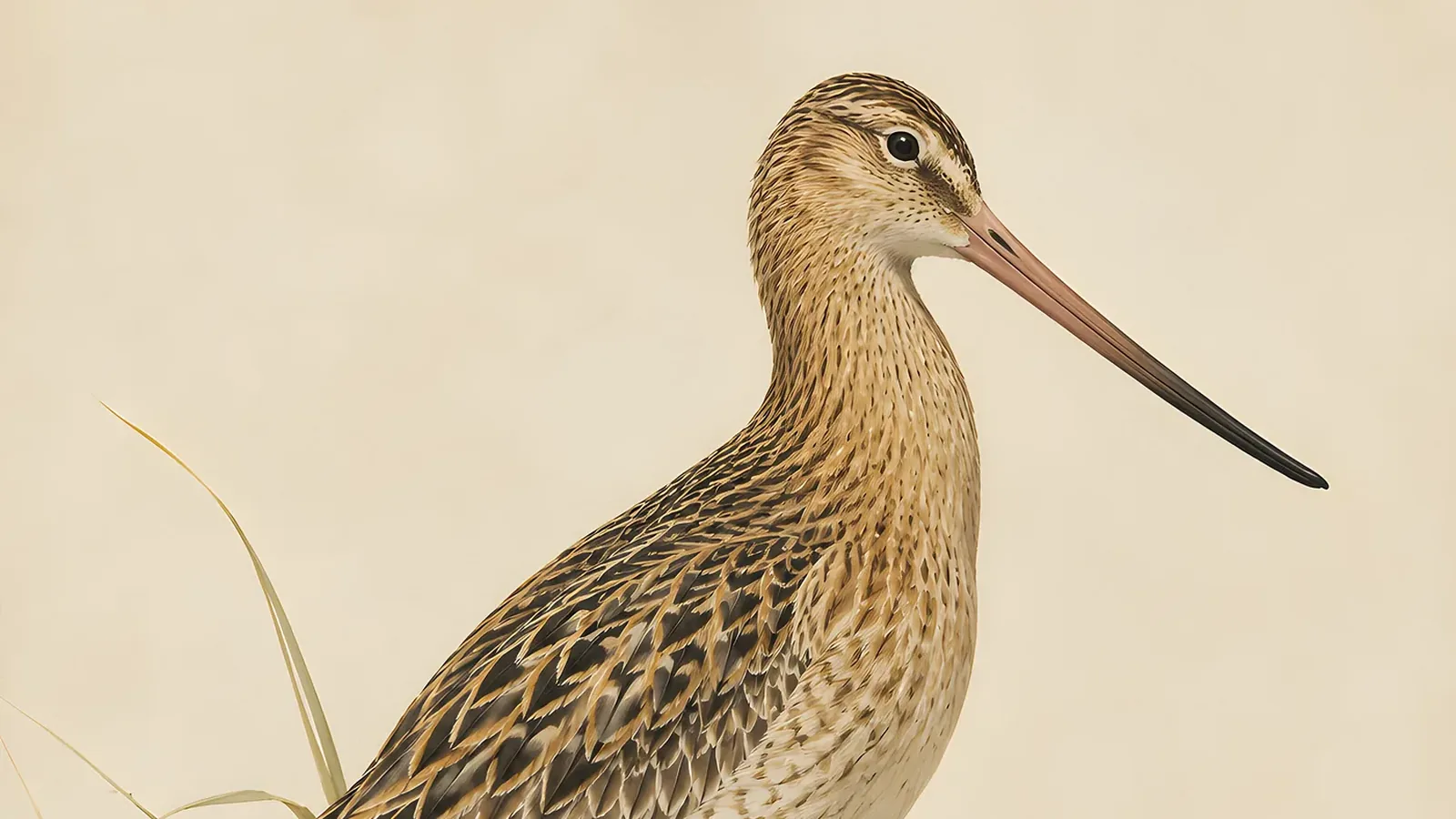
Limosa lapponica is a large, long-legged shorebird, 37 to 41 cm from bill tip to tail, with a wingspan of 69 to 80 cm and a weight that swings wildly depending on season - anywhere from 190 g outside migration to over 600 g in a preflight female loaded with fat. It sits heavier in the hand than most shorebirds its length would suggest.
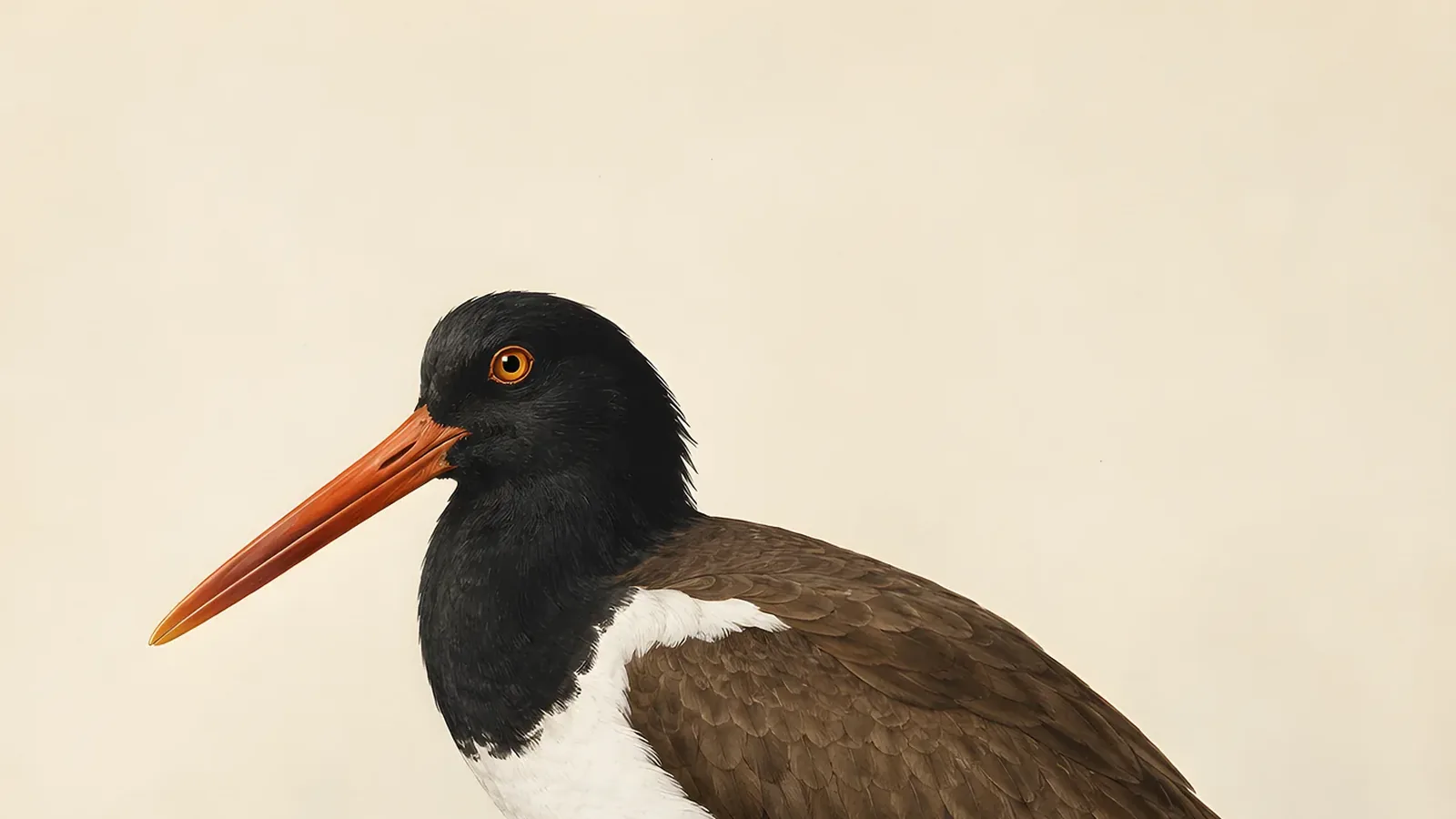
The bill is the defining field mark: long, tapering, and slightly upturned, dark at the tip and pink or salmon at the base. It is a probing instrument, designed for soft substrate, and it carries a practical elegance quite different from the American oystercatcher’s flat blade-bill, which is built to pry open a rigid shell.
Sexual dimorphism in plumage is pronounced. Breeding males are a deep, brick-red cinnamon across the face, neck, breast, and belly - one of the more saturated colors in the shorebird world. Females are considerably paler, with much of the rufous washed out to buff or white below. In nonbreeding and juvenile plumage, both sexes shift to streaked brown above and clean white below, a pattern that reads as nondescript until you register the bill and stance together. The tail, visible in flight, shows pale barring that gives the species its name.
Legs are blue-grey and relatively short for a godwit, which places the bird lower to the substrate than its congeners when probing.
| Measurement | Range |
|---|---|
| Length | 37 - 41 cm |
| Weight | 190 - 630 g (preflight fat load pushes females to upper range) |
| Wingspan | 69 - 80 cm |
| Max recorded age | 34 years (British Trust for Ornithology ringing records) |
| First breeding | 2 years |
| Clutch | 4 eggs |
The voice is not elaborated in the field guides. A carrying kew-wew, various undulating whistles in flight. For a bird of such biological fame, it calls quietly.
The longest flight
On October 13, 2022, a juvenile bar-tailed godwit designated B6 lifted off from the Seward Peninsula near Nome, Alaska. Eleven days and one hour later, it landed in Ansons Bay, northeastern Tasmania, having traveled 13,560 km (8,425 miles) directly across the Pacific Ocean. It had not landed, fed, or drunk fresh water in the interval. The U.S. Geological Survey, working with the Max Planck Institute and the U.S. Fish and Wildlife Service, had fitted B6 with a five-gram solar-powered satellite transmitter, making the entire flight trackable in near-real time.
B6, at four months old, had set the longest confirmed nonstop flight ever recorded for any animal.
The record had itself been set recently, and by the same species. A male tracked in 2020 by the same research consortium flew over 12,000 km from Alaska to New Zealand in 11 days, breaking the then-standing mark (Gill et al. documented the first satellite-confirmed transoceanic flights in their landmark 2008 paper in Proceedings of the Royal Society B: seven females with implanted transmitters flying 8,117 to 11,680 km across the Pacific, averaging 7.8 days in the air). The research program had been expanding, and each cohort of tracked birds revealed something beyond what the previous cohort had shown possible.
“Maintaining an estimated metabolic rate of 8-10 times basal metabolic rate for more than 9 days represents a combination of metabolic intensity and duration that is unprecedented.”
- Gill, Piersma et al., Proceedings of the Royal Society B, 2008
These numbers require a moment to sit with. Eight to ten times basal metabolic rate, sustained continuously for 9 to 11 days. By comparison, elite human athletes can sustain roughly six to eight times basal metabolic rate for a few hours. The godwit does it for a week and a half, without fuel stops, without sleep, across featureless ocean.
How it is possible
The answer is in what happens on the mudflats before departure, and it is a story of controlled self-transformation.
Theunis Piersma of the University of Groningen, one of the world’s foremost authorities on shorebird physiology, first described the paradox in 1998 in a paper pointedly titled “Guts don’t fly.” His finding was this: the godwits that were suspected of embarking on the transoceanic crossing had fat loads that were enormous but digestive organs that were tiny - shrunken, nearly vestigial. He confirmed with Gill and colleagues in a 2021 Frontiers in Ecology and Evolution paper that birds staging for departure showed fat constituting 54.8 percent of total body mass, compared with only 17 percent in birds still actively fueling. Liver, kidneys, stomach, and intestines - all shrank dramatically in the days before the flight began. Intestinal length decreased significantly in departing birds.
The logic is brutal and clear. Digestive organs are heavy, metabolically expensive to maintain, and completely useless once the bird is over open ocean where there is nothing to eat. The body dismantles them before departure, repurposing the protein for fuel and simultaneously reducing the total mass that the flight muscles must carry. Fat is kept. Muscle tissue is partially broken down, though the flight muscles and heart maintain or slightly increase their functional share of fat-free body mass. The bird arrives at the coast of New Zealand lighter, leaner, and metabolically stripped to what an 11-day oceanic crossing actually requires.
The fat load increase from staging through departure was roughly threefold, from approximately 65 g to 201 g (Piersma, Gill, Ruthrauff, Frontiers in Ecology and Evolution, 2021). Near-doubling of total body weight, followed by the systematic demolition of everything that is not wings, heart, and fuel.
The southbound route itself offers advantages. Gill and colleagues noted in 2008 that the transoceanic corridor functions as “an ecological corridor rather than a barrier, providing a wind-assisted passage relatively free of pathogens and predators.” The Pacific trade winds and departing weather systems give a consistent push south and west. The birds use it.
Range and the flyway
The subspecies that holds the flight records is L. l. baueri, which breeds in western Alaska, principally on the Yukon-Kuskokwim Delta, and stages in estuaries along the Alaska Peninsula before its southbound departure. Wintering grounds lie in New Zealand and southeastern Australia, principally on the North Island tidal estuaries and Tasmanian coastlines. The round-trip migration covers roughly 29,000 km per year. A bird that lives to the maximum recorded age of 34 years would fly over 460,000 km in its lifetime in migration alone.
A second subspecies, L. l. menzbieri, breeds in northeastern Siberia and winters in Southeast Asia and western Australia. Its migrations use the East Asian-Australasian Flyway, with a critical staging stop in the Yellow Sea intertidal zone of China and Korea, a habitat under severe pressure from coastal reclamation. Combined, the two subspecies total roughly 325,000 birds: approximately 170,000 menzbieri and 155,000 baueri, according to BirdLife International’s DataZone population estimates.
The species holds Near Threatened (NT) status on the IUCN Red List, with a declining trend. Habitat loss in the Yellow Sea threatens menzbieri in particular: the intertidal flats where these birds rebuild their fat stores before the final push to Siberian breeding grounds are being converted at speed. L. l. baueri is under less immediate pressure on its Alaskan breeding grounds, but the migratory system is long and has multiple choke points.
In Europe and West Africa, L. l. lapponica - the nominate subspecies - conducts a shorter but still substantial migration between Scandinavian and Siberian breeding grounds and wintering estuaries on European and West African coasts. This population is what most British and Irish birders see, arriving on autumn mudflats in massed, striking flocks.
Diet
On the breeding grounds in Alaska and Siberia, Bar-tailed Godwits take aquatic insects, occasional berries, and seeds - the tundra offering during the brief Arctic summer. The bill is the same tool here, probed into soft, waterlogged ground or tundra pools.
On the wintering grounds in New Zealand and Australia, the diet shifts to tidal mudflat invertebrates: polychaete worms, bivalves, crustaceans, and small mollusks. The long, slightly upturned bill is used in a probing action rather than a hammering or prying one. The bird walks slowly, bill angled into the substrate at shallow depth, feeling for prey. A feeding godwit on a New Zealand estuary moves with the deliberate, head-down patience of an instrument making careful contact with the earth.
Breeding
Bar-tailed Godwits breed on Arctic and subarctic tundra, typically on rolling upland terrain with hummocky ground cover, low shrubs, and proximity to wet areas. In Alaska, the Yukon Delta provides the primary breeding concentration for baueri. Breeding begins at two years of age.
The nest is a ground scrape, lightly lined, set on elevated ground with good sight lines. Four eggs are typical, incubated by both parents for approximately three weeks. Males perform aerial display flights over the territory, calling continuously. Chicks are precocial, active within hours, feeding themselves on invertebrates as soon as they can walk. Fledging comes at around 30 days.
The female, having incubated and tended the early brood, often departs the breeding grounds before the male and juveniles. Juvenile godwits make their first transoceanic crossing alone, without parental guidance, in the same October window that B6 used in 2022. The juvenile found Alaska, loaded itself with fat, reduced its own organs, and flew 13,560 km by some combination of inherited star-map and magnetic compass. It had been alive for four months.
There is a temptation, in writing about this bird, to reach for language about limits and extremes and the impossible made real. Resist it. The godwit does not perform a miracle. It executes a highly specific physiological and navigational program that its lineage refined over many thousands of years. What the satellite data showed - and what Gill, Piersma, and their colleagues have spent careers documenting - is that we had simply underestimated what the avian body, under sufficient selection pressure, could be made to do. The mudflat bird probing the estuary is the same bird as the one over the open Pacific on day eight, running on stored fat, intestines gone, heart pumping. It is the same plan, seen from two vantage points in the same season.