Field Guide
Sandhill Crane
Every March, at the edge of a cornfield near Kearney, Nebraska, the sky fills with grey wings before first light.
The birds land by the tens of thousands, fold into the shallows of the Platte River, and stand there in the dark with their feet in water. By mid-morning the roost breaks up. They move into the surrounding fields - still harvested, still scattered with corn - and eat. By dusk they are back in the river, roosting again. This pattern repeats for three to five weeks. Then, in late March or early April, the birds are gone. The Platte River crane staging is the largest gathering of cranes anywhere on earth, and it is also one of the shortest. You get about a month to see it. Then they go north, and the fields go quiet.
This is what Antigone canadensis - the Sandhill Crane - actually is: not a marsh bird with a red crown, though it has one, but a continental-scale migrant whose life is organized around distances that defy easy comprehension. The Platte River stopover is the hinge on which the whole system turns.
What it looks like
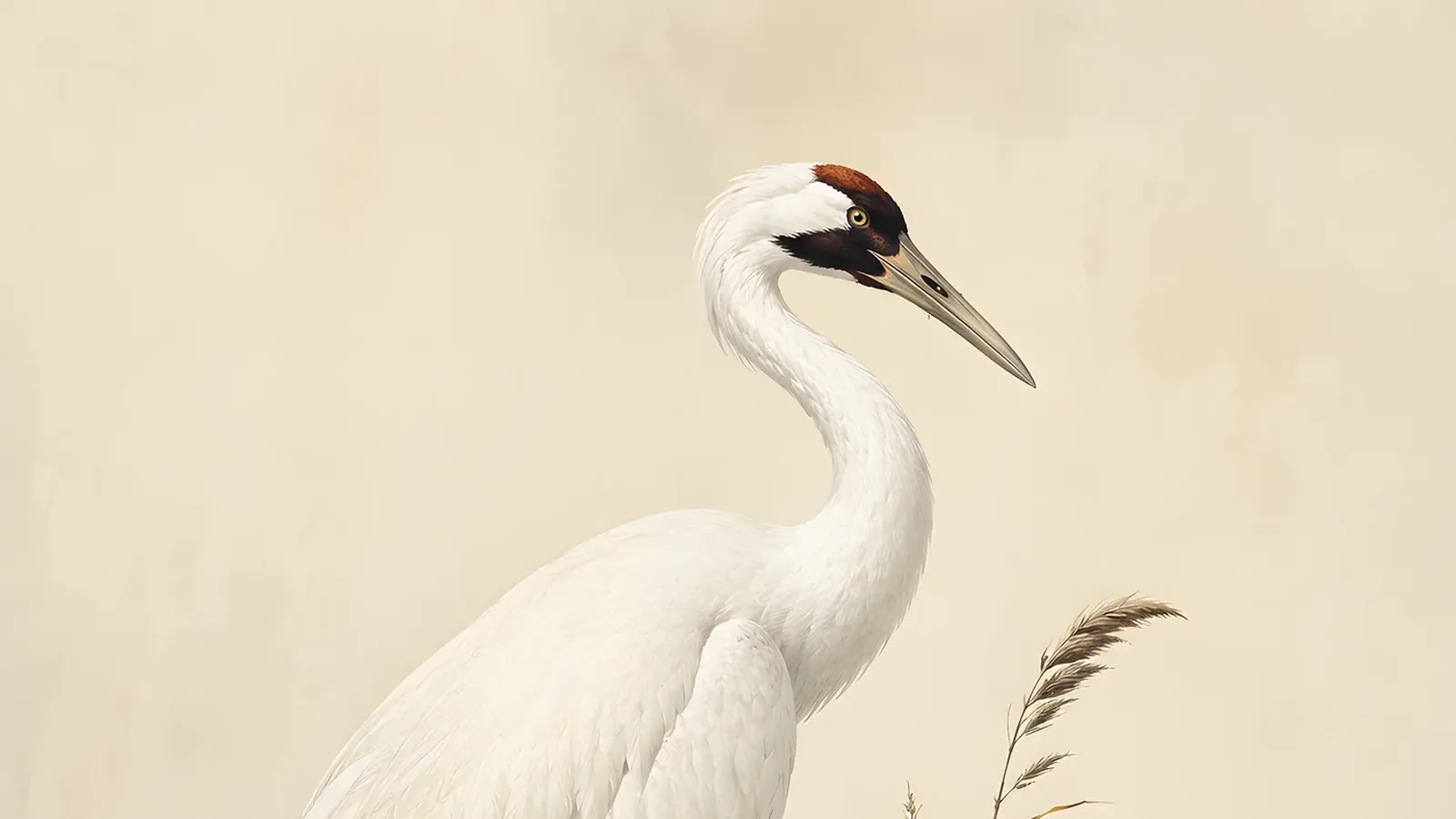
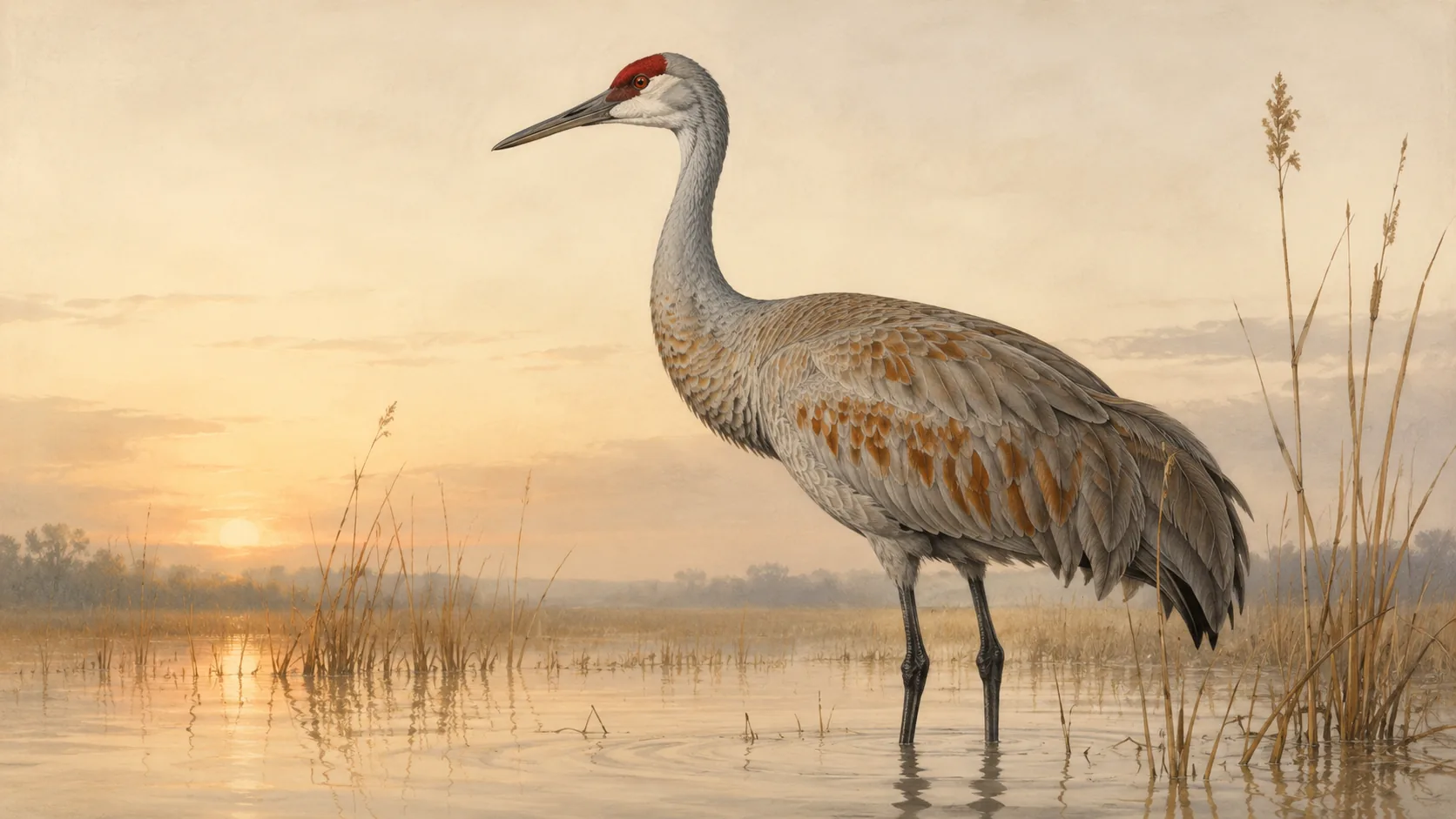
The Sandhill Crane is a tall, heavy-bodied bird, 97 to 122 centimetres long from bill to tail, with a wingspan of 195 to 213 centimetres and a weight of 2.7 to five kilograms. It stands roughly one metre at the shoulder. In profile, standing in a field, it reads as slate grey overall, with a bare red cap - a patch of skin, not feathers - on the crown, and a white cheek. The long neck and long legs are the field marks that matter at distance. The bill is straight and heavy.
The species varies in size across its range. Cornell’s Birds of the World notes that the Lesser Sandhill Crane, which breeds in the Arctic and stages on the Platte in its millions, is the smallest form. The Greater Sandhill Crane of the northern United States is measurably larger. The non-migratory Florida subspecies falls between them. All share the same grey plumage and red crown.
One feature of Sandhill Crane plumage catches every field observer: the rust-brown staining that covers the body feathers on many birds, particularly in summer. This is not a pigment. The birds preen with mud and iron-rich organic material, and the iron oxidises to produce the rusty wash. It fades over winter. Audubon’s field guide notes the adult as grey with a red crown, the juvenile browner overall, without the red cap.
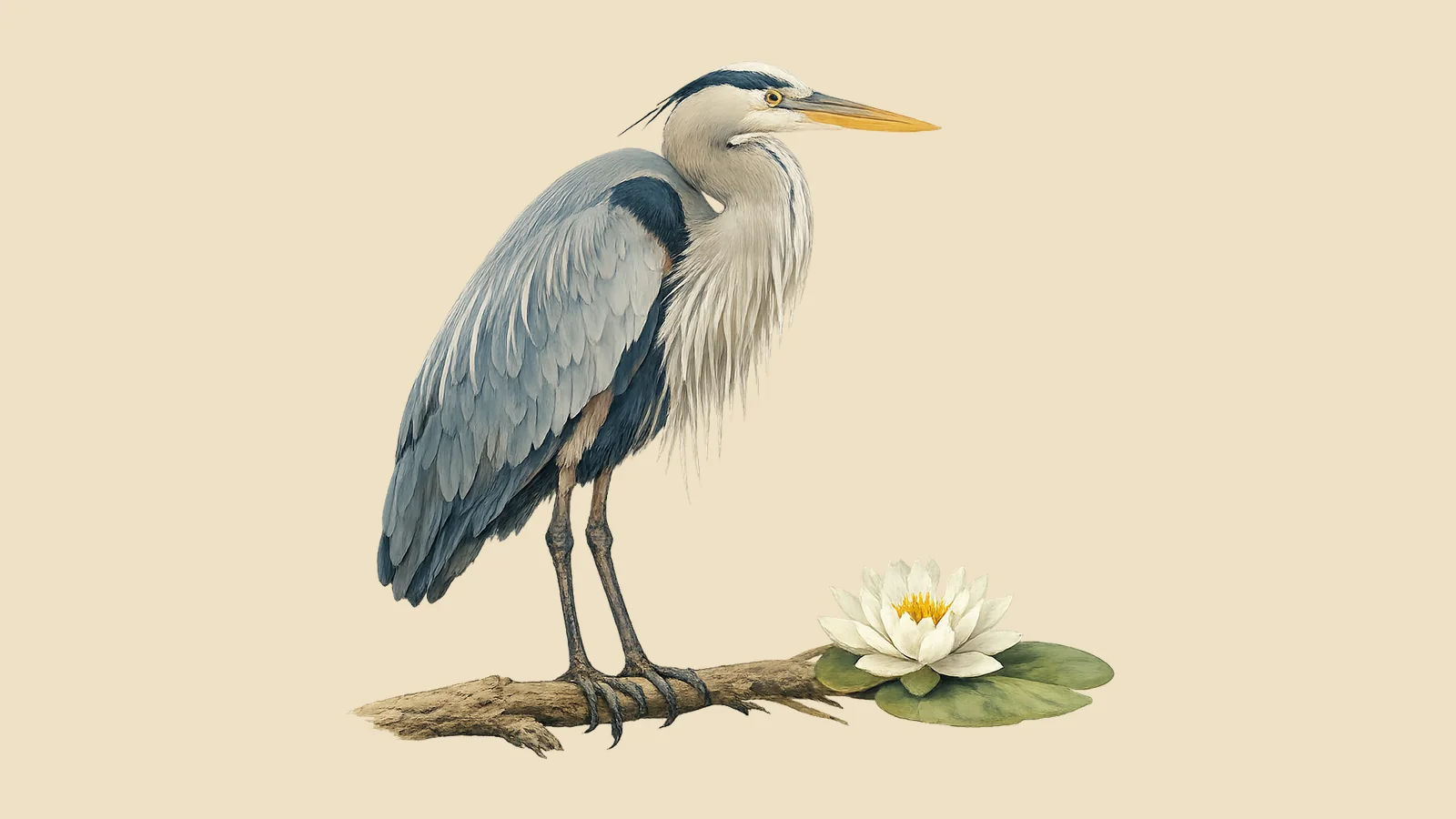
In flight, the Sandhill Crane is unmistakable: a six-foot wingspan, neck extended fully forward, feet trailing behind. Great Blue Herons fold the neck into an S-shape in flight - that one difference resolves most confusion at a distance.
What it sounds like
The call is one of the loudest produced by any North American bird, a rolling, resonant bugle - karrrr-oo - that carries for several kilometres across open prairie. Cornell’s All About Birds describes it as a “loud bugling call.” The anatomy behind it is unusual: the windpipe in an adult Sandhill Crane is partially coiled within the breastbone, adding length and resonance. Two birds calling together produce a duet that functions as a territory proclamation and a pair-bond display simultaneously.
The call carries enough to assemble a roost and enough to hold a territory. On the Platte in March, with half a million birds in one river valley, the combined sound is described by every observer as something that precedes anything else in the experience - before the visual impression registers, you hear the cranes.
Range and habitat across the year
Six subspecies, three migratory and three non-migratory, are distributed across a range that runs from Cuba to eastern Siberia. The migratory populations - Lesser, Greater, and Canadian - breed across Alaska, Canada, and scattered wetlands of the northern United States. The non-migratory populations hold small, isolated ranges in Florida, Mississippi, and Cuba.
The full migratory route uses a funnel geography. Birds that winter across the American Southwest converge on the central Platte River valley in Nebraska, where the flat, braided river channels and adjacent cornfields provide the specific combination of wide-open roosting shallows and high-calorie food that the birds need for staging. The Audubon Society’s Rowe Sanctuary on the Platte hosts around 15,000 crane-watchers each spring and manages the river habitat that makes the staging possible. From Nebraska the cranes fan out north and northwest - to breeding grounds in Canada, Alaska, and across the Bering Strait into eastern Siberia.
Breeding habitat is wetland and adjacent grassland: shallow freshwater marshes, prairie potholes, bogs, tundra. The Florida subspecies uses wet prairies and freshwater marshes year-round. In winter, the migratory populations move to agricultural fields and wetlands in the American Southwest, Texas, Mexico, and California.
Diet
The diet is broadly omnivorous, with the specific composition shifting by season and geography. On the Platte River staging grounds, the Audubon Society’s crane sanctuary data indicates that waste corn from harvested agricultural fields can comprise more than 90 percent of the diet - the birds are building fat reserves, not diversifying. Away from the staging grounds, the diet includes roots of aquatic plants, seeds, insects, grubs, earthworms, snails, amphibians, small reptiles, and small rodents. The birds forage by probing soft ground with their bill and by gleaning vegetation.
Breeding and nesting
Sandhill Cranes are socially monogamous and form long-term pair bonds. Cornell’s Birds of the World reports that pairs typically remain together across multiple breeding seasons. Sexual maturity is delayed - the Platte River birds are generally between two and eight years old before breeding, depending on subspecies.
Courtship involves elaborate dancing: the birds leap, spread their wings, bow, and call. Both members of a pair dance, and groups of unpaired birds sometimes dance together. It is one of the more precisely described courtship behaviours in North American ornithology.
Nesting takes place at wetland edges or in shallow marsh water. Both parents build the nest, a mound of marsh vegetation either floating or anchored to emergent plants. Clutch size is typically two eggs. Incubation lasts 29 to 32 days, with both parents participating. The chicks are precocial - they walk and swim within hours of hatching. They fledge at 65 to 75 days, but they remain with the parents for nine to ten months, travelling with the family group through the first migration and on the wintering grounds.
The low reproductive output - Cornell’s Birds of the World notes approximately 0.3 young raised annually to independence - is typical of long-lived species. The bird compensates with longevity. The oldest Sandhill Crane on record, according to the Cornell Lab, was at least 37 years and three months old.
The behaviour quirk: preening with rust
Sandhill Cranes are grey birds that paint themselves brown. The rust-staining described above is active, not incidental. Birds use their bills to apply mud and iron-rich plant material to their body feathers, and researchers who have watched the behaviour in detail note that it is deliberate and thorough. The proposed explanations include camouflage (a rust-coloured bird against a brown wetland is harder to spot than a grey one), parasite control (iron-rich mud may suppress feather lice), and social signalling (stain condition as a proxy for condition and time spent in productive habitat). None of these explanations has been fully settled, which puts the behaviour in the company of the Blue Jay’s hawk mimicry - useful enough that it has persisted, complex enough that no single explanation accounts for it.
What the staining does accomplish, undeniably, is to make the Sandhill Crane in summer look like a different bird than the Sandhill Crane in winter. The traveller returning from the Arctic breeding grounds in September, heavy-bodied and rust-brown, fading through winter to pale grey, ready again for the Platte in March, carries the whole year on its feathers.
The Sandhill Crane is one of the oldest bird species with a confirmed fossil record - a species closely related to the modern form dates to at least 2.5 million years before present. The Platte River corridor it relies on is a managed, maintained, and somewhat diminished remnant of a much larger river braided system. The cranes are not simply using the river; they are using whatever the river still is. That distinction matters to anyone who watches a crane roost in March and wants it to still be there in thirty years.