Field Guide
Vermilion Flycatcher
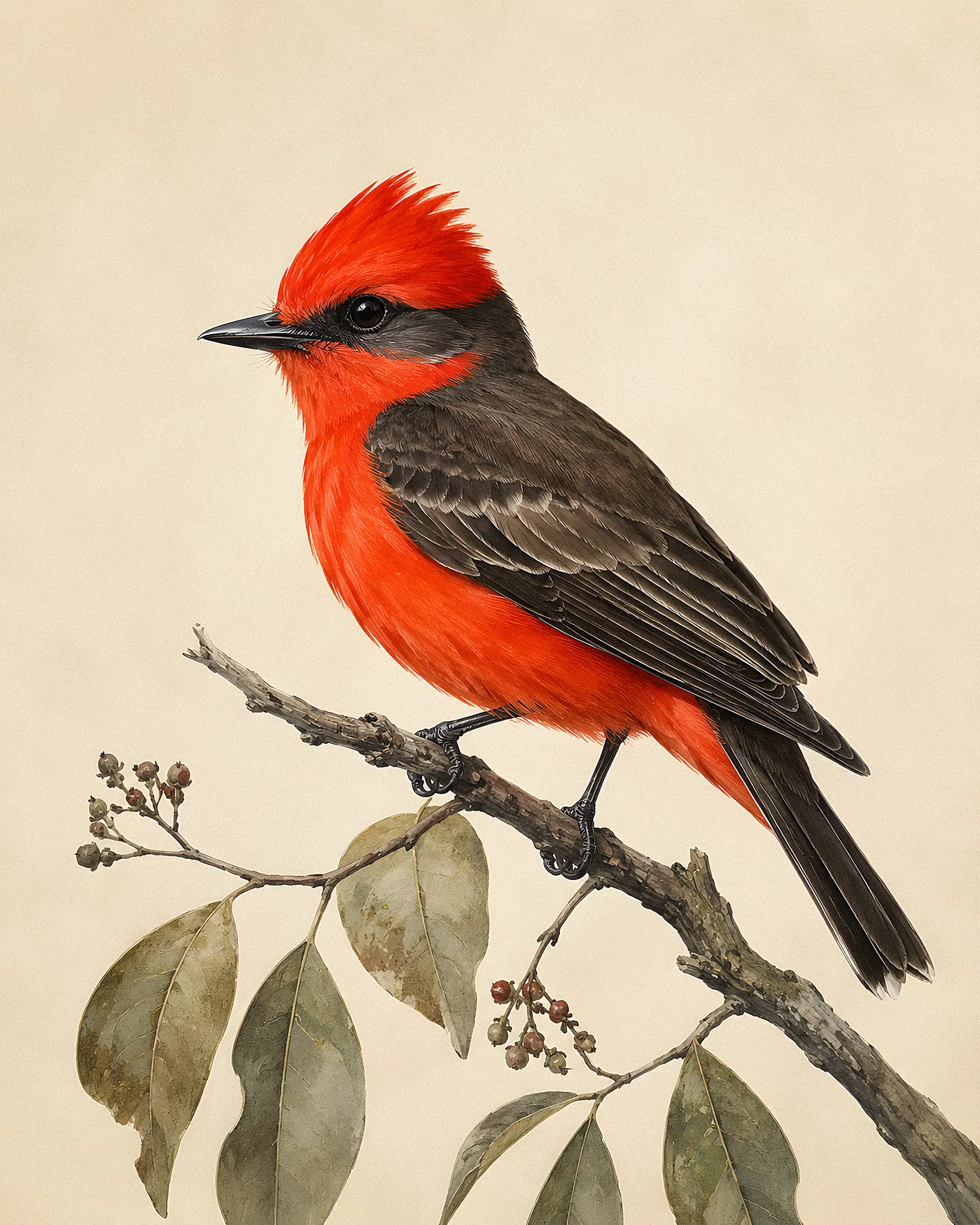
A male Vermilion Flycatcher on a fence wire over a desert stream is one of the most startling sights in the dry American Southwest. Everything around him is the colour of dust, sun-bleached grass, pale mesquite, the grey of a dry wash, and then there is this small bird burning scarlet against it, crown and breast the red of a struck match, the rest of the face and back a deep sooty brown. He sits low, watches the air, and sallies out to snap an insect on the wing before dropping back to the same perch. The desert does not produce many colours like his.
He belongs to the tyrant flycatchers, a large New World family of mostly plain, watchful, insect-hunting birds. The Vermilion is the family’s great exception, the one that traded subtlety for fire. He is small, he keeps to open country near water, and he carries on his back and breast the single most concentrated patch of red of any flycatcher in North America.
What he looks like
This is a small, large-headed flycatcher, 13 to 14 centimetres long, weighing 11 to 14 grams, with a wingspan around 24 to 25 centimetres. He is compact and a little dumpy in profile, with the upright, alert posture of a bird that hunts by sight from a perch.
The adult male is unmistakable. His crown, throat, and entire underparts glow vermilion red, a colour that runs from scarlet to near-orange depending on light and individual. Cutting through it is a broad dark brown mask that sweeps back from the eye, and the same sooty brown covers his back, wings, and tail. The contrast is the whole effect: fire below, soot above, with no in-between.
The female is a different creature and easy to overlook. She is grey-brown above with a plain greyish head, whitish underparts finely streaked across the breast, and a wash of peach, salmon, or pale yellow low on the belly and under the tail. That flush of warm colour at the rear is her best mark, and it separates her from the very similar Say’s Phoebe, with which she is regularly confused. Young males look much like females before the red comes in.
What he sounds like
For so vivid a bird the voice is modest. The male’s song is a soft, tinkling, slightly stuttering phrase, often written as pit-a-see, pit-a-see, delivered repeatedly and most often during his display flight. Field observers have rendered it many ways, from a pit pit pit pidddrreedrr to a thin ching-tink-a-le-tink with the stress falling on the last note, but all the versions agree on its gentleness. It is a quiet, almost musical patter rather than a carrying announcement.
He sings most in the breeding months, often in flight, and the song is bound up with the display rather than sung idly from a perch. The common call away from courtship is a sharp, simple peet, the all-purpose flycatcher note used in alarm and contact.
Range and habitat
Pyrocephalus rubinus is a bird of open country near water across an enormous span of the Americas. In the United States it holds the desert Southwest, then ranges south through Mexico and Central America and deep into South America. The constant across that range is the combination of open ground and moisture: streamside woodland, the edges of ponds and ditches, savanna, ranchland, and desert scrub with scattered trees, generally where there is water to draw the insects he hunts.
He needs perches and open air more than he needs forest, so a line of short trees along a desert creek suits him perfectly. The IUCN lists the species as Least Concern, with a vast global range, though in parts of the United States the northern edge of that range has thinned, and the bird has declined where riparian habitat has been lost or degraded.
Diet
The Vermilion Flycatcher is an aerial hunter, an insectivore that takes most of its food on the wing. From a low, exposed perch he watches the air, then launches out to seize flies, grasshoppers, beetles, bees, and other flying insects, snapping them up in a short sally and returning to the perch to wait again. It is the classic flycatcher technique, patience punctuated by sudden flights, and he will also drop to the ground for prey or hover briefly to pick an insect from vegetation. There are even records of the species taking small fish from the water surface.
That diet turns out to be the source of his colour, which makes the next fact the most surprising thing about him.
Breeding and nesting
The male’s role in courtship is the display flight. He rises into the air on rapidly fluttering wings, crest raised and breast puffed, singing his soft stuttering song as he hovers and flutters above the female before parachuting back down. It is a small, ardent performance, all flutter and colour.
The female does the building. She constructs a shallow, loosely made cup of twigs, grasses, and fine fibres, lined with feathers and hair and finished on the outside with cobwebs and lichen that bind it together and camouflage it on its branch. She lays two or three eggs, whitish to cream and marked with dark spots at the larger end, and incubates them alone for about 13 to 15 days while the male brings her food. Both parents then feed the chicks, which leave the nest around two weeks after hatching, and a pair will often raise two broods in a season.
The colour worth knowing
Here is the strange truth behind the fire. The male’s red is not made by the bird itself but borrowed from his food. The pigments that paint him vermilion are carotenoids, the same family of compounds that turn a flamingo pink, and they come from the wild insects he eats. The diet is the dye. A Vermilion Flycatcher kept in captivity, fed on substitute food, loses the colour within a season and fades to a dull peachy orange, because the supply of pigment has been cut off.
The most flamboyant flycatcher in North America wears a colour he cannot manufacture, only eat, and a few months of the wrong diet washes the fire out of him.
So the scarlet bird on the desert wire is, in a sense, a record of his own hunting. The depth of his red is a readout of the insects he has caught and the country he has caught them in. Watch him sally and return, sally and return, over the green strip of a desert stream, and you are watching the colour being kept alight, one beetle and one fly at a time.