Field Guide
Wild Turkey
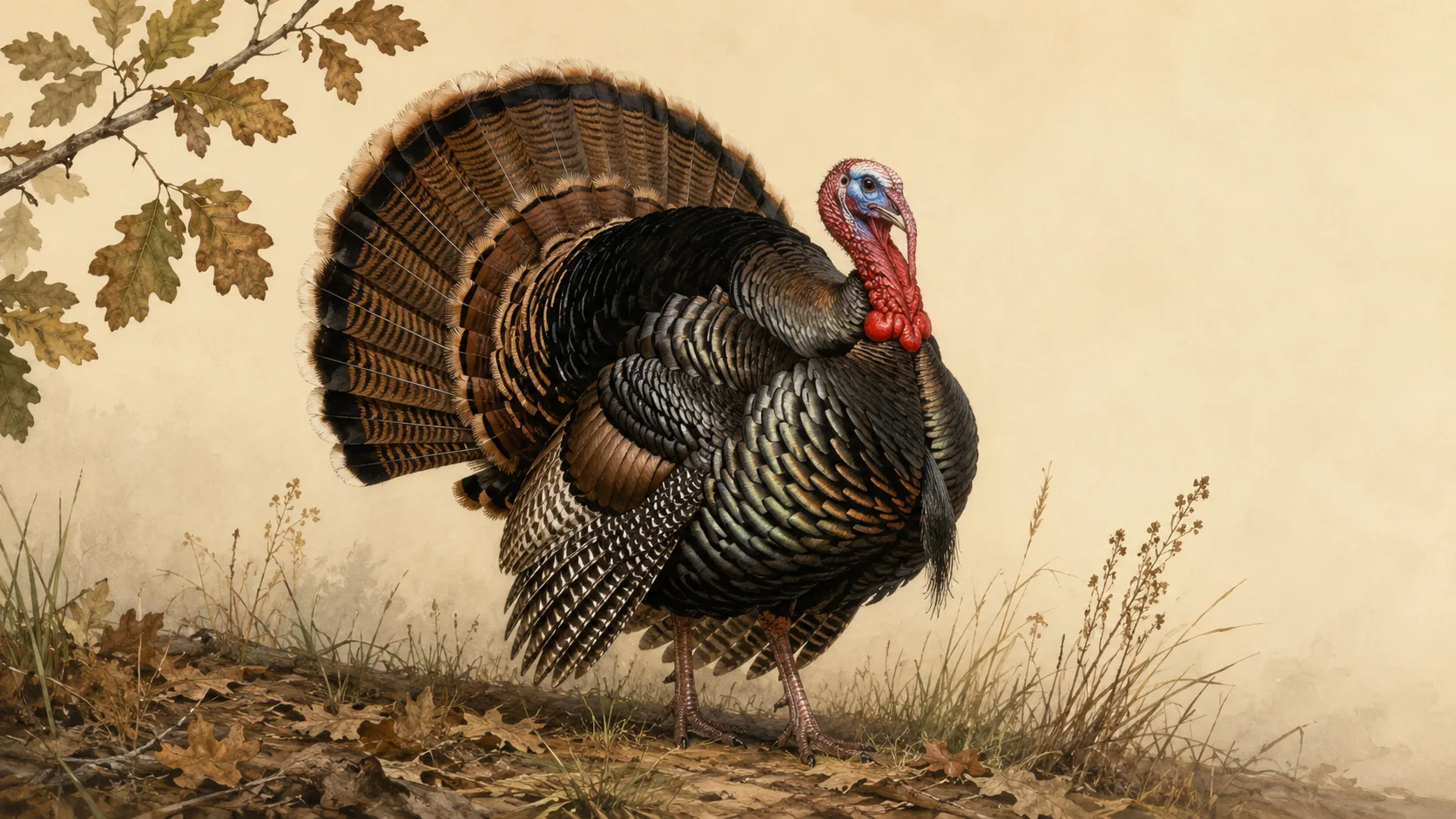
On a cold February morning in an oak-hickory forest in Pennsylvania, a male Meleagris gallopavo steps out of the trees into a clearing and begins to fan his tail. He does not hurry. He holds each pose for 30 seconds, one minute, sometimes longer. His wattles - the fleshy protuberances at his throat - flush from pale pink to arterial red. The iridescent bronze of his breast feathers catches the low winter light and shifts between green and copper as he turns. He has been doing this since before dawn. He will do it until mid-morning, rest, and begin again at dusk.
The Wild Turkey is the largest game bird in North America. It is also, by any measurable standard, the most improbable conservation story on the continent.
What he looks like
The tom - the adult male - runs 100 to 125 centimetres long and weighs up to 10.8 kilograms. His plumage is not simply dark brown. In good light it is black tipped with iridescent bronze and shot through with green, copper, and purple. His naked head is blue-grey or bluish-white. His wattles can shift to brilliant red within seconds when he is aroused or alarmed. A “beard” - a cluster of coarse, hair-like feathers - protrudes from his breast, typically 25 to 30 centimetres long in mature birds. He has a bony spur on each leg. In full display, with tail fanned and wings dragging the ground, he looks like nothing else in North America.
The hen is smaller - 76 to 95 centimetres, 2.5 to 5.4 kilograms - and dressed in plain brown and buff with the same subtle iridescence. She has a smaller, feathered head, no wattles to speak of, and usually no beard. She is well-designed for invisibility. On a ground nest in dry leaves, she is genuinely difficult to see at three metres.
Juvenile birds of both sexes resemble the hen through their first autumn. Young toms develop their beards and spurs in the first full year. The snood - the fleshy projection above the bill that drops over the beak during display - is present in both sexes but longer and more mobile in the male.
Voice
The gobble is among the most recognisable bird calls in North America. A tom’s gobble carries up to 1.6 kilometres on a still morning. He produces it by a rapid compression of air through a specialised laryngeal mechanism, and the sound is structurally different from the domestic turkey’s gobble - wilder, more complex, less uniform. Audubon’s field guide notes the call as “falling and flat,” though anyone who has heard one at close range in April might choose sharper words.
The species also clucks, purrs, yelps, cackles, and produces a soft assembly call. Hens use a “kee-kee” call to gather scattered poults. The full vocal repertoire, documented across wild populations, is large and context-dependent. Toms listen to female yelps and respond to them; turkey hunters have built an entire technology of calls around this.
Range and habitat across the year
The Wild Turkey is non-migratory. Its pre-settlement range covered most of what is now the continental United States east of the Rockies and extended south into Mexico. Market hunting and the clearing of eastern hardwood forests reduced that to scattered remnant populations by 1900. By the 1930s, the species had been extirpated from 18 of its original 39 US states.
The recovery began with trap-and-transfer programs run by state wildlife agencies and the National Wild Turkey Federation starting in the 1950s. Birds trapped in wild source populations were moved to vacant historical range. By 2000, the Wild Turkey had been reestablished across all 48 contiguous states and most of southern Canada. Cornell’s Birds of the World calls this restoration “one of the great successes of modern wildlife management,” with over 200,000 individuals reintroduced by trap-and-transfer across five decades.
Today the species occupies oak and hickory hardwoods, pine-oak mixes, cypress swamps, mesquite grasslands, pinyon-juniper woodlands, and agricultural edges - anywhere that forest meets open ground. It follows oak mast cycles closely. In autumn, a flock moves through a stand of producing oaks the way a combine moves through grain. In winter, the birds concentrate where snow is shallow enough to scratch through or where agricultural fields provide spilled corn and grain.
Diet
The Wild Turkey is a ground-forager, and its diet follows the calendar with precision. Acorns are the dominant food from September through February in oak-range birds. A single bird can consume 200 acorns in a day at peak mast-fall. Insects - grasshoppers, beetles, caterpillars, ants - make up a substantial fraction of the summer diet. Berries, seeds, fern fronds, and grain fill the gaps. Poults eat almost nothing but insects in their first three weeks; the protein load is necessary for rapid feather and bone development.
The bird’s foraging technique is to walk slowly, scratch with both feet simultaneously, and then step back to examine what has been displaced. In a good oak stand in October, a flock of 20 birds scratching through dry leaves sounds like a sustained rain.
Breeding and nesting
Courtship begins in late winter. Toms display on traditional strutting grounds - small clearings or ridgetops - and the gobble serves both to advertise location to hens and to warn competing toms. The Wild Turkey is polygynous: a dominant tom will mate with multiple hens. He takes no part in incubation or brood-rearing.
The hen scrapes a shallow depression in dry leaves under a shrub or log and lines it minimally with leaves. She lays 10 to 15 eggs, sometimes up to 18, at a rate of one per day. Incubation runs 25 to 31 days, by the hen alone. The eggs are pale buff, lightly spotted. Audubon’s field guide gives the clutch range as 10 to 15, consistent with what field biologists observe across most eastern populations.
Poults leave the nest within 24 hours of hatching. They are precocial - mobile and feeding within hours - but unable to thermoregulate for the first two weeks and dependent on the hen for warmth. Chick survival through the first month is the bottleneck in population dynamics. A cold, wet June can fail an entire year’s production across a large area.
A behaviour worth watching for
Wild Turkeys roost in trees. Every evening, at last light, a flock flies up into the canopy - typically into large oaks or pines - and roosts 6 to 12 metres off the ground until dawn. For a bird that spends its entire day on the ground and that many people associate with clumsiness, the roosting flight is unexpectedly competent. Turkeys can fly at over 85 kilometres per hour in a straight sprint and will fly considerable distances to reach a known roost site.
The roost selection is not random. Birds return to the same trees repeatedly, and flock structure on the roost reflects the dominance relationships on the ground. Dominant toms occupy higher branches. The arrangement is consistent enough that a researcher marking individual birds can reconstruct the flock hierarchy from roost position alone.
What makes this worth watching is the moment just before flight. The birds bunch together at the edge of the roost tree, calling softly, seeming to negotiate who goes first. Then one flies, and the rest follow in sequence within 30 seconds, one after another, until the clearing is empty and the forest is loud again with wingbeats.
The recovery, and what it means
The IUCN lists the Wild Turkey as Least Concern - a classification that would have been unthinkable in 1930. The recovery is not just a hunting management story, though hunting license revenue and the Federal Aid in Wildlife Restoration Act funded most of it. It is a demonstration that a species reduced to 30,000 animals continent-wide can be brought back to an estimated seven million if the habitat is secured and the politics held.
The bird is not finished expanding. Wild Turkey populations have established themselves in Hawaii, Germany, and New Zealand through introductions. Within North America, range is still shifting - west into British Columbia, north into Ontario. The ecology the bird requires, forest with open edge, is also, largely, the ecology humans have been creating for centuries of land clearing and partial reforestation. The Wild Turkey has found, in the American suburb with mature oaks and a lawn, almost exactly what it needs.
A bird that walks out of the tree line at the edge of a Massachusetts subdivision in November is not a symbol of anything in particular. It is a bird doing what Wild Turkeys do: moving through the edge zone between forest and field, head down, scratching leaves aside, looking for whatever the oaks dropped.
That it is there at all is a genuine achievement. It nearly wasn’t.