Field Guide
Boreal Chickadee
December. A stand of black spruce in the Yukon interior. The light lasts six hours on a good day, and this is not a good day. Temperature minus thirty Celsius. The spruce crowns are motionless - no wind, which is almost worse, because the cold pools and settles into the air like something solid. In one of the middle trees, roughly two metres up, a small brown bird is working the underside of a branch. It lifts a scale of bark with a short dark bill, finds nothing, moves twelve centimetres to the left, tries again. It weighs eleven grams.
Poecile hudsonicus, the Boreal Chickadee. It has been in this forest all year. It will still be here in February.
What it looks like
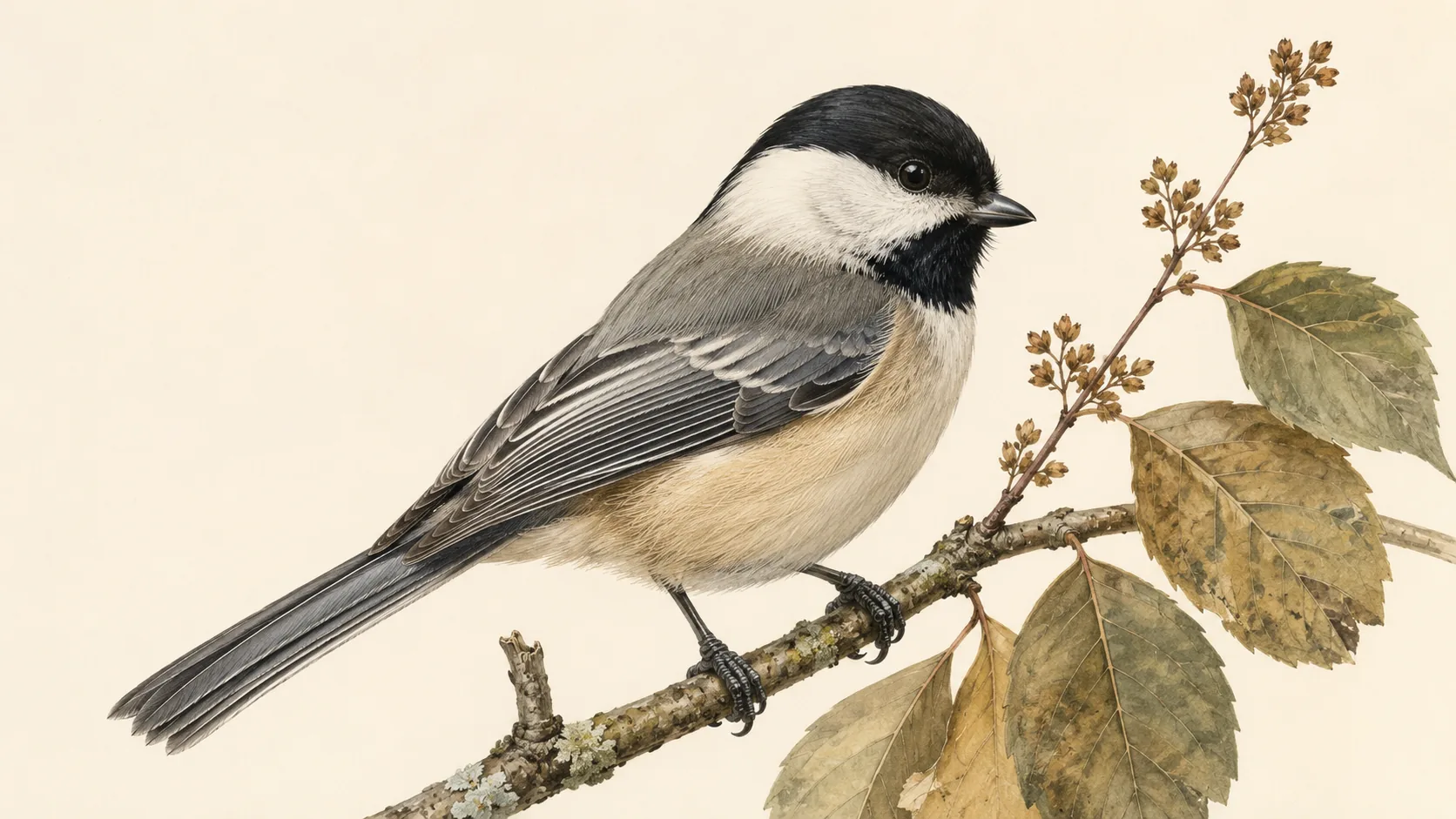
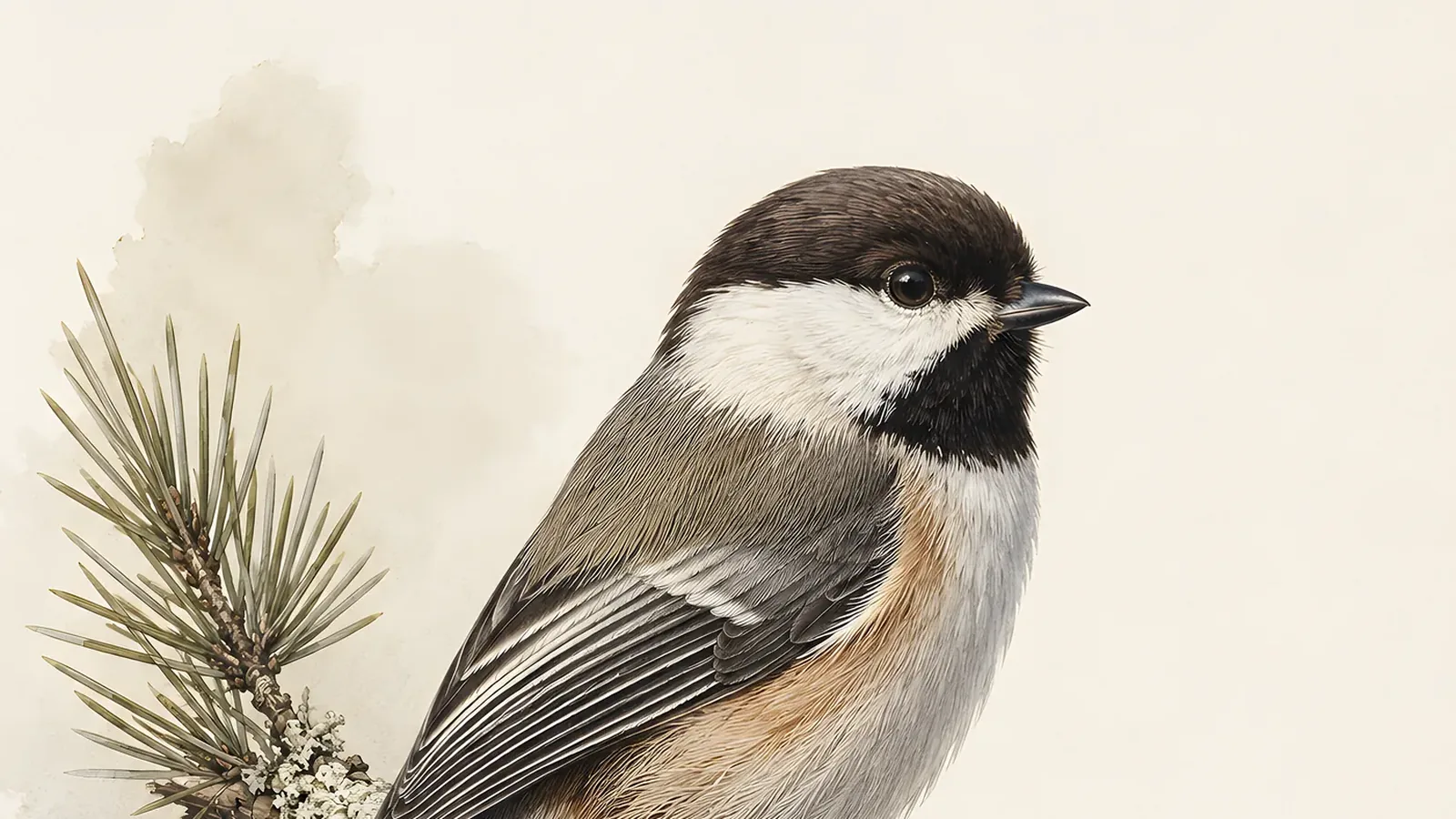
The Boreal Chickadee is built on the same chassis as the better-known black-capped chickadee - short bill, round head, long tail, compact body. But the colouring is its own: a warm brown cap in place of black, a dusty gray-brown back that extends across the wings, and flanks of rich rufous-brown that deepen toward chestnut. The face is pale gray-white on the cheeks, the bib black, but both look washed and faded compared to the sharp geometry of the Black-capped. The whole bird has what field guides reliably call a “dusty look” - as though it has been left out in a northern winter, which of course it has.
The wings carry no bright feather edging. The tail is long and slightly notched. Females are slightly smaller than males and tend to have shorter wings, though the plumage difference between sexes is negligible in the field.
| Measurement | Range |
|---|---|
| Length | 12 - 14 cm |
| Weight | 10 - 14 g |
| Wingspan | 19 - 21 cm |
| Lifespan (typical) | 2 - 8 years |
| Clutch size | 5 - 8 eggs |
| Incubation | 11 - 16 days |
Three subspecies are recognised, with P. h. littoralis of the Atlantic provinces tending to be somewhat smaller overall, and P. h. columbianus of the Pacific ranges carrying warmer tones. All share the brown cap that separates this species at a glance.
Built for the boreal winter
The chickadee that stakes everything on memory and stored food holds the north on two mechanisms. The first is caching. Boreal Chickadees store food year-round - insects, larvae, moth eggs, conifer seeds - in bark crevices, under lichen, in clumps of needles. Each item goes to a separate location. Each location is filed in the hippocampus.
The bird is not guessing where its food is buried. It knows, with a precision that deteriorates only slowly over days and weeks, and is recalled not from habit but from a detailed spatial map.
Sherry and colleagues demonstrated in 1989 (Behavioural Neuroscience, vol. 34) that lesions to the hippocampus in food-storing birds reduced cache retrieval accuracy to chance levels without reducing the tendency to cache at all. The bird still hid seeds. It simply could not find them. Later work by Sherry and Hoshooley (2010, Philosophical Transactions of the Royal Society B, 365: 933-943) documented that hippocampal neurogenesis in food-storing species peaks in winter months - the brain generating new cells precisely when the demand on spatial memory is highest. The hippocampus of a food-storing bird is substantially larger, relative to brain size, than that of a non-storing species of comparable size.
The second mechanism is regulated nocturnal hypothermia. On cold nights - and in the boreal interior, most nights from October to March qualify - the Boreal Chickadee lowers its core body temperature by roughly 10 degrees Celsius before roosting. This is not a failure of thermoregulation. It is deliberate. The suppression reduces metabolic rate enough to conserve the fat reserves the bird spends the short daylight hours rebuilding. The Alaska Department of Fish and Game records that a Boreal Chickadee can deposit roughly eight percent of its body weight in fat each day during winter - a rate that reflects how close the margins run. The bird shivers to rewarm at first light and goes immediately back to work.
These two systems together are why this chickadee can hold a territory in the Yukon interior through January without migrating, irrupting, or dying. The cache is the pantry. The hypothermia is the overnight budget. Both require perfect execution every day.
What it sounds like
The call is slower, huskier, and considerably more nasal than the Black-capped Chickadee’s. Where the Black-capped delivers a crisp, clipped chick-a-dee-dee-dee, the Boreal produces something closer to a lazy, slightly buzzy tsee-day-day - as if the same phrase were being spoken with a cold. Audubon’s field guide to North American birds describes it as “lazier and more nasal” than the Black-capped’s call, a description that holds up reliably in the field. In mixed flocks at the edge of its range, the vocal difference is the most useful separator.
The species also produces a high-pitched trill, a variant of the contact call given during active foraging. Pair bonds may be maintained in part through soft contact calls exchanged within a few metres - the flock’s way of staying organised in dense spruce without having to see one another.
Range and why it stays
The Boreal Chickadee’s world is the boreal forest of North America: from western Alaska across the full breadth of Canada and down into the northernmost fringes of the continental United States - the Upper Peninsula of Michigan, the far north of Minnesota and Maine, the high conifer belt of Montana. The distribution barely crosses the Canadian border anywhere along its length, and in most of its range it never crosses at all.
It is a permanent resident. It does not migrate. On rare years when conifer seed crops fail across a wide area, small southward irruptions occur - mostly hatch-year birds wandering in autumn - but these are episodic and short-range. The species is not designed for travel. Its food is here, cached in known locations in known trees. To leave is to leave the pantry.
This residency is the most important single fact about the Boreal Chickadee. Virtually all of its biology makes sense as a solution to the problem of staying put through a northern winter rather than avoiding that winter by leaving.
The IUCN currently lists the species as Least Concern (LC), with a population estimated at around 12 to 13 million individuals. Numbers are declining in some survey areas, likely tied to climate-linked changes in the boreal forest structure and conifer seed production, but the species remains broadly common across its large, remote range.
Diet and caching
Summer diet is weighted toward invertebrates: caterpillars, moth eggs, beetles, aphids, scale insects, and spiders, gleaned from bark and branch surfaces with a technique that favours the middle portion of trees. The bird works bark crevices and clumps of dead needles where small insects overwinter or cache their eggs. During the breeding season, this protein load is critical for feeding young.
As autumn shortens the days, caching accelerates and seeds take on larger importance - seeds from black spruce, white spruce, and birch among them. Individual items are stored separately, never double-cached. Recovery relies on the spatial memory system described above. The bird does not use smell to find its caches. It uses memory, and that memory is precise enough to be useful weeks later in a forest where every spruce trunk looks nearly identical.
Small winter flocks of six to twelve birds work overlapping home ranges of roughly 40 acres, occasionally teaming briefly with kinglets, creepers, and nuthatches before separating again.
Breeding
Boreal Chickadees are thought to form long-term pair bonds, possibly lifelong, maintained through the non-breeding season. Nesting begins in May or June. The nest cavity may be a natural hole, an abandoned woodpecker excavation, or - where the wood is soft enough - self-excavated by the pair, typically one to four metres above the ground in spruce or other conifer.
The nest cup is built from moss, plant fibres, and animal fur - often the shed undercoat of snowshoe hares or deer. The female lays five to eight eggs, white with fine reddish-brown spotting concentrated at the larger end. Incubation lasts 11 to 16 days and is carried out by the female alone, fed by the male throughout. Young fledge at roughly 18 days. There is one brood per year. The family group stays together for several weeks after fledging before young birds disperse.
This conservatism - one clutch, long parental investment, stable pair bonds - reflects the chickadee’s strategy. In a forest where the winters are long and the margins for error are small, stability and precision matter more than volume.
Most Boreal Chickadees live two to four years. The oldest banded individual on record was at least eight and a half years old. To reach eight years in the boreal interior requires surviving roughly 2,500 nights of managed cold, each one dependent on fat reserves rebuilt from cached food found by memory. The bird that makes it to old age does so not by migrating south but by knowing exactly where it put everything and never running out.
That is not a small thing to know how to do.