Field Guide
Black-capped Chickadee
Every October, on a schedule set by shortening days and cooling air, a Black-capped Chickadee’s brain physically grows.
The hippocampus - the structure responsible for spatial memory - enlarges by roughly 30 percent in the weeks before winter sets in. It does this because the bird is about to cache thousands of food items in separate locations across its home range, and it needs to remember all of them. When spring comes, the neurons that held the winter’s cache map dissolve. New neurons replace them. The bird enters each autumn with fresh architecture for the work ahead.
This is not metaphor. It is structural neuroscience, and the Black-capped Chickadee (Poecile atricapillus) is the species that forced ornithologists to take it seriously.
Identification and appearance
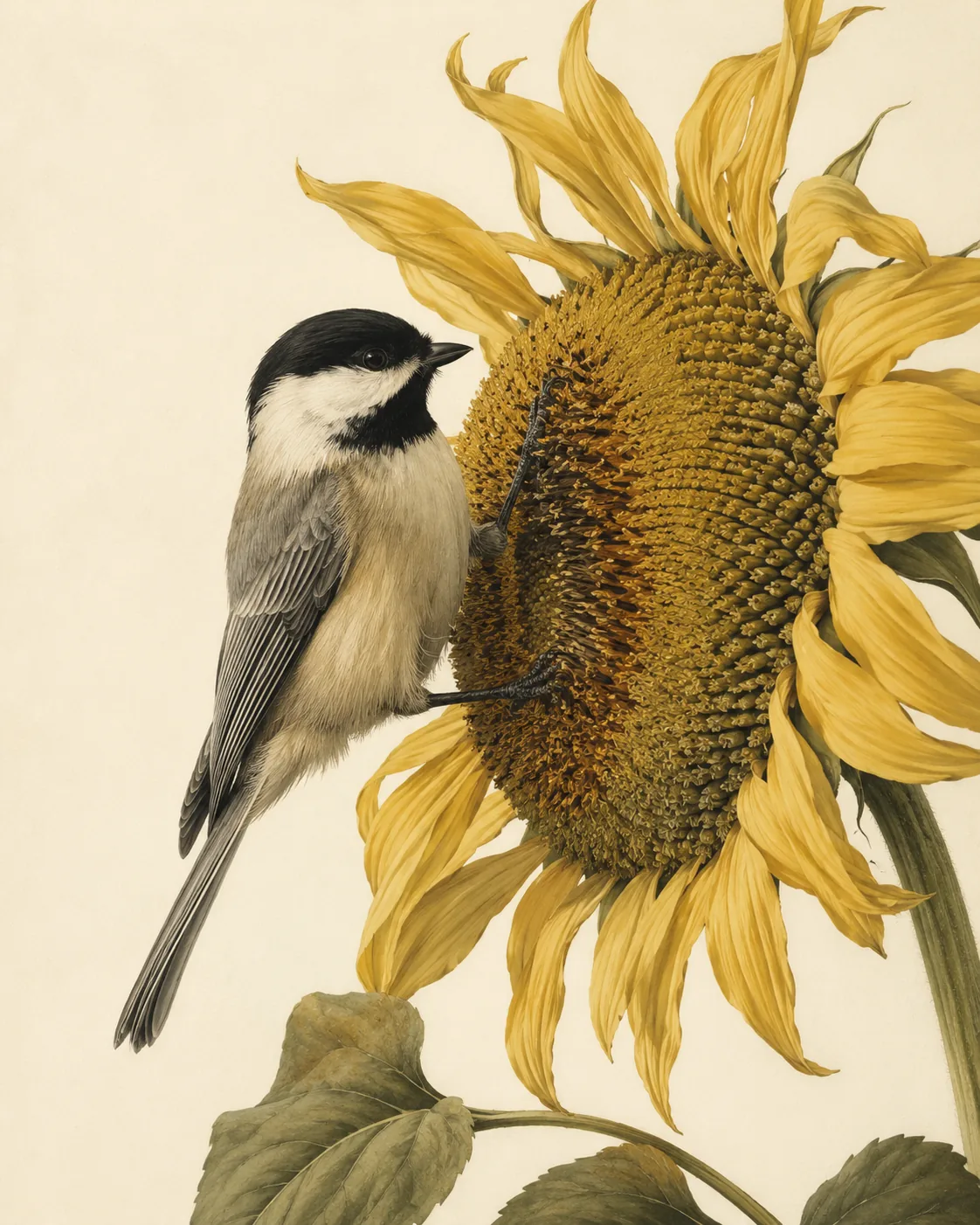
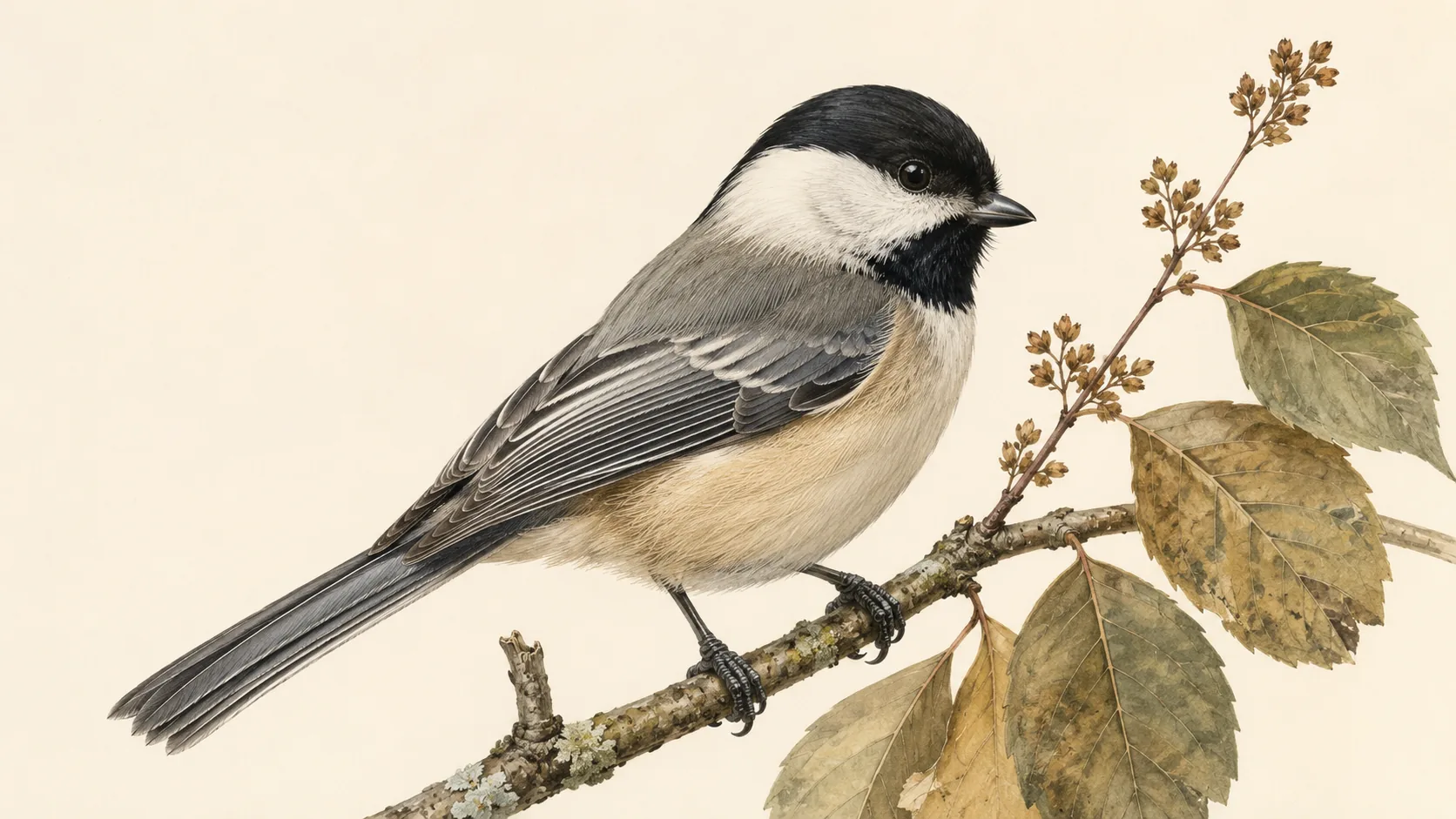
The chickadee is a small, plump bird: 12 to 15 centimetres long, weighing between nine and 14 grams. It is lighter than a AAA battery. The field marks are clean and unmistakable - a glossy black cap pulled low over the eyes, a matching black bib beneath the bill, bright white cheeks between them, and a gray back with buffy-white flanks. The wings carry faint white edging on the secondaries. The tail is long for the bird’s size and held loosely when perched.
Males and females are identical in plumage, so sex cannot be read in the field from a single bird. The bill is short and sharp, suited for prying bark and cracking seeds rather than probing flowers.
The species most likely to be confused with it are the Carolina Chickadee to the south, which is slightly smaller with a neater bib edge, and the Mountain Chickadee of the west, which carries a white supercilium cutting through the black cap. Where the ranges of the Black-capped and Carolina chickadees overlap - a narrow band running across New Jersey, Pennsylvania, Ohio, Indiana, and Kansas - the two species hybridise, and the resulting birds can defeat identification by any method short of genetics.
Voice
The chickadee’s chick-a-dee-dee-dee call is one of the most studied vocalisations in North American ornithology. It is not simply an alarm call. Research has shown that the number of dee notes at the end encodes information about threat level: a small, agile predator like a Northern Pygmy-Owl triggers a longer string of dee notes than a large hawk that poses less genuine danger to a small bird in dense cover. Other chickadees and at least some other songbird species decode this distinction and respond accordingly.
The song is a different register entirely - a clear, whistled fee-bee or fee-bee-ee that carries across winter woods with the precision of a tuning fork. Males begin singing in late January in some northern populations, weeks before the breeding season opens, as if rehearsing.
Range and habitat across the year
The Black-capped Chickadee is a year-round resident across a broad arc of North America: from the western edge of Alaska through the length of Canada and down through the northern two-thirds of the United States, reaching into the southern Appalachians at higher elevations. Audubon’s field guide describes it as a permanent resident across most of this range, with occasional southward movements in autumn when northern populations press into areas normally held by Carolina Chickadees.
Habitat is broadly defined by trees. Mixed deciduous and coniferous woodland is preferred. The species is equally at home in beech-maple forest in Vermont, second-growth poplar in Manitoba, and the spruce-fir belt of the high Rockies. It has adapted readily to suburban parks and gardens with mature tree cover, which is why it is often the first bird a new feeder attracts in winter - bold, curious, weighing less than a handful of change.
Diet and food caching
Summer diet tilts heavily toward insects: caterpillars, beetles, and their larvae, gleaned from bark and leaf surfaces. As autumn advances, seeds and berries take over, and caching begins in earnest.
Each food item - a sunflower seed, a spider’s egg case, a bit of suet - goes into its own separate hiding place, often under bark or in a crevice in a twig, never double-stacked with another item. Studies suggest a single bird may cache tens of thousands of items across a fall season. Each location is memorised individually. Recovery is accurate for weeks. The hippocampal enlargement described above is the mechanism; the caching itself is the argument for why the mechanism evolved.
Cornell’s Birds of the World notes that food-caching birds carry a hippocampus roughly three times larger, relative to the rest of the brain, than non-caching species of similar size. The chickadee’s seasonal expansion of that structure is the more dramatic finding - a brain that reshapes itself around the demands of the season, then reshapes itself back.
Breeding and nesting
Pair bonds form in autumn, within the winter flock, and persist through the breeding season. Flocks of three to 12 birds have stable dominance hierarchies, and higher-ranking individuals tend to find mates earlier. Both the male and female excavate the nest cavity, though the female does most of the work. They favour natural cavities or old woodpecker holes, typically one to seven metres above the ground, in soft or rotting wood. They will use nest boxes readily.
The nest cup is built from moss, plant fibres, and animal hair - often rabbit fur or the soft undercoat shed by deer and foxes. The female lays six to eight eggs, incubates them for roughly 12 days, and broods the chicks in the nest for another 16 days after hatching. She alone incubates; the male feeds her throughout. Fledglings remain with the parents for several weeks before joining a new flock in late summer.
The winter body
The chickadee’s winter physiology is as well-engineered as its winter memory. Cornell’s Birds of the World reports that northern populations practise regulated hypothermia on cold nights: the bird lowers its body temperature by up to 10 degrees Celsius, reducing the caloric burn rate enough to survive a night of minus 20 without starving. It shivers to rewarm at dawn. The cycle repeats each night until spring.
A chickadee roosting in a tree cavity on a January night in Minnesota is running at the edge of what is physiologically possible for a bird that size. The caches it visits each day during winter’s short light are not optional foraging. They are survival.
The oldest known wild Black-capped Chickadee was at least 11 years and eight months old when it was recaptured by banders in New York in 2021 - a bird that had survived more than a decade of those nights. Most chickadees live far shorter lives, and the few that reach old age do so by knowing exactly where every seed is buried.
The chickadee does not survive winter by being tough. It survives by being precise.