Field Guide
Golden-cheeked Warbler
In March, a buzzy song lifts out of a juniper-oak canyon in the Texas Hill Country. It rises in a slurred, insistent phrase - zee zoo zee-dee-zeep - from somewhere inside the dark interior of an old Ashe juniper. The singer is invisible until he moves into a shaft of morning light and the black-and-gold of his face becomes suddenly, briefly legible. Then he is gone again, deep into the canopy, into the cedar-scented shadows that are the only place on Earth where Setophaga chrysoparia - the Golden-cheeked Warbler - will agree to raise its young.
No other bird species breeds in a single American state and nowhere else. That is not a loose claim. It is the defining biological fact of this animal.
What it looks like
Setophaga chrysoparia is a small warbler, 11 to 13 centimetres in length and 8 to 12 grams in weight, spanning 18 to 20 centimetres across the wing. In body mass it sits close to a large bumblebee. What it carries in that small frame stops field observers.
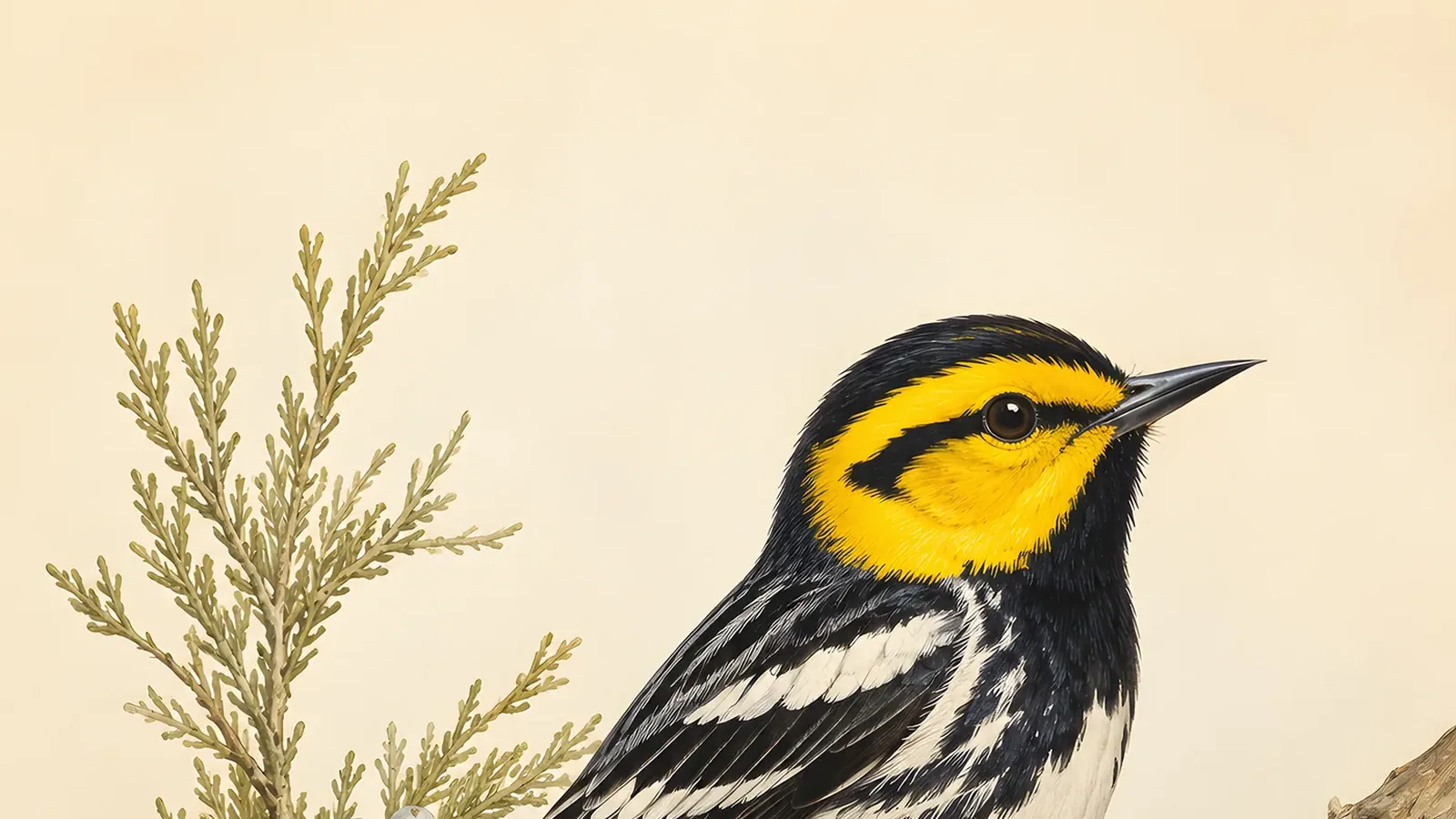
The adult male is one of the most precisely marked warblers in North America. A thick black eye-stripe cuts from the bill backward through the eye and onto the nape. The crown, back, and throat are jet black. Between the eye-stripe and the throat, the cheeks glow - a clean, unmistakable gold-yellow that gives the species its common name and makes the face look as if it were lit from within. The underparts are white, broken by black streaks along the breast and flanks. The wings show two white wing-bars. No other warbler in its range combines that black hood with those burning gold cheeks. The identification is immediate.
The female is considerably quieter: olive-green above, yellowish below, with a dark eye-line and faint streaking on the breast. She resembles a female Black-throated Green Warbler closely enough that the two can be confused at range. The gold cheeks are present but subdued. The darker eye-line and whiter belly tend to separate her from the lookalike in good light.
| Feature | Measurement |
|---|---|
| Length | 11 - 13 cm |
| Weight | 8 - 12 g |
| Wingspan | 18 - 20 cm |
| Oldest recorded wild bird | 10 years, 11 months |
| Clutch size | 3 - 4 eggs |
| Incubation period | 12 days |
One state, one tree
Texas has approximately 360 native breeding bird species. Only one of them breeds nowhere else on the planet.
Setophaga chrysoparia nests exclusively in the mixed Ashe juniper and oak woodlands of central Texas - the Edwards Plateau and its margins, spreading locally north toward Palo Pinto County, bounded by the I-35 corridor to the east and the dry rangeland to the west. Every individual that ever existed hatched within that geography. The total breeding range covers parts of 35 counties. No warbler in a comparable study area anywhere in the Americas is so precisely anchored.
The reason is the tree. Ashe juniper (Juniperus ashei), known locally as cedar, is the cornerstone of the warbler’s nesting system in a way that goes beyond habitat preference. The bird does not simply prefer these woodlands. It requires the mature juniper in a structural sense that cannot be substituted. Specifically, it requires the bark - and specifically, the old bark that has begun to peel naturally from mature trunks.
This arrangement evolved over time in an ecosystem where Ashe juniper and the warbler co-existed across millennia. The Hill Country canyons and ravines where the tree grows densest, mixed with Texas live oak, Spanish oak, and cedar elm, became the reproductive range of the warbler in its entirety. When that range began to shrink under the pressure of suburban development radiating outward from Austin and San Antonio, no alternative woodland existed. There was nowhere else to move.
The U.S. Fish and Wildlife Service listed Setophaga chrysoparia as federally Endangered on May 4, 1990. IUCN independently carries the species at Endangered (EN). The threat was not hunting, not poisoning, not a specific catastrophic event. It was the ordinary pace of a city growing outward through habitat that exists in only one place.
The cedar-bark nest
The Golden-cheeked Warbler’s relationship to Ashe juniper reaches its most precise expression in the nest.
The female - always the female - builds a deep, compact cup from strips of bark peeled from the outer layer of mature Ashe junipers. This is not incidental material collected wherever available. It is the structural element the nest is built around, bound together with spider silk and sometimes lined with rootlets, hair, and feathers. The bark-strip technique appears hardwired: field studies at Fort Hood and in the Balcones Canyonlands documented females consistently returning to old-growth juniper trunks, identifying sections where the outer bark has loosened with age, and peeling long fibrous strips from the surface. Smooth-barked young junipers do not supply usable material. The nest requires old trees.
This is the ecological chain. Old Ashe juniper produces loose, strippable bark. Loose bark produces nest material. Nest material produces viable eggs in a well-insulated cup. Without the old-growth juniper, the chain breaks before it begins.
“Breeding habitat in central Texas typically consists of mature Ashe juniper associated with oaks and other deciduous trees on canyon walls, steep slopes, and ravines of the Edwards Plateau.” - U.S. Fish and Wildlife Service species profile, Setophaga chrysoparia
Mathewson and colleagues, in a range-wide survey published in the Journal of Wildlife Management (2012, vol. 76), estimated 263,339 male warblers across approximately 1.678 million hectares of woodland in 63,616 patches. That figure was sharply higher than prior estimates, but the same authors noted that only about four percent of the total breeding range contained suitable woodland habitat - a measure of how thoroughly the Edwards Plateau has been converted to development and other uses.
What it sounds like
The song is the quickest way to find a male on territory.
Setophaga chrysoparia sings a buzzy, slightly hoarse phrase - often described in field guides as zee zoo zee-dee-zeep, falling at the end - that carries well through the layered canopy of a juniper-oak drainage. The buzzing quality distinguishes it from the cleaner, whistled songs of many other warblers. A male on territory repeats it persistently from inside the tree canopy, rarely choosing an exposed song-post the way a painted bunting or mockingbird might. Finding the singer requires patience and triangulation.
The call note is a thin, high tsip, easily missed under a breeze. In alarm - near the nest, or when a predator moves through the territory - the notes cluster into a rapid chipping scold. Both sexes call. The song is male-only, tied to territorial defence and pair formation on the breeding grounds from March through July.
Range and the development squeeze
Breeding in Texas, wintering in a completely different ecosystem 3,000 kilometres to the south - this is the double geography that makes conservation complicated.
From July onward, adults and young move out of the Hill Country and head south through Mexico. The winter range runs from the highlands of Chiapas in southern Mexico through Guatemala, Honduras, El Salvador, and into Nicaragua - specifically the pine-oak forests at elevations of roughly 1,100 to 2,400 metres. Rappole, King, and Leimgruber (Animal Conservation, 2000) documented the warbler’s strong preference for pine-oak habitat during the non-breeding season, with most individuals located between 1,100 and 2,400 metres, foraging in the deciduous oak component of the forest. Guatemala holds approximately 59 percent of the potential non-breeding habitat. These montane pine-oak forests are themselves heavily fragmented across a range of roughly 104,000 square kilometres, with perhaps only 19,500 square kilometres of suitable habitat remaining.
The bird faces pressure at both ends of its migration. On the breeding grounds, the I-35 corridor - the spine of Texas growth running between San Antonio, Austin, and Dallas - runs directly through the warbler’s range. The Texas Tribune documented in 2022 that a 29 percent habitat loss was recorded between 2001 and 2011 alone, driven by suburban expansion into the cedar-oak woodlands of Williamson, Hays, Travis, and Bexar counties.
On the wintering grounds, clearing for agriculture and pasture strips pine-oak forest from the Central American highlands with little regulatory protection.
Breeding
Males arrive on the Texas breeding grounds in early March. Territory establishment is rapid and territorial song is dense in the first weeks as males space themselves through the juniper-oak woodland. Females arrive shortly after.
The nest is placed two to nine metres above the ground, typically in the fork of an Ashe juniper or adjacent oak, where dense canopy provides shade and concealment. The female builds over several days. The clutch runs three to four eggs - white to creamy, speckled with brown - and incubation lasts 12 days. The female incubates almost exclusively. Fledglings leave the nest approximately nine days after hatching, though they remain dependent on the adults for weeks.
The cerulean warbler faces parallel pressures on its breeding grounds in the eastern hardwood forest - another small warbler with a restricted nesting range, similarly squeezed between breeding-ground clearing and wintering-ground deforestation. The comparison is instructive: both species demonstrate what happens when a small songbird evolves tight specialisation and then the specialist’s substrate begins to disappear.
Duarte and colleagues (Avian Conservation and Ecology, 2014) tracked adult male survival at Fort Hood using capture-resight data collected from 1992 through 2011, estimating annual adult survival at 0.47 - lower than earlier population models had assumed. The implication is that the warbler requires consistent high-quality breeding habitat in contiguous patches simply to maintain stable numbers. Fragmentation that forces longer foraging distances, increases nest exposure, or elevates Brown-headed Cowbird parasitism depresses that already-modest survival rate further.
The song from the juniper canyon is a claim on a tree and a territory and a nesting season that must begin and end and succeed before July. It is sung by a bird that evolved to occupy one ecological niche in one geography on one continent, and that has no biological option to occupy any other. The Ashe juniper is not the Golden-cheeked Warbler’s preferred habitat. It is, in the most literal sense, the warbler’s only habitat. What happens to the old cedars on the Edwards Plateau determines what happens to every member of the species.
That is an unusual amount of power to vest in a tree.