Field Guide
Goldcrest
On an October morning on the Norfolk coast, a Goldcrest lands in a garden hedge after a night’s flight across the North Sea. It weighs four grams. It has flown from Norway or Denmark or Sweden in the dark, navigating by the stars, crossing 400 miles of open water with no landmark and no rest. It arrives and immediately begins feeding, hanging upside down from a branch tip, working methodically through the leaf litter for spiders and fly eggs.
Regulus regulus is Britain’s smallest bird - it shares that distinction with the Firecrest, which it superficially resembles - and it is also one of the least understood in terms of what it actually demands of itself. The facts, once assembled, add up to a picture of a species operating at the absolute edge of what warm blood and feathers can sustain.
The Goldcrest does not survive winter by being tough. It survives by being relentlessly precise about energy: where it comes from, how fast it is burned, how much is stored before dark.
What it looks like
The Goldcrest is 8 to 9 centimetres long - smaller than a wren - and weighs between four and seven grams. The RSPB puts the most memorable comparison simply: about the weight of six paperclips. The wingspan runs 13 to 15 centimetres.
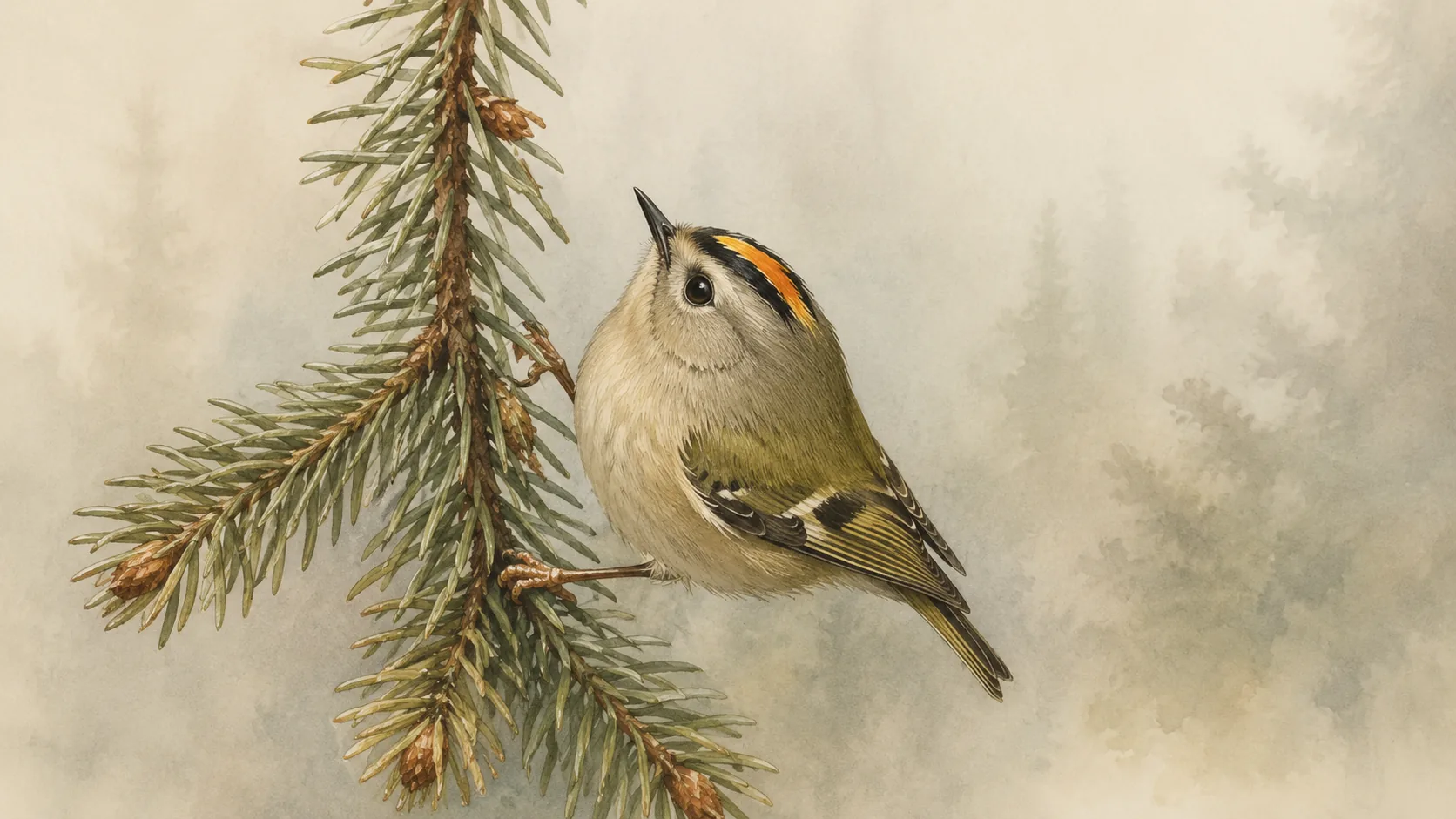
The body is olive-green above, with two pale wingbars on the folded wing and a plain, whitish underside. The face is largely unmarked, which gives the large dark eye - surrounded by a fine pale ring - an exposed, watchful quality. The bill is short and fine, built for extracting small invertebrates from conifer needles, not cracking seed.
The defining feature is the crown stripe. In females it is pure yellow, bright against the olive cap. In males it is yellow at the edges and orange at the centre, bordered by two clean black lines. The stripe is normally held flat and gives the bird a tidy, almost colourless look from a distance. When a male raises it in threat or display, the orange flares like a struck match. Field guides describe the result as ‘gem-like.’ It is a fair description and not a melodramatic one.
Juveniles lack the crown stripe entirely for their first few weeks. They are the plainest small birds in a conifer wood, olive above and pale below, nothing to mark them until the stripe grows in.
What it sounds like
The Goldcrest’s song sits at the very top of what adult human hearing can resolve - around eight to nine kilohertz. Many older birders, and some younger ones, cannot hear it at all. The song is a thin, rhythmic phrase - the BTO renders it as a high-pitched double note repeated in a sequence and ending with a small flourish - that carries perhaps 30 metres in still air before it dissolves entirely. In a wind it is inaudible beyond 10 metres.
The call, a fine needle-sharp ‘see-see-see’, is easier to place, particularly once you have learned that Goldcrests almost always call while moving through foliage. If you hear a high, thin seeping from inside a spruce and nothing moves in response to your presence, look up and look for movement. The bird will be there, and it will not care about you at all.
Range and habitat across the year
Regulus regulus breeds across a band stretching from Britain and Ireland east through Scandinavia, Russia, and into Asia as far as Japan and the Himalayas. The BTO’s breeding atlas maps it across 88 per cent of UK 10-kilometre squares. During the breeding season it prefers coniferous and mixed woodland, with Norway spruce, Sitka spruce, and yew providing the dense hanging nest sites it requires.
In winter the picture shifts. The British resident population of around 600,000 birds - a figure from BTO breeding surveys - is supplemented every October by a migration wave from Fennoscandia and Russia. These birds cross the North Sea, making landfall on the east coast from Shetland down to Kent. They then spread inland into gardens, hedgerows, and scrub that the species would not normally use. Winter birds associate with roving mixed flocks of Blue Tits, Long-tailed Tits, and other small insectivores, using the flock’s collective vigilance while maintaining their own feeding lines through the canopy.
Hard winters kill Goldcrests in large numbers. The RSPB notes that eight out of ten can die in a single severe cold spell. The population recovers with characteristic speed - two broods a year, large clutches - but the winter mortality rate is not a rounding error. It is the central fact of the species’ life history.
Diet
The Goldcrest is insectivorous and largely unable to switch from this to anything else in the way that Blue Tits or Great Tits can fall back on seeds. Its diet runs to small spiders, springtails, aphids, fly eggs, moth cocoons, and any soft invertebrate small enough to be plucked from a needle or bark crevice with a fine bill. Cornell’s Birds of the World notes the species also occasionally takes spider egg cases and plant material, but invertebrates drive essentially all foraging decisions.
The bird feeds constantly, pausing only to investigate a new branch tip. It hangs upside down, clings sideways, hovers briefly in front of foliage to inspect the undersides of needles, and works through a given tree in a pattern methodical enough to watch. In winter, when invertebrate availability drops, the bird compensates not by switching food type but by extending its foraging hours - starting earlier in the morning and stopping later in the day than in summer, to the point where it is sometimes still feeding in near-darkness.
Breeding and nesting
Nesting begins in late April, sometimes extending to two full broods by August. The nest is one of the more demanding constructions in British ornithology: a deep rounded cup of woven moss, lichen, cobweb, and hair, typically slung from the outermost drooping branch of a conifer, so heavily camouflaged and so well-suspended that it flexes with the branch rather than falling when the wind moves it. The BTO records clutch sizes of six to 12 eggs - most commonly six to eight - with incubation of 16 to 19 days carried by the female alone.
The eggs themselves are tiny and cream-coloured with fine reddish speckling. The total mass of a full clutch can exceed the female’s own bodyweight by half. The BTO notes this as one of the more striking physiological achievements among British breeding birds.
Both parents feed the nestlings. Fledging occurs at 16 to 18 days, and the first brood is still being fed by the male while the female begins incubating the second clutch. The urgency is not strategic. It is arithmetic: the summer feeding season is finite, winter is lethal, and two broods give the population a chance of remaining stable across the mortality of the cold months.
The crossing
The autumn migration is the behaviour that earns the Goldcrest its place at the more unusual end of British bird life. The Fennoscandian birds that arrive on the east coast each October have crossed open water in the dark, navigating - as far as research currently understands it - by a combination of stellar cues and magnetic field detection.
Sailors in the North Sea and the Baltic developed a theory, centuries old, that these tiny birds must have hitched rides on passing woodcock, which migrate on broadly similar routes at the same time of year. The theory is recorded in multiple European folklore traditions and shows up in sailor’s journals from the eighteenth century. It is false - there is no evidence that Goldcrests land on or ride other birds - but it is a reasonable inference for someone who watched a four-gram bird arrive exhausted on a ship’s rigging 100 miles from land and concluded that the bird could not have flown there itself.
It did. Whatever the mechanism, the Goldcrest crosses the North Sea under its own power, alone, burning something close to 20 per cent of its body weight overnight to do it. It lands. It feeds immediately. Within a day or two it looks like nothing happened.
That is either a measure of what the bird is capable of, or a reminder that ‘capable’ is a category we defined too narrowly.