Field Guide
White-breasted Nuthatch
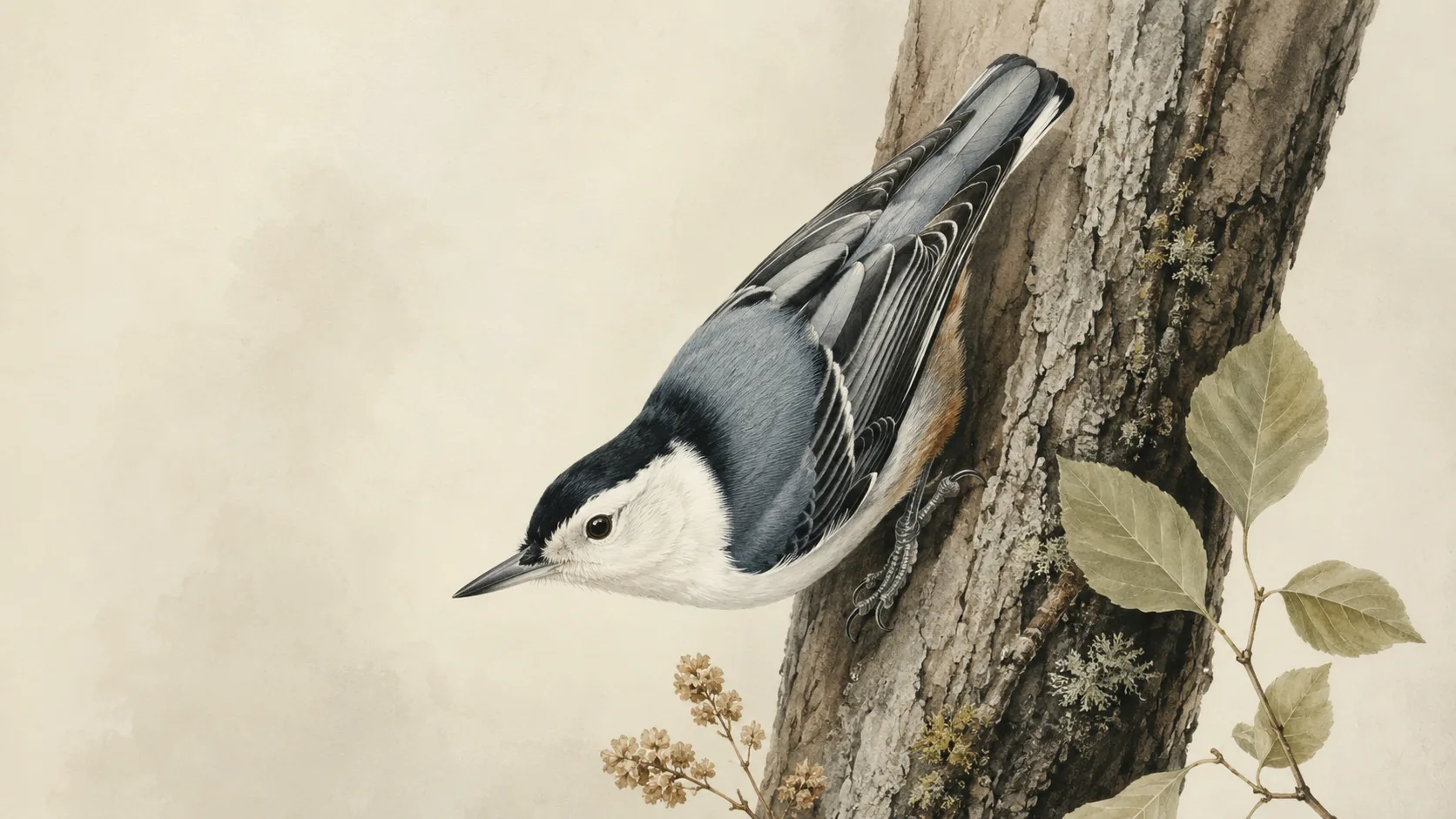
On a still December afternoon in a stand of bare oaks, the forest gives you a sound before it gives you the bird. A nasal, insistent yank-yank-yank, flat and a little comic, somewhere above head height. Follow it up the trunk and you find a compact blue-grey bird doing something no other bird in the wood is doing. It is walking down the tree. Head pointed at the ground. Working the bark from the top.
Every other trunk-climber on the continent goes up. The woodpecker braces its tail and hitches upward. The Brown Creeper spirals up and then drops to the base of the next tree to start again. The White-breasted Nuthatch alone descends face-first, and that single difference in angle is the whole point of the bird. Going downward, it sees into the cracks and crevices of the bark from above, the side a bird climbing upward never gets a clean look at. The grub a woodpecker passed by on the way up, the nuthatch finds on the way down. It has built an entire living out of reading the same bark from the wrong direction.
What he and she look like
The White-breasted Nuthatch is small, compact and almost neckless, with a large head, a short tail and a long, straight bill that turns up very slightly at the tip. Cornell Lab puts it at roughly 13 to 14 centimetres long, the largest of the North American nuthatches, which is a modest distinction for a bird that still weighs only around 20 grams.
The plumage is clean and graphic. The back and wings are soft blue-grey. The underparts and the whole face are bright white, an open white face being the field mark that separates it instantly from the Red-breasted Nuthatch, which wears a black line through the eye. The cap and nape run down in a dark stripe, and here the sexes part. On the male the cap is glossy black. On the female it is grey, or a duller, washed-out slate, often with only a hint of black at the front. Both carry a chestnut wash under the tail. In silhouette the bird is unmistakable: a stub of a tail, an outsized head, and that head-down posture clamped to the trunk, one foot reaching high and one held low to anchor the descent.
What he sounds like
The voice arrives before the bird. The common call is that nasal, repeated yank-yank-yank, or wer-wer-wer, flat and trumpet-toned, carrying surprisingly far through bare winter woodland. It is the sound most people learn the nuthatch by, and Cornell Lab notes the bird’s insistent nasal yammering will often lead you straight to it.
The true song, given mostly in late winter and early spring as the breeding season opens, is a rapid, even series of low whistled notes, softer and more musical than the calls, sung by the male. Through the rest of the year the pair keeps up a running conversation of soft contact notes as they forage, a quiet thread of sound that holds two birds together across a winter territory. Where the Carolina Wren announces itself like a kettle, the nuthatch grumbles, and the grumble is constant.
Range and habitat
Sitta carolinensis is a year-round resident across most of the United States and into southern Canada and the mountains of Mexico. Audubon describes its range as running from southern Canada to northern Florida and southern Mexico. It does not, as a rule, migrate. The pair you watch at the December feeder is the pair that nested in the same wood in May, and they will hold the ground between.
The habitat is mature trees. The bird favours deciduous and mixed woodland, woodland edge, riverbank timber and old suburban gardens with big trees, and it tends to avoid pure stands of conifer, which is where its smaller cousin the Red-breasted Nuthatch takes over. What it needs is large trunks and limbs with deep, furrowed bark to work, and standing dead wood with cavities to nest in. Western and northern populations occasionally make irruptive movements south in years when the seed crop fails, but for most of the range the nuthatch is the definition of a settled bird.
Diet
In summer the diet is mostly insects and spiders, gleaned from bark as the bird walks its trunks. The list Cornell Lab records is a catalogue of woodland pests: weevil and wood-borer larvae, beetles, treehoppers, scale insects, ants, caterpillars including the larvae of gypsy and tent moths, stinkbugs and click beetles. This is a bird that earns its keep in a wood.
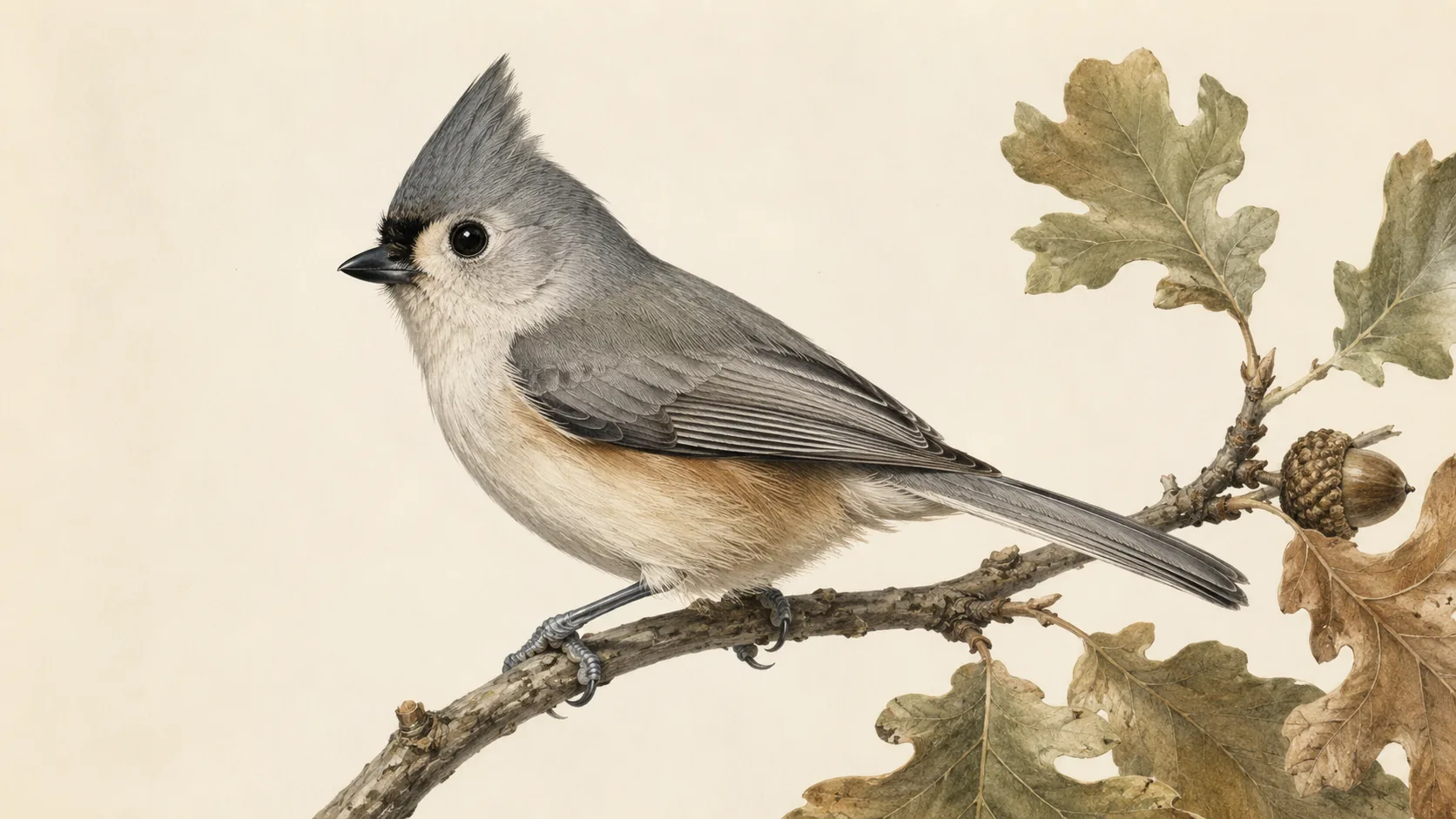
In winter the balance tips. Insects vanish and seeds take over, and Audubon notes the winter diet can run beyond sixty per cent seed. The nuthatch takes acorns, hawthorn, beech mast and, very readily, the contents of a feeder. At the feeder it behaves exactly like its frequent companion the tufted titmouse: it darts in, seizes a single sunflower seed, and carries it off rather than eating in place. It wedges the seed into a crevice of bark and hammers it open with that upturned bill. This is the habit that named the whole family. To hack open a nut by hatching it from the shell is to be a nut-hatch. The bird also caches food obsessively through autumn, jamming seeds into bark furrows across its territory to draw on through the lean months.
Breeding and nesting
The nuthatch nests in a cavity, almost always a natural hollow or an old woodpecker hole rather than one it excavates itself. It will enlarge a hole but rarely digs the whole thing, and it takes readily to a nest box of the right size. Inside, the female builds a cup of bark fibres, grasses, hair and fur.
Cornell Lab records a clutch of five to nine eggs, occasionally ten, white and spotted with reddish-brown. The female incubates for twelve to fourteen days while the male feeds her on the nest, an arrangement that keeps her on the eggs through the cold. The young are fed entirely on insects and spiders, and they leave the nest somewhere between two and four weeks after hatching. Unlike the multi-brooded cardinals and wrens, the White-breasted Nuthatch raises a single brood a year and puts everything into it.
Pairs hold a territory together year-round and many appear to mate for life, the two birds foraging within earshot through every season.
The behaviour worth watching
The detail that rewards a patient watcher is the company the nuthatch keeps. Through the bare months it rarely travels alone. It threads itself into the mixed foraging flocks that move through winter woodland, the loose, restless bands of chickadees, titmice, kinglets and downy woodpeckers that drift from tree to tree. Each species works a different part of the tree, and the nuthatch takes the part nobody else can reach: the underside of the bark, read from above.
There is a quiet logic to the flock. More eyes mean earlier warning of a hawk, and the nuthatch is a known listener, reacting to the alarm calls of chickadees and even tuning its own response to how urgent those calls sound. It pays its way in the flock by working the timber upside-down and flushing what the others miss.
The White-breasted Nuthatch is the only bird in the wood that reads the bark from the top down, and it makes a whole living out of the angle everyone else ignores.
Watch one long enough and the head-down walk stops looking like a trick and starts looking like a thesis. The whole bird, the stubby tail that would only get in the way, the high foot and the low foot, the upturned bill, is built around descending a trunk and seeing what upward birds cannot. It is a small grey lesson in the value of approaching an old problem from the other direction.