Field Guide
Golden Eagle
On a November morning in the Nevada Basin, a Golden Eagle drops from 600 metres in less than four seconds, folds her wings to a blade, and strikes a jackrabbit at a speed most accounts place above 240 kilometres per hour. The rabbit was alive. Then it was not. The eagle lands, mantles her wings over the carcass, and begins to feed. Around her, the sagebrush is still.
Aquila chrysaetos is not the largest bird on the continent. The Bald Eagle outweighs her. The California Condor dwarfs her on wingspan. But measured by hunting competence across open country - by the combination of speed, vision, territorial intelligence, and learned coordination - the Golden Eagle has no North American rival. The Peregrine Falcon is faster in a stoop over water. The Golden Eagle hunts in three dimensions over forty square kilometres of broken terrain, and she does it with a mate who knows her pattern. That competence is why so many warrior cultures, from the Plains nations to the Romans, built their symbolism of sovereignty and courage around this bird.
What she looks like
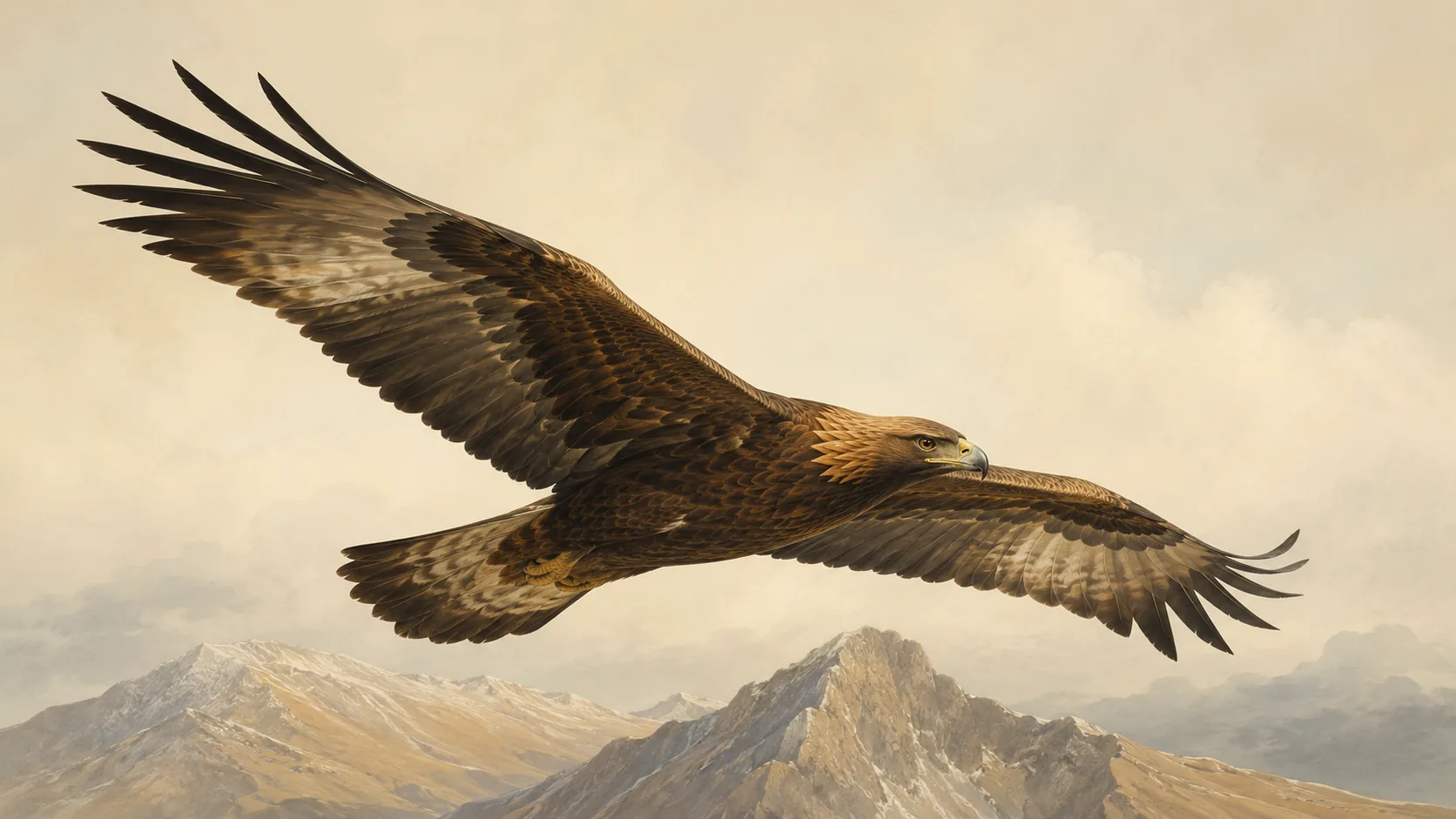
An adult Golden Eagle is dark brown from wingtip to tail, with tawny to gold feathers spreading across the crown and back of the neck - the colour that names the species. The bill is black and heavy, hooked to a degree that looks engineered. The legs are feathered to the yellow feet, a distinguishing mark that separates Aquila eagles from most other large raptors. At rest, the tail shows faint grey barring. In flight, the long, broad wings are held slightly raised - a shallow V that is the field mark to know.
Females are substantially larger. Animal Diversity Web records males at 3,000 to 4,475 grams and females at 3,940 to 6,125 grams - roughly 40 per cent heavier. Wingspan runs 185 to 234 centimetres. Body length ranges from 70 to 102 centimetres. She is a large bird by any measure, and when she beats her wings to gain altitude over a ridgeline, the wing action is slow and deliberate in the way that only very large raptors manage.
Juveniles look different enough to stop birders mid-step. They carry bold white patches at the base of the flight feathers and a broad white tail base that earns them the field name ‘ringtail.’ This plumage phases out over four to six years as the bird approaches breeding age. A bird with partial white in the tail and flight feathers is somewhere in that progression - older than a first-year, not yet a breeder.
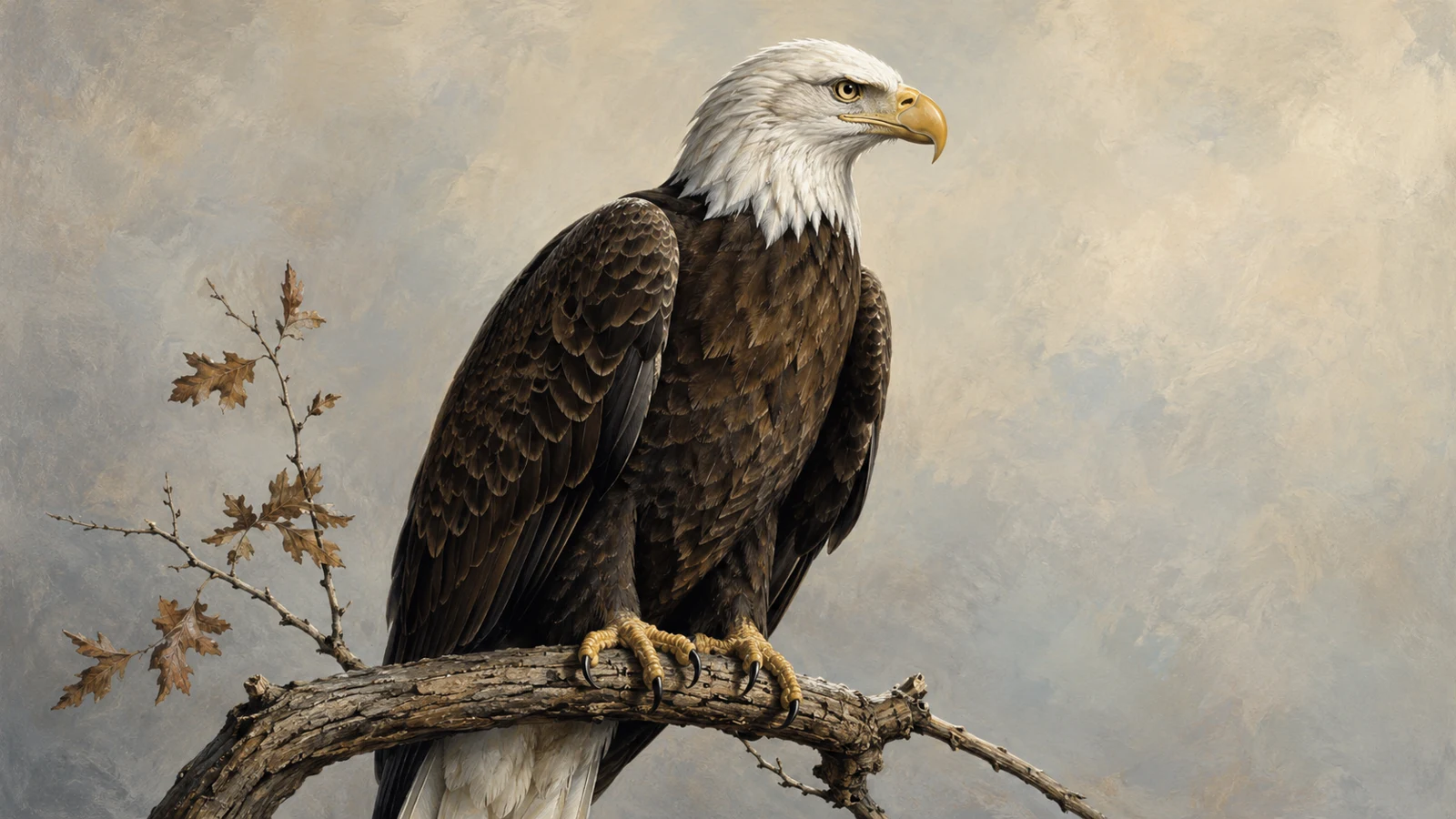
The easiest confusion is with a young Bald Eagle. Both are large, brown, and patterned with white. The Bald Eagle’s white is concentrated at the axillaries (underwing ‘armpits’) and shows no white tail base in the same clean band. The Golden Eagle’s white is at the wing tips and tail base. Bills differ: the Bald Eagle’s is yellow and proportionally enormous, the Golden Eagle’s is darker and smaller relative to head size.
Voice
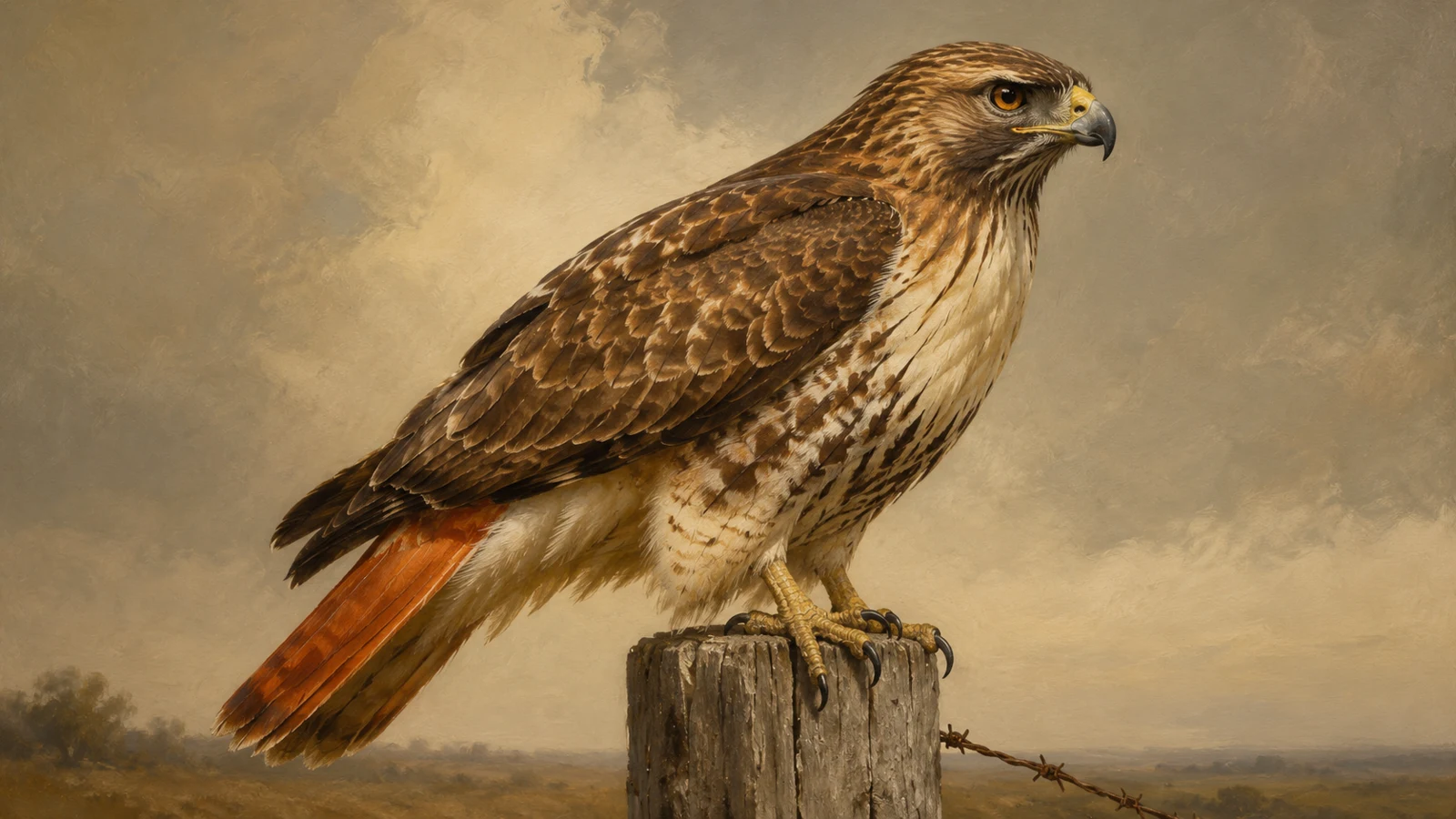
The Golden Eagle is not a vocal bird in the way a Red-tailed Hawk is, and that silence is part of its character. The call is a series of yelping or chirping notes - thin, almost un-raptorlike - used most often around the nest during breeding. It does not carry the declarative authority of the hawk’s scream. Cornell’s Birds of the World notes the species communicates territorial claims primarily through undulating flight displays rather than sound: a series of steep dives and climbs repeated over the territory, most intense in late winter as the breeding season approaches.
Range and habitat across the year
The Golden Eagle holds the widest range of any eagle in the Northern Hemisphere. It breeds from Alaska and northern Canada south through the western United States to central Mexico, across Eurasia, and into northern Africa. The IUCN lists the species as Least Concern globally, with an estimated 170,000 to 250,000 mature individuals worldwide and North American populations in the range of 50,000 to 70,000 birds.
In the US, the bird is essentially a western species. East of the Mississippi, sightings are sparse and almost entirely wintering birds from northern populations. In the West, it is year-round across the mountain and basin states, breeding in open to semi-open country: cliffs, canyons, rolling grassland, tundra, and sagebrush steppe. It avoids dense closed forest. It needs open ground to hunt and high structure to nest.
Northern birds migrate. Those from Alaska and arctic Canada push south along mountain ridges in October and November, following prey availability. The Goshutes Ridge count in Nevada and Hawk Mountain in Pennsylvania both record hundreds per season. Western birds with year-round prey access may remain on territory through winter, supplementing live prey with carrion when the ground is locked under snow.
Diet and hunting
The core prey is medium-sized mammals - jackrabbits, cottontails, ground squirrels, prairie dogs, marmots - taken in open terrain where the eagle’s speed advantage is maximised. The Audubon Society’s field account notes opportunistic hunting of gamebirds, snakes, lizards, and carrion, particularly in winter. The Peregrine Fund’s raptor database records predation on other raptors including owls and falcons.
The coordinated hunt - where two eagles pursue the same prey sequentially until exhaustion drops it - is documented in multiple field accounts. Animal Diversity Web records that pairs employ this relay strategy as a learned behaviour. It is not instinct alone. Young eagles hunt alone; the coordination develops with the pair bond over years.
The carrying capacity often cited in popular accounts - that a Golden Eagle can lift objects up to roughly 3.6 kilograms - sits in line with documented prey weights. The question of whether they can lift dogs or children, which generates considerable internet traffic, is answered fairly directly by wing loading physics: an eagle that weighs four kilograms cannot carry a 10-kilogram child into the air. It can, and does, kill prey that size on the ground and feed on it there.
Breeding and nesting
The pair bond is typically long-term. The Peregrine Fund notes pairs remain together “for many years, possibly for their entire lives.” Territory size in breeding birds runs 20 to 30 square kilometres according to Cornell’s Birds of the World. Pairs maintain multiple nest sites within that territory - cliff ledges or large trees - returning to add material year after year until some nests reach dimensions that have been measured at over six metres tall and 2.5 metres wide.
Two eggs is the typical clutch. Incubation lasts approximately 41 to 45 days and is carried primarily by the female. Fledging occurs at 45 to 81 days. Sibling competition is real: in years when prey is scarce, the first chick to hatch frequently outcompetes the second, and only one chick fledges. In prey-rich years, two fledglings are recorded.
Young Golden Eagles do not breed until they are at least four years old, and first successful nesting often comes later. That delay - years of open-country ranging before acquiring a territory and a mate - means the population is slow to recover from mortality events.
The threat that matters
Humans are responsible for more than 70 per cent of documented Golden Eagle deaths, according to population studies reviewed by the San Diego Zoo Wildlife Alliance’s fact sheet. Electrocution on power lines accounts for a substantial share, particularly in the western US where transmission infrastructure crosses open eagle habitat. Vehicle collisions, gunshot, and lead poisoning from scavenged carcasses containing lead ammunition make up most of the rest. The Bald and Golden Eagle Protection Act - originally the Bald Eagle Protection Act of 1940, amended in 1962 to include Golden Eagles - provides federal legal protection in the US, and utility companies in high-risk areas have been retrofitting power poles since the 1970s.
What the legal framework cannot protect against is the slow loss of open-country prey habitat - the conversion of sagebrush steppe to agriculture, the suppression of prairie dog colonies, the spread of invasive grasses that reduce the hunting visibility the eagle depends on.
The Golden Eagle is not rare. But the country it needs is becoming rare, and that distinction is harder to legislate than the bird itself.
The IUCN global status is Least Concern, and it should be. The bird still crosses the sky in hundreds of thousands. But the particular configuration of open land, cliff structure, and prey density that makes a territory viable is a fragile thing, and most of the places in the American West where it still holds together are places that have not yet been worth developing. That arithmetic does not run in one direction forever.