Field Guide
Osprey
The bird is hovering, perhaps 20 metres above a Maryland estuary, wings beating against a steady headwind while it stares straight down. For five, six seconds it holds the same position - a fixed point in the air above a moving world. Then it folds. Not a tip, not a lean: a sudden, decisive collapse of wings as Pandion haliaetus commits to the water below, feet leading, nostrils sealed against the impact. A white column of spray. A beat of silence. Then the osprey beats upward out of the shallows with a fish - always a fish - clamped in both feet, which it rotates in flight so the prey faces forward into the wind. The whole sequence from hover to airborne prey takes less than two seconds.
This is the animal. Everything about it follows from that one moment.
Pandion haliaetus is the fish hawk, the fish eagle, the river hawk - the bird with a hundred folk names that all mean the same thing. It is also the only species in its family, Pandionidae, placed there because its anatomy has diverged so far from other raptors that no existing family fits. Alan Poole’s 1989 monograph Ospreys: A Natural and Unnatural History remains the foundational text, and the title is precise: the natural history of a bird shaped by 40 million years of specialisation, and the unnatural history of a species nearly poisoned out of existence in a single human generation.
What it looks like
The osprey is a large raptor, 55 to 58 centimetres from bill to tail - roughly the size of a Red-tailed Hawk - but its proportions are unlike those of any other raptor in North America. Wingspan runs 145 to 170 centimetres, with females averaging 5 to 10 percent larger across all dimensions. Females weigh 1,600 to 2,000 grams, males 1,200 to 1,600 grams.
| Measurement | Male | Female |
|---|---|---|
| Length | 55-58 cm | 55-58 cm |
| Weight | 1,200-1,600 g | 1,600-2,000 g |
| Wingspan | 145-165 cm | 155-170 cm |
| Lifespan (max recorded) | 25 years | - |
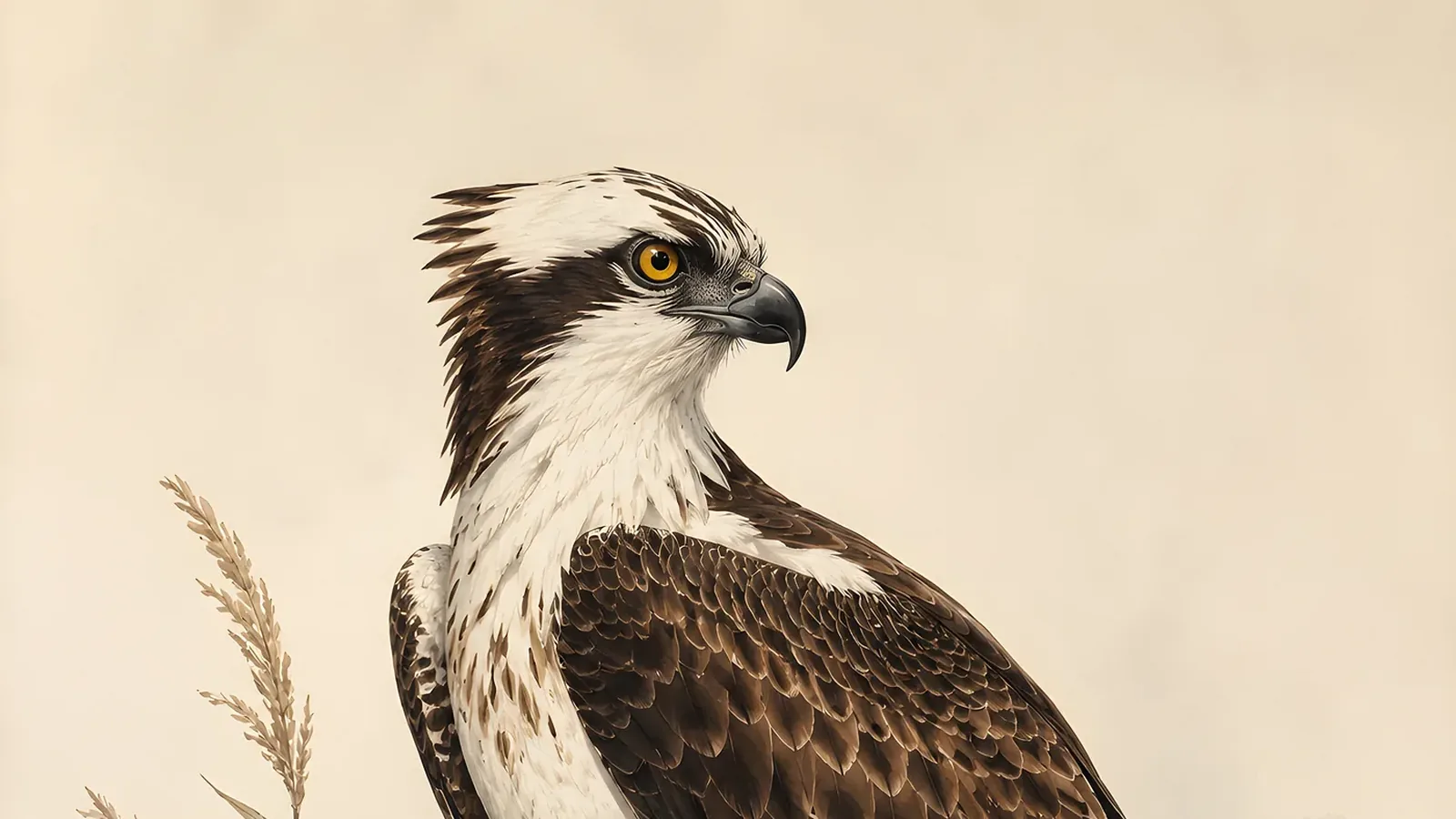
Seen from below in flight, the osprey shows a distinctive kinked or crooked wing profile - the “M shape” field guides describe - with dark “wrist” patches at the bend. Upper surfaces are dark brown. The underparts are largely white with a brown band across the breast, more heavily streaked in females. The head is white with a broad dark stripe running through the eye and down the nape, and the bill is dark and strongly hooked. At rest, the bird looks pale-bellied and barrel-chested, nothing like a buteonine hawk.
Immature birds wear paler buff fringes on their brown upperparts, giving a scaly appearance that fades in the first couple of years. Full adult plumage arrives by the third year.
Built to catch fish
Pandion haliaetus is, in the strictest sense, a fish-catching machine that happens to also be a bird. Nothing about its body is accidental.
Fish make up roughly 99 percent of the osprey’s prey items (Cornell Lab of Ornithology, All About Birds). More than 80 species of live freshwater and saltwater fish have been documented in the diet. In practice, any surface-swimming fish of an appropriate size is a candidate, and ospreys have been documented catching fish on 24 to 74 percent of dives, depending on weather, tidal phase, and water clarity.
Four anatomical features set the osprey apart from every other bird of prey in North America:
The reversible outer toe. Most raptors carry three toes forward and one back (anisodactyl arrangement). The osprey can swing the outer toe into a zygodactyl position - two toes forward, two back - clamping a fish with a symmetrical vice grip that prevents rotation. A fish held anisodactyl would spin and likely be dropped.
Spicules on the toe pads. The undersides of the toes are covered in short, sharp, spine-like projections called spicules - a feature unique among raptors. Spicules function as grip texture against a wet, scaled, thrashing fish. The osprey does not squeeze harder - it grips differently.
Closable nostrils. Most raptors enter water only by accident. The osprey plunges feet-first from heights of 10 to 40 metres, striking the surface at speed and sometimes submerging entirely. Valve-like flaps in the nostrils seal against the impact and prevent inhalation of water. A nictitating membrane simultaneously shields the eye.
Dense, oily plumage. The feathers shed water rapidly on the return to the air, a necessity for a bird that cannot afford to carry extra weight on every fishing run.
What it sounds like
The osprey’s voice does not match its predatory reputation. The alarm and contact call is a series of high, thin, piping whistles - a rapid cheep cheep cheep that carries far over water but sounds more like a large shorebird than a raptor. When alarmed at the nest, the call accelerates and rises in intensity, sometimes described as resembling a whistling kettle taken suddenly off the stove. Males performing aerial courtship flights deliver a slower, more musical version of the same whistle, often while carrying a fish as a display object. There are at least five recognisable call types in the repertoire, used for alarm, territory defence, nest-site advertisement, begging (by nestlings), and pair contact.
The voice is one of the reliable ways to locate an osprey before you see it. On a river or estuary where ospreys are fishing, the call carries across the water at a pitch that cuts through wind noise.
Range and habitat
The osprey breeds on every continent except Antarctica and is among the most widely distributed raptors on Earth. Four subspecies are recognised, with ranges spanning the Palearctic (P. h. haliaetus), North America (P. h. carolinensis), the Caribbean (P. h. ridgwayi), and the Indo-Pacific (P. h. cristatus). Monti and colleagues’ 2015 phylogeographic study in BMC Evolutionary Biology traced these lineages to an initial split approximately 1.16 million years ago, with divergence proceeding from an ancestral population in the Americas outward toward Asia and Australasia.
In Florida and the Gulf Coast, ospreys are year-round residents. In the Pacific Northwest - Washington and Oregon - they breed widely along rivers, reservoirs, and saltwater bays, departing in autumn for wintering grounds in Central and South America. Interior breeders in Montana and the northern Rockies follow a similar pattern, returning in early spring as ice leaves the lakes.
Habitat selection is simple: ospreys nest within three to five kilometres of water and require elevated structures safe from ground predators. Historically that meant tall dead trees, cliffs, or rocky outcrops. Increasingly, across most of the North American range, it means artificial platforms, communication towers, and electricity poles.
DDT and the comeback
The osprey’s mid-twentieth-century collapse and subsequent recovery is one of the cleanest cause-and-effect stories in American conservation, and it runs almost exactly parallel to the bald eagle story - a shared disaster and a shared rescue.
DDT entered the food chain through insects and small fish, concentrating at each trophic level until the osprey, sitting at the apex of an aquatic food web, accumulated doses sufficient to disrupt calcium metabolism. The mechanism was eggshell thinning: DDE (a breakdown product of DDT) interfered with calcium deposition in the shell gland, producing shells too thin to bear the weight of an incubating parent. Pairs would return each spring, lay eggs, begin incubation, and crush them.
Spitzer and Poole documented the scale of the collapse in their 1980 paper in American Birds. Across coastal New England - from New York City to Boston - the osprey population had numbered perhaps 1,000 nesting pairs before DDT use became widespread. By the early 1970s, that population stood at 109 pairs. Connecticut River sites that had held active osprey colonies for generations were empty.
The 1972 U.S. ban on agricultural DDT use changed the arithmetic. Within five to six years, DDE levels in osprey eggs were measurably declining and productivity - chicks fledged per active nest - was rising. Bierregaard and colleagues, writing in the Journal of Raptor Research in 2014, documented the recovery: by 2013, the southern New England and Long Island population “easily exceeded” 1,200 pairs, roughly 10 times the 1970 low. By 2001, the nationwide breeding population had climbed to 16,000 to 19,000 pairs, up from approximately 8,000 pairs in 1981 (Henny, Grove, Kaiser, and Johnson, Journal of Toxicology and Environmental Health, 2010).
Critically, 95 percent of those modern nests sit on human-made structures - erected platforms, power poles, channel markers. The artificial nest platform, widely deployed by wildlife agencies and Audubon chapters from the 1970s onward, accelerated a recovery that the DDT ban had made biologically possible. The bird needed the chemistry to change and the hardware to be installed. Both happened.
The IUCN now lists the osprey as Least Concern, with a global population estimated near 1.2 million individuals and a positive population trend.
Breeding
Ospreys are monogamous and typically pair for multiple seasons, though not always for life. Males arrive on breeding grounds before females, often in March at temperate latitudes, and begin refurbishing the previous year’s nest - a structure of sticks, bark strips, and whatever padding material is available, which grows year on year and can eventually weigh several hundred kilograms.
Females lay two to four eggs (three is the typical clutch) in early to mid-spring. Both parents incubate over approximately 40 days. Hatching is asynchronous, and the first-hatched chick is significantly larger by the time the last egg hatches - a hedge against a bad fishing season, since the smallest chick is the first to starve. Chicks fledge at 48 to 76 days, depending on food availability, and remain near the nest for several weeks before beginning their first migration south. Sexual maturity arrives at around three years, though first breeding may be delayed until five where nest sites are scarce.
The osprey’s argument, as a species, is that specialisation is not fragility. The bird eats almost nothing but fish and has staked its entire evolutionary trajectory on the plunge. That made it catastrophically vulnerable to a fat-soluble pesticide in the mid-twentieth century. But the argument also means that wherever clear water holds surface-swimming fish, the osprey belongs. The range is near-global. The skill is specific. The bird that was nearly gone from the eastern seaboard now nests on every major estuary between Maine and Florida - and what brought it back was the combination of one law passed in 1972 and thousands of wooden platforms bolted to posts over shallow water. The osprey held up its end. People had to hold up theirs.