Field Guide
Western Bluebird
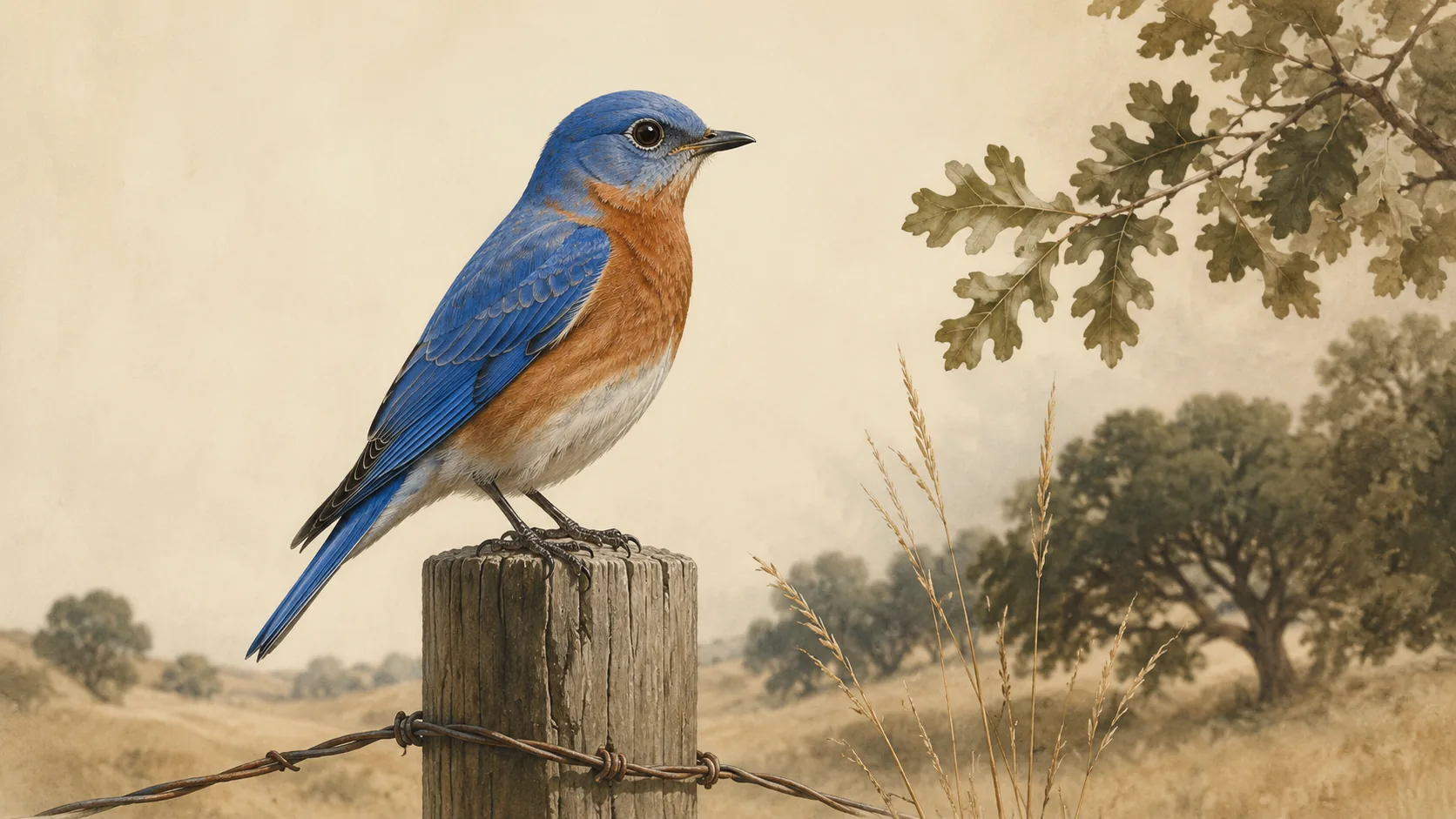
In a California oak woodland in October, a male Sialia mexicana perches on a fence post with a grasshopper in his bill. Beside him, a younger male - his son from the spring - watches the berry-heavy mistletoe clump in the oak above. When the berry crop runs out, the son will leave. When it holds, he stays. And if he stays long enough, he will help raise his parents’ next brood in April without ever having nested himself.
This is the thing about the Western Bluebird that most field guides skip: he is, in the right conditions, a cooperative breeder. The family does not simply disperse in autumn. It sometimes reconstitutes itself as a working unit. Understanding why requires paying attention to mistletoe.
What he looks like
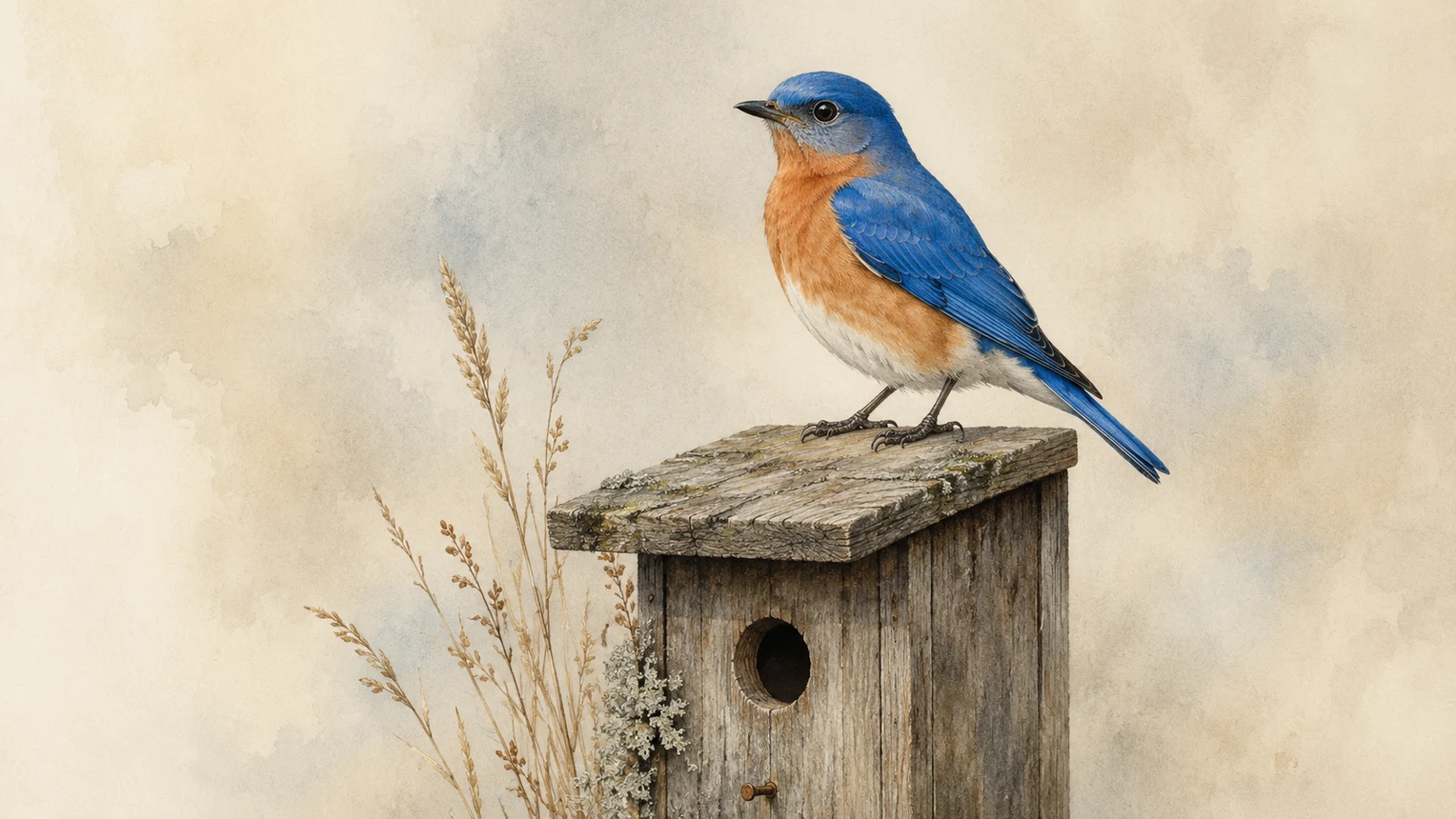
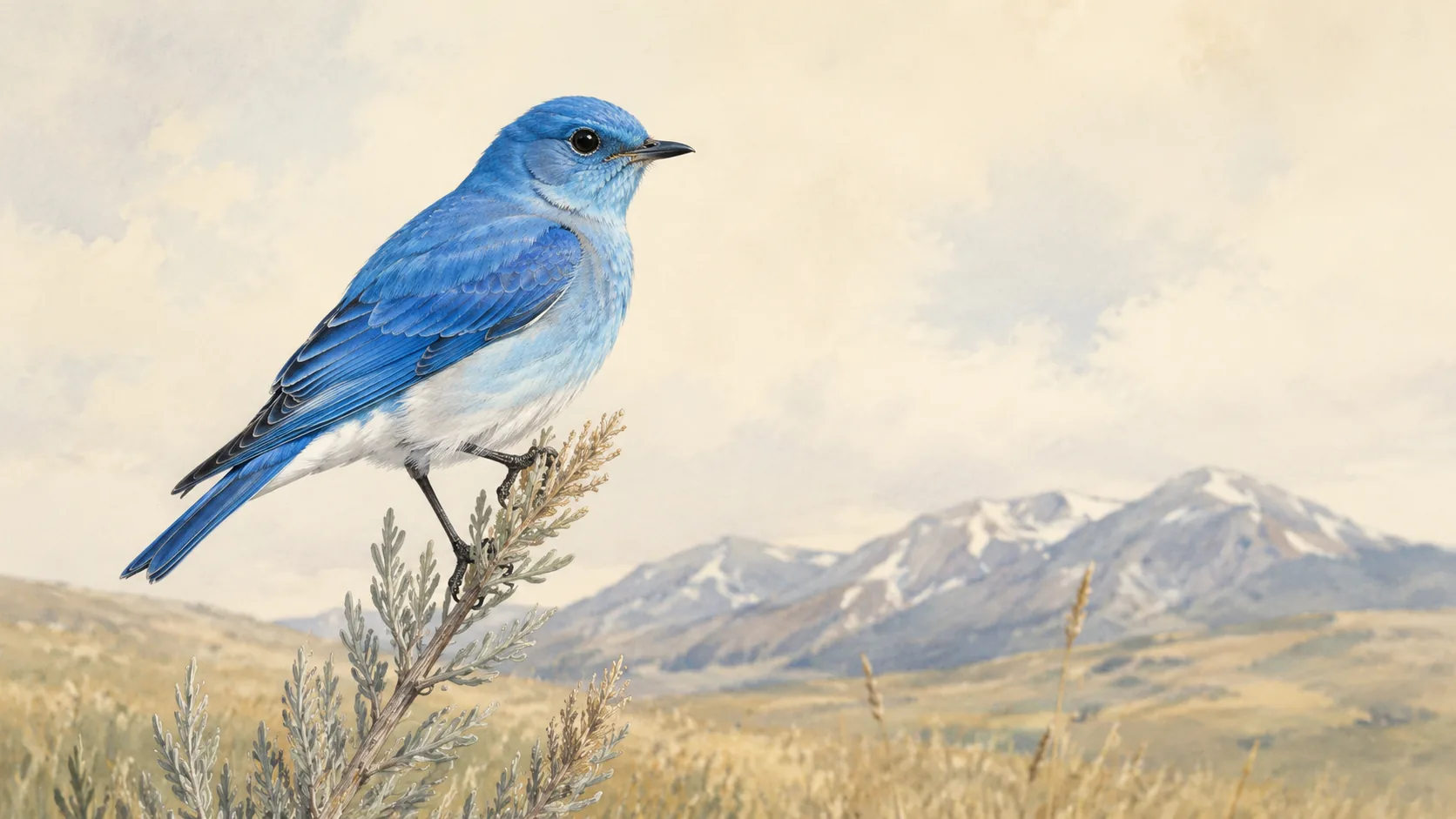
The male Western Bluebird is 16 to 19 centimetres long and weighs 24 to 31 grams - slightly smaller than an American Robin, his closest large relative in the family Turdidae. His head, throat, chin, wings, and tail are a deep cobalt blue. His chest and sides are a rich chestnut rust, and his belly is gray. In some individuals, a chestnut patch runs across the upper back as well, distinguishing him from both the Eastern Bluebird (which has a white belly) and the Mountain Bluebird (which has no rust at all). Wingspan runs 28 to 33 centimetres.
The female is much quieter: gray-brown above, a pale rust wash on the breast, blue only in the wings and tail, and a gray-white throat that distinguishes her immediately from the male’s cobalt chin. She is easy to overlook beside him. She is not a dull bird; she is a well-camouflaged one.
Cornell’s All About Birds notes that the blue in both sexes is structural, not pigment-based - the same optical physics that produces the colour in Mountain Bluebirds and Blue Jays. Hold a feather against a candle flame and it looks brown.
What he sounds like
His calls are soft and conversational rather than loud and territorial. Audubon describes a short, subdued call and a “cheer” note - nothing like the piercing alarm of a Blue Jay or the carrying whistle of a thrush at distance. In spring, males give repeated low churr calls from high perches, more insistent than melodic.
The voice is part of why he is so often missed. He does not announce himself from a hundred metres away. You find him by his colour and by the flash of blue dropping from a fence post to the ground.
Range and habitat
The Western Bluebird breeds across western North America - from southeastern British Columbia and southwestern Alberta south through Washington, Oregon, Idaho, California, Nevada, Utah, Colorado, New Mexico, and Arizona, into the northern Baja peninsula and the highland states of central Mexico. The Audubon Society’s range maps show a year-round presence across much of California and the inland Southwest, with some altitudinal migration in the mountains: birds that nest in montane conifer forests at 2,000 metres descend to valley floor oak savannas and pinyon-juniper woodland for winter.
Habitat is the key variable. He requires open, parklike forest with standing dead trees or large snags for cavities, and enough open ground to hunt insects on the drop. Dense continuous canopy suits him poorly. Burned areas, forest edge, cleared orchards, and California valley oak woodland suit him well. He is not a bird of the deep forest. He is a bird of the in-between.
Diet
Cornell’s All About Birds and the Birds of the World account both note a clean seasonal split: insects during the breeding months, berries during the winter. Summer prey includes grasshoppers, caterpillars, beetles, ants, and spiders - mostly taken by dropping from a perch to the ground in the thrush tradition. In winter, mistletoe berries, juniper berries, and elderberries carry him through. The berry crop is not incidental to his social life; it is structural to it.
Breeding and nesting
He is a cavity nester. Natural hollows, old woodpecker excavations, and nest boxes all serve. The Audubon Society reports that nest box programmes across California and the Pacific Northwest have been critical to stabilising populations that lost ground as European Starlings and House Sparrows colonised available cavities in the twentieth century. Where nest boxes are abundant, bluebird numbers recover. Where they are absent, the species competes for a shrinking pool of natural holes.
Clutch size typically runs four to six pale blue eggs. Both parents incubate. Incubation takes roughly 12 to 18 days, and chicks fledge at around 21 days old. Two broods per year is the usual rhythm. The male feeds the female on the nest - a behaviour common in thrushes, less so in many other songbird families.
The helper question
Here is what Audubon’s field guide and most popular accounts leave out: in some years, roughly one in 14 Western Bluebird pairs is assisted by a helper at the nest. Long-term research at Hastings Natural History Reservation in California, initiated by ornithologist Janis Dickinson of Cornell University in the early 1980s and continuing for decades, has documented this system in detail.
The helpers are almost always young males - sons from the previous year who did not disperse in autumn. Dickinson’s work found that the single best predictor of whether a son remains on his parents’ territory through the winter is the availability of mistletoe berries. Remove the mistletoe, and nearly all sons leave. Leave it in place, and a significant fraction stay, overwinter in a family group, and go on to assist with the following spring’s brood.
Parents with helpers fledge, on average, one more chick per breeding attempt than parents without. That is a meaningful gain. For the son, the calculation is different: he gains through kin selection - helping raise brothers and sisters with whom he shares half his genes - while waiting for the moment to disperse and breed independently. Overwinter survival in these family groups reaches approximately 95 per cent of first-year males, according to the Hastings Reserve research - a remarkably high figure for a passerine, attributed to maternal nepotism reducing competition for mistletoe berries within the group.
A further wrinkle: 45 per cent of females at Hastings engaged in extra-pair copulations, and older males were significantly more successful as extra-pair sires. The social unit looks cooperative; the genetics underneath it are considerably more contested.
A note on the fence post
The Western Bluebird is not declining sharply, but he is not holding everywhere. The IUCN lists him as Least Concern. Partners in Flight estimated a global breeding population of approximately 7.1 million as of recent assessments. But his winter range is projected to contract substantially under climate scenarios, and the California oak savannas that form the heart of his habitat have been listed among the 20 most threatened bird habitats in North America by the American Bird Conservancy.
What you can do with that information is limited, unless you own oak woodland. What you can do with a fence post is put up a nest box with a 38-millimetre entrance hole, face it east or north to avoid overheating, and wait. The male on the wire is real, and not far from him, in October, his son may be watching the mistletoe.
A Western Bluebird family in winter is not a remnant of the breeding season. It is a social structure with its own logic - built around food, kinship, and the calculus of when to stay and when to leave.