Field Guide
Great Blue Heron
On a February morning along a frozen creek in central Ohio, when every other wading bird has gone south, Ardea herodias is still there. Standing in the shallows at the ice margin. Not feeding. Not moving. Just present, in the posture of absolute readiness, neck folded into the spring-loaded S-curve that is its primary hunting tool.
This is the thesis of the Great Blue Heron: it is a bird built entirely around one moment. Everything about its anatomy - the long legs, the daggered bill, the modified sixth cervical vertebra that gives its neck the mechanical properties of a released catapult - exists to make that single strike as accurate and as fast as possible. The Audubon Society notes that herons grab smaller prey in their strong mandibles and impale larger fish with their bill before gulping them head-first. The whole body is an instrument tuned to that fraction of a second.
The fact that it can winter far north of where other herons retreat - foraging through ice-rimmed marshes on rodents, frogs, and whatever moves - says something about how well that instrument serves the bird.
What it looks like
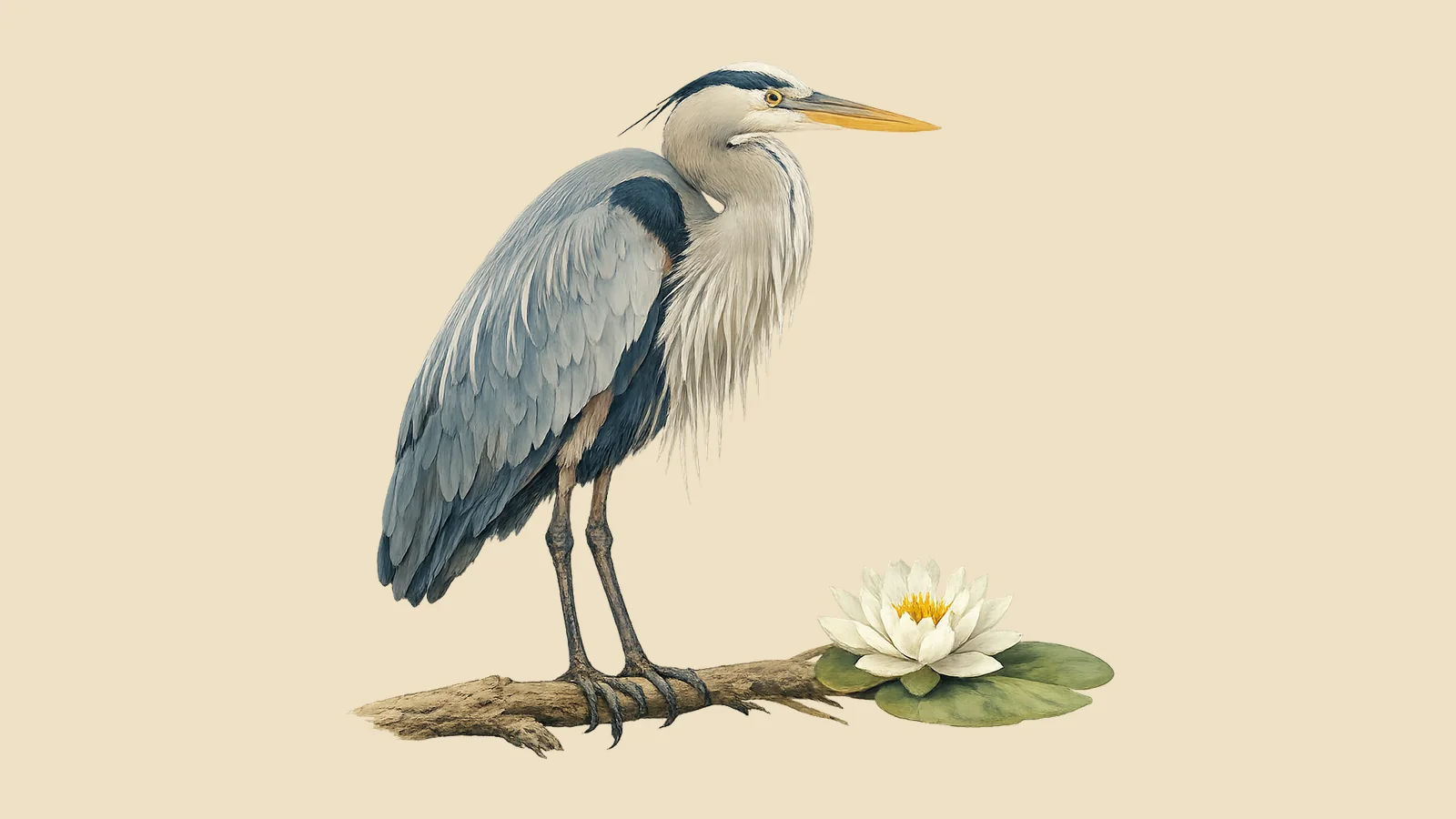
The Great Blue Heron is the largest heron in North America. At 97 to 137 centimetres tall and with a wingspan of 167 to 201 centimetres, it is impossible to mistake for anything else in most of its range. It weighs 2.1 to 2.5 kilograms - which feels astonishingly light for a bird of that height until you understand that much of it is feather and hollow bone.
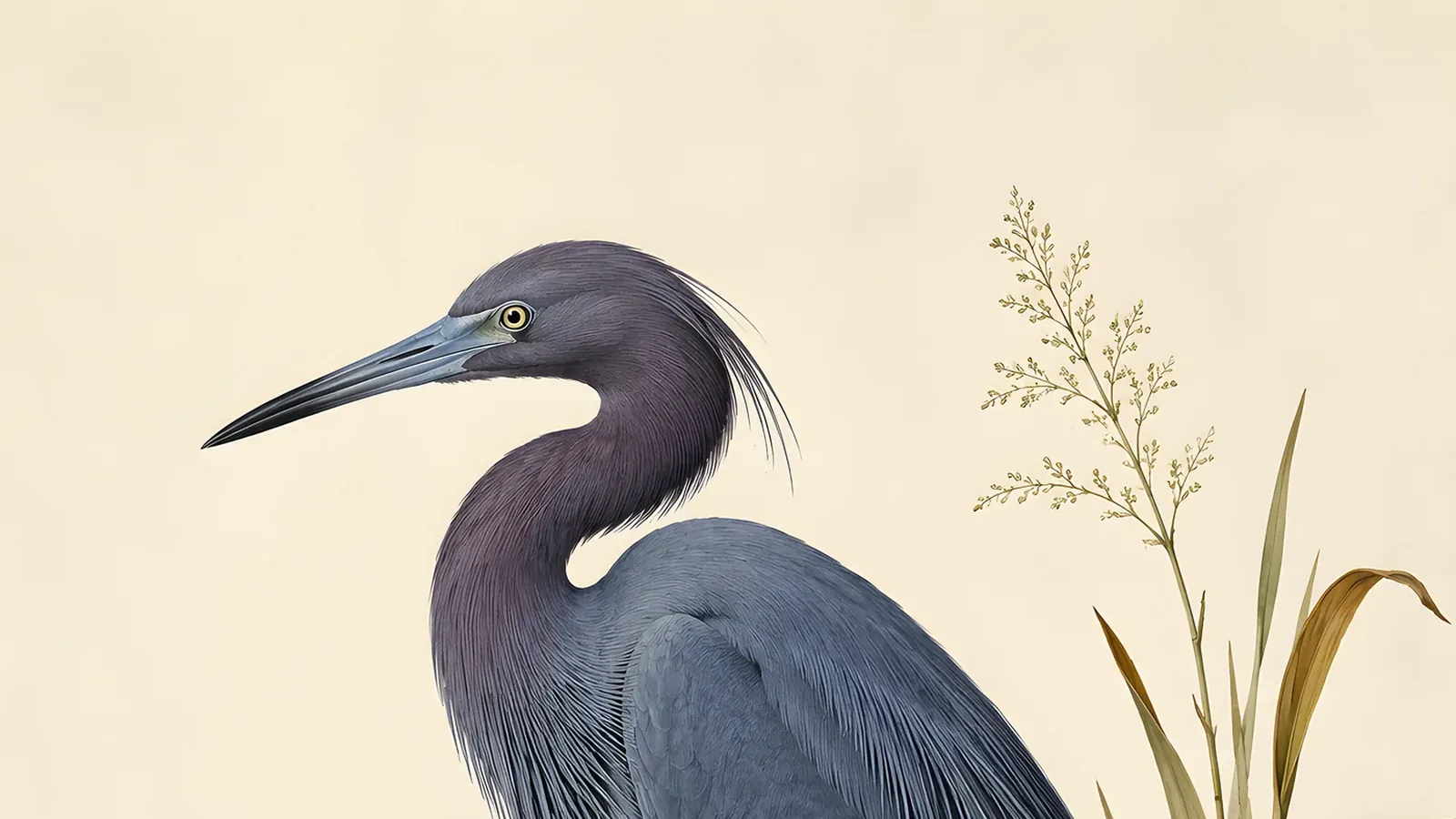
The plumage reads blue-gray from a distance: gray back and wings, with chestnut-and-black accents on the flanks, a white face, and a wide black stripe that runs from the eye back to two long black plumes trailing from the crown. The neck is white and streaked with black. The bill is thick, yellow, and formidably long. In breeding condition, both sexes develop long, airy plumes on the chest and back, the same ornamental feathers that made this genus a target for the plume trade in the nineteenth century before the Migratory Bird Treaty Act of 1918 halted the slaughter.
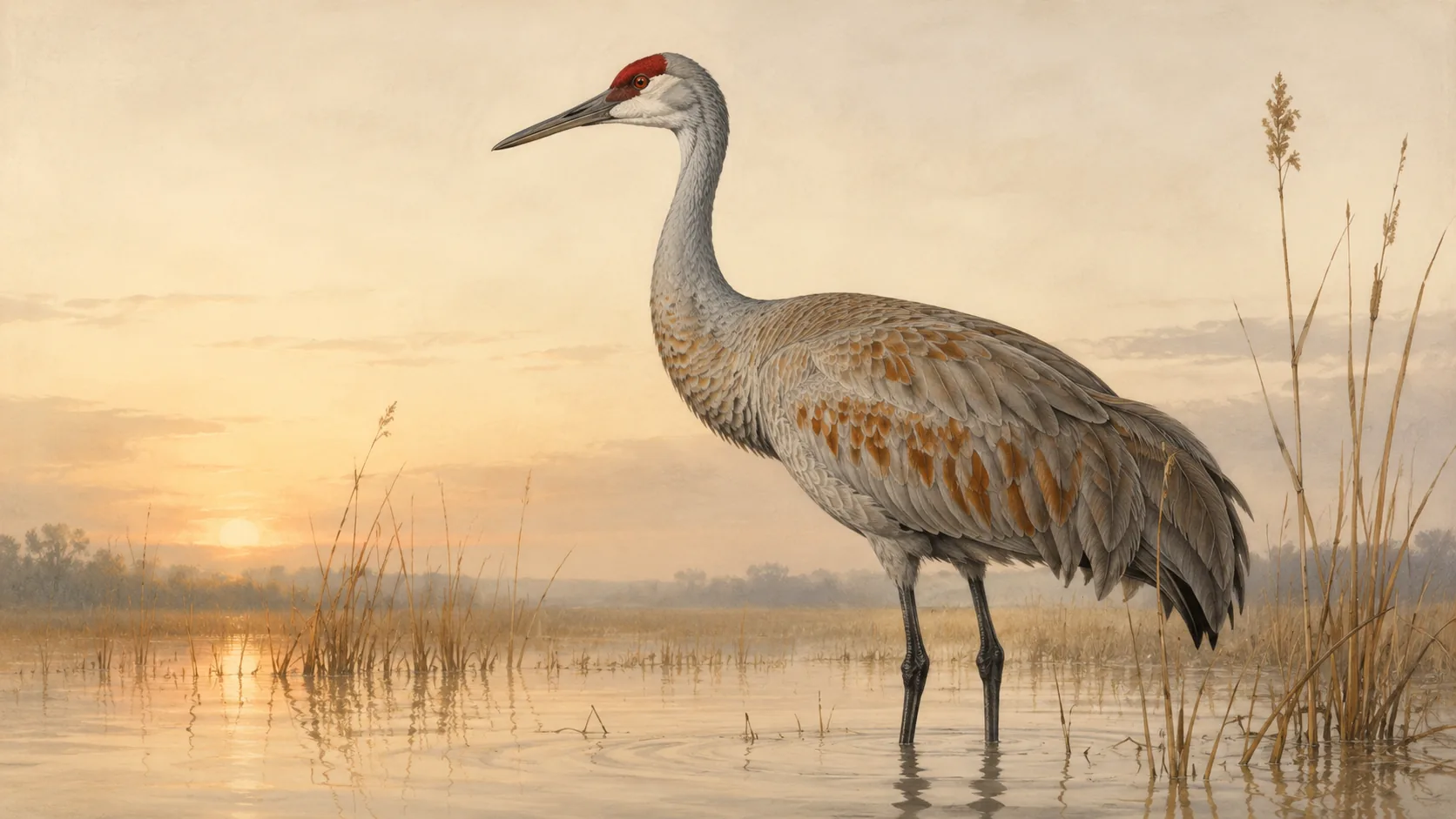
In flight the heron folds its neck into a tight S and trails its legs behind - the field mark that separates it from sandhill cranes, which fly with necks extended. The wingbeat is slow and deliberate, each stroke carrying the weight of something that looks like it should not be airborne.
Two Florida-specific colour forms exist: an all-white variant known as the Great White Heron, and a white-headed form called Wurdemann’s Heron. Both were once treated as separate species. Both breed in the Florida Keys and interbreed with the typical form freely.
What it sounds like
The Great Blue Heron is not a musical bird. Its calls are low, guttural croaks - the Audubon field guide describes a single loud squawk when flushed, and a series of hoarse notes around the colony. At the rookery in breeding season, the calls of hundreds of birds combine into a grinding, prehistoric clatter.
This is not a voice that carries across a meadow like a wood thrush or spirals up through a forest like a veery. It is, instead, the voice of something very old. Herons are in the order Pelecaniformes, which shares a deep evolutionary root with the pelicans. The sound fits the lineage.
Range and habitat through the year
Cornell’s All About Birds documents the Great Blue Heron across virtually all of North America, from coastal Alaska and the northern reaches of Canada south through Central America to parts of northern South America. The species is year-round across much of the continental United States. Northern populations east of the Rockies move south to the Caribbean and Central America in winter. Pacific Coast birds may stay put through the cold months where wetlands remain open.
The Audubon Society notes that the heron is flexible enough to winter farther north than most herons because its diet is broad: fish are the staple, but it also takes frogs, salamanders, snakes, small turtles, insects, rodents, and - occasionally - small birds. That range of prey gives it options when shallow water freezes at the edges.
Habitat follows water. The heron hunts in freshwater marshes, lake margins, tidal flats, slow-moving rivers, irrigation ditches, fish hatcheries, and flooded fields. It does not require wilderness. A retention pond at the edge of a suburban office park, if it holds fish, is enough.
Breeding and the rookery
The colonial nesting habit of the Great Blue Heron is the most sociable thing about a bird that is otherwise resolutely solitary. Heronries - the local term for a breeding colony - can hold anywhere from a handful of pairs to several hundred. Cornell’s All About Birds records the largest heronries holding 500 or more nests spread across many trees, built 20 to 60 feet above the ground or water, often in dead or dying trees on islands or in swamps where ground predators cannot easily reach them.
Males arrive first and claim nest sites within the colony, then court females from those fixed positions. Once a pair forms, the male gathers most of the sticks and branches; the female does the bulk of the construction, weaving them into a platform nest that, with annual additions, grows wide enough to hold two adults and several rapidly growing chicks.
Three to five pale blue eggs. Both parents incubate in shifts. The eggs hatch in roughly 27 days. The chicks grow fast - from hatchlings smaller than a robin to half-grown birds capable of wing-flapping in four weeks. At two to three months they permanently leave the nest, though they spend several more months learning the strike that will sustain them for the rest of their lives.
The oldest Great Blue Heron on Cornell’s banding records was found in Texas at 24 years and 6 months. Most wild birds live considerably shorter lives.
One behaviour worth watching for
A standing Great Blue Heron is already doing something. The neck is not simply folded for rest - it is cocked. The sixth cervical vertebra has a modified shape that allows the neck to compress into a spring and extend at speed in a single smooth motion, the head and bill travelling faster than most prey animals can register. What looks like stillness is a loaded mechanism.
Watch one long enough and you will see the moment it unlocks. The heron does not lunge. It does not splash. The bill enters the water and retrieves the fish in one motion, so fast that observers have reported not seeing the strike itself - only the before and the after.
This is a bird whose entire personality has been shaped by one physical fact: the price of a missed strike, in energy spent standing in cold water, is too high to waste. The patience is not passive. It is the most intense concentration the animal is capable of.
The Great Blue Heron is the argument that patience is not a virtue so much as a technique - a precise, anatomically enabled strategy for making the most of a single instant.