Field Guide
Peregrine Falcon
At four kilometres up over a coastal estuary, a female Falco peregrinus spots a dunlin below. She tips forward. The stoop begins.
In a controlled dive with wings half-folded, the Peregrine Falcon reaches speeds that Audubon’s field artists could only suggest by posture - the swept silhouette, the nearly closed wings, the body turned to a blade. Recorded speeds exceed 320 kilometres per hour. By some measurements, considerably more. The IUCN lists the species as Least Concern across its nearly global range, and the Audubon Society has documented its extraordinary recovery from the DDT era. But neither of those sentences gets at what the bird actually is: the fastest animal on Earth, built for a single repeatable moment of violence at the end of a long fall.
The Peregrine Falcon is not a fast bird. It is speed given feathers and a small, dark face.
What she looks like
The Peregrine is a medium-large falcon, 36 to 49 centimetres from bill to tail - roughly crow-sized, though a large female will outweigh most crows. The weight range across the species is wide: males run 330 to 530 grams; females, which are noticeably larger in the way of most raptors, reach 700 to 1,500 grams. The wingspan spans 80 to 114 centimetres, giving a silhouette that is long-winged and anchor-shaped in a glide, swept and pointed in a stoop.
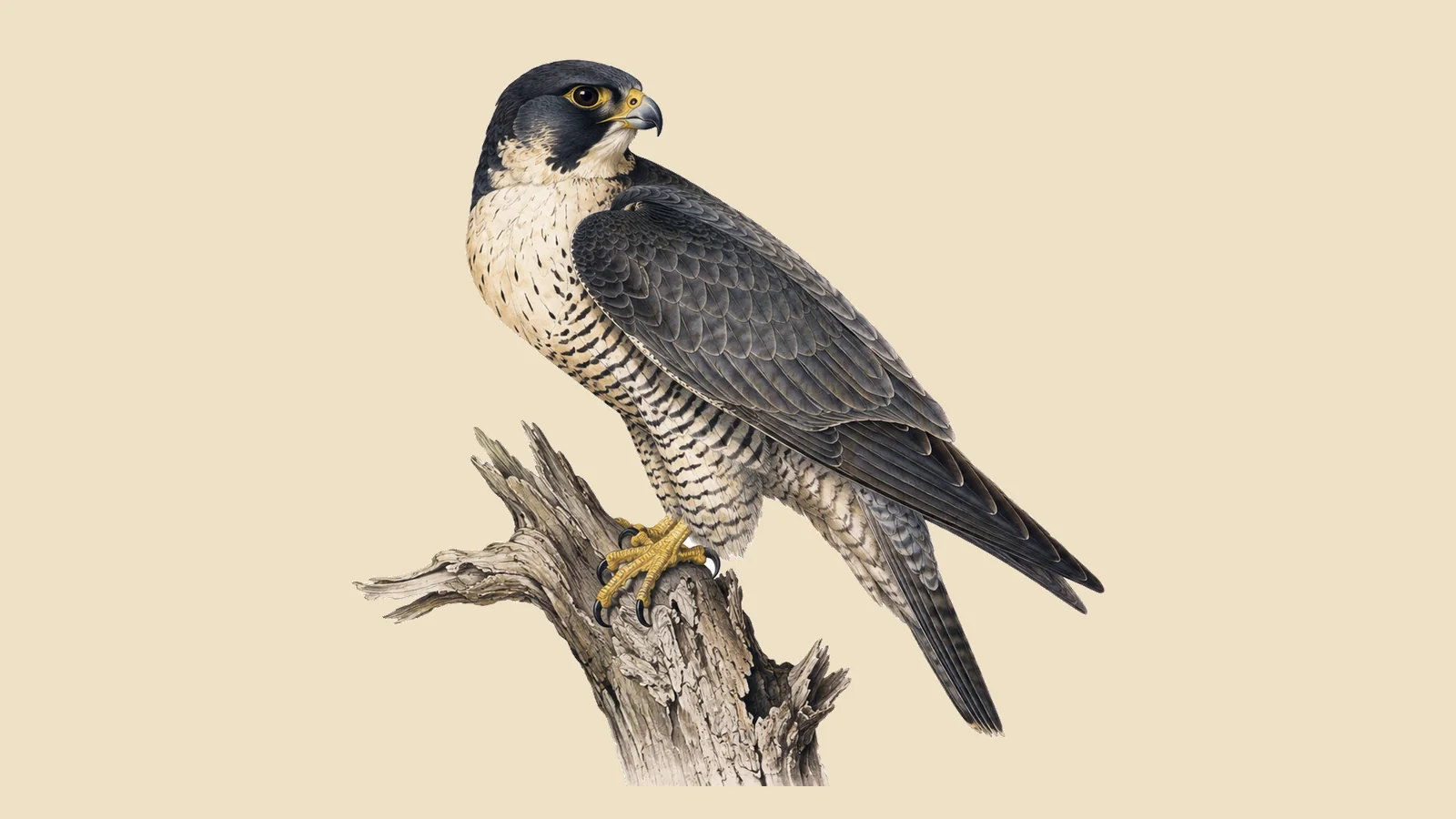
The adult’s upperparts are blue-grey to slate, darkest on the crown and back. The underparts are pale - buff to white on the chest, barred with fine dark bands lower down. The face carries the bird’s most distinctive mark: a wide black “moustache” stripe dropping from beneath the eye against the white cheek. The eye itself is dark brown with a yellow orbital ring. Both sexes share this pattern; juveniles are brown above and streaked below, with a less defined moustache, and may be confused at distance with Merlin or immature Cooper’s Hawks until size is appreciated.
There is no other North American falcon this size with this face pattern. At rest on a ledge - building cornice, bridge girder, cliff face - she looks like a bird designed by a military draughtsman. Nothing is decorative. Every line serves the function.
Voice
The call is a repeated, strident kak-kak-kak, harsh and insistent, used most aggressively near the nest. Near the eyrie in late spring, both adults will call at length when disturbed - a sound that carries further than expected and carries with it something unmistakably territorial. Outside nesting season, Peregrines are mostly silent. A bird on an urban building in December will stand for an hour without sound, watching the pigeons below.
Range and habitat across the year
Cornell’s Birds of the World describes the Peregrine as “one of the most widely distributed of warm-blooded terrestrial vertebrates.” This is unusual language for an authoritative ornithological reference and it is earned. The species breeds on every continent except Antarctica and occupies a range of habitat that runs from Arctic tundra to tropical coastline, from remote fjords to the ledges of city skyscrapers.
In North America, the breeding range includes Alaska, northern Canada, coastal cliffs from California to Baja, the Rocky Mountain west, and an expanding population of urban nesters from New York to Chicago to Los Angeles. Northern populations - tundra breeders in particular - are long-distance migrants. Some individuals travel close to 25,000 kilometres in a single annual cycle, wintering along South American coasts before returning north in spring. Resident populations in the Pacific Northwest and the urban midwest hold territory year-round.
The habitat requirement is simple in theory: open hunting grounds and a high, secure nest site. In practice this means cliffs, gorges, tall buildings, suspension bridges, and occasionally electrical pylons fitted with artificial nest platforms by recovery programmes. What it does not require is forest. The Peregrine is a bird of open sky. She needs room to stoop.
Diet
The diet is birds, almost exclusively. Audubon’s field guide documents hundreds of prey species taken across the global range - everything from the smallest warblers to ducks at the upper limit of what a large female can carry. In North American cities, the primary prey is the feral pigeon. On migration routes and coastlines, shorebirds and waterfowl dominate. In the Arctic, ptarmigan and shorebirds make up the bulk of summer hunting.
The method is the stoop. The falcon locates prey from altitude, orientates above it, and dives. The stoop is not simply fast; it is precise. At high speed the bird uses a rolling manoeuvre to keep prey in the line of sight - a slight S-curve in the descent - before striking with a closed fist or raking the prey with the rear talon. A direct hit at full stoop speed kills by impact. The falcon’s notched “tomial tooth” on the upper mandible is used to sever the spine of prey that survives the initial strike.
Cornell’s All About Birds records that speeds in a stoop may reach 320 kilometres per hour or more - a figure that has been measured by trained falcons with attached instruments and by radar tracking on wild birds. At those speeds the bird breathes through baffled nostrils designed to manage airflow under pressure, a specialisation that has no parallel in other falcons.
Breeding and nesting
The nest - called an eyrie - is a scrape on a ledge, not a constructed structure. The female makes a shallow cup in loose substrate on a cliff face, building cornice, bridge beam, or nest box. No sticks, no lining beyond whatever is already present. The same eyrie site may be used for decades by successive pairs.
Clutch size is two to five eggs, most commonly three or four. Incubation is 29 to 32 days, carried out primarily by the female while the male provides food. Both parents feed chicks after hatching. Young birds fledge at 39 to 49 days and remain dependent on their parents for several more weeks as they learn to hunt. The male’s food deliveries to the fledglings involve mid-air transfers: the adult drops prey from altitude; the juvenile turns and catches it before it falls. This is learned behaviour, and the failure rate early in the season is visible to anyone watching from below.
The oldest recorded Peregrine in North America was banded in Minnesota and identified 19 years and nine months later - a figure from USGS Bird Banding Laboratory records that represents the species’ outer limit. The average wild bird does not approach that age.
The recovery, and what it means
By the 1960s, the Peregrine Falcon had been eliminated as a breeding bird across the entire eastern United States. DDT - entering the food chain through contaminated invertebrates, moving up through fish and birds, concentrating in falcons at the top - caused eggshell thinning so severe that most eggs collapsed under the incubating female’s weight. The species was listed under the US Endangered Species Act. Captive breeding programmes at Cornell and elsewhere produced birds that were released at cliff sites, bridge towers, and buildings across the east through the 1970s and 1980s. In 1999, the Peregrine was removed from the Endangered Species List. The Audubon Society called it one of the most successful recoveries in the history of the Act.
The IUCN now lists the species as Least Concern with an increasing global population trend. As of 2026, a new concern has emerged: Audubon researchers have documented the first population declines since the DDT era, with some North American coastal populations showing high adult replacement rates and reduced occupancy at monitored eyries. Highly pathogenic avian influenza is the primary suspect, tracking through shorebird prey populations before reaching the falcons. The investigation is ongoing.
The DDT recovery took roughly 30 years from the low point to delisting. What it demonstrated is that the Peregrine, given a clean food chain and secure nest sites, is a resilient bird. The stoop has worked for millions of years. The question now, as then, is whether the food chain below it will hold.