Field Guide
Pyrrhuloxia
In late February, on the edge of a dry arroyo in southern Arizona, a male Cardinalis sinuatus climbs to the tip of a mesquite branch and begins to sing. The flock he has spent the last four months traveling with will dissolve in a matter of days. His territories from last year still exist in muscle memory. He will return to them and defend them with the same ferocity he brought to bear before the winter changed everything about him.
The Pyrrhuloxia is not a well-known bird. It sits in the long shadow of its close relative the Northern Cardinal, which is louder, redder, and occupies nearly every garden in eastern North America. But the Pyrrhuloxia is the more interesting study. It is a bird of extremes: solitary and territorial in the breeding months, social and nomadic in winter, and built for a landscape that would finish off most songbirds in a week. The Sonoran and Chihuahuan deserts are not hospitable places. The Pyrrhuloxia is at home in both.
What she looks like - and the bill
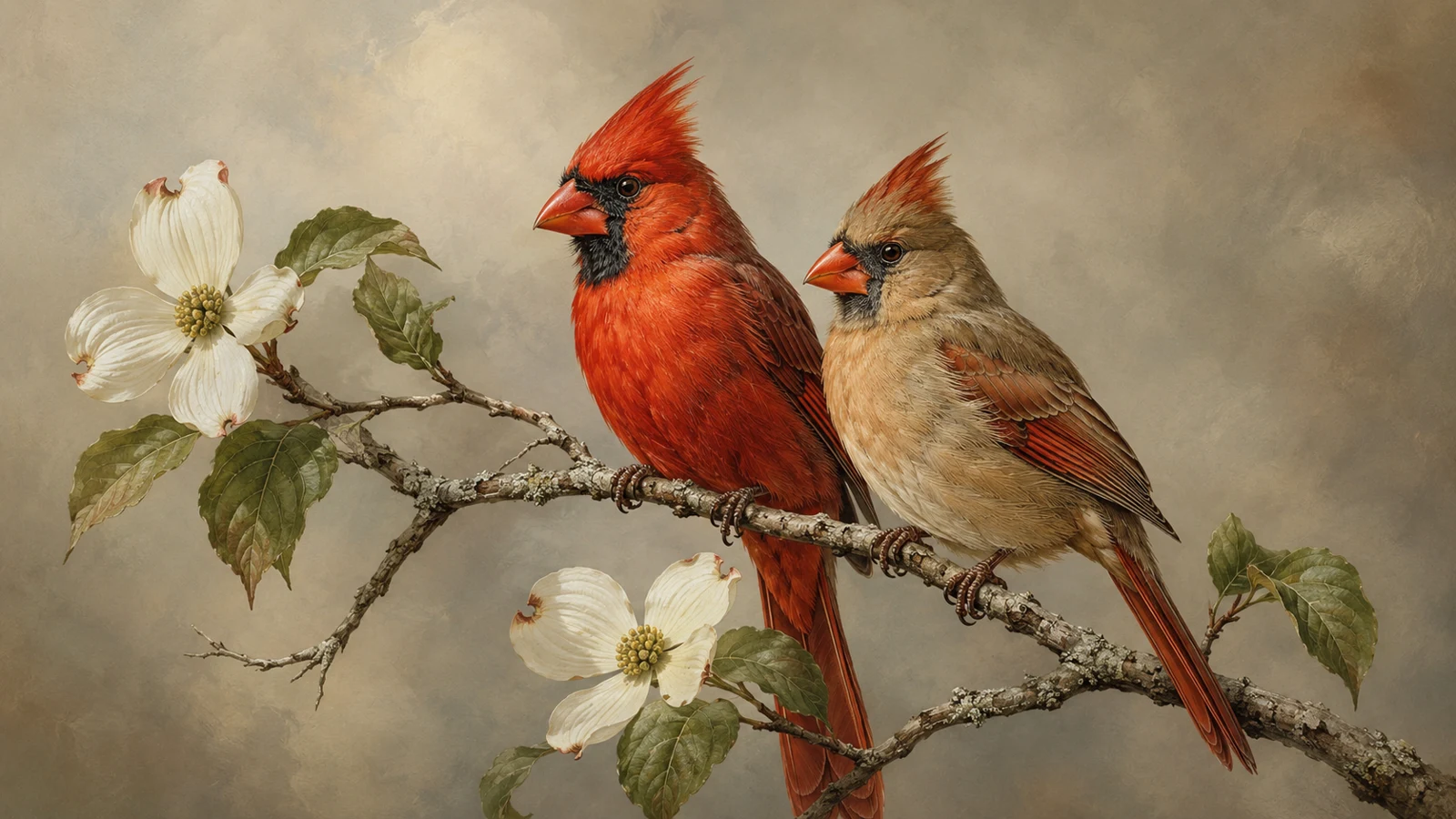
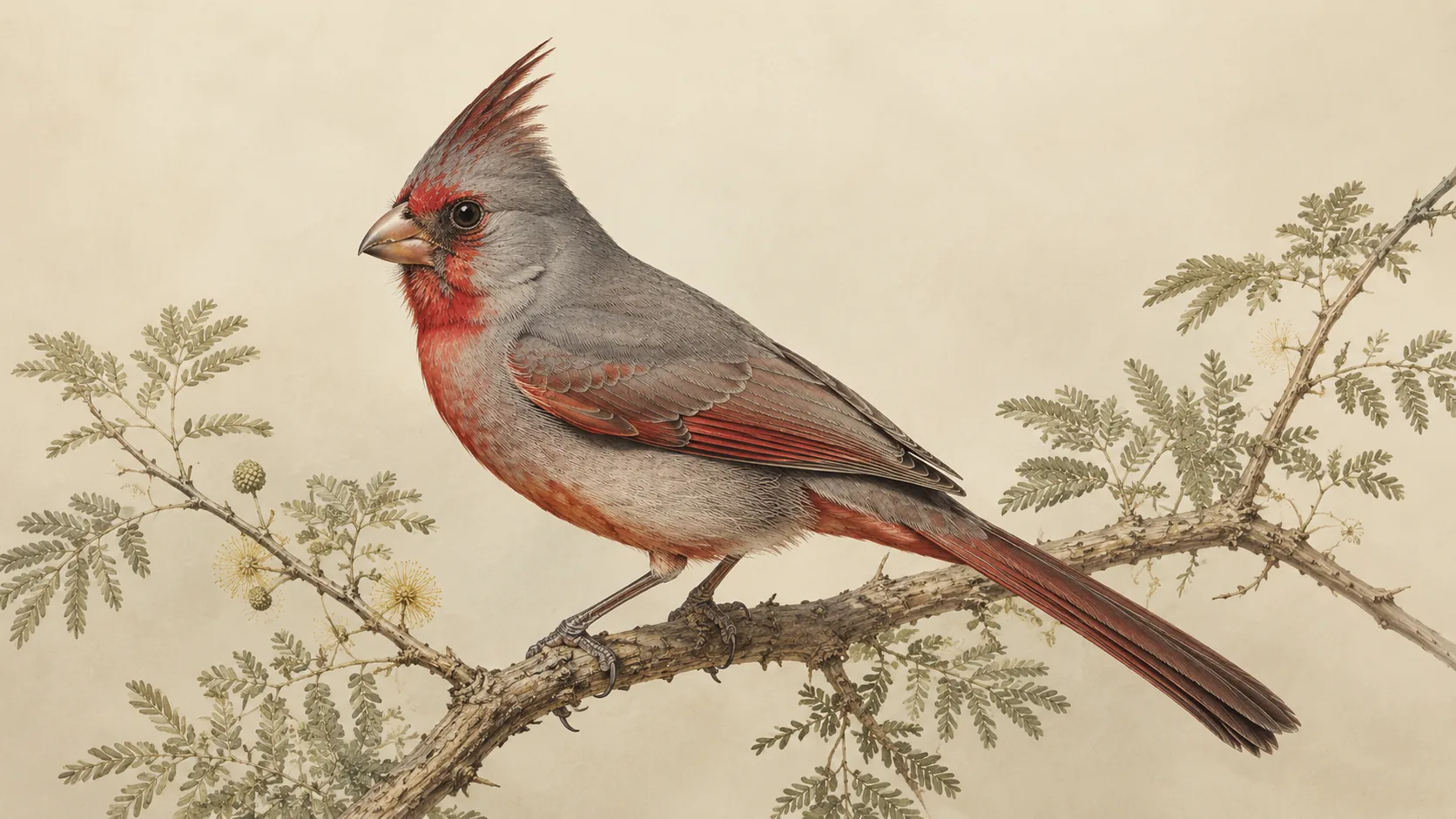
A Pyrrhuloxia is roughly the same size as a Northern Cardinal: 19 to 22 centimetres long, weighing 24 to 43 grams, with a wingspan of 28 to 31 centimetres. The resemblance ends there. Where a cardinal is saturated red or warm brown, the Pyrrhuloxia is ash-gray. The male carries that gray cleanly across his back, flanks, and tail, with washes of red on the face, crest, wing edges, and breast stripe. He is elegant rather than showy. The female is softer still - grayish brown, with faint red on the crest tips and the wings, easy to overlook on a bleached desert floor.
The defining feature of both sexes is the bill. A Northern Cardinal’s bill is conical and large but recognisably finch-shaped. The Pyrrhuloxia’s bill is something else: short, thick, strongly curved at the tip, yellow to yellow-orange, and shaped more like a parrot’s than a songbird’s. The Audubon field guide notes this is where the name comes from - Greek and Latin roots combining “bullfinch” and “crooked,” a description the bill earns every time the bird cracks open a mesquite pod or strips a cactus fruit.
Both sexes carry a tall, thin crest, slightly more slender than the cardinal’s. Males raise it when alert or during song. When a Pyrrhuloxia flattens its crest and tucks into a desert shrub, it becomes very difficult to see. This is not incidental.
Voice
The Pyrrhuloxia’s song is a loud, clear whistle: what-cheer, what-cheer, close enough to the Northern Cardinal’s that a birder at distance will pause. Cornell’s All About Birds describes the call as similar to the cardinal’s but thinner and shorter. The male sings from late winter through summer, from exposed perches at the tops of mesquite, saguaro ribs, or ocotillo stems - anywhere that carries sound across open ground. Females occasionally sing, but rarely.
The song carries a territorial function that is absolute during the breeding season. A male will pursue and confront intruding males at the edge of his territory with a persistence that seems disproportionate to his size. Then November comes, and he joins the same birds in a foraging flock without apparent conflict.
Range and habitat
The Pyrrhuloxia is a year-round resident of the southwestern United States and northern Mexico. Its core range runs through the Sonoran and Chihuahuan deserts: southern Arizona, New Mexico, and Texas (concentrated in the south and west of the state), then south into Mexico’s arid interior. Occasional individuals reach Baja California, southern Colorado, and western Oklahoma, but these are outliers.
The habitat this bird requires is specific: desert washes, mesquite thickets, thorn scrub, arid canyons. It is not a grassland bird or a forest bird. It wants the edge between bare ground and thorny cover - the kind of landscape that offers both open foraging ground and dense, protected nesting sites. In the Chihuahuan desert, that means the narrow strips of mesquite and acacia that follow dry creek beds through otherwise open terrain.
The Audubon Society notes that Pyrrhuloxias are less sedentary than southwestern cardinals, and surveys confirm slight population declines in some areas, probably as a result of habitat loss. The IUCN lists the species as Least Concern. The range is intact. The declines are real but not yet acute.
Diet
The Pyrrhuloxia’s parrot-bill is built for tough material. Its diet leans heavily on seeds - bristlegrass, doveweed, sandbur, panicum, sorghum, pigweed - and it handles these with the same technique as any cardinaling: crack and swallow. In summer it adds insects heavily, particularly grasshoppers, caterpillars, beetles, and cicadas, which supply the protein needed for raising a brood in the heat. Cactus fruits are taken when available; the bird will work over a prickly pear or a saguaro fruit without apparent discomfort from the spines.
At feeders it takes sunflower seeds readily, which explains its occasional appearance in suburban Tucson or El Paso gardens that back onto desert habitat. It is not a committed feeder visitor the way a cardinal is. It arrives, feeds efficiently, and leaves.
Breeding and nesting
The breeding season runs from mid-March to mid-August. The male establishes territory first, spending February singing from prominent perches as the winter flocks dissolve around him. The female selects the nest site, typically in thorny desert scrub - a mesquite thicket, a cholla, a palo verde - between one and five metres off the ground. The nest is an open cup of twigs, weeds, and bark, compactly built and well hidden.
Clutch size runs two to four eggs, grayish-white with gray and brown speckling. Incubation lasts 14 days, and the female handles most of it. The chicks fledge within about 10 days of hatching. Two broods per season are common given the long breeding window. The male feeds the female during incubation and both parents provision the nestlings.
The winter
The Pyrrhuloxia’s most striking behaviour is its winter transformation. Cornell’s All About Birds records winter flocks reaching nearly 1,000 individuals. These are not loose aggregations but cohesive foraging groups that move through desert habitat together, working the ground for seeds and shifting across territory lines that will be violently defended come spring. The Audubon guide describes this directly: the Pyrrhuloxia is “less sedentary and more social than southwestern Cardinals, with flocks often wandering away from nesting areas in winter.”
What drives this is almost certainly food distribution. Desert seed crops are patchy and unpredictable. A single bird defending a winter territory in the Chihuahuan desert is betting on a resource base that may simply not exist from year to year. A flock of several hundred birds can cover more ground and shift faster than any individual. The strategy is rational in the way that the breeding-season strategy is also rational: guard a resource when it is dense enough to guard, pool effort when it is not.
In late February the logic reverses. The winter flock breaks apart bird by bird, each male pulling back to his remembered territory, climbing a mesquite branch, and beginning to sing. The solitary, belligerent breeding-season bird reconstitutes itself out of the flock animal of December. It happens every year, and it happens fast.
The Pyrrhuloxia is the same species in two different social arrangements - and it makes both of them work.