Field Guide
Summer Tanager
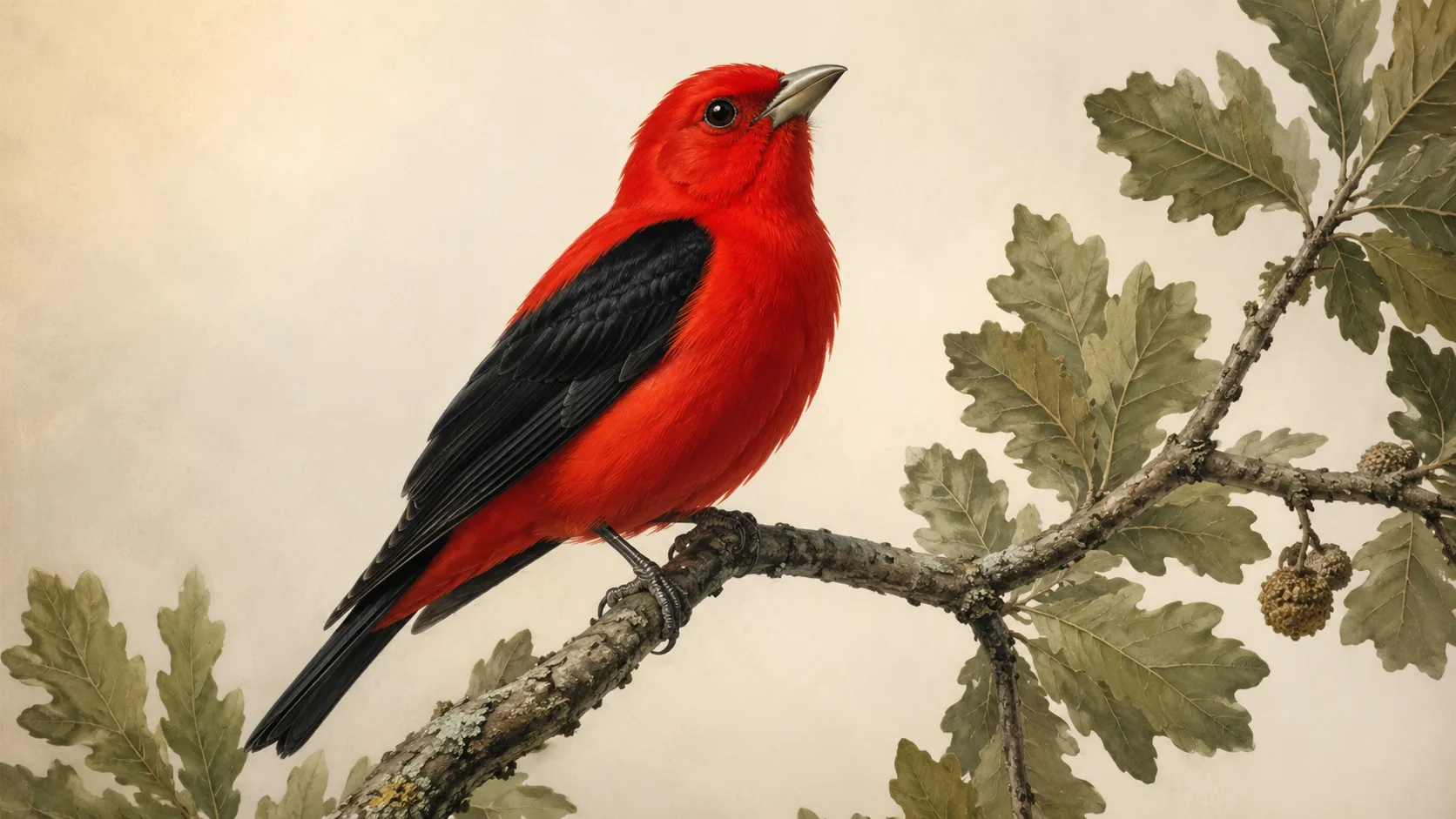
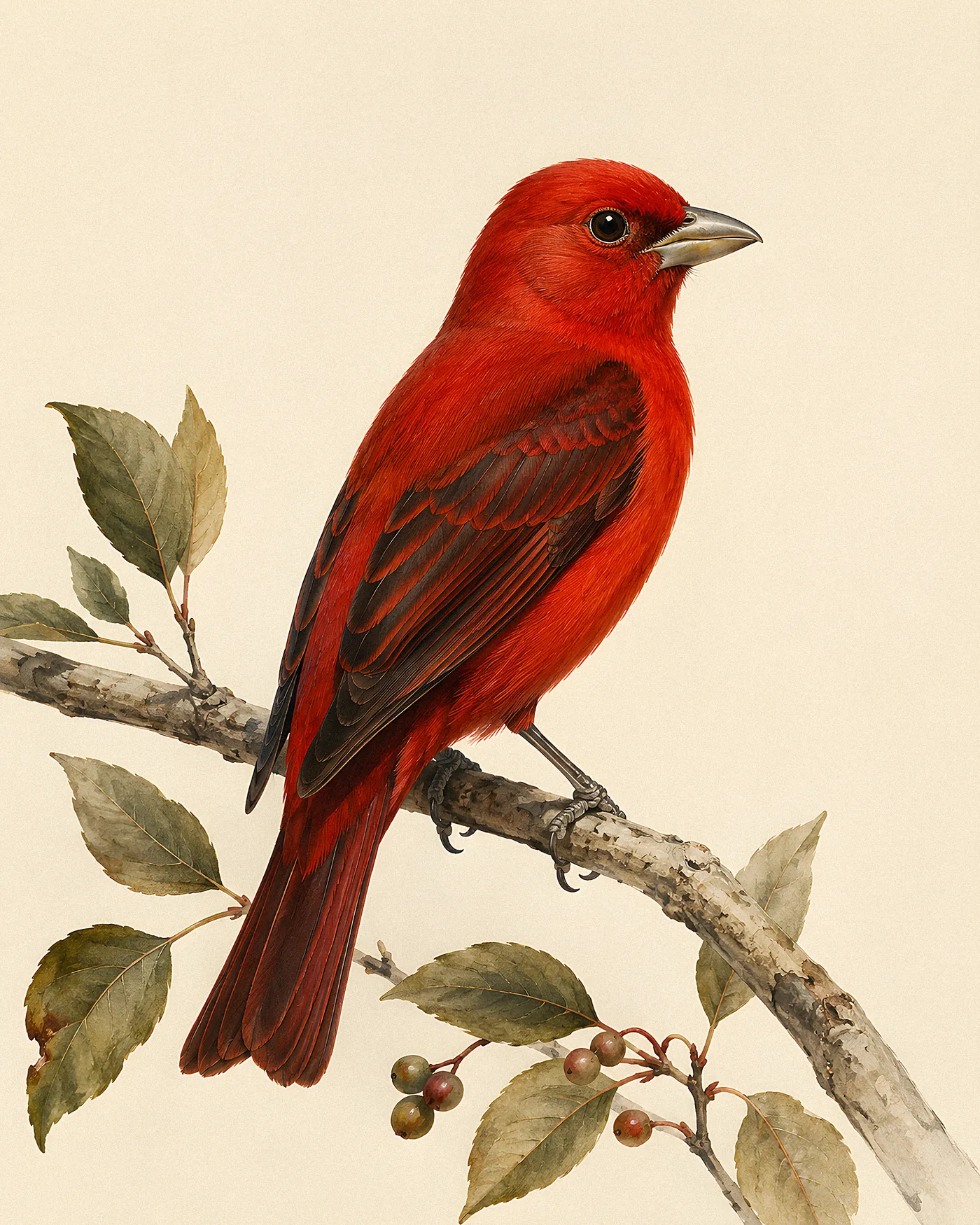
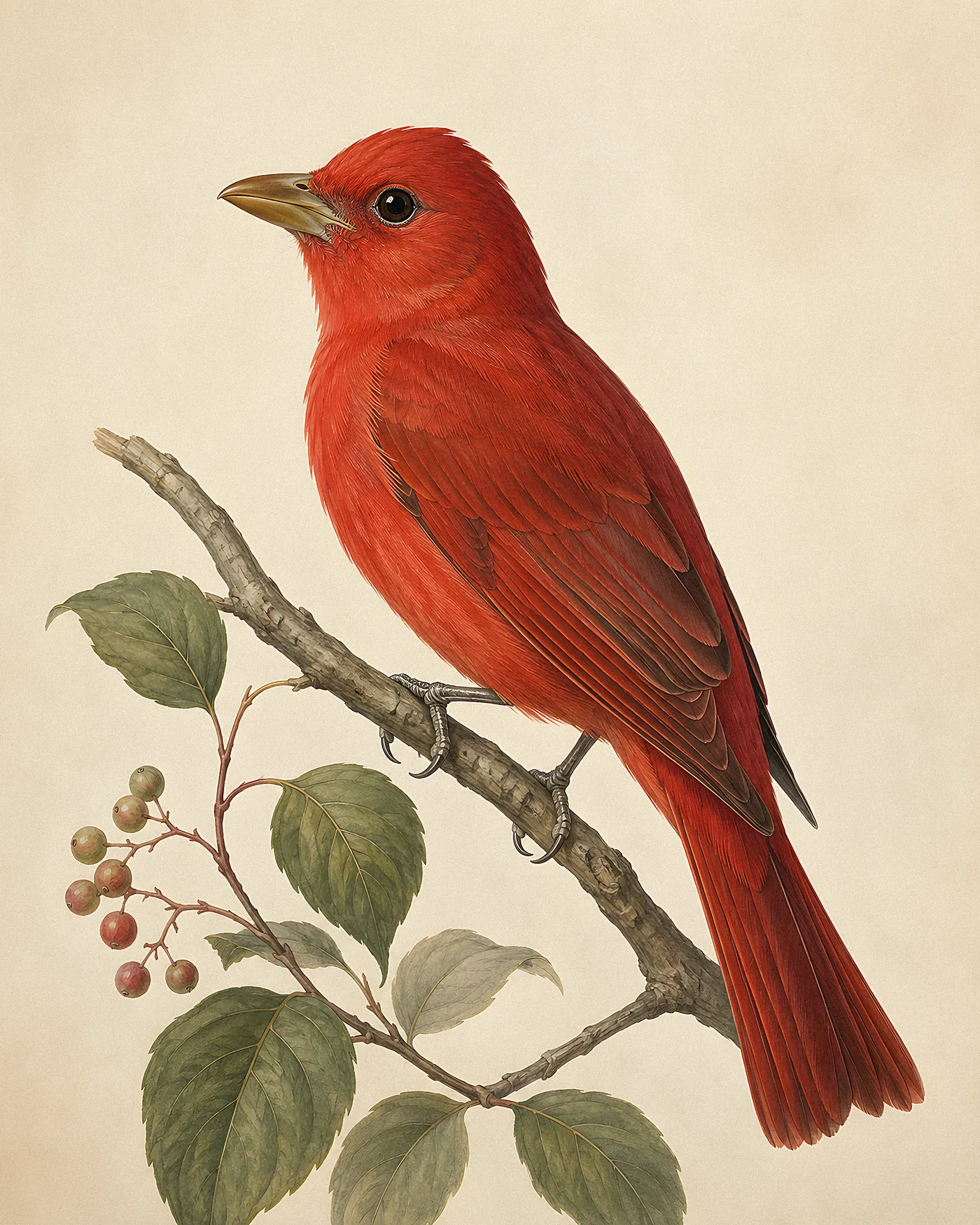
In late April, in a stand of open oak in east Texas, there is a bird in the canopy that is entirely, evenly red. Not the operatic scarlet of his eastern cousin against black wings, but a softer, rosier red that runs from bill to tail with no break in it at all. A male Summer Tanager has come back from the tropics, and he is the only entirely red bird in North America, no black wings, no crest, no mask, just red all over, with a large pale bill.
He is hunting as he goes, and what he is hunting tells you most of what you need to know about him. The Summer Tanager is a bee and wasp specialist. He works the edges of the wood and the tops of the oaks, watching for the glint of a flying insect, and when a wasp or a bee passes he sallies out, takes it on the wing, and carries it back to deal with it properly.
What he looks like
The breeding male is unmistakable in the south: uniform rose-red over the whole body, slightly brighter on the head and breast, with no contrasting wings or tail. The bill is large, pale and stout, heavier and blunter than the Scarlet Tanager’s, built for handling hard-bodied insects and fruit. Cornell Lab puts the species at roughly 17 to 19 centimetres long, weighing 29 to 40 grams, with a wingspan around 28 to 30 centimetres, a sturdy, big-billed bird, robin-shaped but a touch smaller.
The female is mustard yellow, brighter and warmer below, with greener-yellow wings and back. She carries no red, and the soft overall yellow plus the heavy pale bill separate her from the greener female Scarlet Tanager. The young male is the strange in-between: he does not reach full red until the autumn of his second year, so a first-summer male can be a patchwork of yellow and red, blotched and mottled, looking as though the colour has been applied unevenly and left half-finished.
What it sounds like
The song is sweet and whistled, a run of musical phrases that rise and fall, very like an American Robin’s but a little sweeter and less burry than the Scarlet Tanager’s hoarse delivery. It carries from the canopy, where the male sings from a high open perch.
The call is the clincher, and it is unlike anything else. Both sexes give a sharp, staccato pit-ti-tuck or picky-tucky-tuck, a dry rattling note that, once learned, picks the bird out of a noisy summer wood even when the red stays hidden in the leaves. In a southern oak full of robin-like song, the pit-ti-tuck is the tell that a Summer Tanager is overhead.
Range and habitat
Piranga rubra breeds across the southern United States, from California and the Southwest east through Texas and the Gulf states to the mid-Atlantic, favouring open deciduous and pine-oak woodland, especially oak, and the edges and gaps within it rather than deep closed forest. It likes a more open, sun-broken wood than the Scarlet Tanager’s unbroken canopy, which is part of why the two can share a region without competing head-on.
It is a long-distance migrant. Cornell Lab records the species wintering from central Mexico south through Central America to northern South America, where it keeps up its insect-hunting in tropical woodland and forest edge. The IUCN lists the Summer Tanager as Least Concern, with a large and broadly stable population, and the bird has in places expanded northward, helped by its tolerance for the open, edgy woodland that human land use tends to create.
Diet
This is the bird’s signature. The Summer Tanager is a specialist on bees and wasps, taking them on both its breeding and its wintering grounds, a diet few birds share because few birds care to handle the stings. Cornell Lab describes the method precisely: the tanager catches a bee or wasp in flight, carries it to a perch, beats it against the branch to kill it, then wipes it on the bark to remove the sting before swallowing. It will raid wasp nests for the larvae as well.
Beyond the stinging insects it takes spiders, cicadas, beetles, ants, termites, grasshoppers, flies, moths and true bugs, and in late summer and on migration it turns increasingly to fruit: mulberries, blackberries, pokeweed and, in the tropics, Cecropia, citrus and bananas. The same heavy bill that subdues a hornet handles soft fruit without trouble.
Breeding and nesting
The pair is seasonally monogamous, holding a territory for a single breeding season. The female builds the nest and does the incubating, while the male defends the territory; both parents then feed the nestlings and fledglings. The nest is a shallow open cup of grasses and stems, set out on a horizontal limb, often well out from the trunk and screened by leaves.
Cornell Lab records a typical clutch of three to four eggs, occasionally as few as two or as many as five, pale blue to green and marked with brown spotting. Incubation runs about 12 to 13 days, and the young fledge roughly 9 to 10 days after hatching, then depend on the adults for a further stretch before the family breaks up ahead of the southward migration. The species usually raises a single brood a year.
The wasp-eater’s nerve
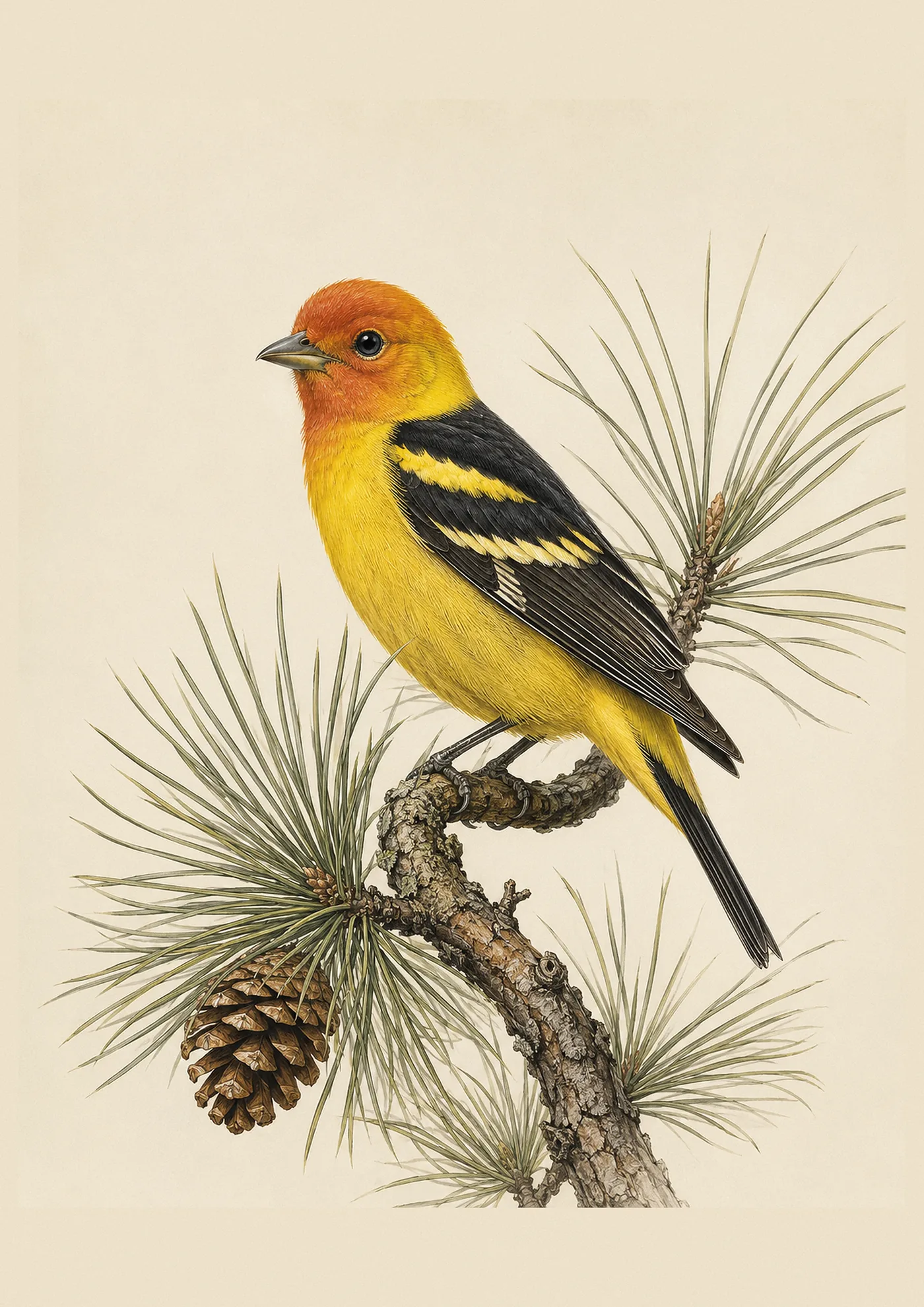
The Summer Tanager is easy to undersell from a field guide, because on the page he is simply a red bird, less dramatic than the Scarlet Tanager’s red-and-black and less colourful than the Western Tanager’s flame-orange head. In the wood he is something better: the only solid-red bird on the continent, and the one with the most striking habits.
It is the diet that lifts him. A bird that hunts wasps and bees as its main food, that takes them on the wing and disarms them with a practised flick against a branch, is doing something most songbirds would never risk. The nerve of it is hidden in plain sight, behind a quiet rosy bird working the tops of the oaks.
The only all-red bird in North America earns its living catching wasps and bees, beating the sting out against a branch before it swallows.
So when a wholly red tanager turns up in a southern oak in spring, whistling like a sweetened robin and dropping that dry pit-ti-tuck, watch him hunt. The colour is the easy part. The wasp-eating is the bird.