Field Guide
Kentucky Warbler
A low, shaded ravine in late May. Oaks closing overhead, leaf litter thick and damp on the slope. The song arrives before the bird - rolling, emphatic, almost mechanical in its rhythm: churry churry churry churry. It comes from somewhere down in the greenery, perhaps three metres off the ground, perhaps less. You wait. Nothing moves. The song continues, as loud as a Carolina Wren but with a different cadence, a little rougher at the edges. You are listening to Geothlypis formosa, the Kentucky Warbler, and there is every chance you will leave that ravine without ever laying eyes on it.
That is this bird in miniature. Vivid, vocal, and almost entirely hidden.
What it looks like
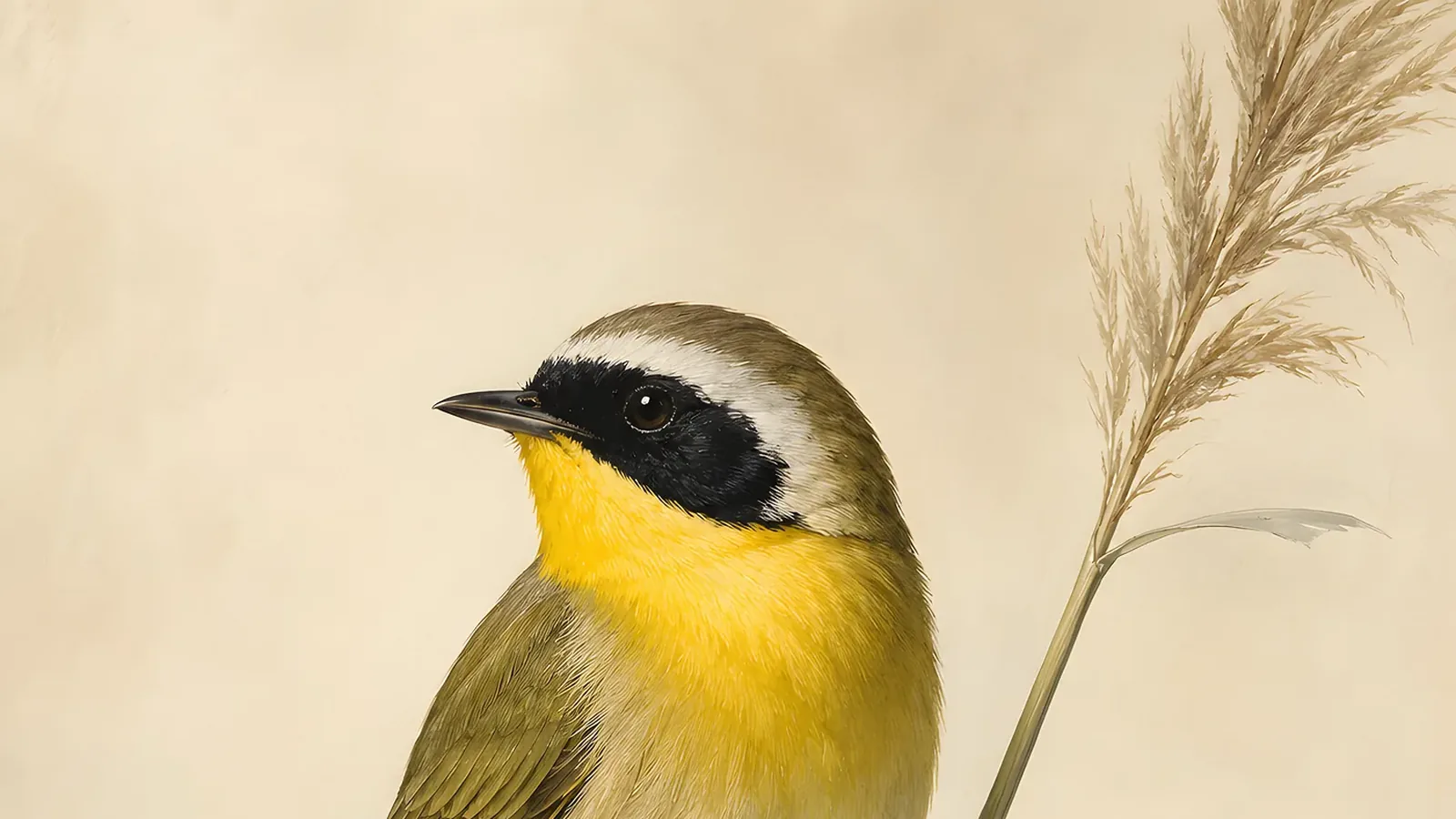
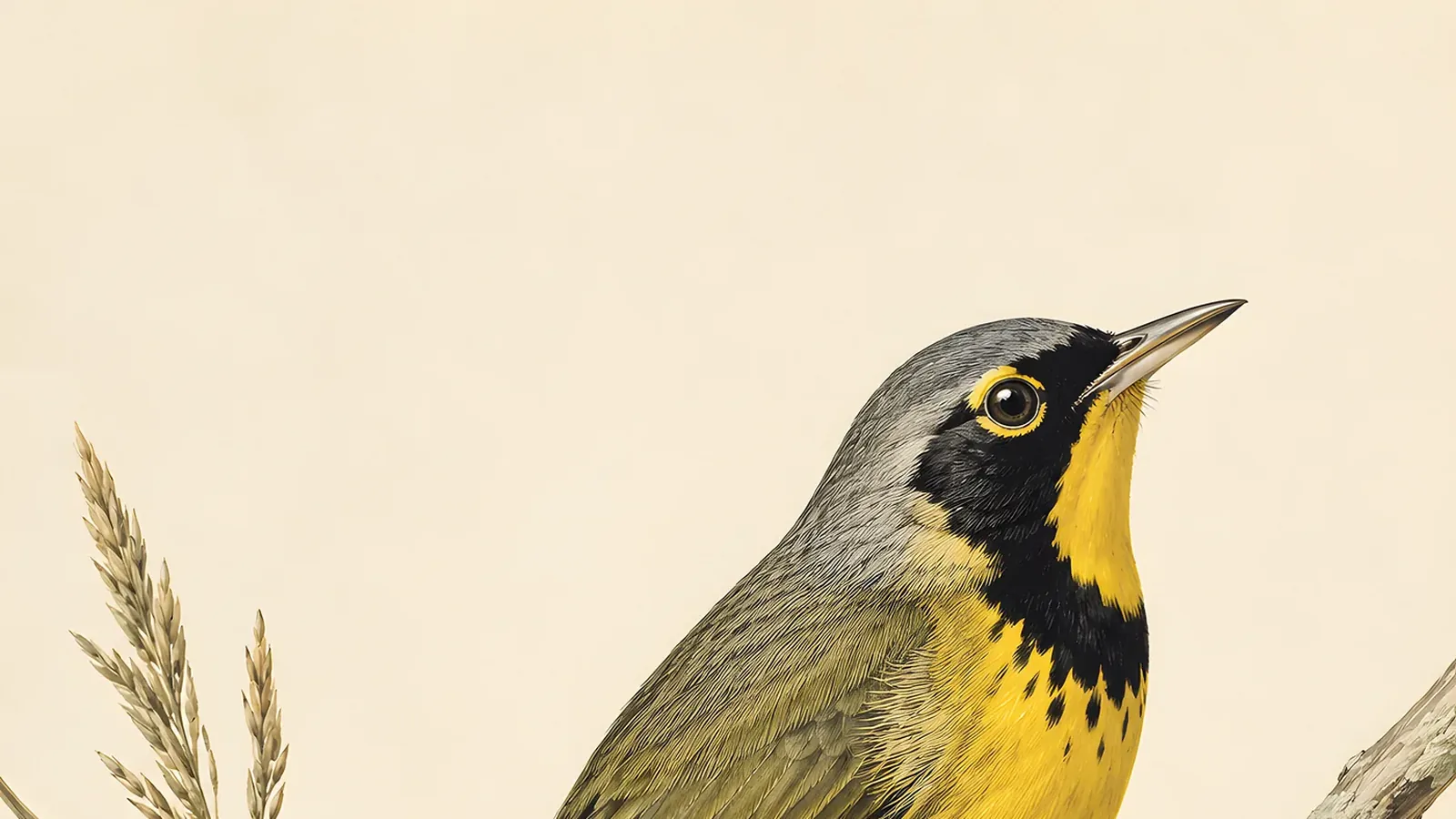
The male Kentucky Warbler is unmistakable once seen. Olive-green from crown to tail on the upperparts - a good, warm olive that reads almost brown in deep shade. The underparts are a clean, saturated yellow, running unbroken from throat to undertail coverts. No wingbars, no streaking, no tail spots.
The face is where the field marks live. A crown of black runs back from the forehead. Below the eye, a broad black mask extends down as a widening patch along the jaw, producing the distinctive shape that observers often call sideburns. Between crown and mask, a yellow supercilium loops forward around the eye to meet a yellow patch below it - the “spectacles” that give this bird its best-known identification feature. In strong light, those spectacles glow.
The female carries the same pattern but with less black, often reduced to a dusky olive wash rather than solid black on the crown and face. Young birds in their first autumn are duller still. The legs are notably long for a warbler - this is a walker, and the legs show it.
| Measurement | Range |
|---|---|
| Length | 13-15 cm |
| Weight | 11-14 g |
| Wingspan | 20-23 cm |
| Lifespan (recorded) | up to 11 years |
The oldest Kentucky Warbler on record was a male banded by Alabama biologist Eric Soehren at the Wehle Land Conservation Center in Midway, Alabama. First captured in summer 2010, it was recaptured again in summer 2019 - at least 11 years old and the subject of a longevity notice from the Institute for Bird Populations (Soehren, MAPS program, 2019). That this tiny bird had crossed to Central America and back at least 22 times by that age is not a small thing.
A life on the forest floor
The Kentucky Warbler does not forage in the canopy. It does not hang from outer twigs or probe bark. It lives and feeds at or near the ground, and it walks - deliberately, with a slight bob of the tail - through the leaf litter in a manner that reminds experienced observers more of a thrush than a wood warbler.
“This bird typically walks rather than hops, and it habitually bobs its tail.” - Missouri Department of Conservation field account
Watch one working a patch of forest floor and you see the technique clearly. The bill goes under a leaf, flipping it aside. The bird steps forward. Another leaf turned. It moves slowly enough that you can follow the logic of it - a systematic working of the debris layer, pulling up moths, beetles, caterpillars, ants, spiders, and grubs. Occasionally it leaps to glean an insect from low foliage. On its wintering grounds in Central America and northern South America, it has been recorded following army ant swarms, picking off prey flushed by the column - opportunistic, alert, adaptable in the way ground foragers tend to be.
The habitat requirement is specific. This is not a bird of scrubby second growth or dry upland oak. It wants moist, mature deciduous forest with a dense, layered understory - bottomland woods along creek drainages, ravine slopes where shade is heavy and the ground stays wet, the thick mid-story between the leaf litter and the canopy where a bird can be entirely concealed at one metre off the ground. In Kentucky and the core of its southeastern range, that means bottomland hardwoods, cove forest in the Appalachian foothills, and the rich mesic woodlands that once covered much of the mid-Atlantic and Ohio Valley lowlands.
The song
The song is the reason most people know this bird exists at all. It carries. On a still May morning in the right forest it can be heard from 200 metres away, a loud rolling churr repeated in a phrase of five to eight notes, rendered variously as churry churry churry or tur-dle tur-dle tur-dle. It is lower in pitch and rougher in texture than the bright songs of most wood warblers, and unmated males have been recorded singing as frequently as every 12 seconds during territory establishment (Gibbs, 1988, cited in New York Natural Heritage Program species account).
The call note is a short, hard chuck, easily passed off as background noise until you know to listen for it.
The problem, of which any birder in the Southeast is aware, is that song carries but the bird does not show. A Kentucky Warbler singing from a dense tangle of greenbriar and spicebush will face away, move between singing bouts, and resume from a slightly different location. Playback will pull it closer. It rarely pulls it into the open. In most encounters, the song is the whole event.
Range and habitat
The breeding range runs from eastern Nebraska east to coastal Connecticut and south through the Appalachians, Gulf Coast states, and the Ozark Plateau to eastern Texas. The core of abundance is the mid-Atlantic and lower Midwest - the river bottoms of Missouri and Arkansas hold strong populations, as do the bottomland forests of Virginia and the Carolinas.
Kentucky Warblers are long-distance Neotropical migrants. They cross the Gulf of Mexico at night in spring, arriving on their breeding grounds from late April onward. By late July the southward movement has begun. They winter from southern Mexico through Central America to northern Colombia and Venezuela, occupying lowland and foothill forest, often in areas with closed canopy cover similar to their breeding habitat.
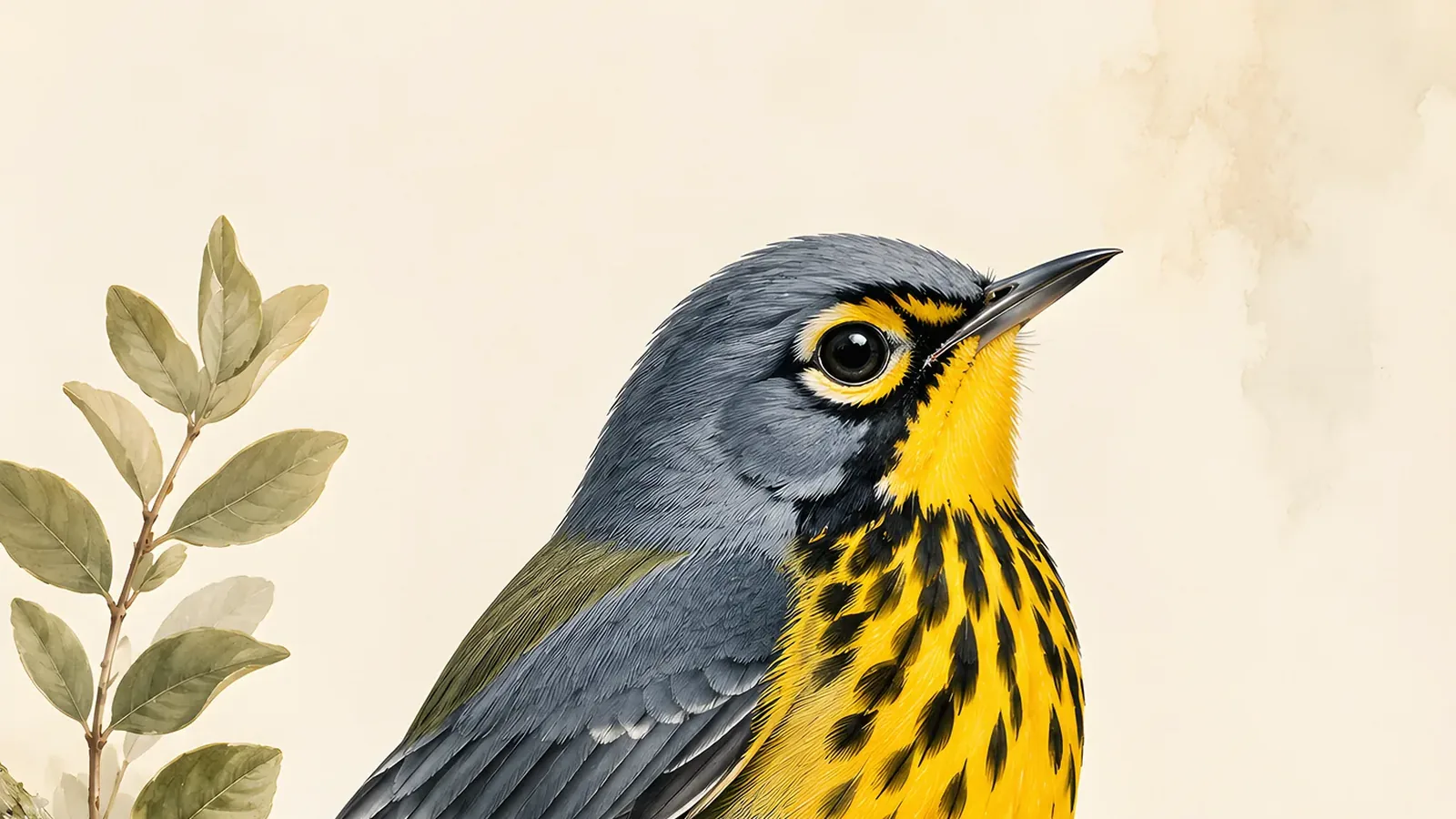
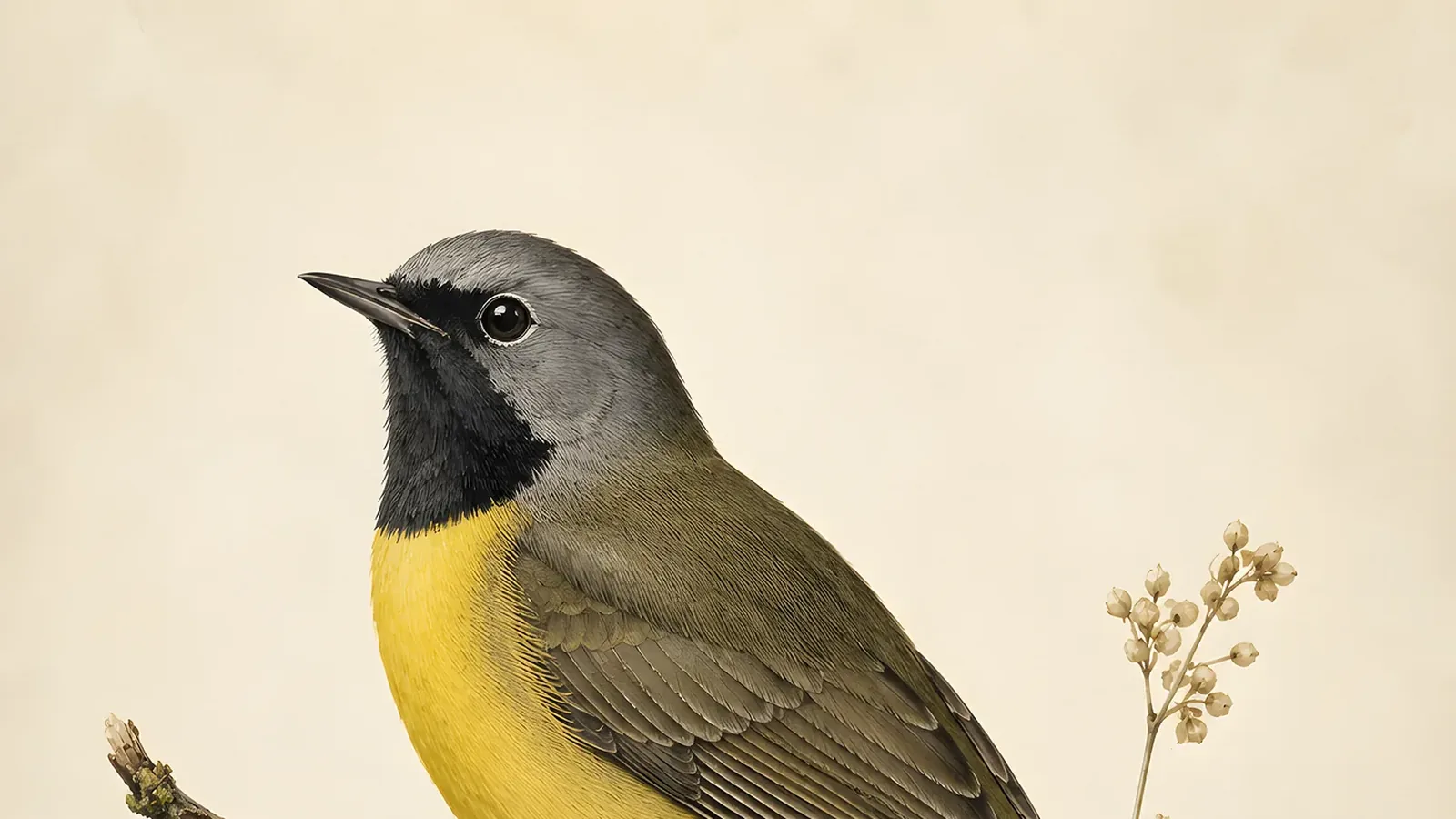
The common yellowthroat shares wet, dense habitat across much of the same range but forages higher and in more open shrubby margins. The Canada Warbler is another understory specialist of moist forest, but breeds further north and carries bold necklace streaking that the Kentucky lacks entirely.
Diet
The diet is almost entirely animal matter during the breeding season: insects and their larvae, spiders, and other invertebrates extracted from leaf litter and low vegetation. Specific prey documented includes moths, beetles, ants, grasshoppers, caterpillars, aphids, and grubs. Small berries are taken occasionally, particularly during migration.
The foraging style - patient, ground-level, leaf-flipping - favors prey that hides in debris rather than prey that moves in the open. It is an effective strategy in old-growth understory where the accumulation of leaves and downed wood creates a rich invertebrate layer. It is a poor strategy in a forest where that layer has been disturbed.
Breeding
Males arrive on the breeding grounds ahead of females and begin singing immediately to establish territory. Nesting begins in May. The female builds a bulky open cup on or very near the ground, placed at the base of a shrub or small tree or tucked into dense grass, constructed from leaves and plant fibers and lined with rootlets, hair, and fine grasses. The clutch is typically four to five eggs, creamy white with brown and gray spotting. Incubation lasts 12 to 13 days and is performed by the female alone. Nestlings fledge quickly - within eight to ten days of hatching - but remain dependent on the adults for several weeks.
Brown-headed Cowbird brood parasitism is a significant problem. In fragmented forest, where cowbirds range easily from agricultural edges into woodlands, parasitism rates can reach 60 percent near those edges, dropping sharply toward forest interiors. Robinson and colleagues (1995, Science 267:1987-1990) documented that highly fragmented Midwestern forests had become population sinks for interior-forest breeding birds precisely because cowbird access was so pervasive across small forest patches.
The Kentucky Warbler has declined across much of its range. The North American Breeding Bird Survey estimated a decline of approximately 0.69 percent per year between 1966 and 2019 (Sauer et al., 2019). Partners in Flight placed the species on its Watch List with a Conservation Concern Score of 14 out of 20 (Rosenberg et al., 2016). The IUCN lists it as Least Concern given a global breeding population estimated at 2.6 million, but the trend is downward, and the causes are understood well enough to be troubling.
Forest fragmentation opens the canopy and removes the shrub layer. Deer overbrowsing removes it from below. The New York Natural Heritage Program’s species account notes that “high White-tailed Deer populations reduce dense understory vegetation,” and the species is absent from forests where the understory has been browsed out - exactly the kind of forest that makes up an increasing share of the eastern landscape. A bird that has spent several million years perfecting a life at knee height in dense, layered, moist forest has no fallback when that layer disappears.
That is the measure of this bird’s problem. It is not rare. It is not on the edge of anything. But it asks for something increasingly hard to find: old, wet, dark forest left alone long enough to grow a proper understory. Shaded ravines with leaf litter deep enough to turn over. The kind of place where a rolling song can stop you on a May morning and hold you there, listening, for longer than you intended to stay.
That is what the Kentucky Warbler is defending, down there in the green. Whether the forest holds is a different question entirely.