Field Guide
Puerto Rican Parrot
In 1975, wildlife biologists counted thirteen Amazona vittata in the wild. Thirteen individuals of a species that, before European colonisation, had occupied every forested acre of Puerto Rico from the coast to the mountain peaks. The population had been falling for three centuries - cleared forest, trapped birds, introduced rats, yellow-shouldered blackbirds stealing nest cavities - and in 1975 it reached the number at which extinction and survival become functionally indistinguishable. That the Puerto Rican Parrot still exists at all is not a story about nature’s resilience. It is a story about what happens when people intervene, persistently and at great cost, and the bird barely cooperates.
The Puerto Rican Parrot occupies only 16 square kilometres of its historical range - about 0.2 per cent - and every living individual carries the genetic legacy of those thirteen survivors.
What it looks like
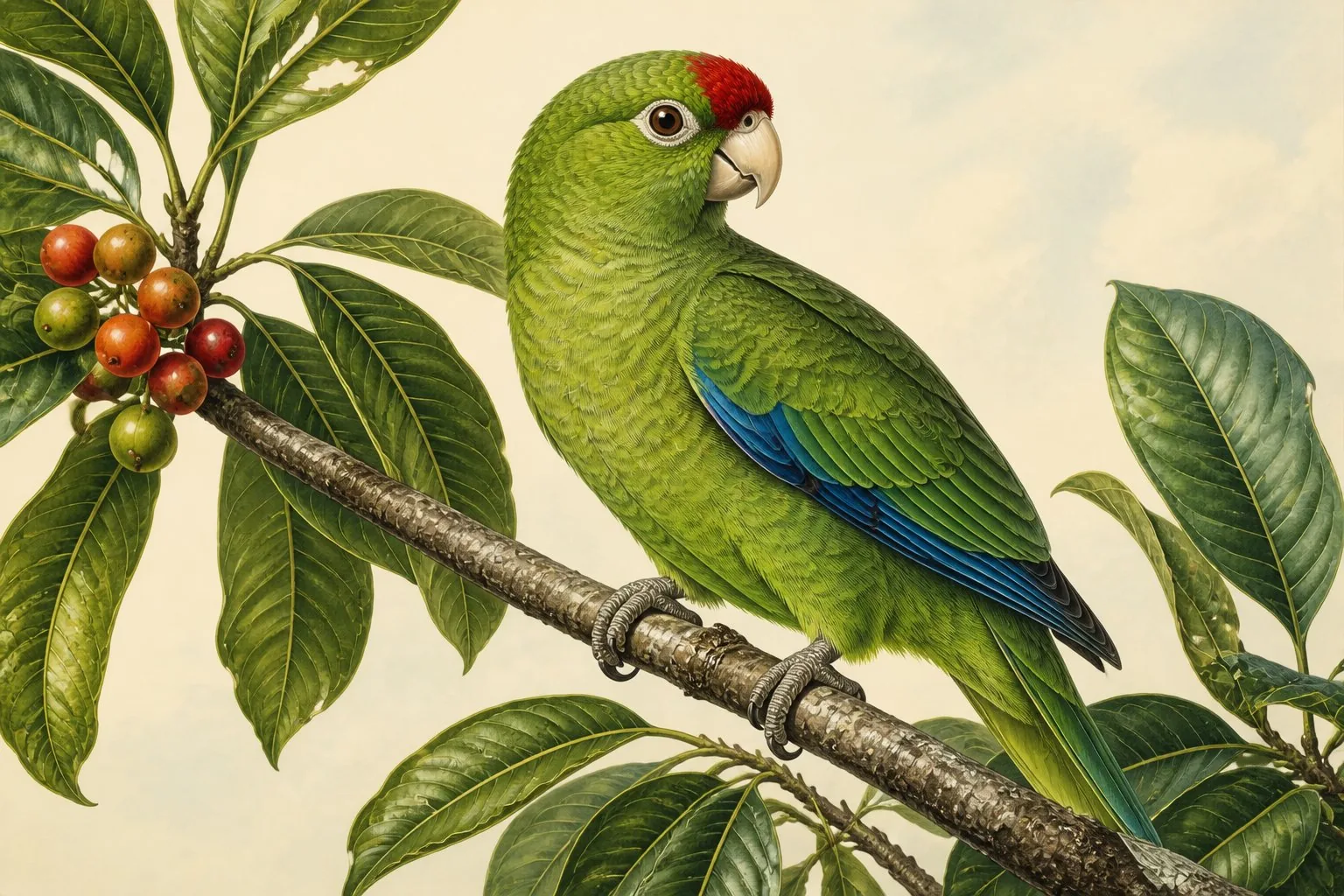
The Puerto Rican Parrot is a compact amazon, 28 to 30 centimetres long and weighing between 250 and 300 grams. The body is predominantly green, but the green is not simple. Almost every feather carries a dark subterminal band that gives the plumage a scaled appearance in good light - overlapping layers of colour that shift as the bird moves. The forecrown is red, a patch running from the base of the bill back between the eyes. A bare white orbital ring encircles each eye. The primary flight feathers are a distinct bright blue, visible clearly in flight. The bill is pale horn, the legs and feet a pinkish flesh tone.
Males and females are visually identical. Juveniles resemble adults but with softer, less defined markings on the forecrown. At rest in the canopy the green plumage renders the bird nearly invisible against leaf cover. The red forecrown appears abruptly when the bird turns toward you.
At 28 to 30 centimetres it is smaller than popular imagination suggests for an amazon parrot. In the hand it has the weight and solidity of a large thrush. In flight the silhouette is blunt-winged and direct, with a bugling contact call - loud, carrying, unmistakably parrot - that announces the bird well before it is visible.
Voice
The flight call is the field identification mark. It is a loud, resonant bugling note, sometimes rendered as a high quaa or quaak, carrying well through dense rainforest. The species produces a range of additional calls including softer conversational notes between paired birds, alarm calls, and contact notes within foraging flocks. Cornell’s Birds of the World describes the plumage as largely green relieved by the red forecrown and blue primaries, with the bugling flight call distinguishing the species from other forest birds in its range. Nothing else in Puerto Rican forest produces that sound.
Range and habitat
Amazona vittata is endemic to Puerto Rico. Its current range has contracted to two primary sites: the Luquillo Mountains in the northeast, centred on the Caribbean National Forest (El Yunque), and a second population established through release efforts in the Rio Abajo State Forest in the west-central part of the island. The first wild nesting at Rio Abajo was documented in 2013, a milestone reached after decades of captive breeding and release work.
Historically the species occupied lowland and montane forest across the entire island and on several offshore islands including Culebra and Vieques. The Culebra subspecies - Amazona vittata gracilipes - is now extinct, extirpated by the early twentieth century. The main population persists in montane rainforest between roughly 200 and 600 metres elevation. It requires old-growth trees with large, deep cavities for nesting and broad forested areas for foraging.
Diet
The Puerto Rican Parrot is a canopy forager with a broad palate. Animal Diversity Web documents it feeding on more than 60 different plant materials: fruits, seeds, leaves, flowers, bark, and nectar taken from the rainforest canopy. It has also been recorded feeding on agricultural crops, particularly maize, which brought the species into conflict with farmers during the period when it still ranged across lowland agricultural areas. Today its diet is almost entirely forest-sourced, constrained by the boundaries of the protected areas it occupies.
Foraging typically occurs in pairs or small groups, moving through the canopy in the early morning and late afternoon, resting through the midday heat in dense foliage.
Breeding and nesting
Breeding runs from late February through July. The Puerto Rican Parrot nests in natural tree cavities or cliff-side hollows, typically positioned seven to 15 metres above the ground. Nest sites are scarce in second-growth forest, and competition from the pearly-eyed thrasher for the same cavities proved one of the most intractable problems for early recovery efforts. Conservation managers now supplement natural cavities with artificial wooden nest boxes, which the parrots have accepted.
Pairs are monogamous and appear to mate for life. Courtship involves a coordinated display: both birds bow repeatedly, extend their wings partially, and fan their tails fully - a visual synchrony that seems to confirm or reinforce the pair bond. Clutch size is two to four white eggs, incubated for 24 to 28 days. Chicks fledge 60 to 65 days after hatching. Sexual maturity is reached at three to four years. Given this slow reproductive rate, the loss of even a few breeding adults to predation or hurricane damage has outsized consequences for the population.
A territory that expands with experience
One detail about this species stands out when you look at the movement data. Juvenile Puerto Rican Parrots have a home range of roughly 22 hectares. Adult birds, the same species and in the same forest, range across an average of 1,243 hectares - more than 50 times larger. That gap is not merely the difference between a small inexperienced bird and a larger experienced one. It reflects something learned: where the food is by season, which cavities are defensible, which routes through the canopy are safe. The knowledge is built slowly and retained. It is why losing experienced adult birds - the individuals who carry that map of the forest - matters so much more than losing juveniles. Recovering a number is easier than recovering a knowledge base.
What the hurricanes took
Hurricane Hugo struck Puerto Rico in 1989. The wild population had climbed to 47 birds. After the storm: 23. Fourteen years of recovery work erased in a night. The population rebuilt slowly, reached 58 to 80 wild birds by 2012.
Then in September 2017, Hurricane Maria made landfall with sustained winds of 155 miles per hour, crossing Puerto Rico directly. Subsequent surveys found approximately three birds alive in the wild. The IUCN lists the Puerto Rican Parrot as Critically Endangered, and the Maria episode demonstrated why that designation is not cautionary but literal: a single extreme event can reduce a recovering population to statistical zero.
The recovery since 2017 has been driven by releases from two captive facilities - one managed by the US Fish and Wildlife Service, one by the Puerto Rico Department of Natural and Environmental Resources. By 2021 roughly 500 birds combined (wild and captive) existed. The wild count remains far below what the habitat could theoretically support.
The argument for persistence
Thirteen birds in 1975. A storm that left three. An animal that nests only in large old-growth cavities, matures slowly, and requires intact montane rainforest in a place where rainforests are battered periodically by category-four storms. There is a reasonable argument that the Puerto Rican Parrot’s survival has depended more on the stubbornness of a small group of conservation biologists than on anything the bird itself has done.
That argument is probably correct, and it matters. Most species at thirteen individuals do not come back. This one did because people chose to spend decades in the forest at Luquillo, learning the nest sites, the predators, the pair bonds, the seasonal food sources. The parrot’s green body against green leaves, invisible at rest and announced only by that bugling call overhead, carries that history in it now.