Field Guide
Common Yellowthroat
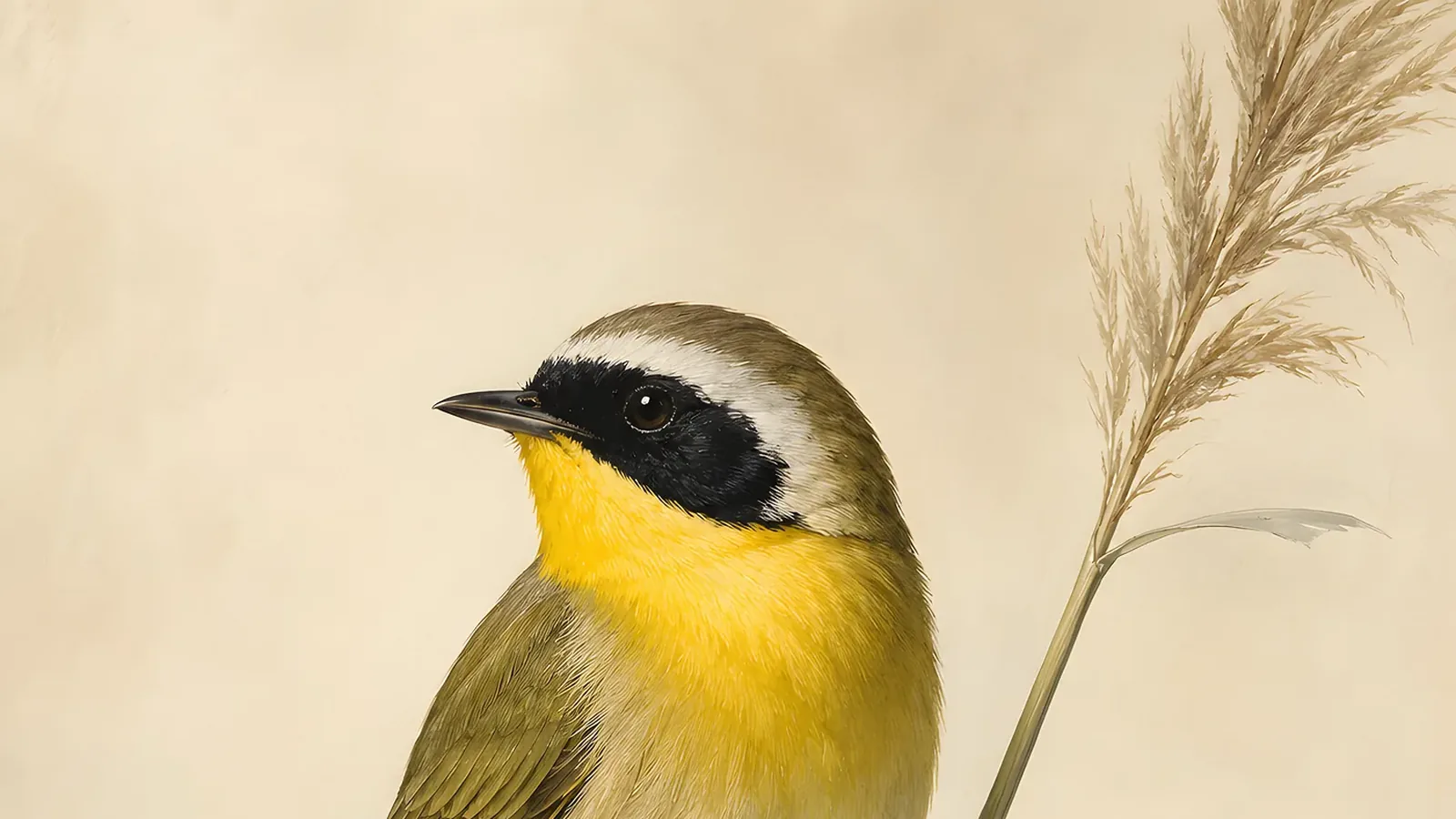
You hear it before anything else. The cattails are thick, the reeds pressing together so that no clear line of sight opens through them, and from somewhere in that green curtain comes the rolling, insistent phrase - witchety-witchety-witchety - repeated with a persistence that borders on declaration. Then, for a single second, a mask appears at the parting of two stems: coal black, bordered above with white, the throat below it burning yellow. Then it is gone, slipped back into the reeds as cleanly as a hand into a glove. That is the encounter most people get with Geothlypis trichas, the Common Yellowthroat. A voice, a glimpse, and the certainty that something worth seeing lives inside the tangle.
What it looks like
The male is built to be identified at once and seen poorly. Length runs 11 to 13 cm, weight eight to 12 grams, wingspan 15 to 19 cm - smaller, in other words, than a house sparrow, lighter than a letter. He perches on a cattail spike and the stem barely bends.
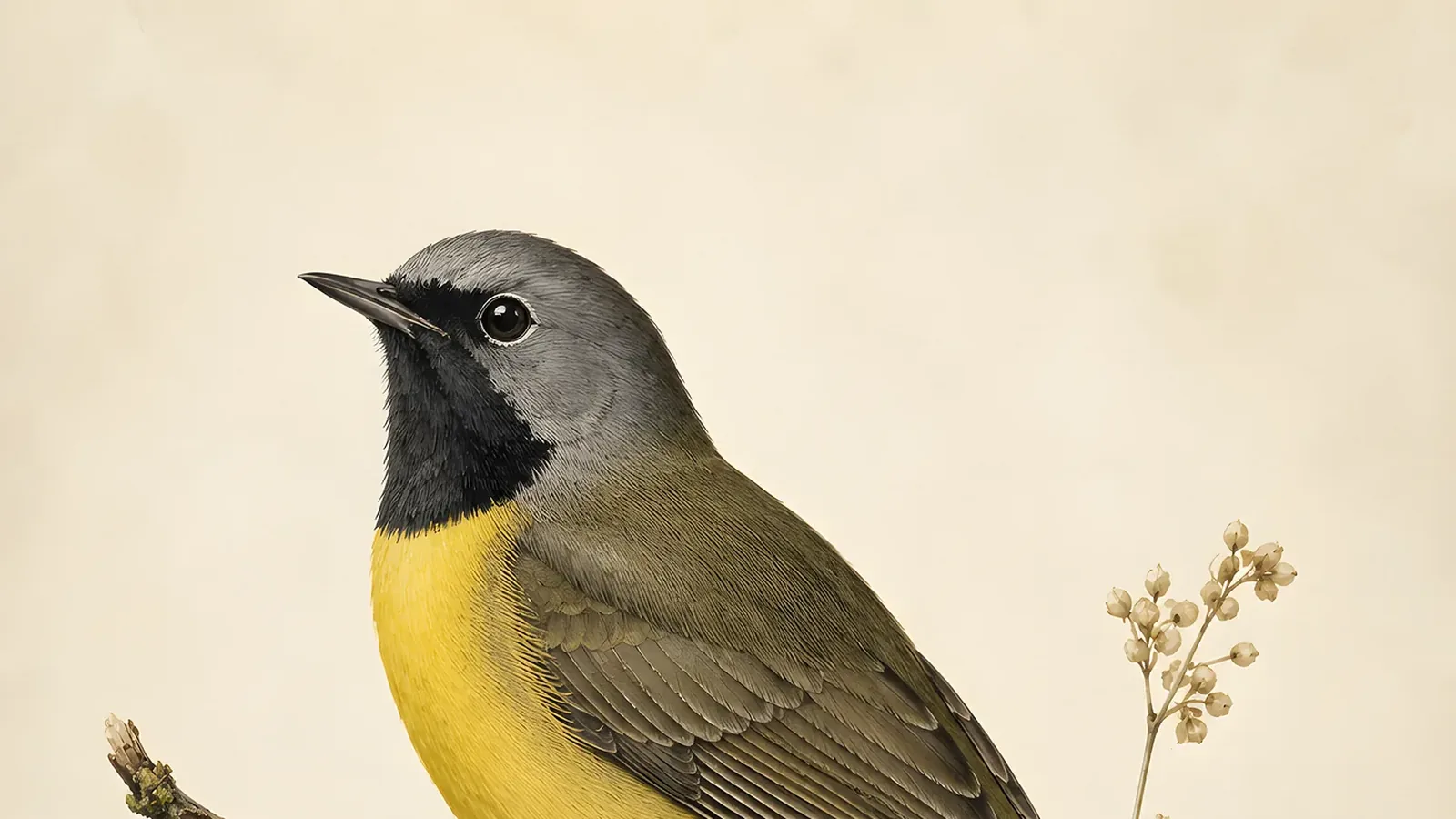
The upperparts are olive-brown, unremarkable on their own. But the face stops you. A broad black mask covers the forehead, the lores, the eyes, and sweeps down the sides of the neck, bordered along its upper edge by a clean band of pale grey or white that grades toward the crown. Below it, the throat and breast glow yellow, the exact shade of a ripe lemon in low autumn light. The belly shades to pale yellowish-white toward the flanks. The bill is thin and dark, the legs pale pinkish. In flight the bird is compact and low, crossing an open gap in the reeds with a few quick wingbeats before diving back under cover.
The female wears no mask. She is olive above, with a yellow throat and undertail coverts, plain buff flanks, and a faint suggestion of a pale eyering. She is easy to overlook, which is precisely the point. Young males in their first autumn carry a partial, smudged version of the adult mask - recognisable but incomplete, as though the ink has not fully dried.
Thirteen subspecies are recognized across North America (Cornell Lab of Ornithology, Birds of the World account for Geothlypis trichas), differing in the intensity of yellow, the width of the white mask border, and body size. The races of the Pacific coast tend to be richer yellow than eastern birds. The variation is real but subtle, and in the field most birds present simply as The Masked Warbler.
| Measurement | Range |
|---|---|
| Length | 11 - 13 cm |
| Weight | 8 - 12 g |
| Wingspan | 15 - 19 cm |
| Max recorded lifespan | 11 years, 6 months |
The mask and the song
The song is one of the most recognisable in North America. Males deliver a loud, rolling phrase of three to five units - rendered variously as witchety-witchety-witchety or wichita-wichita-wichita, each unit falling slightly in pitch at the end. It carries well across open marsh and can be heard from a surprising distance. A territorial male sings with astonishing frequency: Cornell Lab of Ornithology records males singing as high as 125 times per hour during the breeding season, with peaks approaching 300 songs per hour at the height of territorial defence. Few warblers invest as heavily in the voice.
The mask on a male Common Yellowthroat is the bird’s entire argument: it declares territory, intimidates rivals, and apparently draws females. Studies have found that females prefer males with wider, more symmetrical masks. The white border matters too - it frames the black and makes the signal legible even in poor light inside the reeds.
The call note is a sharp, husky jip or chip, used year-round. On migration this call, heard at night from a moving bird overhead, is how experienced birders confirm the species in darkness.
The bird is a skulker by default. It moves through the lower stems of cattails and rank marsh vegetation, rarely rising above head height, often at knee level or below. When alarmed it drops straight down and vanishes. Patience will sometimes produce a male climbing to the top of a reed stem to sing from an exposed perch, where you can see the full animal - but that view is earned. Most warbler field guides note that the Common Yellowthroat is among the most heard and least well seen of its family.
Range and habitat
Partners in Flight (2019) estimates the global breeding population at 77 million individuals. That number makes the Common Yellowthroat one of the most abundant warblers on the continent. It breeds in every US state, including Wisconsin, Ohio, Michigan, and New York, and across Canada from southern British Columbia to Newfoundland, north toward the boreal edge of the marshlands. A small year-round population holds on in the Rio Grande delta of south Texas. Wintering birds scatter through Mexico, Central America, and the Caribbean.
The habitat requirement is simple in principle and exacting in practice: dense, low, wet vegetation. Freshwater marsh with cattails and bulrushes is the core. But the species is flexible - it occupies wet thickets along streams, brushy field edges where drainage keeps the ground soft, overgrown irrigation ditches, and brackish coastal marsh. On migration it turns up in drier scrub and forest edge, taking the best available cover.
The key variable is not the water itself but what grows in it. The Common Yellowthroat needs that wall of vegetation - rank, tangled, impenetrable. Where wetlands drain, fill, or are tidied into manicured channels, it disappears. North American Breeding Bird Survey data compiled through 2019 shows a cumulative decline of roughly 26 percent since 1966, a rate of about 0.6 percent per year, tracking closely with the long-term loss of freshwater wetland acreage.
During winter in Mexico and Central America the birds occupy similar dense low cover, often joining mixed-species flocks briefly but largely keeping to themselves in the thickets.
Diet
The Common Yellowthroat is almost entirely insectivorous through the breeding season. It gleans low, working stems and the undersides of broad leaves for beetles, ants, grasshoppers, dragonflies, damselflies, mayflies, moth and butterfly caterpillars, aphids, and leafhoppers. It also takes spiders. The yellow warbler shares some of this wetland-edge foraging space but tends to work higher, in the willows and shrub canopy above the water line - the yellowthroat stays lower, in the stems themselves.
Winter diet shifts slightly. With insects less available, birds add some fruit and seeds to the mix, making the species somewhat more flexible than its summer profile suggests. But it remains largely insectivorous through the year, and the thin pointed bill is not designed for serious seed-cracking.
Breeding and the cowbird
Males arrive on the breeding grounds one to two weeks before females. They establish territories through song and through direct chases, sometimes flying in looping display flights above the marsh before dropping back into cover. Territory size varies with habitat density, but males will defend patches aggressively and persistently.
The female builds the nest alone - a bulky open cup of dried grass, leaves, and plant fibers, placed low in marsh vegetation, usually below 30 cm from the ground or the water surface. She lines it with fine grasses and plant down. Eggs number three to five, creamy white with brown and black speckling concentrated at the larger end. Incubation lasts 12 days. Nestlings fledge at eight to ten days - quickly, given the ground-level exposure - and the male takes over feeding fledglings while the female begins a second clutch.
Two broods per year is the norm across most of the range.
The Common Yellowthroat is among the warbler species most heavily parasitized by the Brown-headed Cowbird (Molothrus ater). A monitoring study in east-central Illinois (Jones 2023, Ecology) found that yellowthroat nests showed substantial parasitism rates across the study period, with cowbird chicks successfully fledged alongside host young. Unlike the yellow warbler, which sometimes responds to a cowbird egg by building a new nest floor directly over it, the Common Yellowthroat typically does not bury foreign eggs - it accepts them and raises the larger cowbird chick, usually at significant cost to its own offspring. A cowbird nestling can weigh two to three times as much as a yellowthroat chick within a week of hatching, and the host parents work at capacity to provision it.
The yellowthroat’s low, open-cup nest in marsh vegetation may make rejection behaviours harder to evolve than in species that nest in denser or drier cover with clearer sight lines. Whether the birds actively choose to accept parasitism or simply lack the cognitive trigger for ejection remains an open question in ornithology.
Here is what stays with you, though: the masked male singing 200 times an hour from the top of a cattail, announcing himself to every rival and every female within earshot, is also signalling his exact location to every cowbird in the marsh. The song that makes him one of the most recognisable birds on the continent may be part of what makes him one of the most reliably found. Abundance and vulnerability are the same trait, seen from two directions.