Field Guide
Mourning Warbler
The male is singing from inside the blackberry tangle before you ever see him. A ringing two-part phrase - chirry chirry chirry, chorry chorry - dropping on the second syllable like a question answered. The cane patch looks impenetrable. Good. That is exactly where Geothlypis philadelphia, the Mourning Warbler, intends to be.
What he looks like
The adult male in spring is built on a simple plan, and the simplicity is the point.
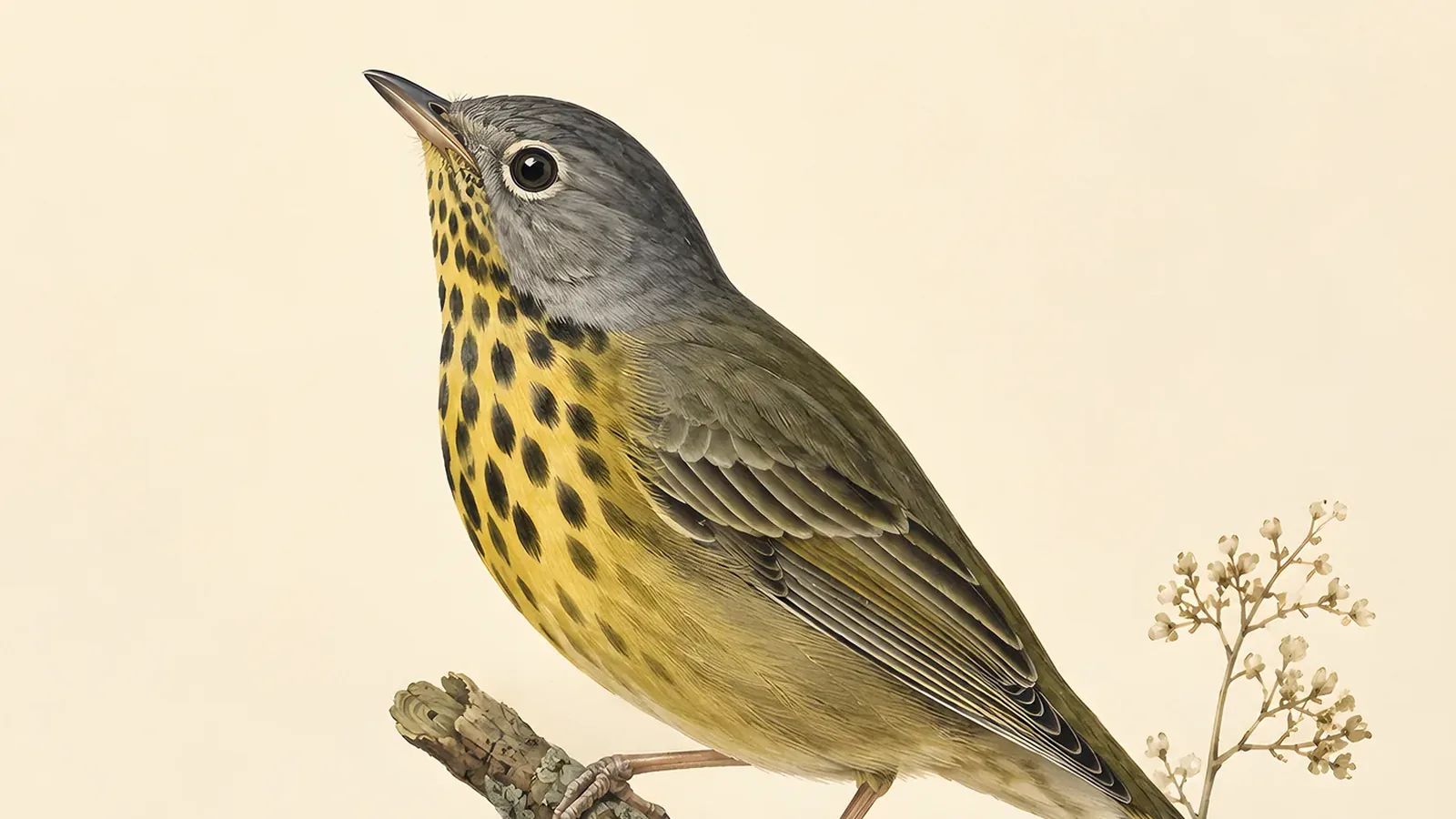
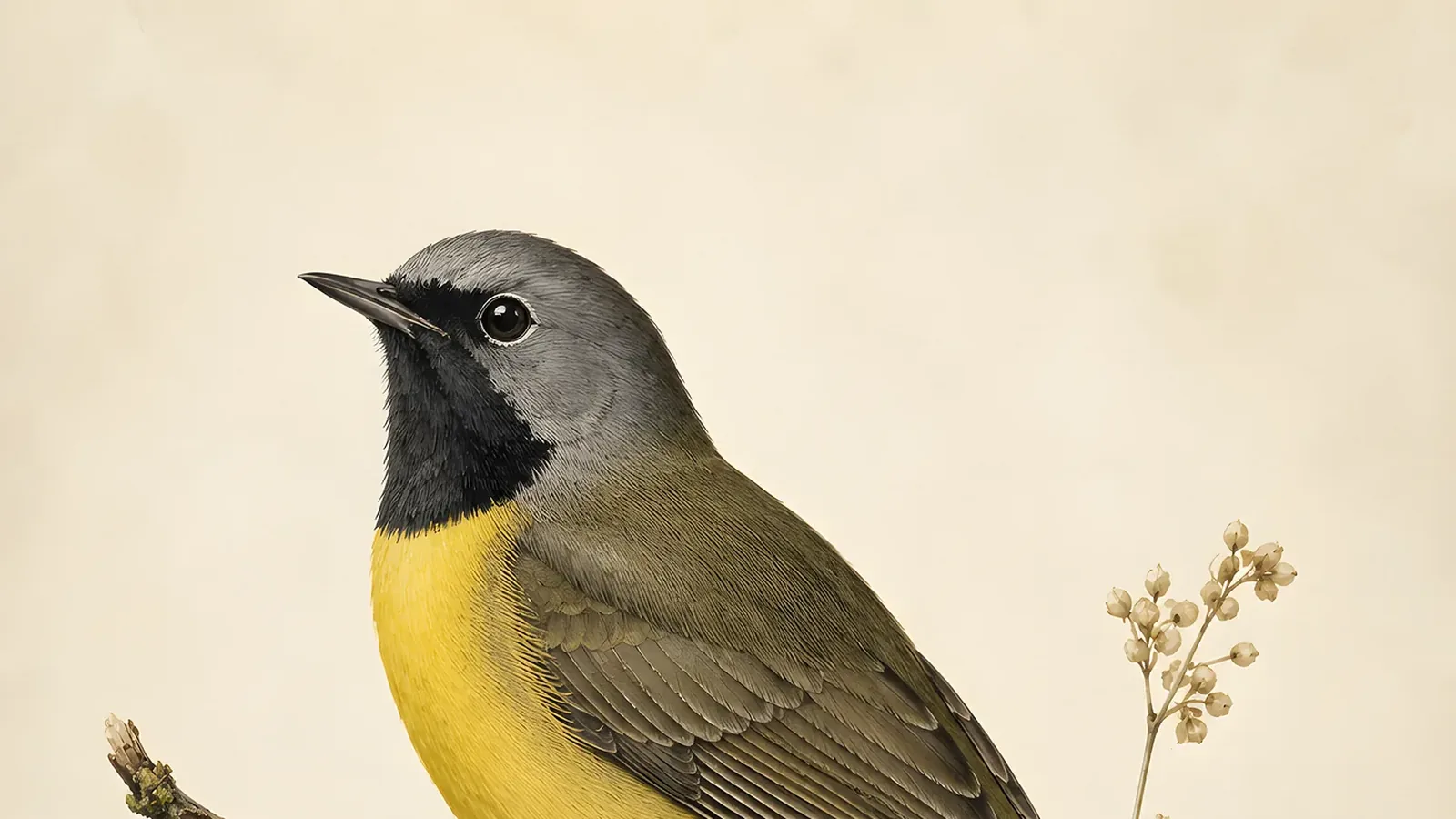
His upperparts are clean olive-green. His belly and flanks are bright, warm yellow. His head and throat are cloaked in blue-grey, darkening on the face to a near-black mask at the lores and chin. The effect is hooded, shrouded, closed off from the world. And across his upper breast, just below where the grey throat ends, sits a ragged black smudge - not a clean breast-band, but a blotched, mottled crescent that looks as though it were painted in a hurry.
He is small. Cornell Lab of Ornithology measurements put length at 11 to 14 cm, wingspan at 18 to 20 cm, and weight between 11 and 17 grams - no heavier than a handful of paperclips. His bill is thin and slightly curved, adapted for gleaning, not probing.
The female is the same bird turned down. Her hood is pale grey-brown rather than blue-grey, her throat is washed yellowish rather than blocked grey, and the breast smudge is absent or only faintly suggested as a broken grey necklace. Both sexes, and especially the immature in autumn, may show a thin broken eye ring - a detail that matters later, when the question of confusion arises.
The mourning veil
The name is Alexander Wilson’s. He collected the first described specimen near Philadelphia in 1810, and the smudged breast stopped him. As he noted, “the singular appearance of the head, neck and breast suggested the name.” That dark crescent on the upper breast recalled the black crepe bands that nineteenth-century mourners stitched to their coats - a veil worn in grief.
The scientific epithet repeats the geography: philadelphia, the city on whose marshes Wilson first shot him. So the bird carries both the occasion and the address of its discovery in its two names.
The dark hood and the black breast-patch reminded Alexander Wilson of a mourner’s veil. He named the bird in 1810, and the name has held. Some birds name themselves.
The mourning imagery holds up in the field. The blue-grey hood does look drawn low, like a cowl. The black smudge below the throat does look like something added in haste, a mark of solemnity not quite finished. But step into the thicket and the sound coming from this apparent mourner is exuberant - full-throated, loud, emphatic. The veil, it turns out, is decorative.
Telling it from Connecticut and MacGillivray’s
The Mourning Warbler belongs to a trio of hooded warblers that have confused birders since the field-guide era began. The three are the Mourning, the Connecticut warbler, and the MacGillivray’s Warbler of the West. All share the grey-or-olive hood, the yellow belly, and a taste for dense cover. The separating marks are exact and learnable.
The eye ring is the first thing to look for. The Connecticut Warbler has a bold, complete, white eye ring in every age and sex class - conspicuous, unbroken, a full circle of white around the dark eye. The MacGillivray’s Warbler has white arcs above and below, but they are broken, incomplete - eye arcs rather than a ring. The Mourning Warbler, in spring adults, typically has no white around the eye at all. Adult males are usually clean-faced. Adult females and immatures may show a faint, thin, partial ring, but it is never the fat complete circle of the Connecticut.
Wing length is another reliable tool in the hand. Pitocchelli (2011, Birds of North America) and the Birds of the World account document that the difference of flattened wing minus tail ranges 19 to 27 mm in Connecticut Warblers, with no overlap with Mourning (10 to 16 mm) or MacGillivray’s (2 to 11 mm).
The breast marking separates males cleanly. Male Mourning Warblers have the ragged black smudge on the upper breast. Male Connecticut Warblers have a grey breast that may show some darker mottling but lacks the distinctly black feathering. Female Connecticut Warblers are paler-hooded and rounder in the head.
Behavior is useful too. The Connecticut tends to walk - it bobs along the ground in a deliberate gait, more ground-thrush than warbler. The Mourning skulks and creeps in the dense mid-layer of the thicket, rarely touching the ground, rarely showing itself.
| Feature | Mourning Warbler | Connecticut Warbler | MacGillivray’s Warbler |
|---|---|---|---|
| Eye ring | Absent in adult males; thin/broken if present | Bold and complete, all ages | White arcs, always broken |
| Male breast mark | Ragged black smudge | Grey, no distinct black | Black or dark grey |
| Wing minus tail | 10 to 16 mm | 19 to 27 mm | 2 to 11 mm |
| Foraging posture | Skulks in mid-layer | Walks on ground | Skulks in mid-layer |
| Range in the East | Breeds east of Rockies | Breeds Great Lakes/Manitoba | West of Rockies only |
Range and the value of disturbance
The Mourning Warbler breeds from Alberta east to Atlantic Canada and south through the Great Lakes states and the Appalachians into West Virginia. The Boreal Forest holds approximately 75 percent of the North American breeding population, according to the Boreal Songbird Initiative. It winters in Central America and the Andes piedmont from Nicaragua to Ecuador.
It is a late migrant. Very few reach the upper Midwest and Great Lakes before the latter half of May - arriving when the warblers most birders associate with spring have already sorted themselves out and moved on. Its departure is early. Most birds leave breeding territory by very late August, with only stragglers remaining into September.
The species’ dependence on early-successional disturbed habitat makes its conservation story genuinely unusual. Most boreal songbirds are negatively affected by clearcutting and forest management. The Mourning Warbler rapidly colonizes new clearings, typically one to two years post-harvest, with numbers peaking and then declining as the canopy closes over the next decade. Niemi and Hanowski (1984) found the species abundant two to ten years after logging in northeastern Minnesota but absent from mature closed-canopy stands. Schulte and Niemi (1998) confirmed it more abundant in logged areas than in burned ones - the structural complexity of a post-harvest tangle, with its crisscrossed slash, blackberry, and young saplings, beats the sparser ground cover left after fire.
Partners in Flight estimates a North American population of around 17 million birds, with 75 percent of those in Canada. Despite this, the species has declined approximately 45 percent since 1970, as measured by the North American Breeding Bird Survey. The mechanism is uncertain. Building collisions are a documented pressure - one analysis found Mourning Warblers 19 times more likely to strike low-rise buildings than other species in comparable migration corridors. Conservation practitioners working under Partners in Flight have explored prescribed burning and active disturbance creation as tools to maintain and expand suitable thicket habitat.
Diet
The Mourning Warbler is an insectivore on the breeding grounds, foraging low in the tangle for caterpillars, beetles, spiders, and other arthropods, often removing wings and legs from prey before eating. George Cox, whose 1960 paper in the Wilson Bulletin (72: 5-28) remains the foundational life-history study of this species, documented the primary importance of Lepidoptera larvae for nestlings - a diet that mirrors the caterpillar-rich environment of regenerating cut-over forest. Beer (1958) noted population spikes correlated with tent caterpillar outbreaks, a reminder that this bird is tracking insect productivity as much as plant structure.
On wintering grounds and during migration the diet expands. Audubon records Mourning Warblers eating protein bodies from the leaf-bases of young cecropia trees in the tropics - a dietary flexibility not associated with the dense-thicket skulker of the breeding season.
Breeding
The nest goes on or near the ground. The female constructs a deep cup from dead leaves, weed stems, and coarse grasses, lined with fine grass and hair, placed inside a dense bramble clump or tucked against a thicket base. Cox (1960) documented clutch sizes of three to five eggs, creamy white with brown spots concentrated at the larger end. The female incubates alone for approximately 12 days. Both parents feed nestlings, which fledge at seven to nine days - a short nestling period that limits time in the vulnerable ground-level nest. Post-fledgling care by parents extends another four weeks.
Males sing persistently from late May through mid-July, primarily from elevated perches within or at the edge of the tangle. The song is louder and carries further than you expect from a bird of this size, loud enough to locate him well before you ever see him. Only the males sing. Females produce two call notes: a harsh tshrip during disturbance, and a softer tsip near fledglings.
The male feeds the incubating female at the nest, and both birds use distraction displays near the nest when approached - drooping wings, moving erratically along the ground. The nest’s concealment and low profile make it genuinely difficult to locate without following a disturbed adult.
Here is a species named for grief that thrives on destruction. Every clearcut, every windthrow, every burned-over hillside that strips the canopy and lets the blackberries rush in is, for the Mourning Warbler, an opportunity. The bird in its mourning dress turns out to be among the more pragmatic warblers in the forest - arriving late, singing loudly, nesting fast, and gone again before summer ends. What looks like solemnity from outside the thicket is, from within, nothing but urgency.