Field Guide
Canada Warbler
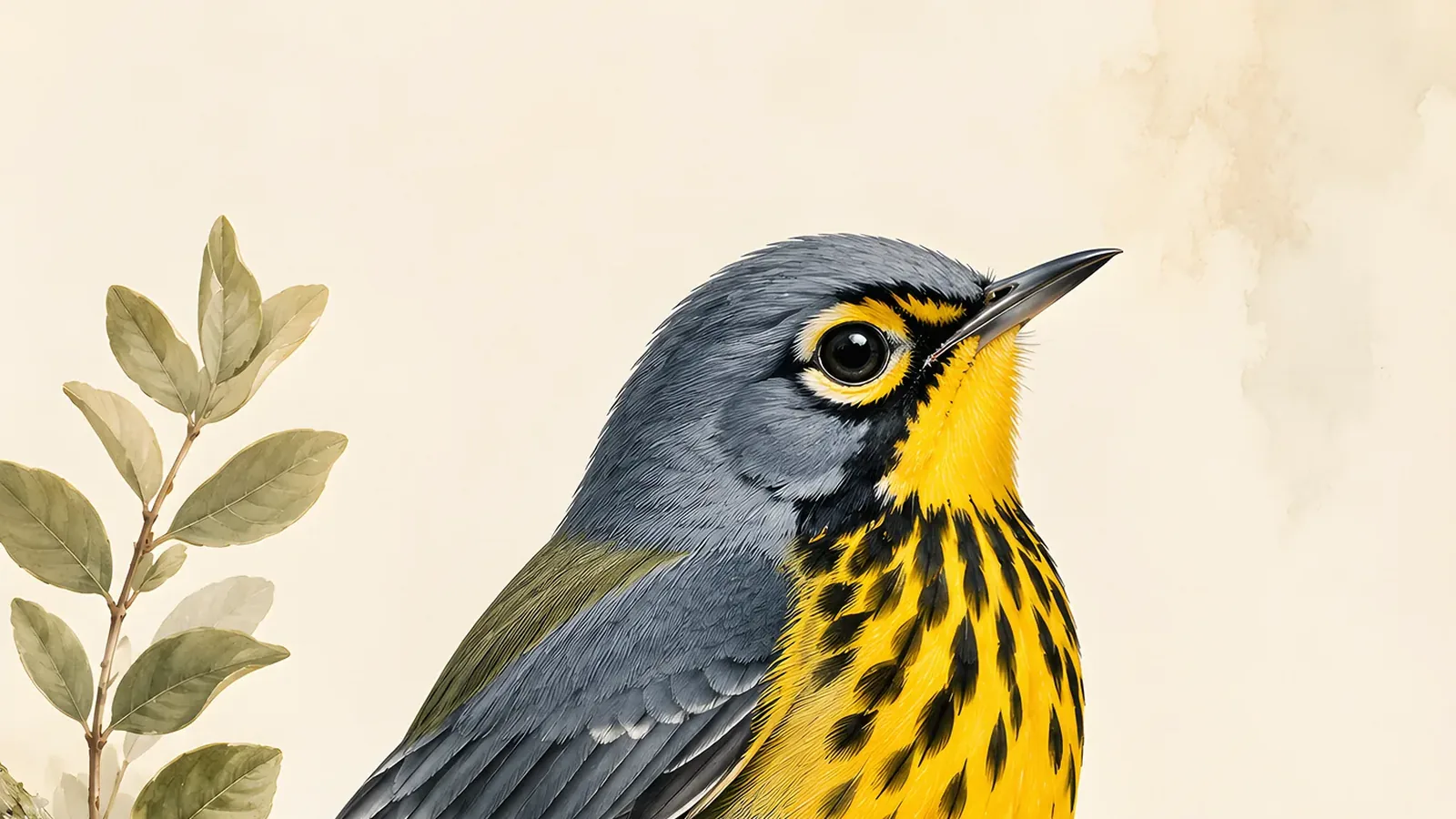
The shrub layer along the hemlock-lined brook is still dripping from last night’s rain. Low in the dense tangle of speckled alder, something moves with intent - not the nervous hop of a sparrow but the abrupt, assured pivot of a warbler hunting on the wing. A flash of yellow belly. Then, as the bird angles toward you and sits for a moment on an alder stem: a bold collar of black streaks across a lemon-yellow breast, and above that, white spectacles so sharply drawn they look deliberate. Cardellina canadensis, the Canada Warbler, has arrived from the northern Andes. It will not stay long.
What it looks like
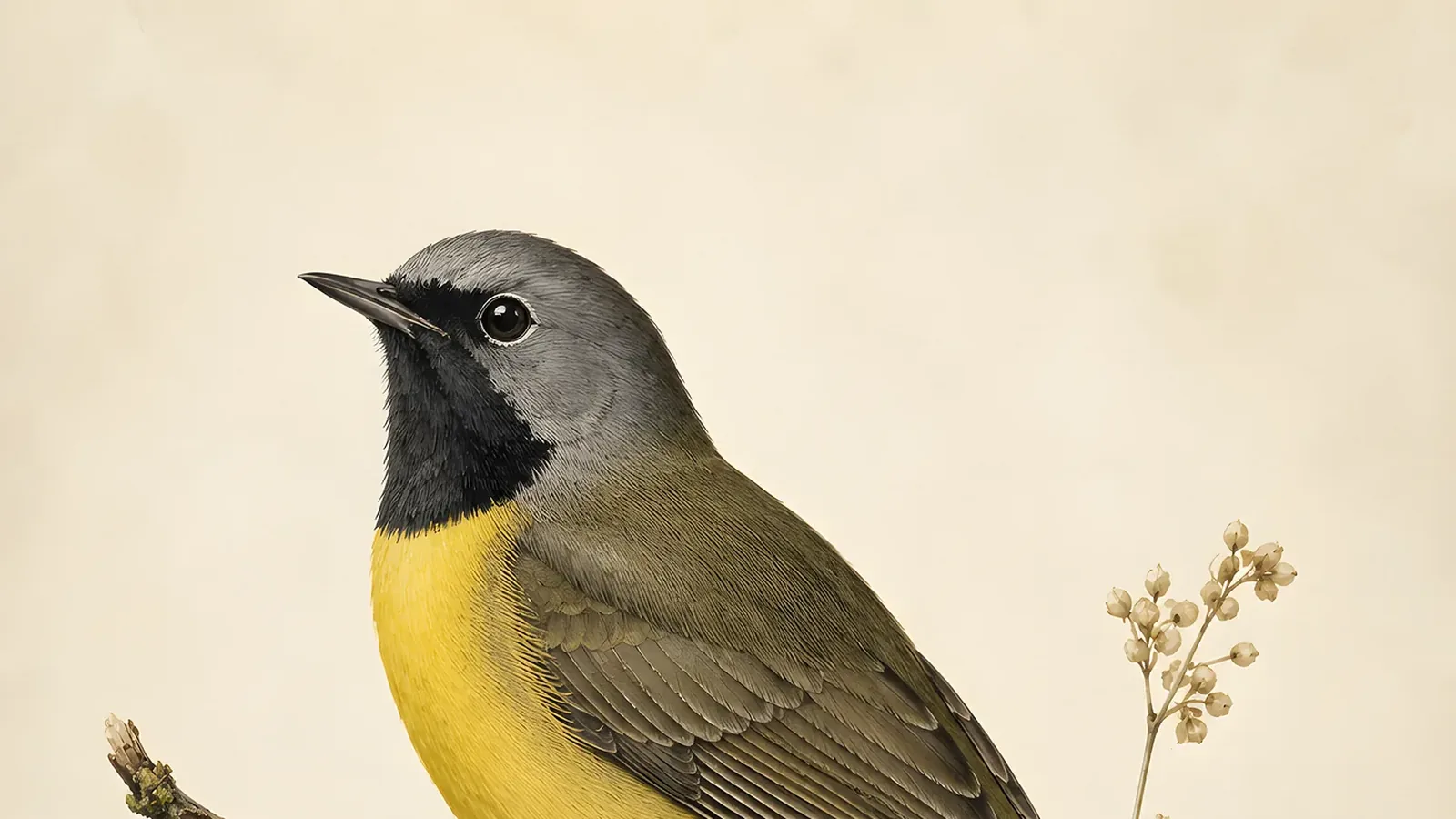
The adult male is built around three colors, deployed with unusual economy. His back, crown, and wings are a uniform blue-grey. His underparts from chin to undertail are a bright, clean yellow, unbroken by streaking on the flanks. His face shows a yellow stripe that rises from the bill and frames each eye, forming the conspicuous spectacle effect. In breeding plumage his crown wears fine black spots and his face grades toward black at the lores, completing the masked appearance.
The female carries the same pattern but reduced. Her grey is slightly browner, her spectacles thinner, and her necklace far less vivid. Young birds in their first fall can be a puzzle, showing only a faint yellowish wash across the breast and the merest shadow of a collar. Look for the combination of grey-above, yellow-below, no wing-bars, and that persistent spectacle mark on the face - something always remains of each element.
The species runs 12 to 15 cm in length, weighs nine to 12 grams, and spans 17 to 22 cm across the wings. The longest-lived bird on record was a male at least eight years old, recaptured in Quebec in 1982 (Cornell Laboratory of Ornithology banding data).
The necklace and the spectacles
No other North American warbler wears this combination. The “necklace” - a row of sharp black streaks running from shoulder to shoulder across the upper breast, sometimes coalescent in the center - is unique among the wood-warblers. It lies against the yellow breast like a sentence underlined twice. Paired with it are the spectacles: a yellow eye-ring connected forward to the bill base by a fine yellow loral stripe, giving the impression that the bird is wearing eyeglasses.
| Feature | Male (breeding) | Female | First-fall |
|---|---|---|---|
| Upperparts | Blue-grey | Brownish-grey | Grey-brown |
| Breast | Vivid yellow | Pale yellow | Yellowish-white |
| Necklace | Bold black streaks | Faint streaks | Barely visible |
| Spectacles | Bright white-yellow | Pale yellow | Dull yellow |
| Crown | Black-spotted | Plain grey | Plain |
These marks function as instant identifiers in the field, even at the peripheral glimpse that is often all a moving warbler grants you. In dim understory light, the necklace reads before any color does.
The mourning warbler shares the same shrubby, low-country habitat on the breeding grounds and can cause brief confusion, but the mourning lacks both the spectacles and the yellow underparts, appearing instead with an olive back and a grey hood smudged with black.
Last in, first out
Among the wood-warblers that breed across the northern forest, Cardellina canadensis keeps a schedule that stands apart. Males reach their breeding grounds later than almost any other species in the family - typically not until the first two weeks of May across New Hampshire and Vermont, often not until late May in the boreal core. The season when most warblers are already sorting out territories, this one is still traveling.
Then, just as the breeding season seems barely underway, departure begins. Peak southward movement through many areas runs in August, sometimes as early as the first days of that month. The birds do not linger. A species that appears in late May and begins to slip away in August spends perhaps ten to twelve weeks on the breeding ground - a narrow window set against a migration that reaches all the way to the northern Andes.
The logic is legible in the math of distance. The route south runs through Central America, with spring migration apparently favoring the western Gulf approach through Mexico rather than a direct Caribbean crossing (Audubon Society Field Guide). The birds arrive in their Colombian and Ecuadorian wintering grounds in late September to early October. What that migration demands of a bird weighing ten grams is worth pausing over.
A Canada Warbler in August, pushing south from a damp Quebec ravine toward the Andes, is two months into a journey that will cover more than five thousand kilometers. It left before the goldenrod opened.
Range and the Andes
The breeding range extends from the boreal forest of Alberta, Saskatchewan, and the Atlantic provinces south through the Appalachians to northern Georgia at higher elevations. Roughly 80 percent of the global breeding population nests in Canada (Nature Canada). Across West Virginia and Pennsylvania, breeding birds occupy the cool, damp coves and ravine forests of the Ridge and Valley and Allegheny Plateau, often tied to rhododendron tangles and mountain streams.
Wintering birds concentrate in the Andes from Venezuela south through Colombia and Ecuador to northern Peru, at elevations between 750 and 2,305 meters, with the highest densities between 1,000 and 2,000 meters (Céspedes and Bayly, Bird Conservation International, 2018). In Colombia, the eastern Andes hold the bulk of the population. The warblers winter in mature montane forest and forest edges, foraging in the mid-story five to 15 meters above the ground and often joining mixed-species flocks. They are not habitat generalists in winter: Céspedes and Bayly found that densities were highest in mature forest, substantially lower in shade-grown coffee and secondary growth, and zero in sun coffee plantations.
This preference for intact montane forest is the source of the species’ primary conservation problem. The Colombian Andes had lost 69 percent of their original forest cover by 1998 (Céspedes and Bayly 2018), and the rate of clearing has continued since. The eastern Andean wintering region showed a 23 percent increase in human footprint between 1993 and 2009 alone - compared to just 0.11 percent on the Canadian breeding grounds over the same period (Wilson et al., Scientific Reports, 2018). The breeding grounds are not the bottleneck.
Diet
Cardellina canadensis is an insectivore that hunts by hawking - sallying from a perch to take prey in flight - as well as by gleaning from leaf surfaces and bark. Its diet spans a wide range of small arthropods: beetles, mosquitoes, flies, moths, smooth caterpillars including cankerworms, and spiders. In winter it forages in the mid-story of Andean forest, following mixed flocks and working the foliage with the same quick, pivoting energy that marks the bird on the breeding grounds.
The habit of aerial sallying makes it more conspicuous than a strict gleaner would be. Watch the understory where a stream runs through older forest and you may catch it repeatedly launching from a dead twig, making a short looping flight, and returning to the same perch.
Breeding
Females construct the nest on or very near the ground, tucked into dense cover - a mossy bank, an upturned root mass, the base of a clump of ferns. The cup is built from dead leaves, bark fibers, grasses, and plant down, with finer materials lining the interior. It is nearly invisible from above, and the sitting female adds to the concealment by departing the nest at a distance, running along the ground before flying.
Clutch size runs three to five eggs, with four most common. Eggs are creamy white with brown speckles, incubated for roughly 12 days. Males defend the breeding territory actively, singing their rapid, sputtering warble from exposed perches just above the shrub layer. The song almost always begins with one or two sharp chip notes, then tumbles into an irregular, emphatic warble with no fixed pattern - less musical than assertive.
The species requires extensive, moist, shaded understory with a shrubby layer for nesting cover and foraging height. It does not tolerate heavy human disturbance. Breeding densities are highest in intact forest near streams, swamps, and rocky ravines, particularly where rhododendron, speckled alder, or elderberry creates a dense mid-story. Edge habitat without interior forest depth rarely supports breeding birds.
The Canada Warbler International Conservation Initiative, established in 2013, coordinates full-life-cycle monitoring across breeding grounds in Canada, stopover sites in Central America, and wintering areas in the Andes. Wilson and colleagues (2018) found that adult survival in the east was below 50 percent and declining, and that the wintering range - not the breeding grounds - showed the strongest evidence of demographic stress. A species whose breeding productivity appears stable but whose adult survival is failing is a species losing ground quietly.
Cardellina canadensis carries a global IUCN designation of Least Concern, a category that reflects raw numbers rather than trajectory. The Committee on the Status of Endangered Wildlife in Canada rates it Special Concern. The Breeding Bird Survey recorded declines of 4.5 percent per year between 1968 and 2007. The necklace may be bold. The bird wearing it is not secure.
That is what the August urgency means. Every year, the Canada Warbler arrives late and leaves early - not from indifference but from necessity, reading something in the shortening days of a northern August that we only just began to understand. The necklace flickers through the alders. Then the bird is gone, southbound, trading one forest understory for another five thousand kilometers away, where the forest is being taken down.