Field Guide
Hermit Thrush
The light goes out of the northern woods slowly in June. Spruce and balsam fir turn from green to black. A pool of sky overhead holds blue longer than anything else, and then the first bat appears, and then, from somewhere in the understorey, a single note sounds - pure, sustained, clear as struck glass. A pause. Then the same note again, pitched a tone higher. Then the cascade begins: a shimmering, spiralling fall of overtones, the phrase completing itself like a sentence that knows where it is going. That is Catharus guttatus, the Hermit Thrush, doing what it does in the final minutes of boreal light. It is the finest bird song on the continent, and the case for that position is stronger now than it has ever been.
What it looks like
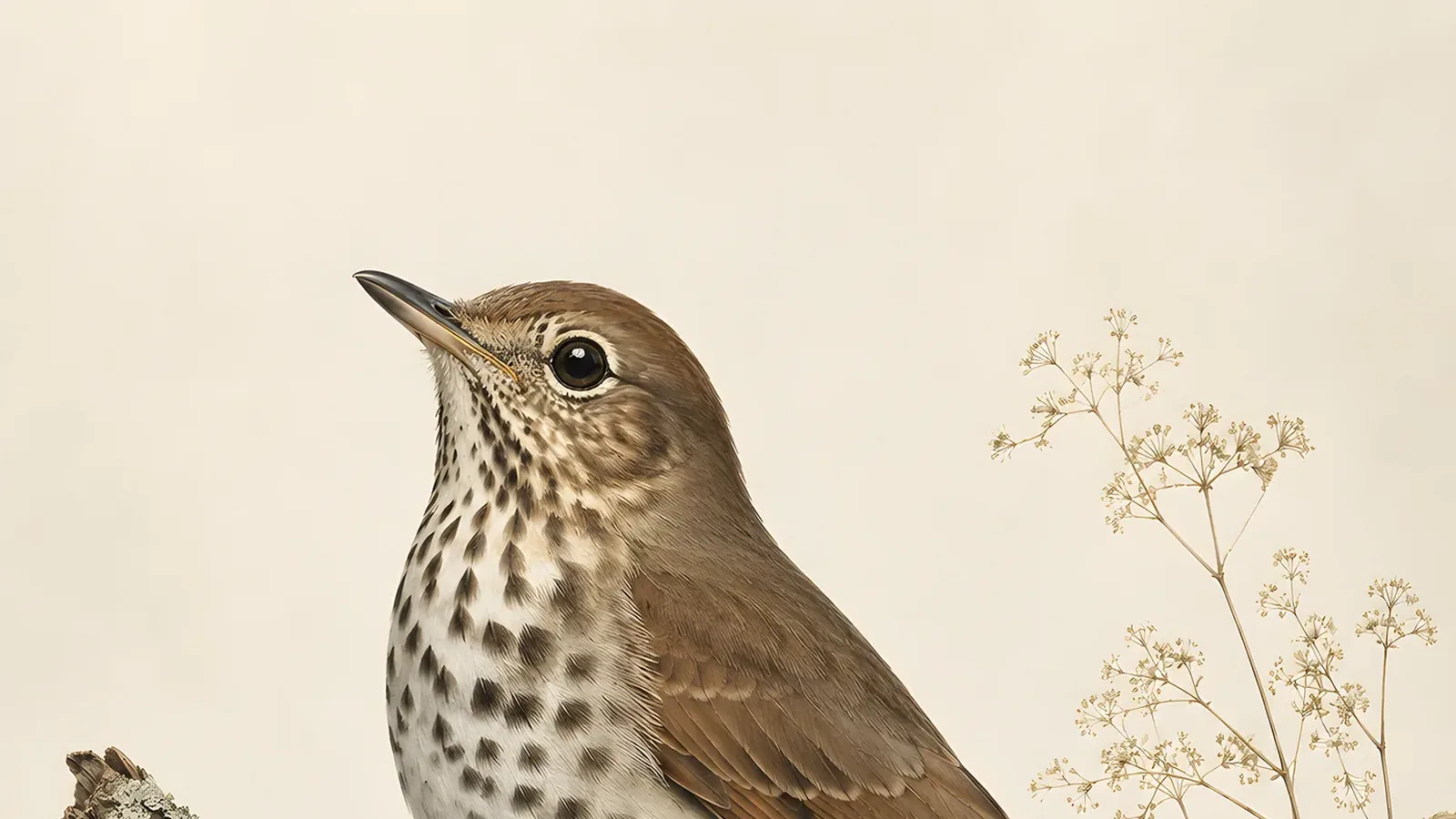
The Hermit Thrush is a compact, upright songbird - 15 to 18 cm long, weighing between 18 and 37 g, with a wingspan of 25 to 30 cm. It is roughly the shape and posture of a small robin, standing alert and erect, but quieter in colour and more secretive in manner.
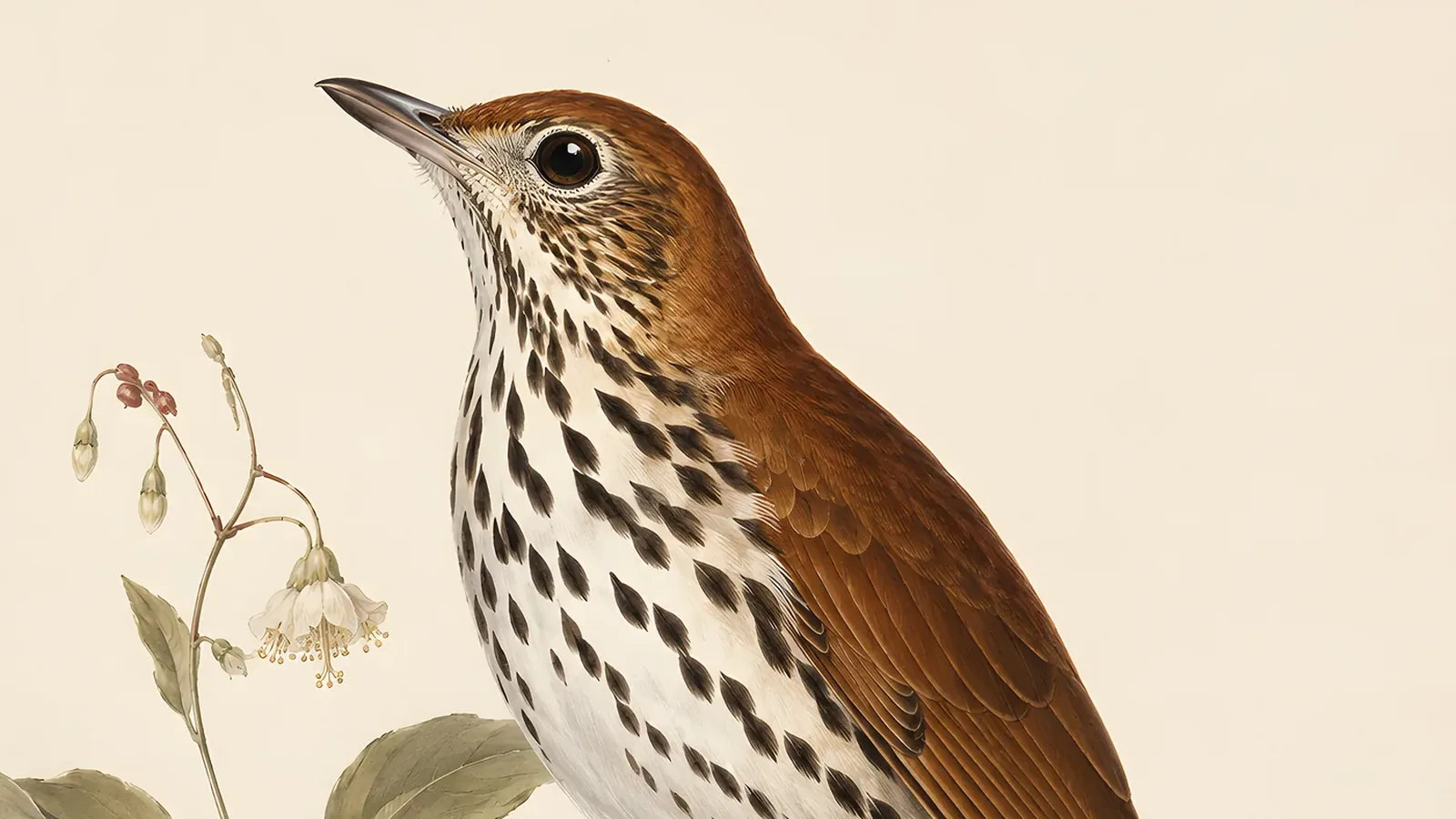
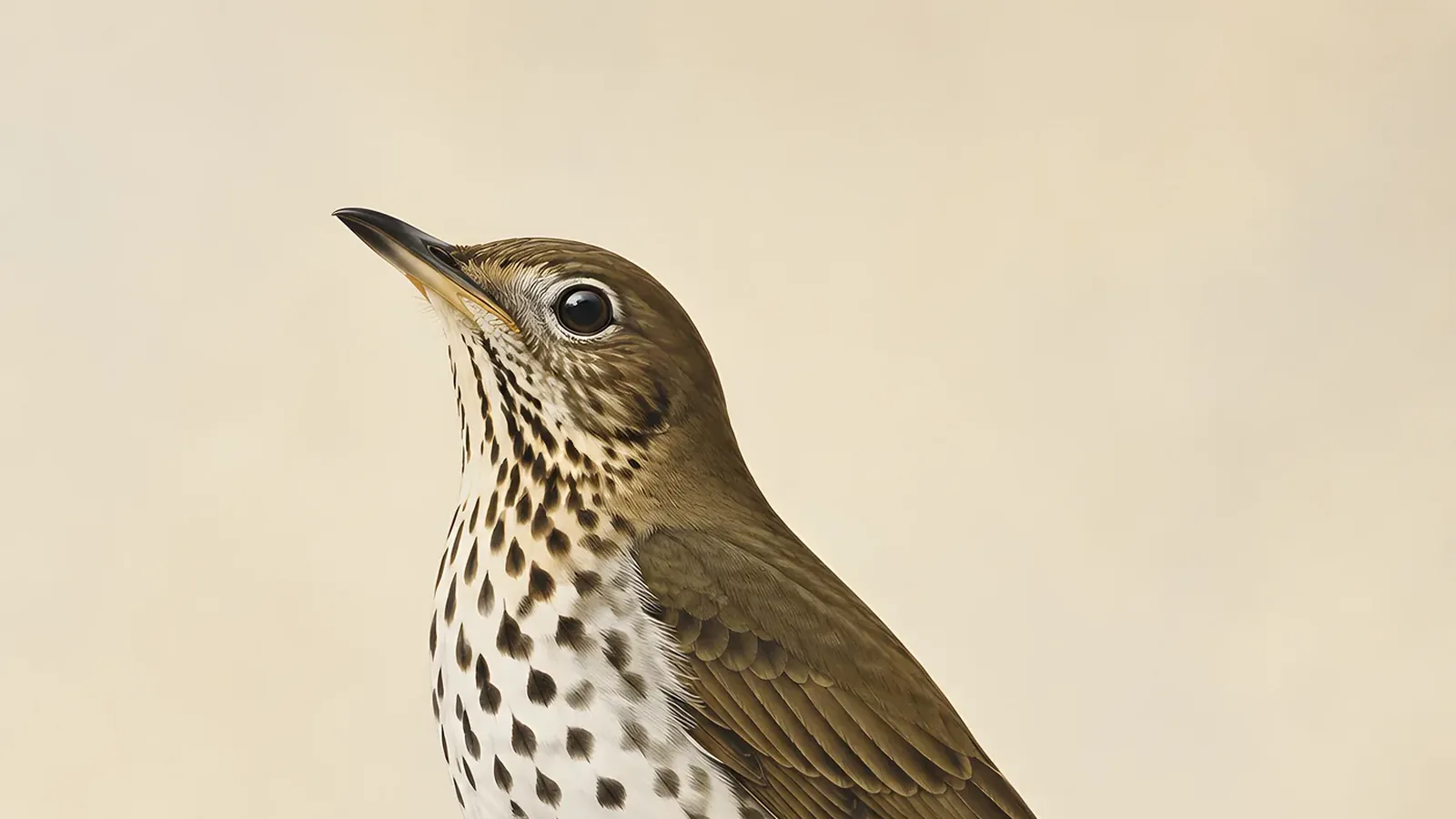
The back is olive-brown, warm but not bright. The head is the same tone, unremarkable at a distance. Then the bird turns and the tail catches the light: a clear reddish-rufous, distinctly warmer than anything else on the bird’s body. That tail is the field mark that separates the Hermit Thrush from every other spotted thrush. When the bird is nervous or freshly landed, it raises the tail slowly and lowers it again - a calm, deliberate pump that looks almost deliberate, as though the bird is composing itself. No other Catharus does this consistently.
The breast and flanks carry the spotted pattern shared by most of the thrush family: dark brown spots on a white ground, concentrated on the upper breast and fading toward the belly. The eye is ringed prominently in white, giving the face an open, attentive expression. The bill is slender and pale. The legs are pinkish-grey.
| Feature | Description |
|---|---|
| Back and wings | Olive-brown, unpatterned |
| Tail | Rufous-red, distinctly warmer than back |
| Breast | White with brown-black spots |
| Flanks | Lightly spotted, fading to clean white |
| Eye-ring | Prominent white |
| Tail habit | Slow raise-and-lower when perched |
The sexes are identical in plumage. First-year birds are buffier on the underparts and show fine pale tips to the wing coverts that wear away through the first winter. Subspecies across the continent vary slightly in size and overall warmth of tone - western birds tend to be grayer, eastern birds browner - but the rufous tail and the tail-pump are constant.
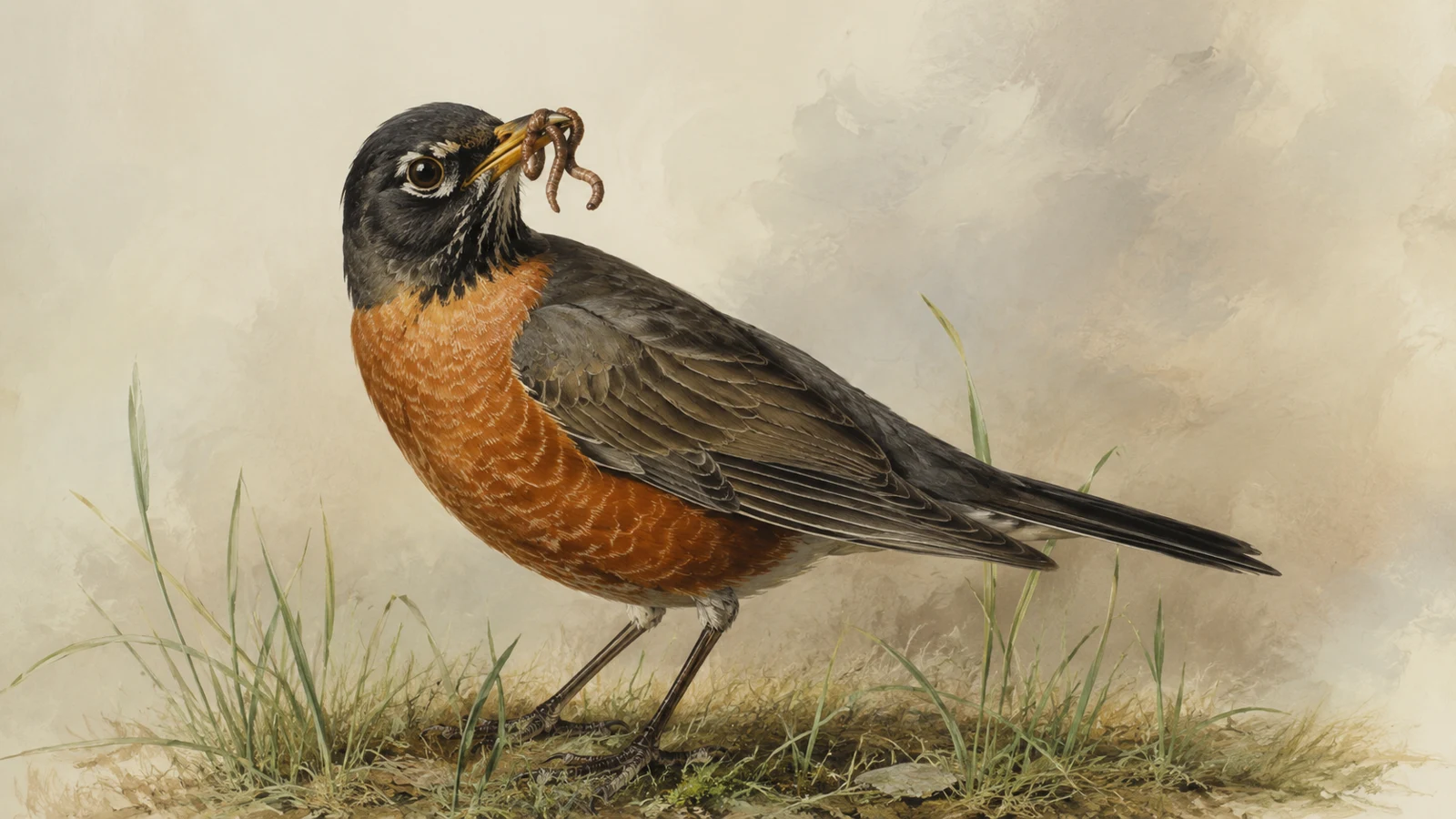
The wood thrush is the most frequently confused relative in eastern forests. It is noticeably larger, its back is a stronger rufous-cinnamon, and its spots are larger and bolder. The American Robin is far bigger, with a brick-red breast and no spotting. The Bicknell’s Thrush is nearly identical to the Gray-cheeked Thrush and lacks any rufous tone in the tail.
The song
The opening note of a Hermit Thrush song is a single, flute-clear pitch - not a chip, not a warble, but a sustained tone of unusual purity. After a breath, the bird sings the same kind of note again, this time on a different pitch. Then the shimmering cascade follows: a rapid, trembling phrase that seems to spiral upward and then dissolve. Each complete song - opening note plus cascade - takes about two seconds. But the bird sings at intervals, the phrases falling into the dusk at a pace that lets the silence between them do work too. A single male may run through five or six pitch-levels in sequence, moving up or down through the harmonic registers it commands, never repeating the same key twice in a row.
The Hermit Thrush is widely regarded by ornithologists and field naturalists as the finest singer among North American birds. That judgment is partly subjective, but it is also, unusually, partly structural. The song carries. It carries through dense boreal forest because it concentrates energy in frequencies that travel cleanly through vegetation - a feature recognized by the Cornell Lab of Ornithology’s research on bird acoustic ecology. It also commands attention in a way that is hard to explain as mere preference. People stop walking. People stop talking. The song asks for something.
The bird that produces it has a syrinx - the avian vocal organ - capable of operating both its left and right sides with fine independent control. At peak complexity, the cascade phrase involves the simultaneous production of multiple notes that reinforce each other. The result is a single bird that sounds, for a few seconds at sunset, like a small choir.
The mathematics in it
In 2014, Emily L. Doolittle, Bruno Gingras, Dominik M. Endres, and W. Tecumseh Fitch published an analysis of 71 Hermit Thrush songs recorded from 14 individual males. Their study, “Overtone-based pitch selection in hermit thrush song: Unexpected convergence with scale construction in human music,” appeared in the Proceedings of the National Academy of Sciences (PNAS, Vol. 111, 2014).
Their finding was this: 57 of those 71 songs (80%) showed a strong, non-random tendency for each note to stand in a simple integer-ratio relationship to the phrase’s fundamental frequency - the same ratios that define the harmonic, or overtone, series. These are the ratios that underlie the octave (2:1), the perfect fifth (3:2), the perfect fourth (4:3). The intervals that humans across cultures have independently decided to call consonant. The Hermit Thrush, apparently, prefers them too.
Doolittle and colleagues were careful about what this does and does not mean. The convergence is real and statistically significant. But it does not mean the bird is composing music consciously, nor that it is following human scales. What it does mean, the authors argued, is that the preference for harmonic-series ratios in melodic construction may not be a uniquely human invention. It may be something that emerges independently - in at least one bird - from the physics of how complex tonal structures interact. The harmonic series is, after all, the natural resonance pattern of vibrating columns and strings. Any system that evolves to produce resonant sounds may tend, over time, toward the same mathematical relationships.
The authors noted that the selection “results not from physical constraints governing peripheral production mechanisms but from active selection at a central level.” The bird is not accidentally landing on these intervals because its throat forces it to. It is choosing them.
That is the most interesting word in ornithology of recent years: choosing.
Whitman’s bird
Walt Whitman wrote “When Lilacs Last in the Dooryard Bloom’d” in the summer of 1865, weeks after the assassination of Abraham Lincoln. It is the finest American elegy. Its three symbols are a sprig of lilac, a great fallen star, and the song of a Hermit Thrush hidden in a swamp.
Whitman chose this bird precisely. He had noted in his journal that the Hermit Thrush “sings oftener after sundown, sometimes quite in the night” and is “very secluded, likes shaded, dark places in swamps.” He heard in its voice something that could carry what no other language could carry - the weight of mass death, the grief of the war years, the fact of Lincoln’s coffin moving across a darkening continent.
Sing on! sing on, you gray-brown bird! Sing from the swamps, the recesses - pour your chant from the bushes.
In the poem the Hermit Thrush is the voice the speaker cannot find in himself. It sings the “carol of death” not as lamentation but as acceptance - death as the “strong deliveress,” the thing that holds all things together. Whitman understood the song the way a listener in the field understands it: not as sadness, but as something larger than sadness. The bird does not mourn. It simply sings, at dusk, in the swamp, and the song reaches whatever is listening.
The Hermit Thrush has been Vermont’s state bird since 1941. Vermont chose it, the records suggest, for exactly the qualities Whitman identified: the song’s unearthly quality, the bird’s preference for solitude, the way it arrives each spring from somewhere south and fills the maple woods before the leaves are fully out.
Range and habitat
The Hermit Thrush breeds across an enormous arc of North America - from central Alaska east to Newfoundland, south through the mountains of the west to southern California and northern New Mexico, and along the Appalachians to New Hampshire and northern Michigan. An estimated 75% of its North American breeding population occupies the boreal forest zone (Boreal Songbird Initiative, species account for Catharus guttatus), where it nests beneath spruce and balsam fir at low elevations, often on or near the ground.
In the east it favors mixed and coniferous forests, sphagnum bogs edged with tamarack, and the kind of damp, dark northern forest where the sun hits the floor only at noon. In the west it shifts to drier pine-oak and mixed conifer mountain forests. It is adaptable within those broad parameters. It will take up territory in regenerating forest, in open woodland with a shrubby understory, in sheltered mountain canyons.
What distinguishes the Hermit Thrush from all its Catharus relatives in winter is this: it stays north. While the Veery, the Swainson’s Thrush, and the Gray-cheeked Thrush push south into Central and South America for the winter, the Hermit Thrush winters across the southern United States - from coastal Maine in mild years, south through the mid-Atlantic to Texas and northern Mexico. It is the only spotted thrush that a birder in the American southeast or mid-Atlantic is likely to see in January. The Cornell Lab of Ornithology notes it as “the only one likely to be seen in winter in North America.” That hardiness - that willingness to remain on cold ground eating holly berries while its relatives move toward the tropics - is one more piece of the bird’s particular character.
Diet and breeding
On the breeding grounds the Hermit Thrush is an insect hunter, working leaf litter and low vegetation for beetles, ants, wasps, caterpillars, spiders, and small earthworms. It forages by standing still, watching, then lunging or running a short distance. In winter, when insects are scarce, it shifts substantially to fruit - holly, sumac, elderberry, pokeberry. This dietary flexibility is part of what allows it to overwinter at latitudes where most insect-dependent songbirds cannot survive.
Nesting begins in late April or May. The female builds a cup nest on the ground or very low in vegetation, typically under a small conifer or shrub, concealed by overhanging vegetation. The nest is made of grasses, bark strips, moss, and plant fibers, with a finer interior lining of rootlets and pine needles. She lays three to five pale blue-green eggs and incubates them alone for about 12 days. Both parents feed the nestlings, which fledge 10 to 15 days after hatching. Many pairs attempt two broods in a season.
The oldest banded Hermit Thrush on record was at least 10 years and 10 months old when it was recaptured during banding operations in Maryland in 2009 (Cornell Lab of Ornithology, Bird Banding Laboratory records). That particular bird survived eleven breeding seasons. Given that it sang every one of them, it contributed several thousand individual song phrases to the acoustic record of its species - each one, if Doolittle and colleagues (PNAS, 2014) are right, built from intervals the bird actively chose.
That fact - the choosing - is what the Hermit Thrush leaves you with, in the end. Not just a beautiful sound but a sound that, on current evidence, is structured in ways that mirror what human musical cultures across thousands of years have independently converged upon. We did not teach the bird the harmonic series. The harmonic series is older than any of us. The bird found it first.