Field Guide
Grey Heron
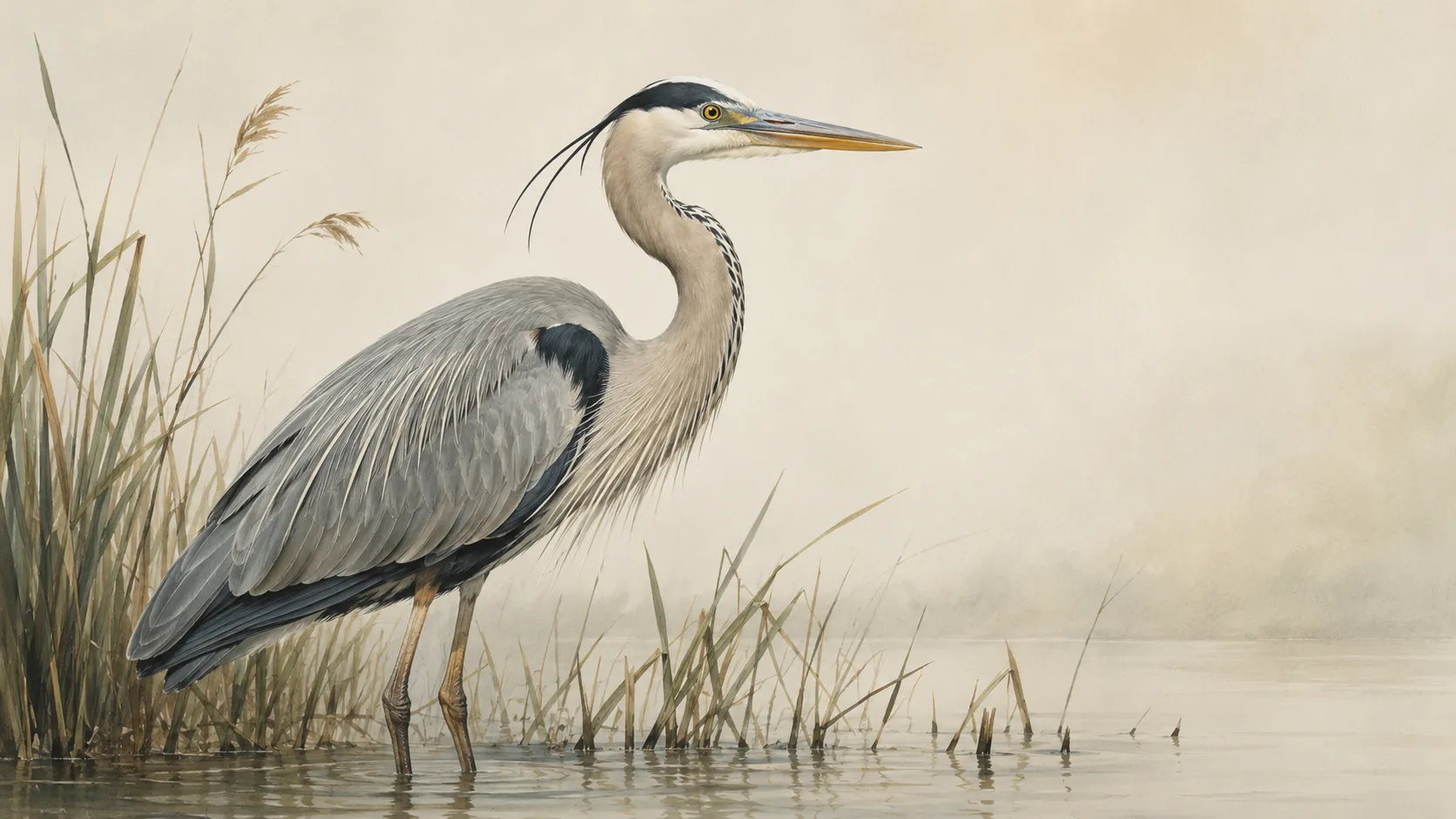
Stand at the edge of almost any British river on a grey February morning and there is a reasonable chance you will see one before you hear it. A Grey Heron, Ardea cinerea, in mid-hunt is as close to a still life as a living animal gets: neck pulled back, head cocked at a slight angle, one leg perhaps lifted and suspended mid-step. It is not resting. It is measuring. The fish below the surface has no idea it is there.
This is the bird’s central thesis, and it rewards sitting with. The Grey Heron succeeds not by speed or stealth in the mammalian sense, but by an almost architectural patience that the animal deploys for minutes at a time in cold water. When the strike comes, it is violent and exact: the neck uncoils like a released spring, the bill drives down, and the fish is out of the water before the surface settles. The BTO Heronries Census, running continuously since 1928, tells us that around 11,000 pairs breed in the UK each year. They are everywhere. We still mostly underestimate them.
What it looks like
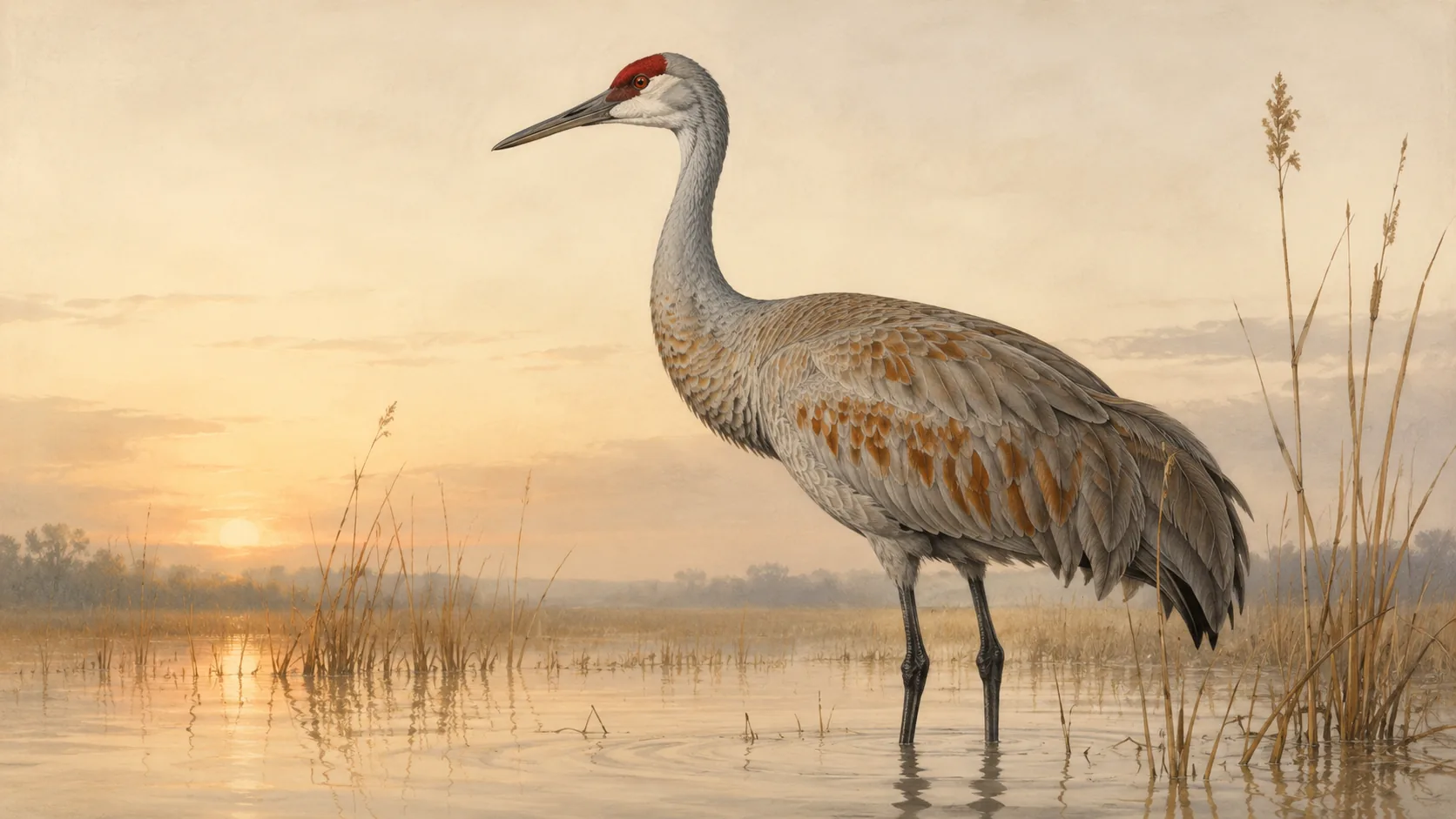
A Grey Heron at 84 to 102 centimetres long is one of the largest birds most British people encounter. The wingspan - 155 to 195 centimetres across - makes it look implausible in the air, as if something that size should not be permitted to fly. In flight it is recognisable immediately by the folded-back neck (a feature that separates all herons from cranes and storks, which extend the neck) and by the slow, deep wingbeats that give a slightly ponderous quality to an otherwise capable flier.
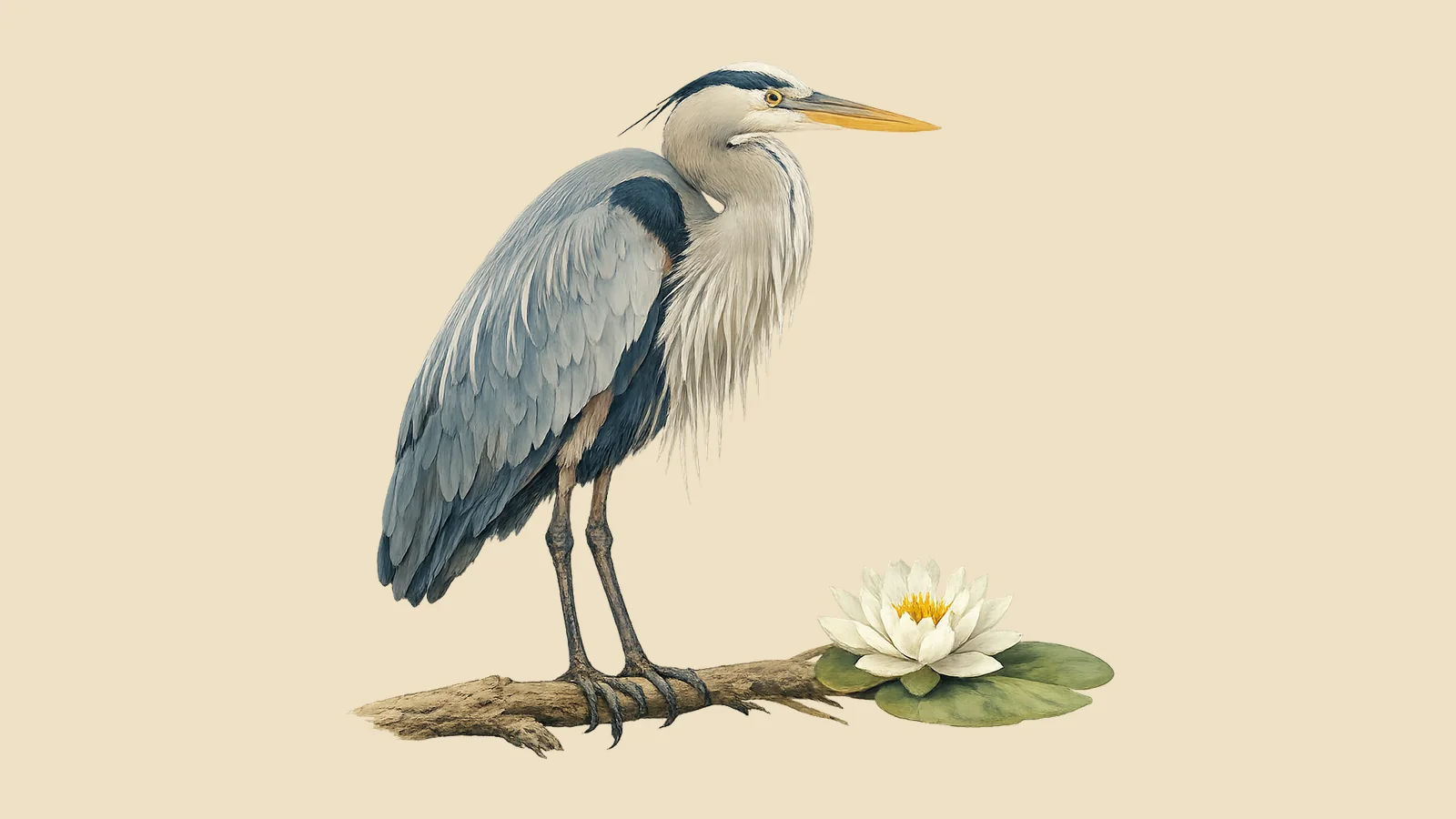
The plumage is built for ambiguity. The back and wings are soft ash-grey. The neck is white streaked with black down the front. The head is white with a bold black stripe running back from the eye into a long drooping black crest plume. The bill is dagger-yellow, long enough to reach fish that are further away than the bird appears to be aiming at - a fact that prey exploits poorly. Underparts are whitish, washed pale grey on the flanks. The legs are ochre-brown, reddening during the breeding season. Both sexes look alike. Juveniles are duller overall, with a grey cap rather than the crisp black-and-white of the adult.
What it sounds like
Away from the heronry, the Grey Heron is largely silent. The sound most people know is the alarm call given in flight: a harsh, loud kraank that carries across flat water and is hard to forget once you have placed it. At the breeding colony it is a different matter entirely - a sustained racket of croaks, bill-clapping, and low grunting calls as pairs greet each other and defend nest sites. It is one of the more distinctive flight calls of any large European bird - a sound that emphatically does not match the bird’s visual stillness.
Range and habitat across the year
The BTO winter atlas records Grey Herons in 92 per cent of all 10-kilometre squares in the UK - a coverage that makes it one of the most widespread large birds on the island. In summer the figure drops slightly, to 69 per cent, as pairs concentrate around productive wetland areas for nesting. In Ireland the pattern is similar.
The broader range runs from temperate Europe across Asia to Japan, and south through most of Africa. Northern European birds may move south in hard winters, pushed off frozen freshwater by ice that makes hunting impossible. British birds are largely resident year-round, though juveniles disperse widely after fledging and ringed birds have been recovered as far away as West Africa.
Habitat is any productive shallow water: rivers, lake margins, estuaries, marshes, drainage ditches, garden ponds. The species is not particular about whether that water is rural or urban - herons hunting ornamental ponds in central London parks are a routine sight, and the fish rarely last long.
Diet
Fish is the primary prey, taken by the ambush method described above. The bill technique is a two-stage action: the bird positions itself to minimise the refraction angle between its eye and the target, then drives the bill in a single committed thrust. Larger prey - eels in particular - are often beaten against rocks or the bank edge before being swallowed head-first.
The diet is broader than fish. Frogs and newts are taken in spring when they are abundant and slow-moving. Small mammals, including water voles and field mice near water edges, are taken opportunistically. Animal Diversity Web records grey herons targeting waterbird chicks during colony nesting seasons when other food is scarce. A grey heron that has learned a garden pond exists will return to it repeatedly, taking goldfish that have sometimes been resident in a single garden for years. This is not a subtle bird when it is hungry.
Breeding and nesting
The BTO records average first clutch laying on 12 March, with a range from late February to early May. This makes the grey heron one of the earliest large birds to commit to nesting in the British year, returning to heronry trees while the branches are still bare. Incubation runs 26 to 27 days, with both sexes sharing the duty. Chicks fledge at 50 to 55 days.
Heronries are colonies of nests, usually placed in the crowns of tall trees - ash, oak, Scots pine - and often on the same trees for decades. The BTO Heronries Census has been tracking specific colonies since 1928, making this one of the longest-running population monitoring programmes for any British bird. Some heronries recorded in the 1930s are still active. The nests themselves are large, untidy platforms of sticks that accumulate across years into structures substantial enough to hold adult birds without flexing.
Clutch size is typically three to four eggs, pale blue-green, incubated by both adults. Only one brood per year is normal, though replacement clutches are occasionally attempted after early failure. Maximum recorded lifespan is 23 years and nine months - a figure from a BTO ring recovery.
One genuine quirk
The timing matters. Grey herons begin the breeding cycle in February and March specifically to ensure chicks are in the nest and demanding food during the peak of the coarse fish spawning season in April and May, when shallow water is crowded with accessible prey. The calendar alignment between heron breeding effort and fish availability is not coincidence - it is the reason the bird is successful at hatching chicks that survive. An unusually cold March that delays spawning is bad for heronry productivity in measurable ways. The BTO has documented this link across decades of census data.
The other thing worth knowing: a Grey Heron’s resting posture - neck folded, head sunk into the shoulder feathers - looks, especially in poor light, like a post or a broken branch. This is almost certainly not accidental.
The Grey Heron is not still because it is calm. It is still because stillness is what kills fish.